Cambridge International · iGCSE · English Literature
Course version: 0475 · Version from Sept 2026
A Streetcar Named Desire
Tennessee Williams' 'A Streetcar Named Desire' is a powerful, atmospheric masterpiece exploring the tragic collision between the faded gentility of the Old South and the brutal, raw energy of post-war America. It offers incredible opportunities for candidates to earn high marks by analysing sophisticated dramatic techniques, complex character psychology, and the devastating conflict between illusion and reality.
- 9 min read
- 2 worked examples
- 2 practice questions
- 8 key terms
Study Notes
Overview
Tennessee Williams' 1947 masterpiece, A Streetcar Named Desire, remains one of the most frequently studied and critically rewarding texts on the Cambridge IGCSE English Literature syllabus. The play traces the tragic psychological deterioration of Blanche DuBois, a fragile Southern belle who seeks refuge with her sister Stella and brother-in-law Stanley Kowalski in a cramped New Orleans apartment. Examiners consistently reward candidates who can move beyond simple plot summary to analyse how Williams constructs meaning. This means engaging deeply with his sophisticated use of stage directions, plastic theatre (non-realist techniques like lighting and music), and the pervasive symbolic conflict between illusion and harsh reality. To achieve top bands, you must demonstrate how personal tragedies in the play mirror broader societal shifts in post-war America.
Plot/Content Overview
Scene 1-4: The Arrival and The ClashBlanche DuBois arrives in New Orleans, having lost her teaching position and the family estate, Belle Reve. She is immediately out of place in the vibrant, gritty setting of Elysian Fields. Her delicate, pretentious manner instantly clashes with Stanley's aggressive, working-class masculinity. The tension escalates during the poker night (Scene 3), where Stanley's drunken violence towards Stella reveals the dangerous dynamics of their marriage, though Stella quickly returns to him, driven by physical desire.
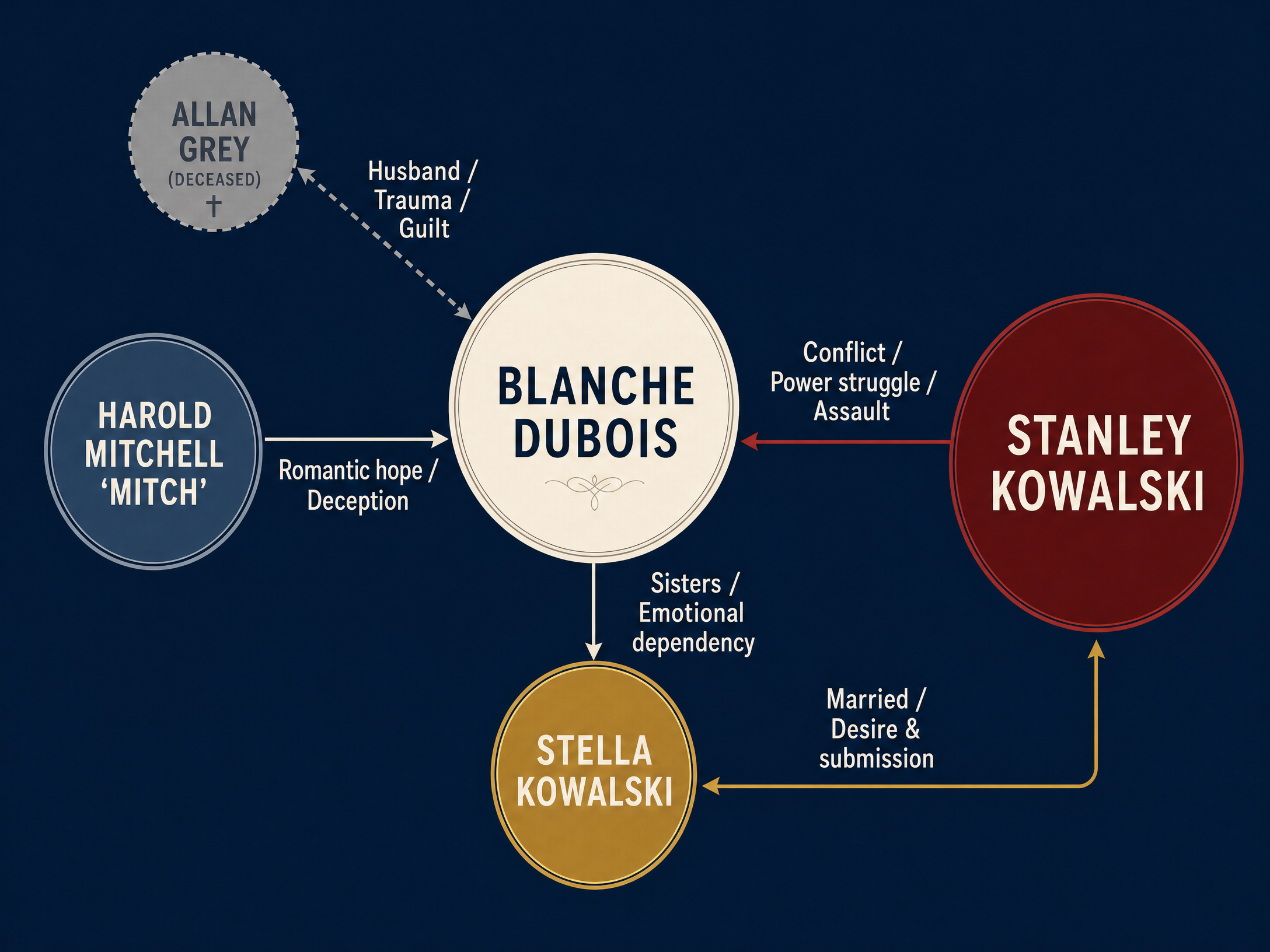
Scene 5-8: The Illusion and The ThreatBlanche attempts to secure her future by courting Mitch, Stanley's friend. She weaves a web of illusions, hiding her age and her scandalous past in Laurel. However, Stanley begins investigating her background. In Scene 6, Blanche opens up to Mitch about the tragic suicide of her young husband, Allan, creating a moment of genuine connection. But Stanley's cruel exposure of her past (Scene 7 and 8) systematically destroys her hopes, culminating in him giving her a bus ticket back to Laurel as a cruel birthday 'gift'.
Scene 9-11: The DestructionMitch confronts Blanche, tearing the paper lantern from the light bulb to expose her true age, and rejects her for not being "clean enough." In Scene 10, while Stella is at the hospital giving birth, Stanley and Blanche are left alone. The psychological conflict becomes physical as Stanley brutally assaults her, a final assertion of his dominance that shatters her fragile sanity. In the final scene, Blanche is committed to a mental institution, departing with the tragic line, "I have always depended on the kindness of strangers," while the Kowalski household returns to its normal, brutal rhythm.
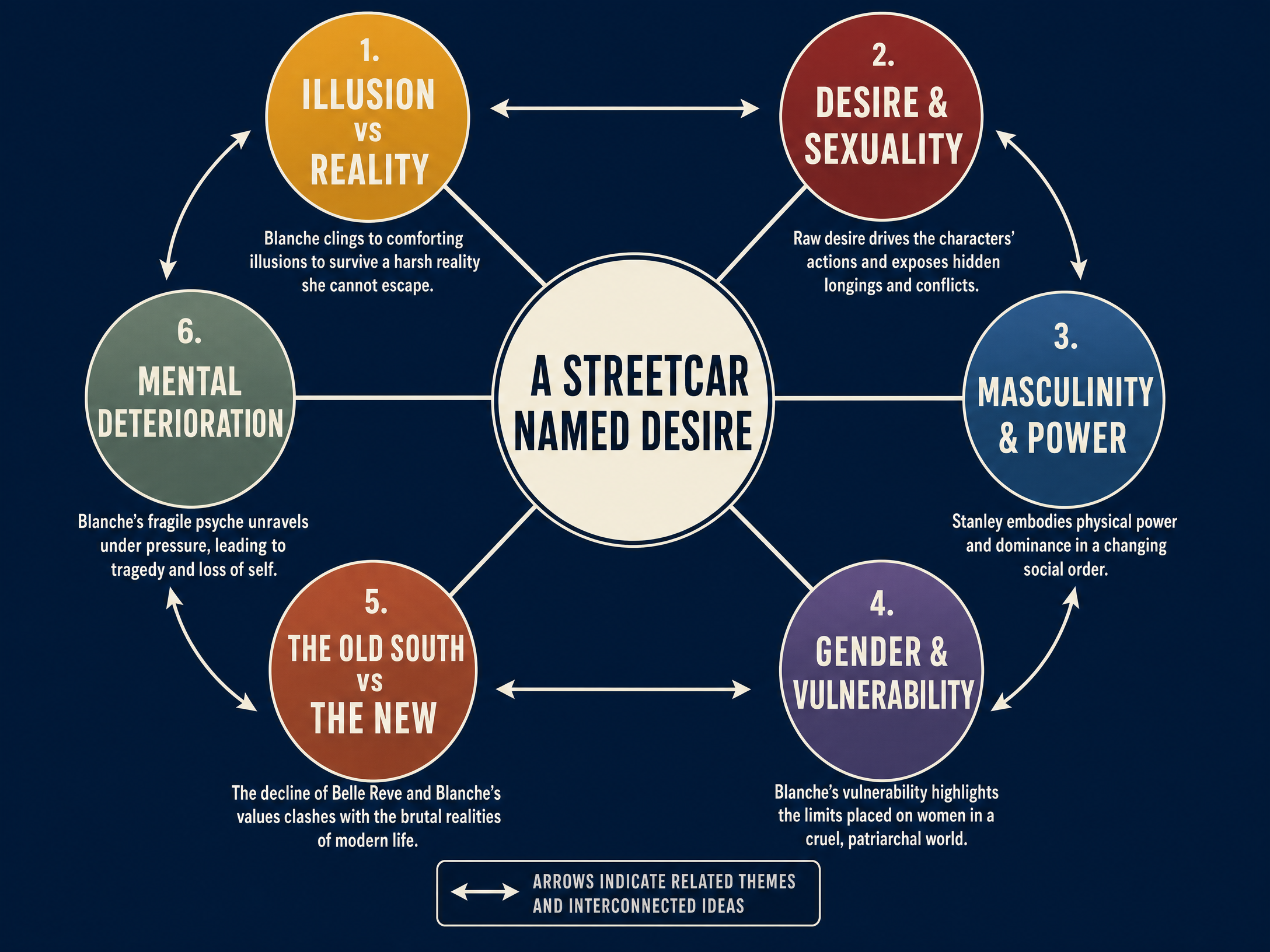
Themes
 Open full-size image (opens in a new tab)
Theme 1: Illusion vs Reality
Blanche's survival mechanism is to retreat into illusion when reality becomes unbearable. She uses literal and metaphorical 'paper lanterns' to soften the harsh glare of truth. Williams presents illusion not just as a lie, but as a desperate coping strategy for trauma. However, in the brutal world of Stanley Kowalski, illusions cannot survive; reality always asserts itself violently.
Key Quotes:
- "I don't want realism. I want magic!" (Scene 9) - This is Blanche's ultimate manifesto. She deliberately chooses to perceive the world as it ought to be, rather than as it is. Examiners reward analysis of how this makes her both deceptive and profoundly vulnerable.
- "I can't stand a naked light bulb, any more than I can a rude remark or a vulgar action." (Scene 3) - The light bulb is Williams' central symbol for objective, inescapable truth. Blanche's attempt to cover it reflects her attempt to mask her fading beauty and her tarnished past.
Theme 2: Desire and Sexuality
Desire is the driving force of the play—it is the literal streetcar that brings Blanche to her downfall, and the glue that binds Stella and Stanley's toxic marriage. Williams explores how desire can be both life-affirming (for Stella) and utterly destructive (for Blanche and Allan).
Key Quotes:
- "What you are talking about is brutal desire-just-Desire!-the name of that rattle-trap street-car that bangs through the Quarter..." (Scene 4) - Blanche recognises the destructive power of pure physical lust, yet she is hypocritically driven by it herself.
- "But there are things that happen between a man and a woman in the dark - that sort of make everything else seem - unimportant." (Scene 4) - Stella's admission highlights how sexual desire overrides her rationality and moral judgement, cementing Stanley's control over her.
Theme 3: Masculinity and Power
Stanley embodies a raw, aggressive, territorial form of masculinity that dominates the post-war American landscape. His power is physical, vocal, and absolute within his domain. Williams contrasts this with the 'soft' masculinity of Allan Grey, suggesting a world where only the brutal survive.
Key Quotes:
- "Animal joy in his being is implicit in all his movements and attitudes." (Scene 1, Stage Directions) - Williams explicitly links Stanley to primal, animalistic forces. This is crucial AO2 material—always analyse how stage directions construct character.
- "Every Man is a King! And I am the king around here, so don't forget it!" (Scene 8) - Stanley's assertion of patriarchal dominance highlights his need for absolute control and his resentment of Blanche's perceived superiority.
Character Analysis
 Open full-size image (opens in a new tab)
Blanche DuBois
Role: The tragic protagonist; a symbol of the dying, aristocratic Old South.
Key Traits: Fragile, manipulative, cultured, deeply traumatised, vain, and desperate.
Character Arc: Blanche moves from a state of desperate performance and fragile hope to complete psychological collapse, destroyed by Stanley's cruelty and her own inability to face reality.
Essential Quotes:
- "I have always depended on the kindness of strangers." (Scene 11)
- "I tell what ought to be truth. And if that is sinful, then let me be damned for it!" (Scene 9)
Stanley Kowalski
Role: The antagonist; the embodiment of the new, industrial, working-class America.
Key Traits: Brutal, vital, territorial, fiercely loyal to his friends, profoundly cruel to those he perceives as threats.
Character Arc: Stanley's arc is one of maintaining dominance. He perceives Blanche as an invader and systematically dismantles her defenses until he re-establishes absolute control over his home and wife.
Essential Quotes:
- "We've had this date with each other from the beginning!" (Scene 10)
- "Be comfortable is my motto." (Scene 1)
Stella Kowalski
Role: The battleground between Blanche and Stanley; the bridge between the Old South and the New America.
Key Traits: Passive, sensual, pragmatic, deeply conflicted.
Character Arc: Stella is forced to choose between her sister and her husband. Ultimately, she chooses self-preservation and her child, forcing herself to disbelieve Blanche's accusation of rape in order to survive.
Essential Quotes:
- "I couldn't believe her story and go on living with Stanley." (Scene 11)
- "I'm not in anything I want to get out of." (Scene 4)
Writer's Methods
 Open full-size image (opens in a new tab)
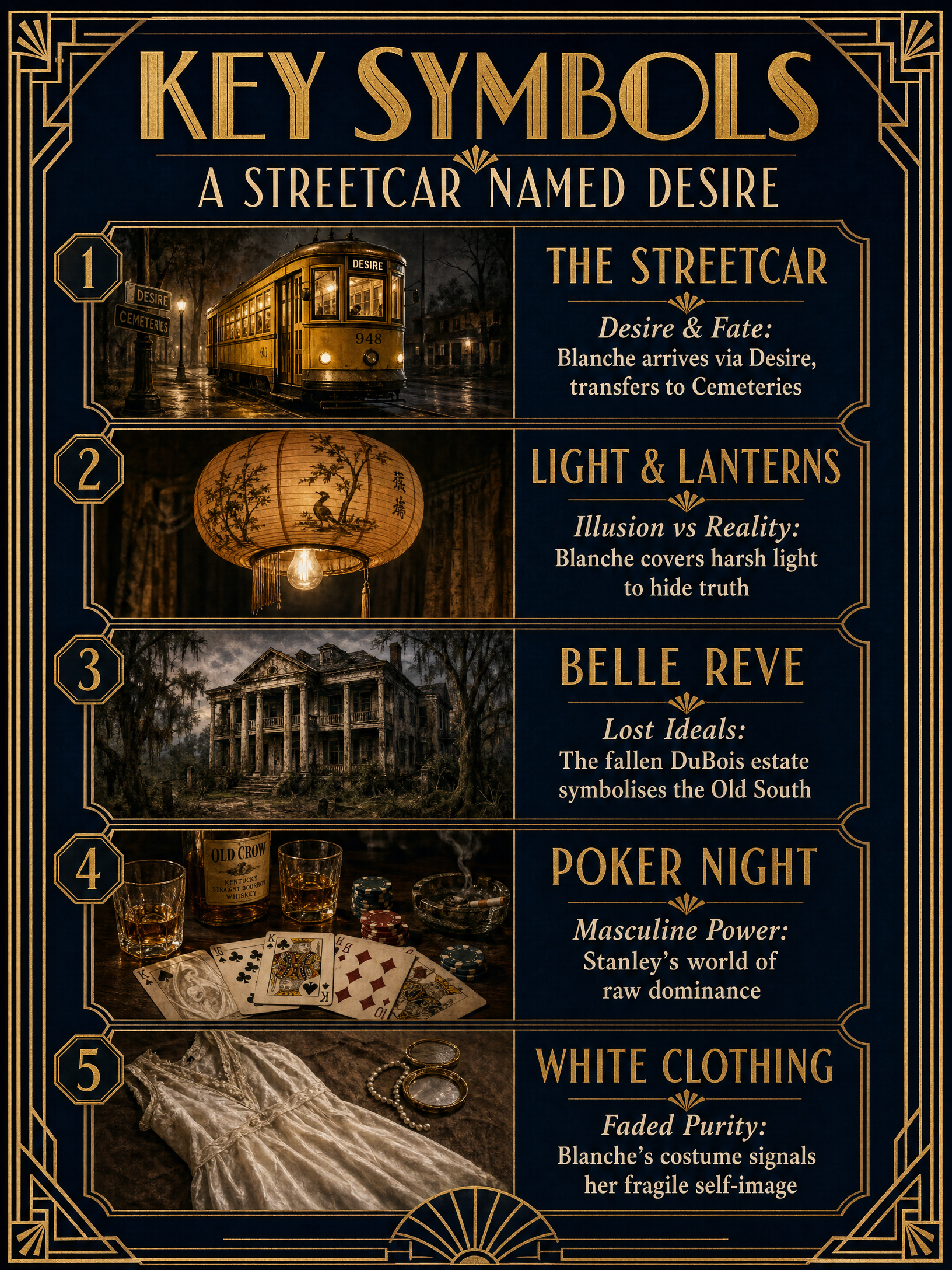
Williams is renowned for his concept of 'Plastic Theatre'—the use of props, sound, lighting, and costume to convey psychological states and thematic meaning, rather than relying solely on dialogue.
- Music: The 'Blue Piano' represents the vitality and sensual rhythm of New Orleans. In stark contrast, the 'Varsouviana Polka' plays only in Blanche's mind (and for the audience), acting as an auditory hallucination that signals her trauma regarding her husband's suicide.
- Lighting: Harsh, naked light symbolises the brutal, unforgiving truth of Stanley's world. Soft, filtered light (via the paper lantern) represents Blanche's world of illusion and romance.
- Costume: Blanche frequently wears white, attempting to project an image of virginal purity ("like a summer tea-party") that ironically contrasts with her tarnished past. Stanley is associated with vivid, primary colours (the "solid blues, a purple, a red-and-white check" of the poker players), representing raw, vital energy.
Context
Examiners expect context to be integrated seamlessly into your analysis, not added as an afterthought.
- The Old South vs The New America: The play reflects the post-WWII transition in America. Belle Reve represents the decaying agrarian aristocracy of the South, built on slavery and outdated codes of chivalry. Stanley represents the rising, industrial, diverse, and aggressively meritocratic working class.
- Gender Roles: Written in 1947, the play reflects a society where women had limited economic independence. Blanche's tragedy is partly economic; without a husband or a job, she has no means of survival. Stella's choice to stay with an abusive husband reflects the stark realities of female dependency.
- Homosexuality: Allan Grey's suicide highlights the severe stigma and tragic consequences of homosexuality in the 1940s, a deeply personal theme for Williams, who was himself a gay man navigating a prejudiced society.
Check what you remember
Read the wording for your board, then hide it and explain Plastic Theatre in your own words. Rough notes are fine. This is a self-check, with no mark or grade.
Reference: Cambridge International
Williams' term for using props, sound, lighting, and staging to convey abstract psychological states.
Interactive Diagrams
1 interactive diagram to visualise key concepts
Conceptual Flow Outline
Blanche's Trajectory of Decline
Worked Examples
2 worked examples — open one to explore the question and available guidance.
Practice Questions
Try the question, then reveal an answer plan or example response
Explore how Williams presents the conflict between illusion and reality in the play. (30 marks + 4 AO4)
Hint: Consider the paper lantern, Blanche's lies about her past, and how Stanley acts as the agent of brutal reality.
How does Williams make the ending of the play so dramatic and moving? (30 marks + 4 AO4)
Hint: Focus on Scene 11. Look at Stella's betrayal, the use of plastic theatre, and Blanche's final line.
Ready to test yourself interactively?
Active recall beats reading alone. Answer questions on A Streetcar Named Desire with instant AI scoring and mark scheme guidance.
A week of Premium from your first lesson · Then the free plan continues · No card, no charge
Exam technique
How to turn what you know into marks
How to approach the question
Underline the key theme/character in the prompt. Brainstorm 3-4 distinct points that track this theme from the beginning, middle, to the end of the play. Ensure you have AO2 (methods) evidence for each point.
How to structure your answer
Use PEAL: Point (conceptual claim), Evidence (embedded quote), Analysis (zoom in on a specific word/technique and explain its effect), Link (connect to context or the wider tragedy).
Timing
For a 30+4 mark question, spend 5 minutes planning, 40-45 minutes writing.
Common pitfalls
- Retelling the story: Do not write 'In Scene 3 Stanley hits Stella and then they make up'. Write: 'Williams uses Stanley's violence in Scene 3 to demonstrate...'
- Ignoring stage directions: Williams' stage directions are highly literary and symbolic. Quoting them is excellent AO2.
- Bolted-on context: Do not write a history essay about 1940s America. Only mention the Old South/New America when it directly explains a character's motivation or conflict.
What the command words want
- How does Williams present...
- Focus heavily on AO2. Use phrases like 'Williams constructs', 'The playwright symbolises', 'Through the use of lighting, Williams suggests...'
- Starting with this extract...
- Spend roughly half your essay on the extract, analysing language closely, then pivot outwards: 'This dynamic is established earlier in the play when...'
- Explore the significance of...
- Look at the topic from multiple angles. Why is it important to the plot? To the characters? To the audience's understanding of the era?
Watch or listen (optional)
Test your understanding of A Streetcar Named Desire
Active recall beats re-reading. Take an instant quiz now to test what you’ve learned and lock it into long-term memory.
A week of Premium from your first lesson · Then the free plan continues · No card, no charge