A Taste of Honey
A Taste of Honey is a groundbreaking, gritty social realist play that revolutionised 1950s British theatre by placing working-class women and marginalised outsiders centre stage. Studying this text rewards candidates who can analyse Delaney's sharp, naturalistic dialogue and explore how she challenges societal prejudices regarding class, race, and sexuality.
Study Notes
Overview

Written by Shelagh Delaney when she was just eighteen, A Taste of Honey (1958) is a seminal work of British social realism. Set in the industrial slums of post-war Salford, the play challenges the sanitised, middle-class theatre of its time by offering an unflinching yet compassionate portrayal of working-class life. Cambridge examiners highly reward candidates who can move beyond plot summary to analyse Delaney's dramatic methods—particularly her use of naturalistic dialogue, bare stagecraft, and jazz music—and who can seamlessly integrate the 1950s social context into their exploration of themes like poverty, prejudice, and unconventional family structures.
Plot/Content Overview
Act One:
The play opens with sixteen-year-old Jo and her chaotic mother, Helen, moving into a dilapidated, damp flat in Salford. Their relationship is volatile; Helen is self-absorbed and constantly seeking male attention, while Jo is sharp-tongued but vulnerable. Helen begins a relationship with Peter, a younger, wealthy, and arrogant car salesman. Meanwhile, Jo meets Jimmy, a young Black sailor. They share a brief, tender romance, and Jimmy proposes to her before his ship sails, leaving Jo pregnant. Helen decides to marry Peter, abandoning Jo to live alone in the flat.
Act Two:
Months later, Jo is heavily pregnant and living in squalor. She has taken in Geoff, an art student who is implied to be gay. Geoff becomes a surrogate mother/father figure to Jo, cleaning the flat, making baby clothes, and offering her the stable affection she has never had. However, their unconventional, peaceful domesticity is shattered when Helen returns. Peter has thrown Helen out, and she forces her way back into Jo's life. Helen cruelly drives Geoff away, leaving Jo isolated once again as she goes into labour. The play ends cyclically, with Jo alone, facing an uncertain future in the same poverty she started in.
Themes

Theme 1: Class and Poverty
Delaney presents poverty not just as a backdrop, but as an inescapable trap that shapes the characters' psychology and choices. The physical decay of their surroundings mirrors their lack of social mobility.
Key Quotes:
- "It's not a bad little hole." (Helen, Act 1) - Helen's use of the word "hole" suggests an animalistic existence, highlighting the substandard living conditions of the working class.
- "I'm not planning on being a mother, I'm planning on being a woman." (Jo, Act 1) - Jo's desire to escape the cycle of poverty and early motherhood that trapped Helen.
Theme 2: Mother-Daughter Relationships
Helen and Jo's relationship subverts traditional maternal expectations. It is defined by neglect and resentment, but also by a fierce, unsentimental dependency.
Key Quotes:
- "You're nothing to me. I'm nothing to you." (Jo to Helen, Act 1) - Jo attempts to assert independence, yet her constant return to Helen reveals her deep-seated need for maternal affection.
- "I should have got rid of you before you were born." (Helen, Act 1) - Demonstrates Helen's brutal honesty and the lack of romanticised motherhood in Delaney's world.
Theme 3: Race, Sexuality, and Outsiders
Delaney deliberately centers characters marginalised by 1950s British society: a Black sailor, a gay man, and an unmarried teenage mother. She challenges audience prejudices by presenting these outsiders with profound empathy.
Key Quotes:
- "I want it to be black. Black as coal." (Jo, Act 2) - Jo defiantly embraces her baby's mixed-race identity, directly challenging the racism of the era.
- "You're just like a big sister to me." (Jo to Geoff, Act 2) - Highlights Geoff's nurturing, non-toxic masculinity, contrasting sharply with the aggressive masculinity of Peter.
Character Analysis
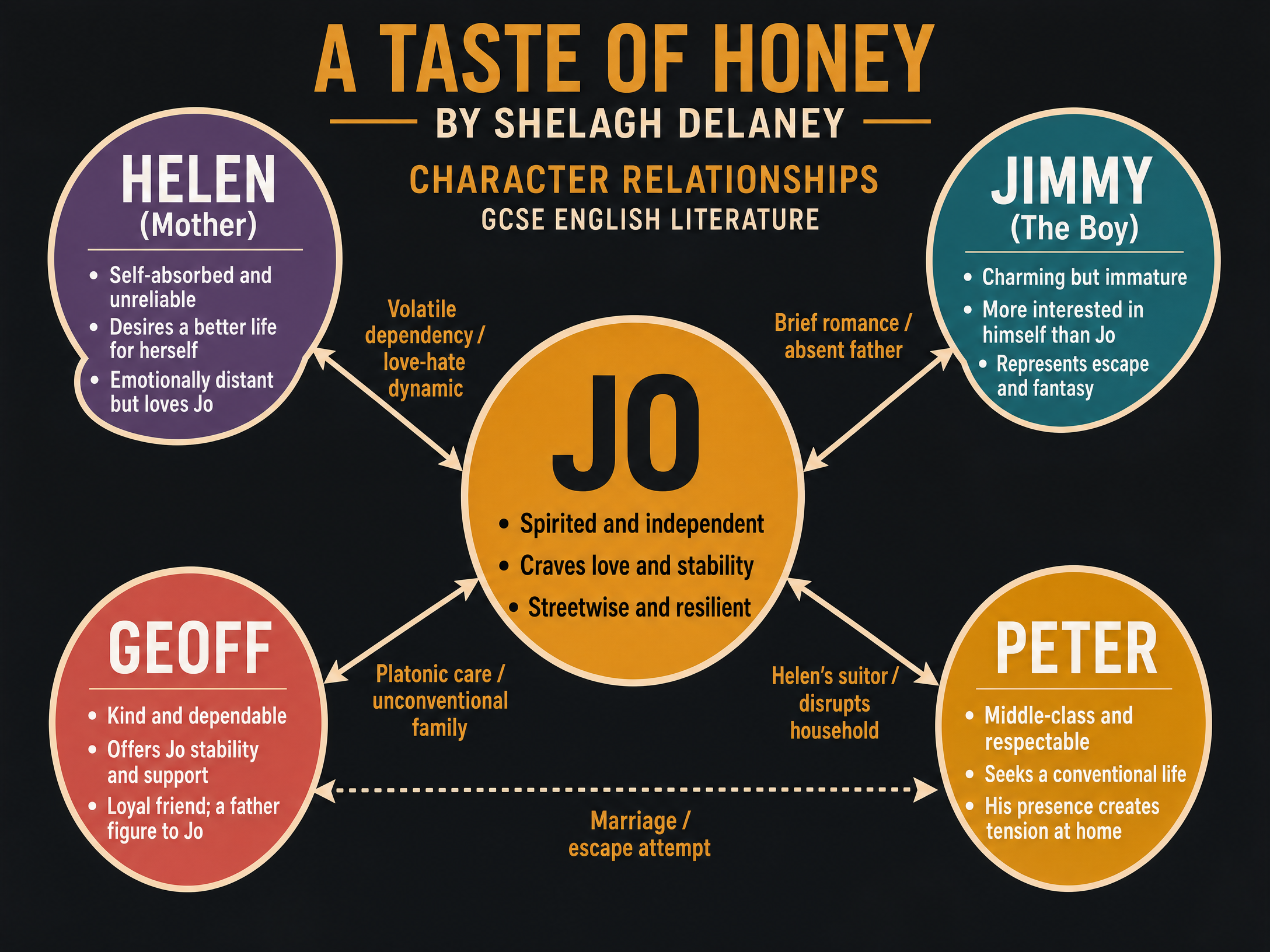
Jo
Role: The protagonist; a resilient, cynical, yet vulnerable working-class teenager.
Key Traits: Sharp-witted, independent, fearful of abandonment, desperate for love.
Character Arc: Jo moves from cynical defiance in Act 1 to vulnerable dependence on Geoff in Act 2, ending the play facing the terrifying reality of repeating her mother's mistakes.
Essential Quotes:
- "I always think it'll turn out all right."
- "I'm contemporary. I really am."
Helen
Role: Jo's mother; a chaotic, selfish woman who prioritises her own desires over her daughter's needs.
Key Traits: Vain, pragmatic, unsentimental, survivor.
Character Arc: Helen attempts to escape her class via marriage to Peter, but is inevitably dragged back to the slums, incapable of changing her fundamental nature.
Essential Quotes:
- "I have to consider my own feelings sometimes."
- "There's no room for two of us."
Geoff
Role: Jo's flatmate and surrogate family.
Key Traits: Nurturing, gentle, socially marginalized (implied homosexuality), loyal.
Character Arc: Geoff briefly finds purpose and family with Jo, but is ultimately defeated and expelled by the dominant, aggressive forces of society (represented by Helen).
Essential Quotes:
- "You need somebody to love you."
- "I'm not a man, I'm an old woman."
Writer's Methods
Naturalistic Dialogue: Delaney uses sharp, witty, colloquial Northern speech. The humour is often a defense mechanism masking deep pain. Examiners reward analysis of how this dialogue creates a sense of gritty authenticity.
Stagecraft: The stage is sparse and dilapidated. Delaney uses this to visually represent the characters' poverty and emotional emptiness. The physical environment (leaking roofs, cold) directly impacts the action.
Music: The use of a live jazz trio punctuates the scenes. The music acts as a Brechtian device, breaking the illusion of reality, while also providing a melancholic, bluesy atmosphere that underscores the characters' loneliness.
Context
Social Realism / 'Kitchen Sink' Drama: The play is a reaction against polite, upper-class drawing-room plays. It brings the harsh realities of working-class life to the forefront.
1950s Britain: A society in transition. Post-war austerity was giving way to consumerism, but deep inequalities remained.
Prejudice: Homosexuality was illegal until 1967. Interracial relationships faced intense social stigma. Single motherhood was considered highly shameful. Delaney forces the 1950s audience to confront these realities sympathetically.
Listen to the Podcast
For a deeper dive into the play's themes and exam techniques, listen to our exclusive revision podcast:
Visual Resources
2 diagrams and illustrations
Interactive Diagrams
1 interactive diagram to visualise key concepts
Conceptual Flow Outline
The Cyclical Structure of Jo's Character Arc
Worked Examples
2 detailed examples with solutions and examiner commentary
Practice Questions
Test your understanding — click to reveal model answers
Explore how Delaney presents the theme of loneliness and isolation in A Taste of Honey. (30 marks + 4 AO4)
Hint: Consider how physical isolation (the flat) mirrors emotional isolation, and how characters try (and fail) to connect.
How does Delaney present the impact of poverty on the characters in the play? (30 marks + 4 AO4)
Hint: Don't just describe the dirty flat; explain how poverty forces characters to make ruthless, selfish decisions to survive.
Explore the significance of the title A Taste of Honey in relation to the play's themes. (30 marks + 4 AO4)
Hint: Think about the biblical reference, the idea of fleeting happiness, and the contrast with the bitter reality of their lives.
How does Delaney use the character of Peter to highlight the vulnerability of Jo and Helen? (30 marks + 4 AO4)
Hint: Look at Peter's wealth, his aggressive masculinity, and how he treats the women as disposable.