Antony and Cleopatra
Dive into the epic clash of empires and passions in Shakespeare's 'Antony and Cleopatra'. This guide unlocks the complex interplay between personal desire and political duty, equipping you with the precise analytical tools and context needed to achieve top marks in your IGCSE Literature exam.
Study Notes
Overview
William Shakespeare's Antony and Cleopatra (c. 1606) is a sprawling, spectacular tragedy that spans the known world of the ancient Mediterranean. It chronicles the passionate, destructive, and deeply complex relationship between Mark Antony, one of the three rulers of the Roman Republic, and Cleopatra, the charismatic Queen of Egypt. For Cambridge IGCSE Literature examiners, the key to high marks lies in moving beyond simple character descriptions. Candidates are rewarded for nuanced analysis of the central conflict between Roman duty and Egyptian indulgence, and for exploring how Shakespeare's sophisticated poetic language, imagery, and structural choices convey this epic clash of values. You must demonstrate how personal desires inexorably alter the political landscape, leading to the tragic downfall of both protagonists.
Plot/Content Overview
Act 1: The play opens in Egypt, establishing Antony's infatuation with Cleopatra and his neglect of Roman duties. News arrives of his wife Fulvia's death and a rebellion by Pompey, forcing Antony to return to Rome, much to Cleopatra's dramatic dismay.
Act 2: In Rome, Antony forms a fragile alliance with Octavius Caesar by marrying Caesar's sister, Octavia. Meanwhile, in Egypt, Cleopatra receives the news of Antony's marriage with violent fury. The triumvirs negotiate a temporary peace with Pompey.
Act 3: The political alliances fracture. Antony returns to Cleopatra in Egypt, abandoning Octavia and deeply insulting Caesar. Caesar declares war on Antony and Cleopatra. The disastrous naval Battle of Actium occurs; Cleopatra's ships flee, and Antony shamefully follows her, abandoning his fleet and his honour.
Act 4: Antony's forces face further defeats. Enobarbus, Antony's most loyal friend, defects to Caesar (and later dies of a broken heart). In a final battle, the Egyptian fleet surrenders. Believing Cleopatra has betrayed him, Antony vows to kill her. Cleopatra hides in her monument and sends false word that she has killed herself.
Act 5: Upon hearing of Cleopatra's supposed death, a devastated Antony attempts suicide but only wounds himself. He is brought to Cleopatra's monument, where he dies in her arms. Rather than be taken as a captive trophy to Rome by the victorious Caesar, Cleopatra commits suicide by applying a venomous asp to her breast, dying in regal splendour.
Themes
Theme 1: The Conflict Between Love and Duty
This is the central thematic axis of the play. Antony is continually torn between his obligations as a Roman triumvir (duty, military discipline, political strategy) and his overwhelming passion for Cleopatra (love, pleasure, personal freedom). Shakespeare structures the play to physically bounce between Rome and Egypt, mirroring Antony's internal division. Ultimately, the play suggests that these two worlds are incompatible; Antony's attempt to inhabit both leads to his destruction.
Key Quotes:
- "Let Rome in Tiber melt, and the wide arch / Of the ranged empire fall! Here is my space." (Act 1, Scene 1) - Antony explicitly rejects his Roman duties in favour of his love for Cleopatra, establishing the core conflict immediately.
- "I must from this enchanting queen break off: / Ten thousand harms, more than the ills I know, / My idleness doth hatch." (Act 1, Scene 2) - Antony recognises the destructive nature of his passion, showing his internal conflict and awareness of his failing duty.
Theme 2: Rome vs. Egypt (Clash of Cultures)
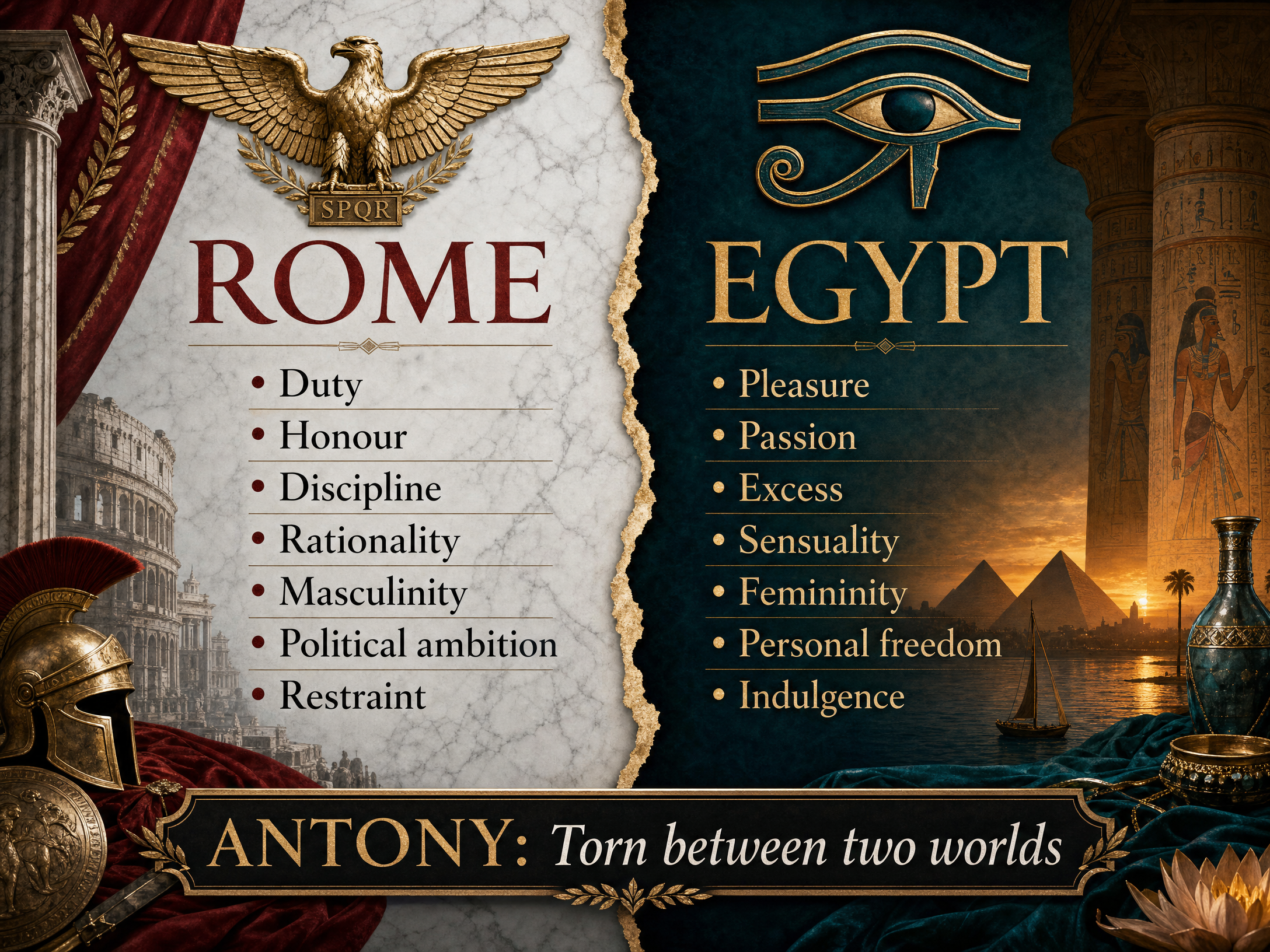
Shakespeare presents Rome and Egypt not just as locations, but as contrasting sets of values. Rome is characterised by masculinity, stoicism, military prowess, political calculation, and emotional restraint (embodied by Caesar). Egypt is characterised by femininity, sensuality, excess, emotional volatility, and artistic imagination (embodied by Cleopatra). The tragedy arises from the collision of these incompatible worldviews.
Key Quotes:
- "These strong Egyptian fetters I must break, / Or lose myself in dotage." (Act 1, Scene 2) - Antony uses the metaphor of "fetters" (chains) to describe Egypt's hold on him, contrasting Roman freedom/action with Egyptian captivity/stagnation.
- "He was disposed to mirth; but on the sudden / A Roman thought hath struck him." (Act 1, Scene 2) - Cleopatra highlights how Roman values ("a Roman thought" of duty and war) interrupt the Egyptian atmosphere of "mirth" and pleasure.
Theme 3: Power, Politics, and Honour
The play explores the nature of political power and what constitutes true honour. Caesar represents ruthless, effective political calculation, achieving total power but lacking emotional depth. Antony represents an older, heroic, martial honour, which he loses through his infatuation. The play questions whether true greatness lies in political conquest (Caesar) or in the transcendent, albeit destructive, power of love (Antony and Cleopatra).
Key Quotes:
- "I have fled myself; and have instructed cowards / To run and show their shoulders." (Act 3, Scene 11) - Following his flight at Actium, Antony recognises that he has lost not just a battle, but his very identity and Roman honour.
- "'Tis paltry to be Caesar; / Not being Fortune, he's but Fortune's knave, / A minister of her will." (Act 5, Scene 2) - Cleopatra diminishes Caesar's political victory, suggesting that earthly power is subject to the whims of Fortune, elevating her own impending death above his political triumph.
Character Analysis
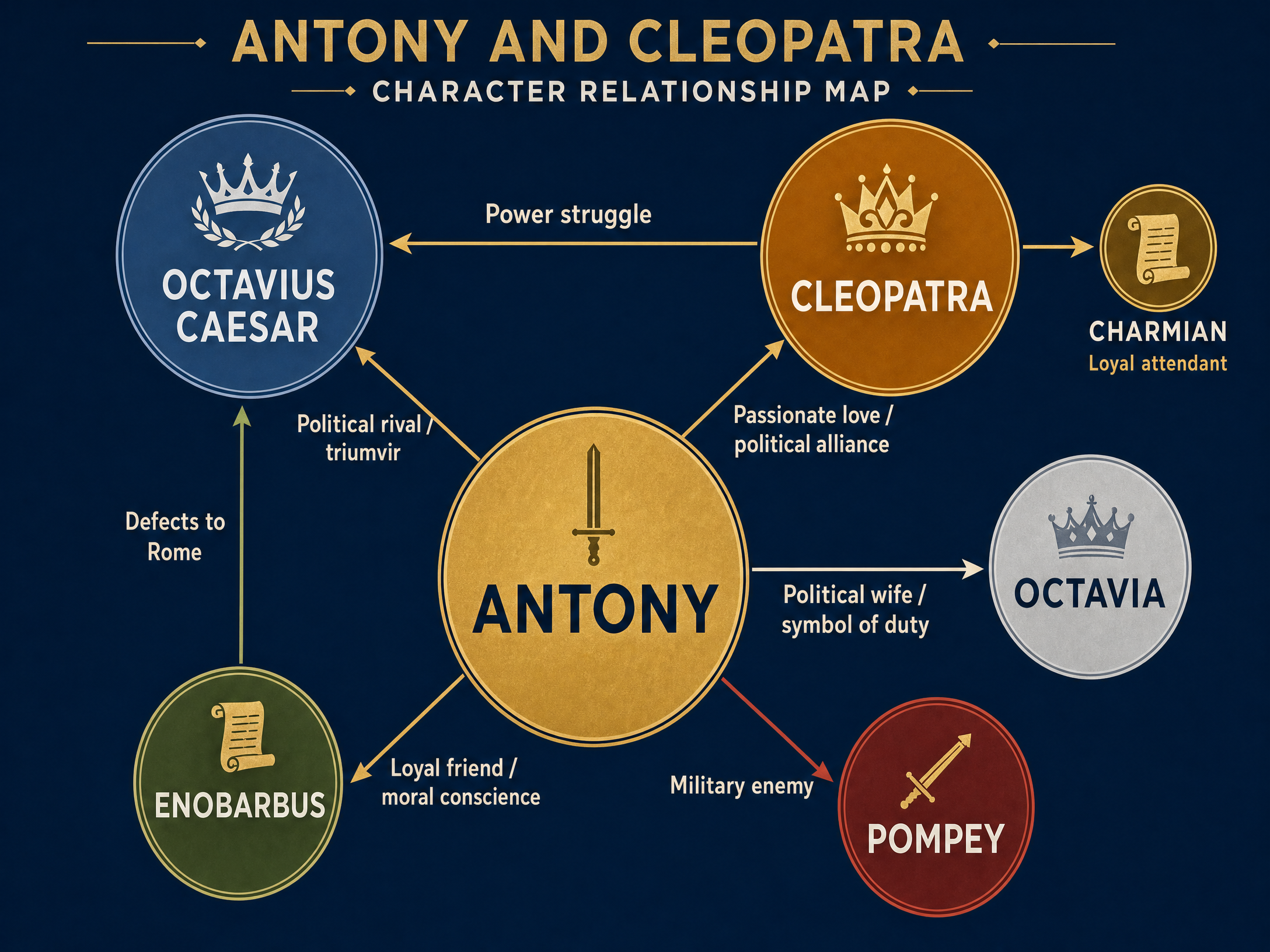
Mark Antony
Role: The tragic hero; a Roman triumvir torn between two worlds.
Key Traits: Heroic, passionate, generous, increasingly reckless, deeply conflicted.
Character Arc: Antony begins as a legendary military commander whose reputation is already being tarnished by his life in Egypt. He attempts to re-engage with Roman politics (marrying Octavia) but inevitably returns to Cleopatra. His arc is a steady decline in military and political power, culminating in his loss of honour at Actium and his botched suicide, though he retains a tragic grandeur in his final moments.
Essential Quotes:
- "His captain's heart, / Which in the scuffles of great fights hath burst / The buckles on his breast, reneges all temper..." (Act 1, Scene 1) - Philo's opening description establishes Antony's past greatness and current degradation.
- "I am Antony yet." (Act 3, Scene 13) - A desperate assertion of his identity and past glory as his power crumbles.
Cleopatra
Role: Queen of Egypt; Antony's lover and the embodiment of the Egyptian world.
Key Traits: Charismatic, manipulative, deeply passionate, theatrical, regal, defying categorisation.
Character Arc: Cleopatra is consistently theatrical and manipulative in her relationship with Antony, using her emotional volatility to control him. However, after Antony's death, she ascends to a higher tragic plane. She orchestrates her own death with immense dignity and courage, ensuring she dies as a queen rather than living as a Roman captive.
Essential Quotes:
- "Age cannot wither her, nor custom stale / Her infinite variety." (Act 2, Scene 2) - Enobarbus captures her endless fascination and complexity; she is not a static character but constantly shifting.
- "Give me my robe, put on my crown; I have / Immortal longings in me." (Act 5, Scene 2) - In her final moments, she embraces her royal identity and elevates her suicide to an act of transcendent, immortal love.
Octavius Caesar
Role: Roman triumvir; Antony's primary political rival.
Key Traits: Cold, calculating, politically astute, emotionally restrained, ambitious.
Character Arc: Caesar is the steady, rising force in the play. He uses every situation, including his sister's marriage, for political advantage. He represents the inevitable triumph of Roman order over Egyptian excess, but his victory feels hollow compared to the passion of the lovers.
Essential Quotes:
- "Let our best heads / Know, that to-morrow the last of many battles / We mean to fight." (Act 4, Scene 1) - Demonstrates his cold, strategic military focus, contrasting with Antony's emotional desperation.
Writer's Methods
Shakespeare's linguistic choices in Antony and Cleopatra are extraordinarily rich and varied, reflecting the vast scope of the play.
Hyperbole and Cosmic Imagery: The language frequently elevates the lovers to a cosmic scale. They speak of themselves, and are spoken of, in terms of the world, the stars, and the gods. (e.g., Antony: "Let Rome in Tiber melt... Here is my space"). This hyperbole stresses the epic nature of their passion and the global consequences of their actions.
Contrasting Registers: Shakespeare sharply contrasts the language of Rome and Egypt. Roman scenes feature measured, pragmatic, and unadorned verse (focusing on politics, maps, and strategy). Egyptian scenes are lush, poetic, sensual, and filled with imagery of nature, fertility, and the Nile.
Structural Fluidity: The play's structure is notoriously fluid, with short, rapid scenes shifting constantly between Rome, Egypt, and various battlefields. This cinematic structure creates a sense of a vast, unstable world and mirrors Antony's own geographical and emotional vacillation.
Context
Historical Context: The play is based on Thomas North's 1579 translation of Plutarch's Lives of the Noble Grecians and Romans. Examiners expect candidates to understand that Shakespeare is dramatising real historical figures, but adapting them for dramatic purpose. The historical shift from the Roman Republic to the Roman Empire (under Augustus/Octavius) is the political backdrop to the personal tragedy.
Jacobean Context: Written early in the reign of King James I (c. 1606), the play reflects contemporary anxieties about empire, political succession, and the tension between a monarch's personal desires and public duties. James I styled himself as a new Augustus Caesar, bringing peace and unity, which makes Shakespeare's somewhat cold portrayal of Octavius Caesar politically resonant.
Listen to the full revision podcast here:
Visual Resources
2 diagrams and illustrations
Interactive Diagrams
1 interactive diagram to visualise key concepts
Conceptual Flow Outline
The Tragic Arc of Mark Antony
Worked Examples
2 detailed examples with solutions and examiner commentary
Practice Questions
Test your understanding — click to reveal model answers
How does Shakespeare present the character of Octavius Caesar as a political leader? (30 marks)
Hint: Consider how Caesar contrasts with Antony. Look at his calculated use of his sister Octavia, his measured language, and his ultimate, somewhat hollow victory.
Explore how Shakespeare presents the theme of honour in the play. (30 marks)
Hint: Track how Antony's definition of honour changes. Compare Roman military honour with the 'honour' Cleopatra seeks in her final suicide.