Cambridge International · IGCSE · English Literature
Fire on the Mountain
Anita Desai's 'Fire on the Mountain' is a haunting, psychologically rich novel that explores the cost of a life lived for others and the destructive nature of isolation. Studying this text rewards candidates who can analyse precise, atmospheric language and understand the complex interplay between a character's internal emotional landscape and the external physical setting.
- 8 min read
- 2 worked examples
- 2 practice questions
- 8 key terms
Study Notes

Overview
Set in the isolated Himalayan foothills of Kasauli, Anita Desai's Fire on the Mountain (1977) is a profound exploration of isolation, memory, and the generational inheritance of trauma. The novel focuses on Nanda Kaul, an elderly woman who has retreated to Carignano, a crumbling colonial bungalow, seeking total solitude after a lifetime of duty as a wife and mother. Her self-imposed isolation is disrupted first by the arrival of her feral, independent great-granddaughter, Raka, and later by her tragic old friend, Ila Das. For Cambridge IGCSE Literature, examiners reward candidates who can move beyond plot summary to analyse Desai's meticulous use of pathetic fallacy, symbolism, and shifting narrative perspectives. Strong responses will connect the physical setting of the mountain to the psychological isolation of the characters, while evaluating the profound ambiguity of the novel's climactic ending.

Plot/Content Overview
Part I: Nanda Kaul at CarignanoThe novel opens by establishing Nanda Kaul's fierce protection of her solitude at Carignano. She resents any intrusion, even the postman. When a letter arrives announcing that her great-granddaughter Raka is coming to stay to recover from an illness (typhoid), Nanda is deeply resentful of the impending disruption to her carefully constructed peace.
Part II: Raka's ArrivalRaka arrives, but to Nanda's surprise, the child does not demand attention or mothering. Raka is feral, solitary, and fascinated by the wild, dangerous aspects of the mountain (like the ruined club and the ravine). A silent, uneasy parallel develops between the old woman and the child. Nanda begins to feel a strange desire to capture Raka's interest, inventing elaborate, fictional stories about her past and a glamorous explorer father to impress the girl, though Raka remains largely indifferent.
Part III: Ila Das and the ClimaxIla Das, Nanda's childhood friend whose life has been defined by poverty and struggle, visits for tea. Ila is a welfare officer fighting against child marriage in the local villages. Her presence forces Nanda to confront the painful reality of the past they share. After leaving Carignano, Ila is brutally raped and murdered by a man whose child's marriage she had opposed. When the police call Nanda with the news, the shock forces a devastating internal confession: Nanda's entire life, her marriage, and the stories she told Raka were lies constructed to hide her husband's infidelity and her own profound unhappiness. Simultaneously, Raka appears at the window to announce she has set the forest on fire.
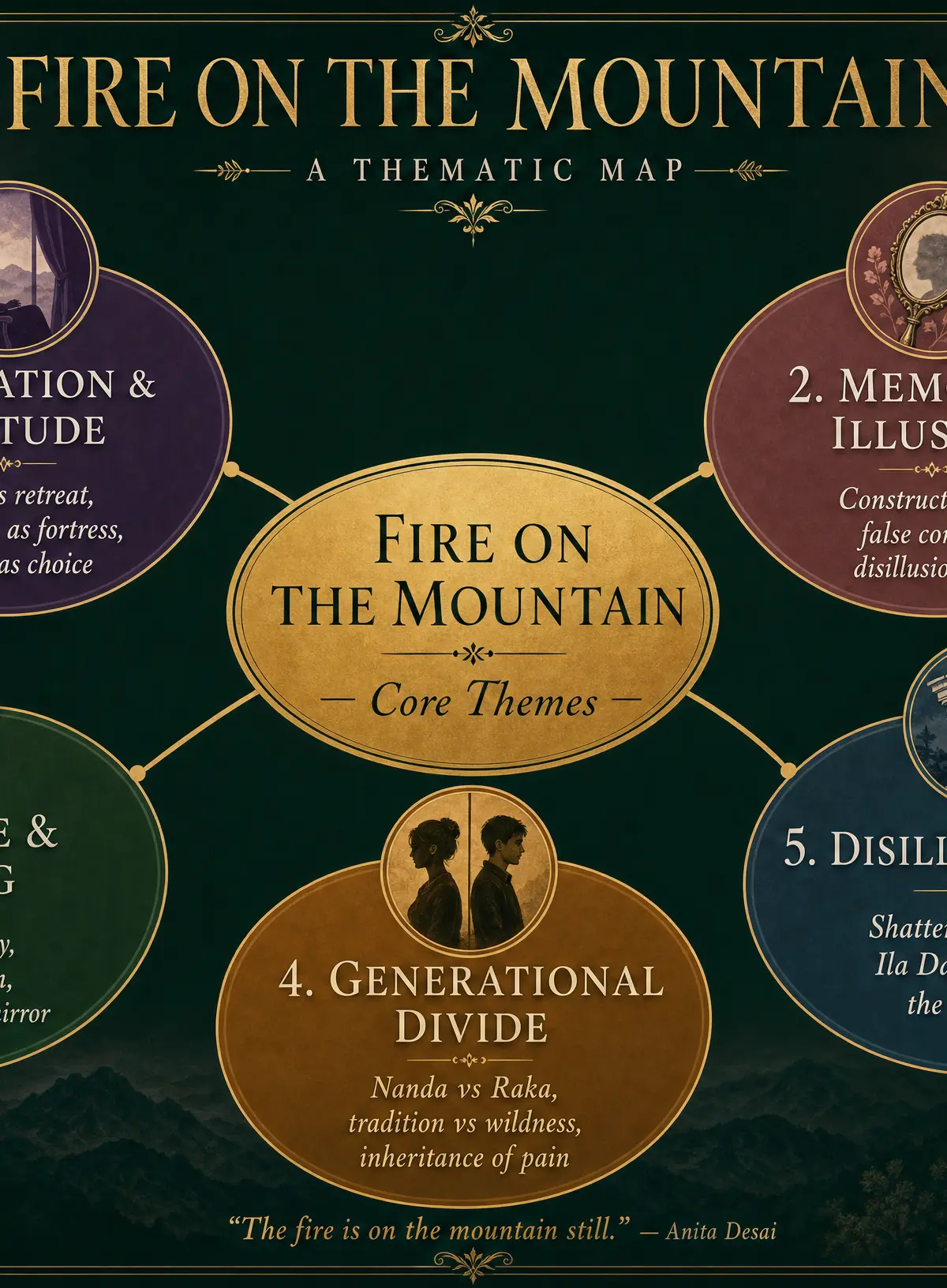
Themes
Theme 1: Isolation and Solitude
Desai presents isolation not merely as a physical state, but as a complex psychological defence mechanism. Nanda's retreat to Carignano is an attempt to strip away the roles she played for decades. However, the novel questions whether true isolation is ever possible or healthy. While Nanda's isolation is a withdrawal from a painful past, Raka's solitude is presented as innate and elemental.
Key Quotes:
- "She had not come to Kasauli to meet people." (Part I) - Establishes Nanda's active rejection of social connection.
- "She was a recluse out of vengeance for a long life of duty and obligation." (Part I) - Reveals the motivation behind her isolation; it is a reaction to past trauma rather than genuine peace.
- "Raka, you really are a great-grandchild of mine, aren't you? You are more like me than any of my children or grandchildren." (Part II) - Nanda recognises their shared need for solitude, though their motivations differ entirely.
Theme 2: Memory, Illusion, and Disillusionment
Memory in the novel is unreliable; it is a tool used to construct comforting illusions. Nanda fabricates a glamorous past to impress Raka, but ultimately, these illusions are violently stripped away by the reality of Ila Das's death. The novel suggests that living in illusion is ultimately destructive.
Key Quotes:
- "It was all a lie, all. She had lied to Raka, lied about everything." (Part III) - The climactic moment of anagnorisis (discovery/recognition) where Nanda confronts the truth of her constructed life.
- "She had been glad when it was over... she had been glad to leave it all behind." (Part I) - Refers to her role as Vice-Chancellor's wife, highlighting the hollowness of her past.
Theme 3: Nature and Setting as a Psychological Mirror
The landscape of Kasauli is active and hostile, reflecting the internal states of the characters. Desai uses the mountain, the wind, and the flora to mirror Nanda's barren emotional landscape and Raka's wild, untamed nature.
Key Quotes:
- "The gorge was deep and dark and filled with the sound of water." (Part II) - Reflects the hidden depths and dangers of the subconscious that Raka is drawn to.
- "The fire is on the mountain still." (Part II) - The literal fire prefigures the destructive emotional climax and the burning away of illusions.
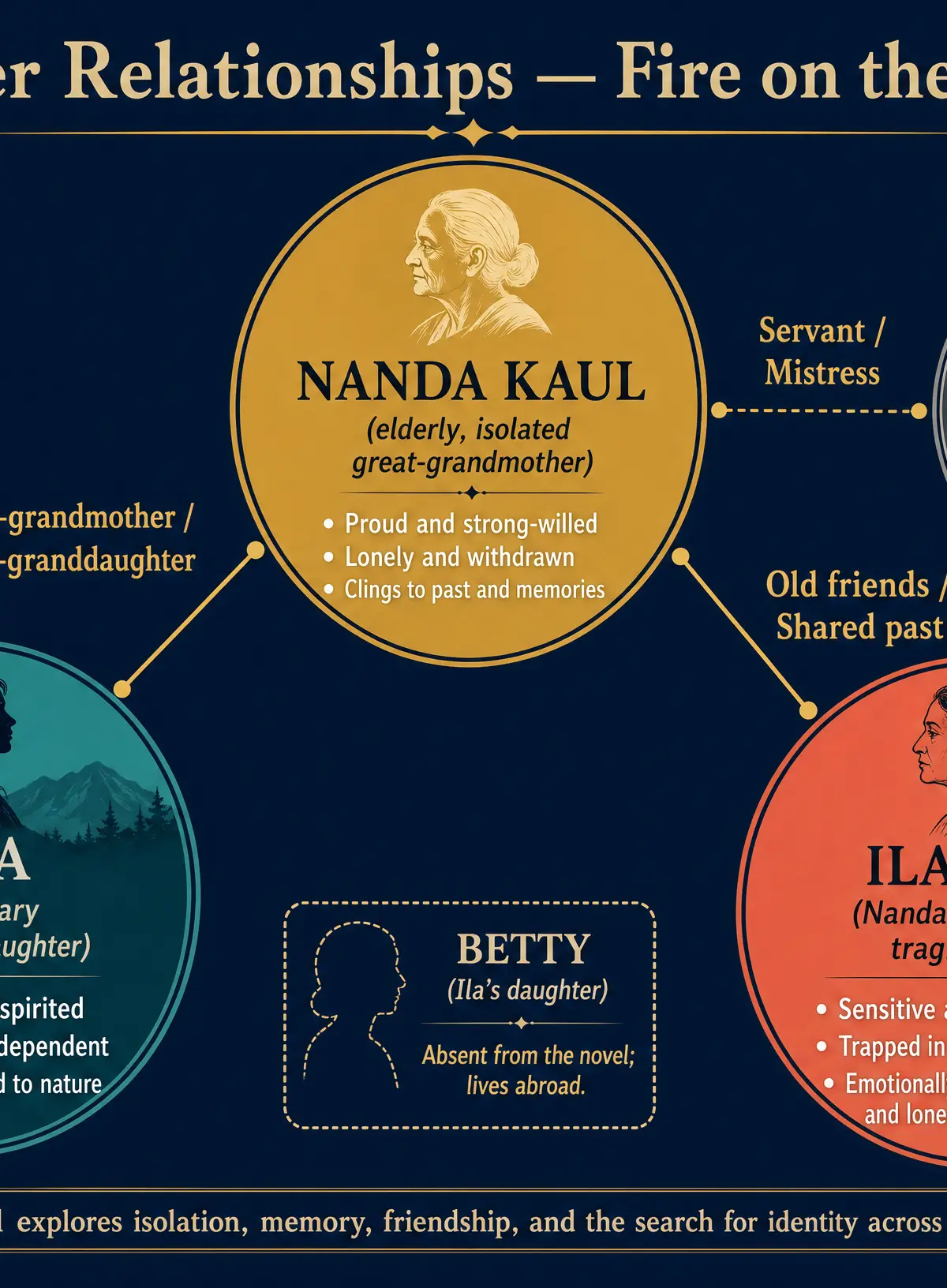
Character Analysis
Nanda Kaul
Role: The protagonist; an elderly woman seeking refuge from her past.
Key Traits: Proud, rigid, deeply wounded, performative, emotionally withdrawn.
Character Arc: Moves from fiercely guarded, self-imposed isolation based on illusion, to a desperate attempt to connect with Raka through fabrication, culminating in a devastating confrontation with the truth of her hollow life.
Essential Quotes:
- "She wanted no one and nothing."
- "She was a recluse out of vengeance..."
- "It was all a lie, all."
Raka
Role: Nanda's great-granddaughter; a catalyst for Nanda's self-reflection.
Key Traits: Feral, solitary, observant, indifferent to social norms, drawn to destruction.
Character Arc: Raka remains largely static in her wildness, acting as an unchanging mirror that forces Nanda to see her own artificiality. Her final act of setting the fire is the ultimate rejection of the adult world's order.
Essential Quotes:
- "She was the finished, perfected model of what Nanda Kaul was merely a brave, flawed experiment in."
- "Look, Nani, I have set the forest on fire."
Ila Das
Role: Nanda's childhood friend; the intrusion of harsh reality.
Key Traits: Tragic, vulnerable, shrill, courageous, socially marginalised.
Character Arc: Ila represents the reality of female vulnerability in a patriarchal society. Her brutal murder shatters Nanda's illusions of safety and peace.
Essential Quotes:
- "Her voice was a ragged, jagged, tearing sound."
- "It is so hard, Nanda, so hard."
Writer's Methods
Pathetic Fallacy and Anthropomorphism: Desai constantly uses the landscape to reflect human emotion. Carignano is "perched" precariously, much like Nanda's sanity. The harsh, glaring light of the sun exposes truths, while the dark ravines represent hidden traumas.
Sensory Imagery: Desai relies heavily on auditory and visual imagery. The "shrill" voice of Ila Das is jarring, disrupting the "silence" Nanda craves. The visual motif of fire builds tension throughout the narrative.
Shifting Narrative Perspective: While written in the third person, the narrative closely aligns with Nanda's consciousness, allowing the reader to experience her illusions before violently shifting to objective reality at the end.
Symbolism: The fire symbolises both destruction and purification. The bronze Buddha Nanda keeps represents the detached, emotionless state she aspires to but fails to achieve.
Context
Fire on the Mountain was written in post-independence India (1977). Examiners expect candidates to understand the patriarchal structures that constrained women of Nanda's generation. Nanda's role as the Vice-Chancellor's wife was entirely performative; she had no independent identity, and her husband's infidelity was something she had to silently endure to maintain social standing. Ila Das represents the precarious position of unmarried, impoverished women in this society. The setting of Kasauli, a former British hill station, with its decaying colonial architecture, mirrors the decay of the old social order and Nanda's own crumbling facade.
Visual Resources
2 diagrams and illustrations
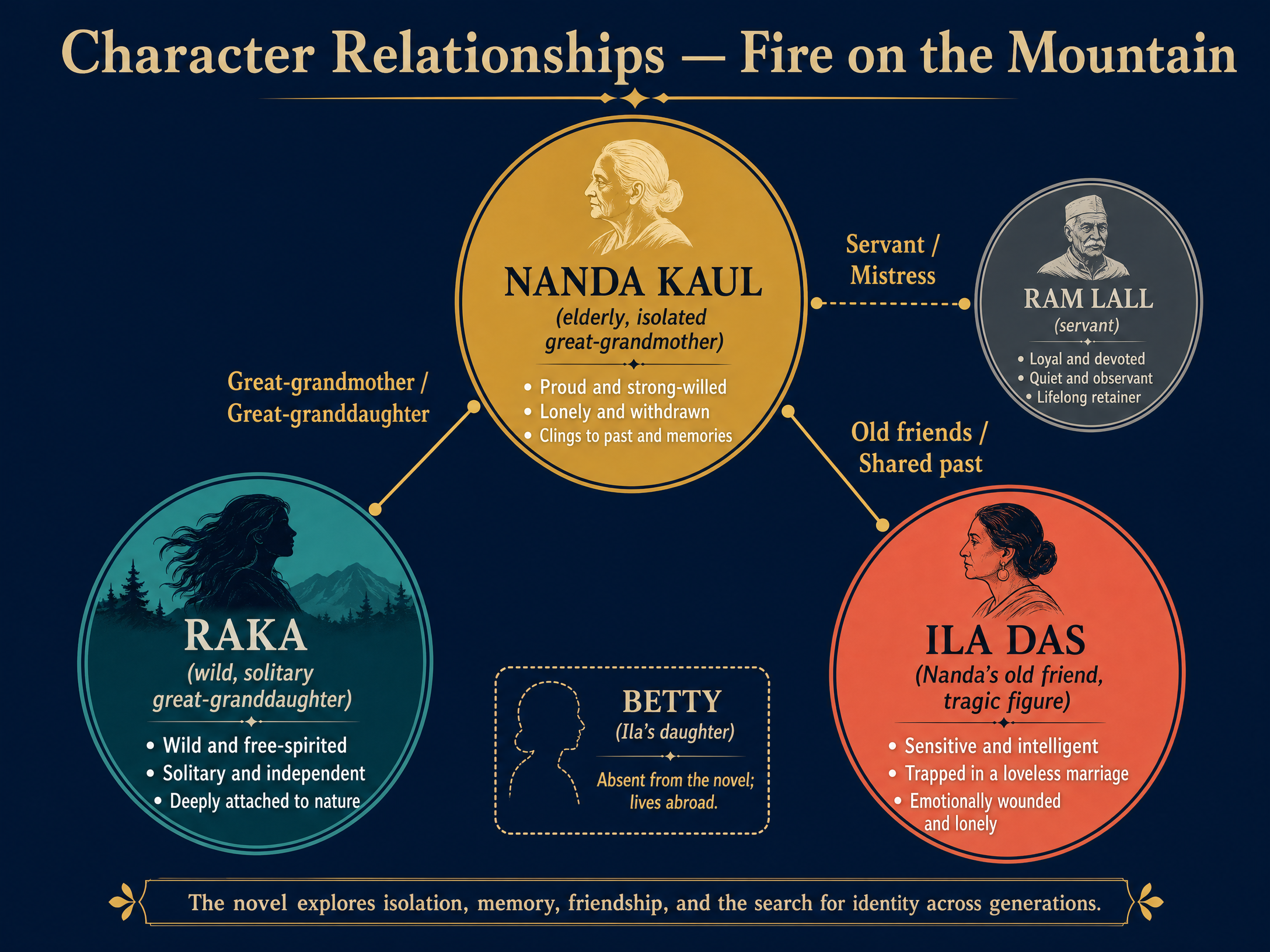
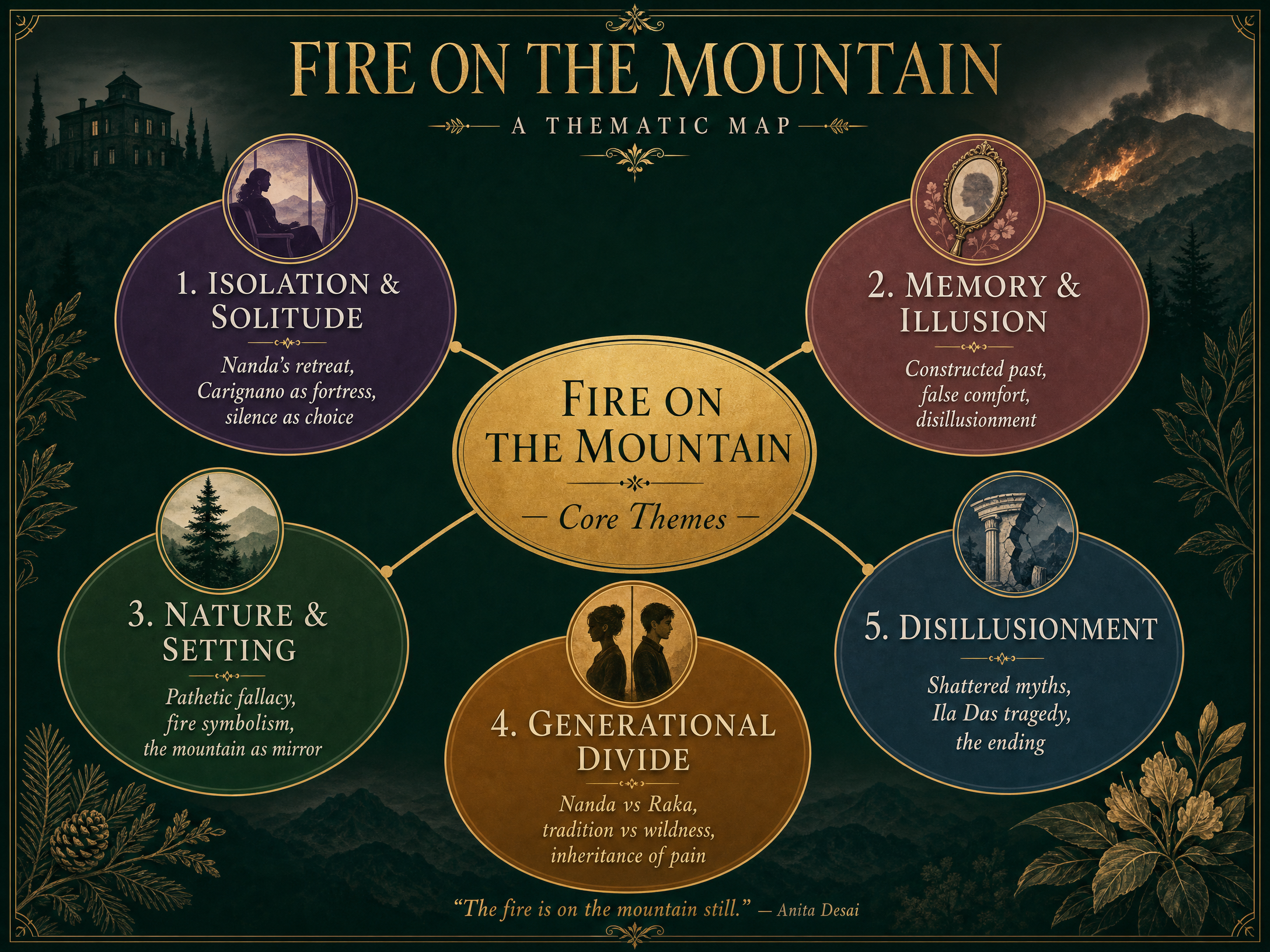
Interactive Diagrams
1 interactive diagram to visualise key concepts
Conceptual Flow Outline
Narrative Structure and the Collapse of Illusion
Worked Examples
2 worked examples — open one to explore the question and available guidance.
Practice Questions
Test your understanding — click to reveal model answers
How does Desai use the setting of Carignano to explore the theme of isolation? (30 marks + 4 AO4)
Hint: Consider Carignano's physical location, its history, how Nanda interacts with it, and how it contrasts with the world outside (represented by Ila Das).
Explore the significance of the novel's ending. (30 marks + 4 AO4)
Hint: You must discuss both internal events (Nanda's realisation) and external events (the literal fire), and evaluate the ambiguity of Raka's actions.