Cambridge International · IGCSE · English Literature
Hullaballoo in the Guava Orchard
Anita Desai's 'Hullaballoo in the Guava Orchard' is a delightful, satirical exploration of a young man who escapes societal expectations by moving into a tree. It offers rich opportunities to analyse humour, social critique, and the tension between individual freedom and community pressure, making it a highly rewarding text for IGCSE Literature students.
- 7 min read
- 2 worked examples
- 4 practice questions
- 8 key terms
Study Notes
Overview
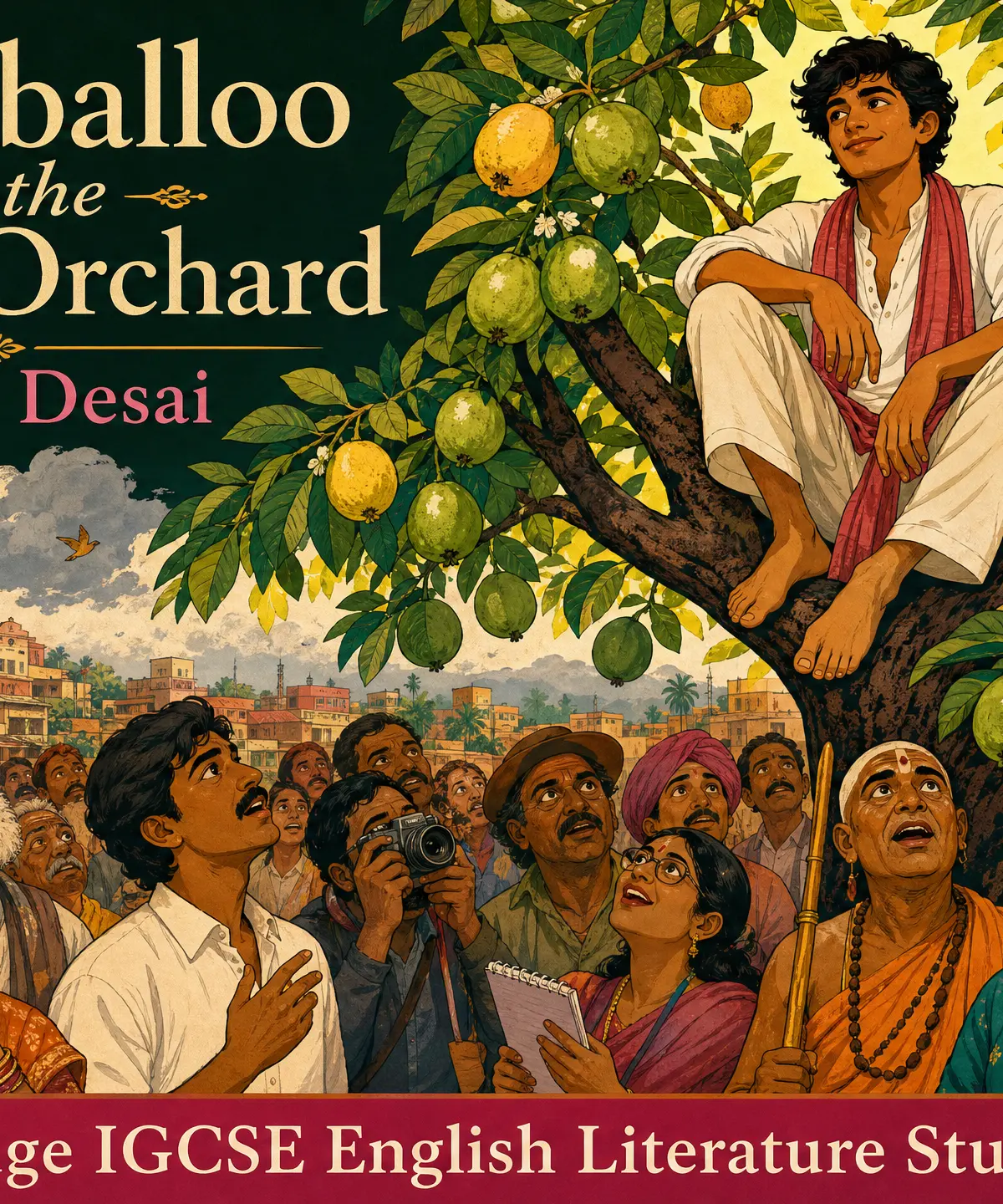
Anita Desai's 1998 novel Hullaballoo in the Guava Orchard is a masterful blend of comedy, satire, and social commentary. Set in the fictional Indian town of Shahkot, it follows the life of Sampath Chawla, an unmotivated young man who inadvertently becomes a revered holy man after escaping his mundane life by climbing a guava tree. For Cambridge IGCSE candidates, this text offers rich opportunities to explore the tension between individual desires and societal expectations. Examiners look for perceptive analysis of Desai's methods—specifically how she uses caricature, irony, and the absurd to critique the commodification of spirituality, the pressures of conformity, and the constraints placed on women in traditional societies. A strong response will always link the novel's comedic surface to its deeper thematic concerns.
Plot/Content Overview
The narrative begins with a prologue detailing the chaotic circumstances of Sampath's birth during a long-awaited monsoon, setting the tone for a life marked by unpredictability. Growing up, Sampath is a profound disappointment to his ambitious father, Mr Chawla, failing at school and losing his job at the post office. Exhausted by the demands of society, Sampath flees to a local guava orchard and climbs a tree, seeking only peace.
However, his retreat is misinterpreted. Drawing on gossip he read in other people's mail at the post office, Sampath makes 'prophetic' statements that convince the townspeople he is a clairvoyant baba (holy man). His father quickly commercialises this fame, transforming the peaceful orchard into a bustling pilgrimage site. Chaos ensues, culminating in an invasion of alcoholic monkeys. When the military is called in to resolve the monkey crisis, Sampath vanishes, leaving behind only a single guava fruit in his clothing, suggesting a magical escape from a world that refused to leave him alone.
Themes
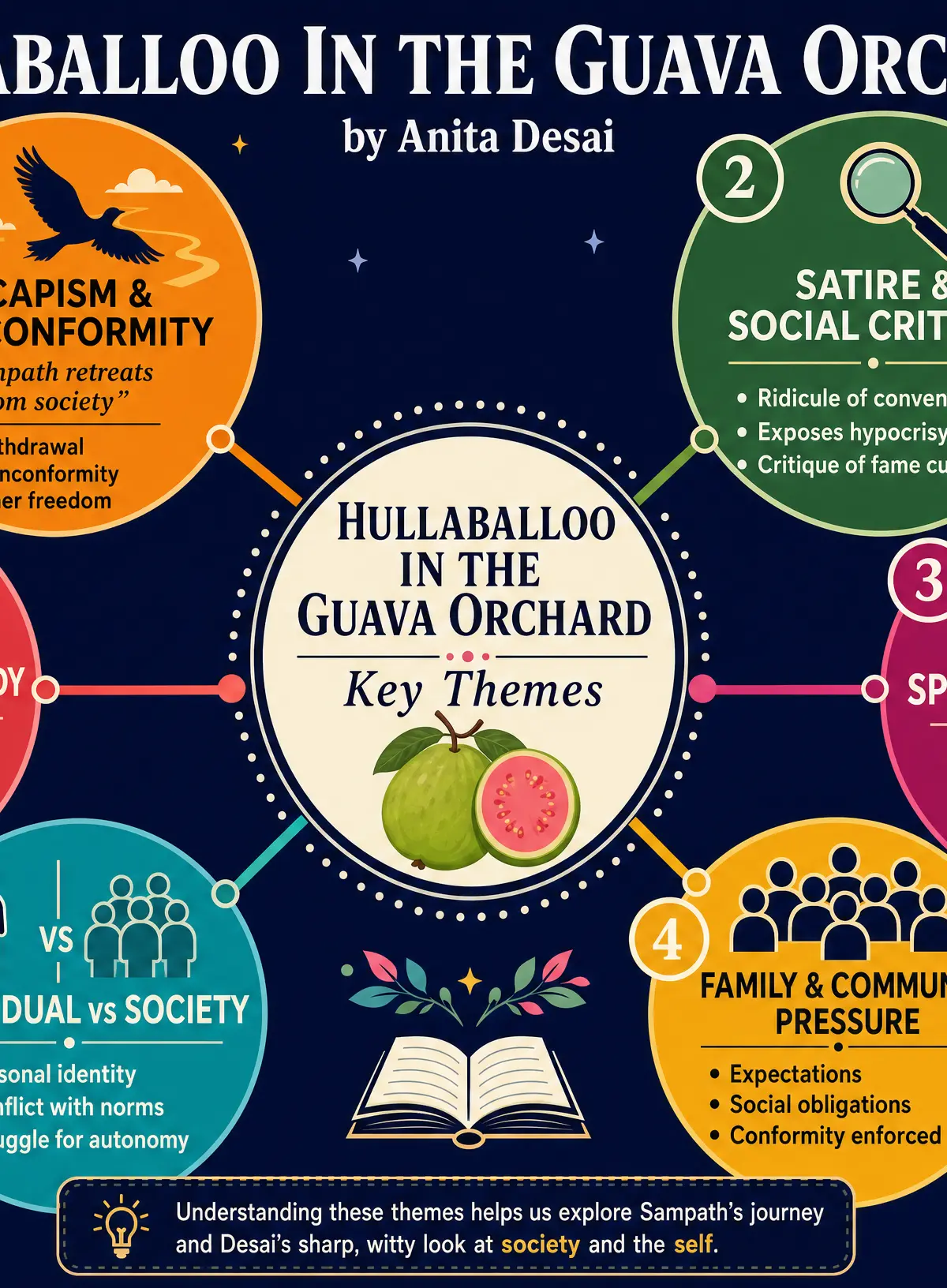
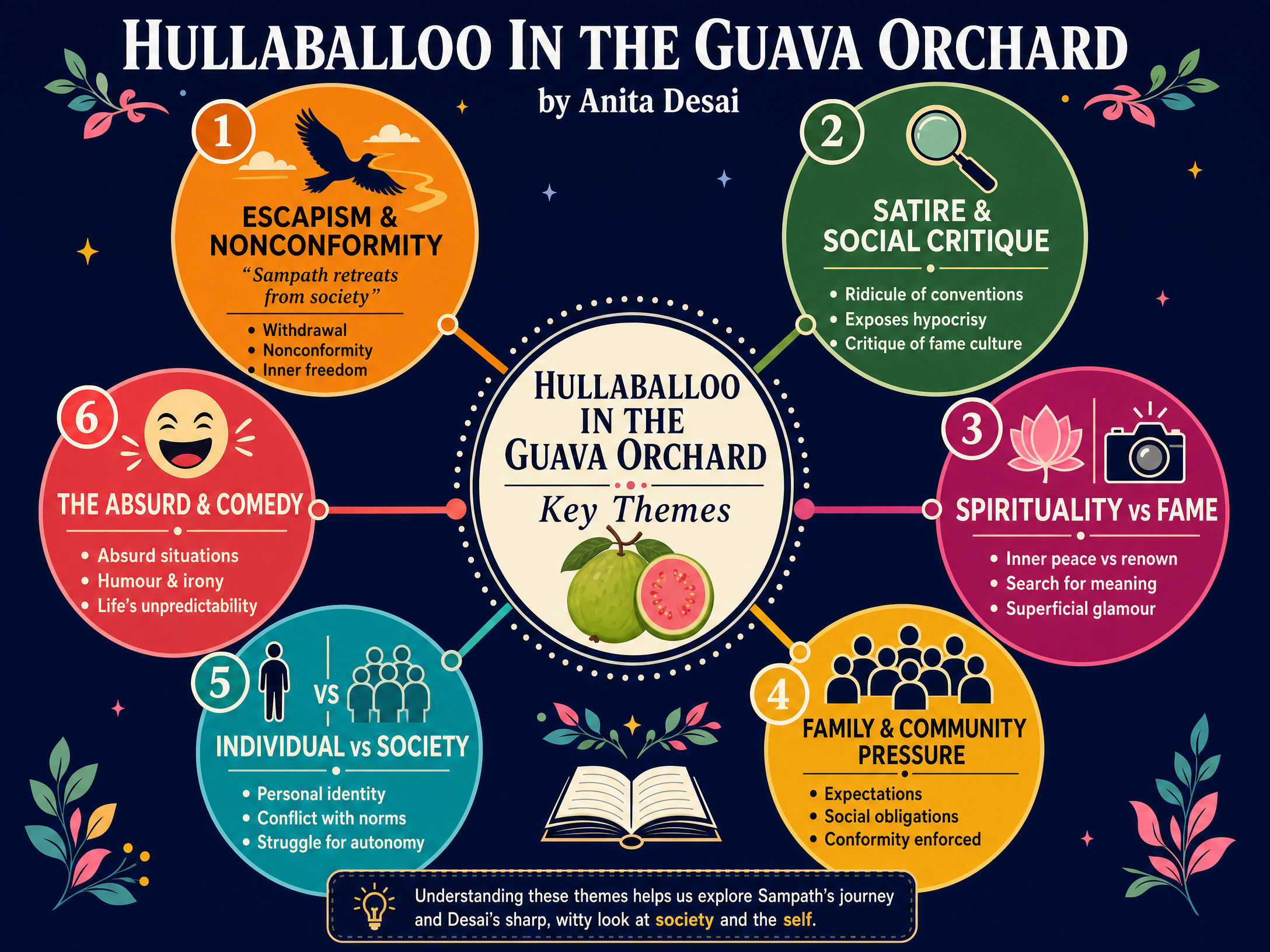
Theme 1: Escapism and Nonconformity
Desai presents escapism not merely as laziness, but as a desperate response to a stifling society. Sampath's retreat to the tree is a physical manifestation of his desire to disconnect from the expectations of productivity and status. The novel suggests that in a society obsessed with material success, doing nothing is the ultimate act of rebellion.
Key Quotes:
- "He wanted only this—to be left alone." (Chapter 5) - Highlights the simplicity of Sampath's desire in contrast to the complex machinery of society that pursues him.
- "What is the use of a son if he does not work?" (Mr Chawla, Chapter 2) - Exposes the transactional nature of familial relationships and the societal equation of human worth with economic output.
Theme 2: Satire and Social Critique
The novel functions as a sharp satire of modern Indian society, particularly the commodification of spirituality. Desai uses the town's reaction to Sampath to expose how readily people project their own desires onto others, and how quickly genuine spiritual seeking is corrupted by capitalism.
Key Quotes:
- "We must put an advertisement in the papers..." (Mr Chawla, Chapter 7) - Demonstrates the immediate commercialisation of the spiritual; Mr Chawla sees a business opportunity, not a miracle.
- "They had come for a miracle and they would not leave without one." (Chapter 10) - Reveals the demanding, consumerist nature of the pilgrims, who treat spirituality as a transaction.
Theme 3: The Absurd and Comedy
Desai employs the absurd to highlight the irrationality of 'normal' societal conventions. The presence of the alcoholic monkeys serves as an agent of chaos, disrupting the ordered, commercialised world Mr Chawla tries to build around the tree. The comedy is used to undermine authority and expose hypocrisy.
Key Quotes:
- "The monkeys were drunk... they were swinging from the branches, singing." (Chapter 15) - The sheer absurdity of the situation highlights the loss of control and the triumph of nature over human order.
Character Analysis
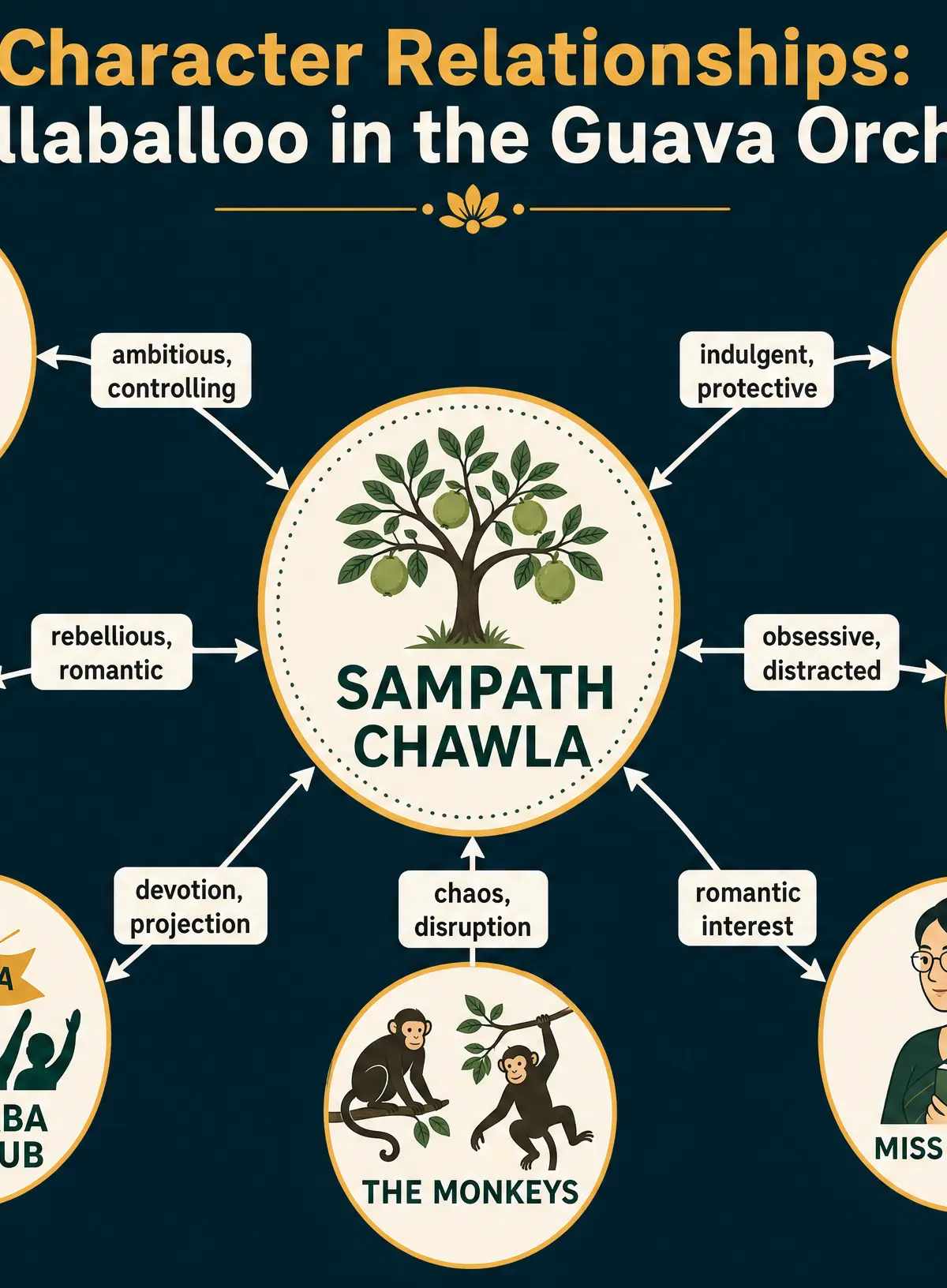
Sampath Chawla
Role: The protagonist and reluctant holy man.
Key Traits: Passive, observant, nonconformist, deeply connected to nature.
Character Arc: Moves from a passive victim of societal pressure to an active escapee, though he ultimately finds that society will not let him go easily. His final disappearance represents his ultimate, magical liberation.
Essential Quotes:
- "He felt he was born for a different life entirely."
- "The world was a noisy place, but here, in the tree, there was silence."
Mr Chawla (The Father)
Role: The antagonist and embodiment of societal expectations.
Key Traits: Ambitious, controlling, transactional, lacking in imagination.
Character Arc: He does not change; rather, he adapts his ambition to the new circumstances, turning his son's rebellion into a business enterprise.
Essential Quotes:
- "Progress! We must have progress!"
- "A baba in the family is better than a bank manager."
Kulfi (The Mother)
Role: Represents female frustration and alternative forms of escapism.
Key Traits: Obsessive, creative, detached from reality, defined by her culinary fixations.
Character Arc: As Sampath retreats to the tree, Kulfi retreats into her cooking, finding her own wild, untamed sanctuary in the preparation of exotic and increasingly bizarre meals.
Essential Quotes:
- "She cooked as if she were feeding an army of ghosts."
Writer's Methods
Desai's primary method is satirical caricature. Characters like Mr Chawla are exaggerated to expose the flaws they represent (ambition, greed). She also uses sensory imagery heavily, particularly in descriptions of food (Kulfi's cooking) and nature (the orchard, the monsoon), to contrast the vibrant, untamed natural world with the rigid structures of Shahkot society. The narrative voice is third-person omniscient, maintaining an ironic, slightly detached tone that allows the reader to see the absurdity of the characters' actions while still feeling a degree of warmth towards them.
Context
For Cambridge IGCSE, context (AO3) should be integrated to illuminate the text. The novel reflects late 20th-century India, a society caught between traditional values (the reverence for holy men, strict family structures) and rapid modernization/capitalism. Desai critiques how modern consumerism corrupts traditional spirituality, turning pilgrimage into tourism. Understanding this tension is crucial for analyzing the town's reaction to Sampath.
Listen to our 10-minute deep-dive podcast for a comprehensive overview of themes and exam strategies!

Visual Resources
2 diagrams and illustrations
Interactive Diagrams
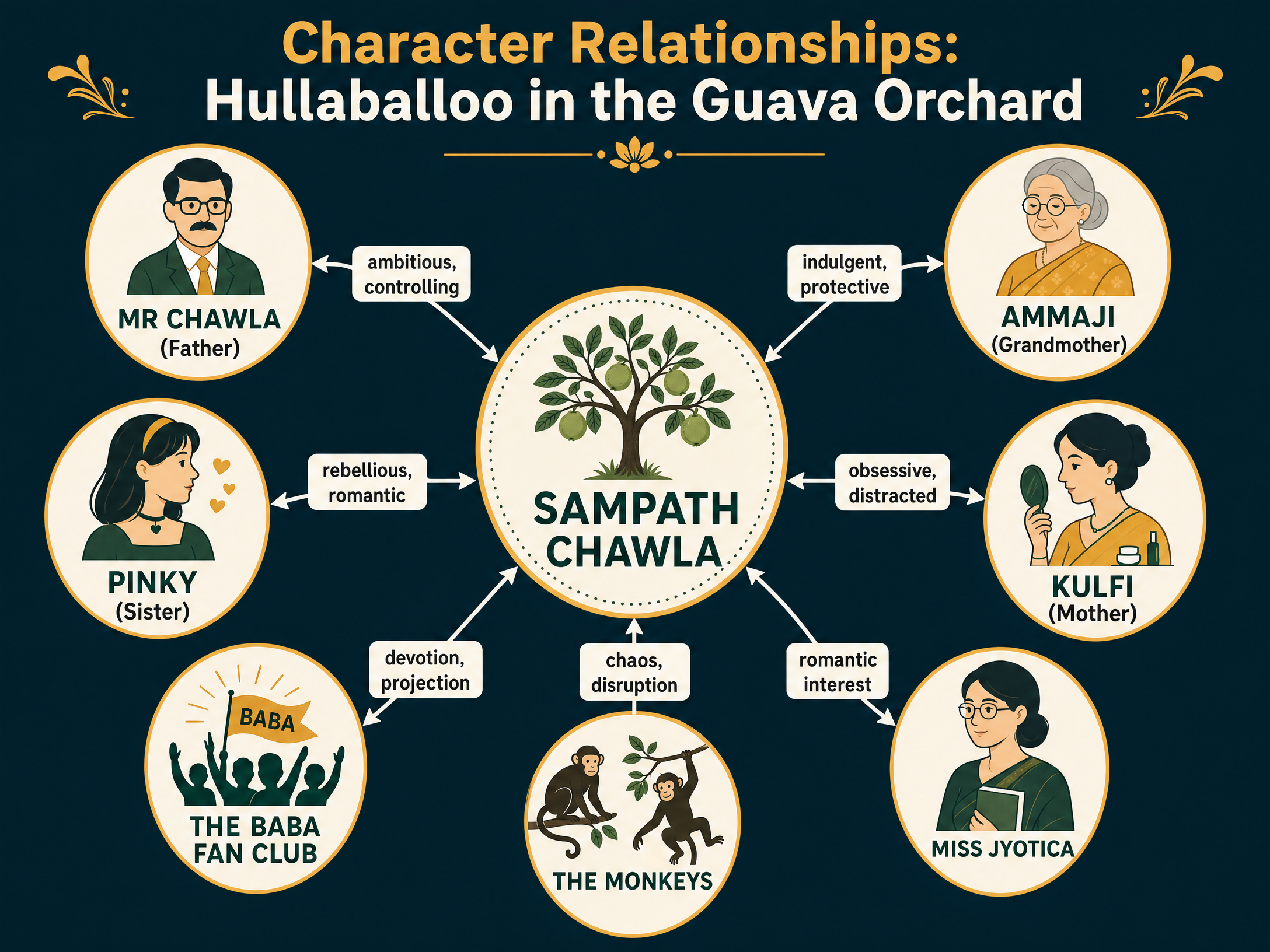
1 interactive diagram to visualise key concepts
Conceptual Flow Outline
Sampath's Narrative Arc: The Cycle of Escape and Capture
Worked Examples
2 worked examples — open one to explore the question and available guidance.
Practice Questions
Test your understanding — click to reveal model answers
How does Desai use humour to explore serious ideas in Hullaballoo in the Guava Orchard?
Hint: Don't just list funny moments. Explain what Desai is criticising through the comedy (e.g., capitalism, societal pressure).
Explore the presentation of Kulfi and her relationship with her family.
Hint: Consider how her cooking is a form of rebellion and escapism, similar to Sampath's tree climbing.
How is the setting of the guava orchard important to the novel as a whole?
Hint: Contrast the orchard with the town of Shahkot. Think about what the orchard represents initially vs. what it becomes.
To what extent is Mr Chawla presented as the villain of the novel?
Hint: Consider whether he is truly evil, or simply a caricature of misguided societal values.