Cambridge International · IGCSE · English Literature
Kumukanda (Kayo Chingonyi)
Kayo Chingonyi's 'Kumukanda' is a profound and formally inventive poetry collection that explores the fractured nature of dual identity. It offers students a rich opportunity to analyse how a contemporary poet uses musicality, form, and striking imagery to navigate the complex journey from childhood to manhood between Zambian heritage and Black British experience.
- 8 min read
- 1 worked example
- 4 practice questions
- 8 key terms
Study Notes
Overview
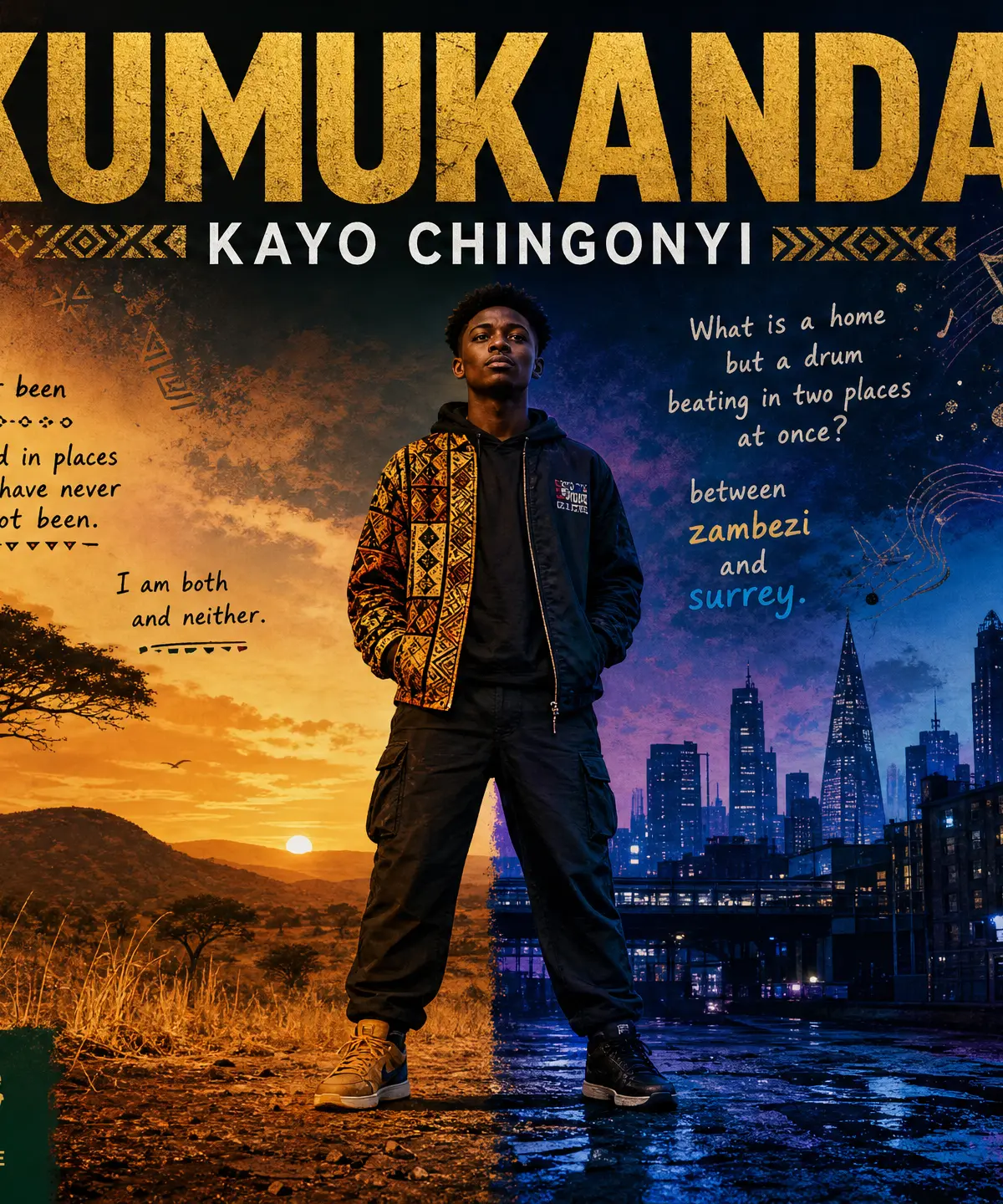
Kayo Chingonyi's debut collection Kumukanda (2017) is a seminal work of contemporary British poetry. The title, derived from the Luvale language of Chingonyi's Zambian father, translates to 'initiation'—specifically referring to the traditional rites of passage for young boys entering manhood. Removed from Zambia at the age of six following his father's death, Chingonyi never underwent this ritual. The collection itself acts as a substitute initiation: a poetic journey navigating the complex terrain of grief, race, masculinity, and dual identity in modern Britain. Examiners reward candidates who can perceptively analyse how Chingonyi's formal choices—his use of free verse, enjambment, and musical intertextuality—mirror the thematic tensions of a life lived between two cultures.

Plot/Content Overview
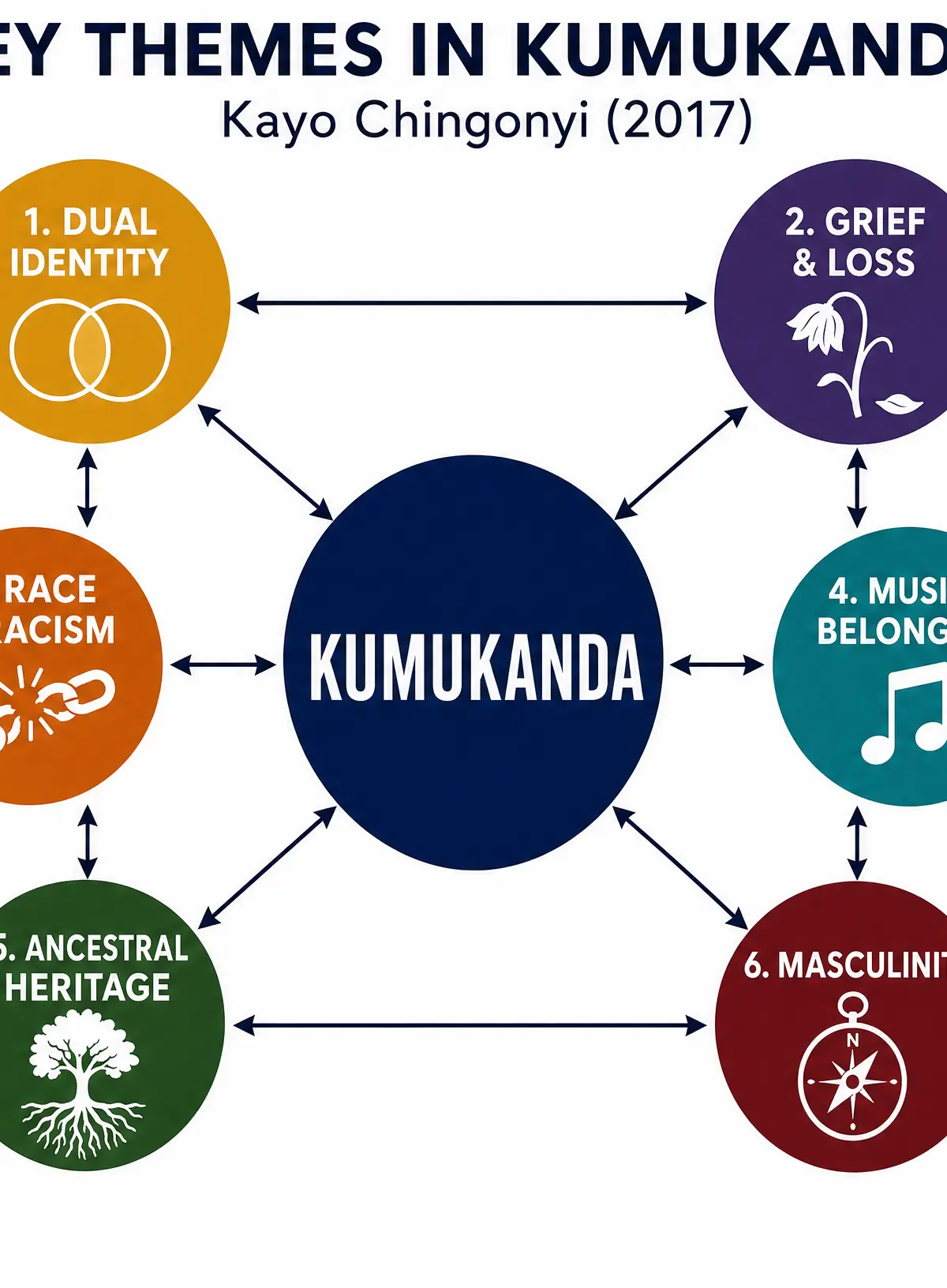
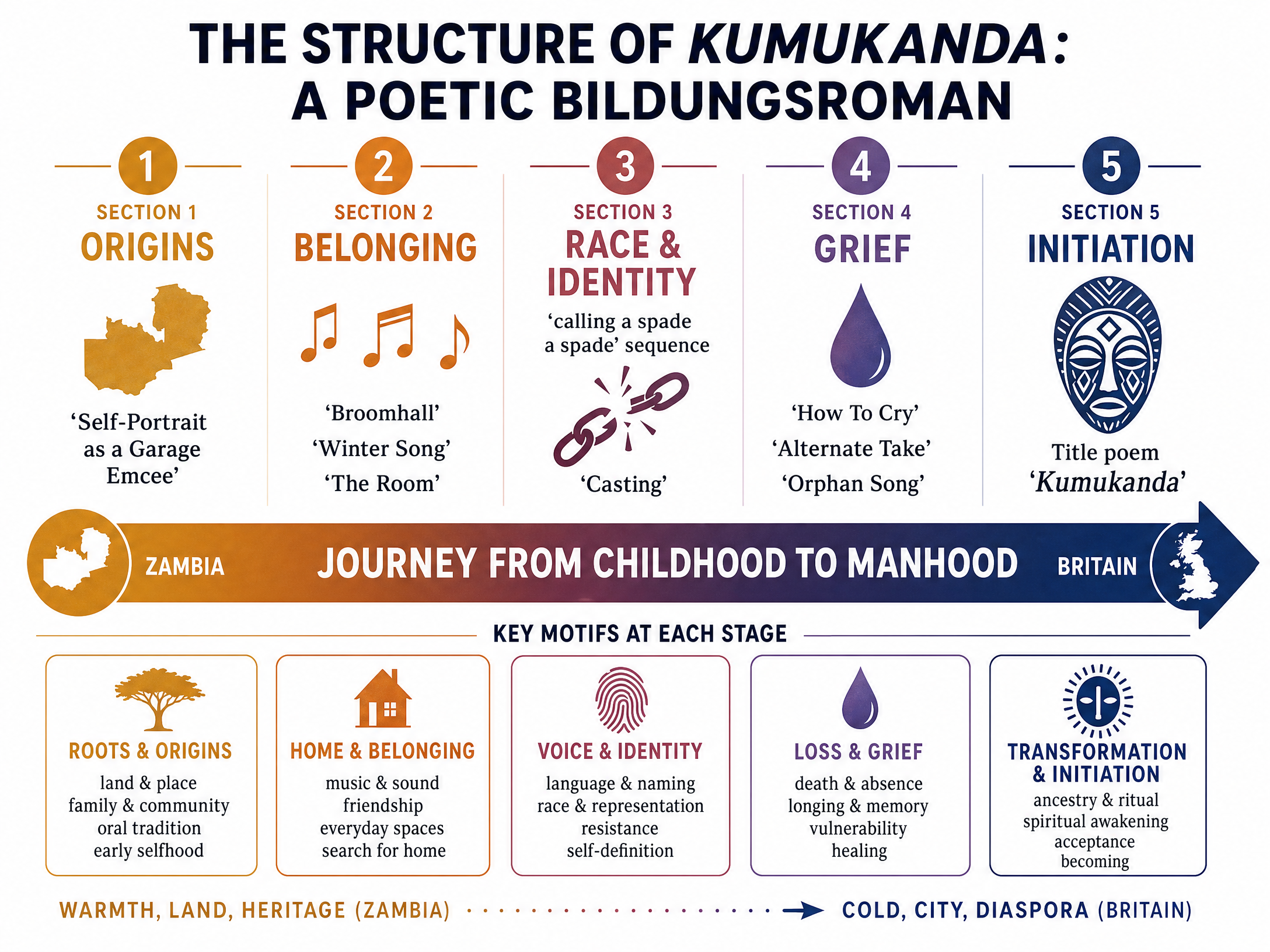
While poetry collections do not have a traditional 'plot', Kumukanda operates as a poetic bildungsroman—a coming-of-age narrative. The collection is broadly structured into phases of development:
- Origins and Isolation: Early poems like Self-Portrait as a Garage Emcee establish the speaker's childhood displacement and search for solace in music following his father's death and relocation to Essex.
- Community and Belonging: Poems such as Broomhall and The Room explore the speaker's attempts to forge a surrogate community through Black British music culture (grime, garage) and shared spaces.
- Race and Representation: The calling a spade a spade sequence and poems like Casting confront structural racism and the limitations placed on Black identity in Britain.
- Grief and Memory: A deeply moving sequence (including How To Cry and Orphan Song) addresses the loss of the speaker's mother when he was thirteen, exploring vulnerability and alternative masculinities.
- Initiation: The collection culminates in the title poem, Kumukanda, where the speaker directly addresses his ancestral heritage, acknowledging the permanent fracture between his British reality and his Zambian roots.
Themes
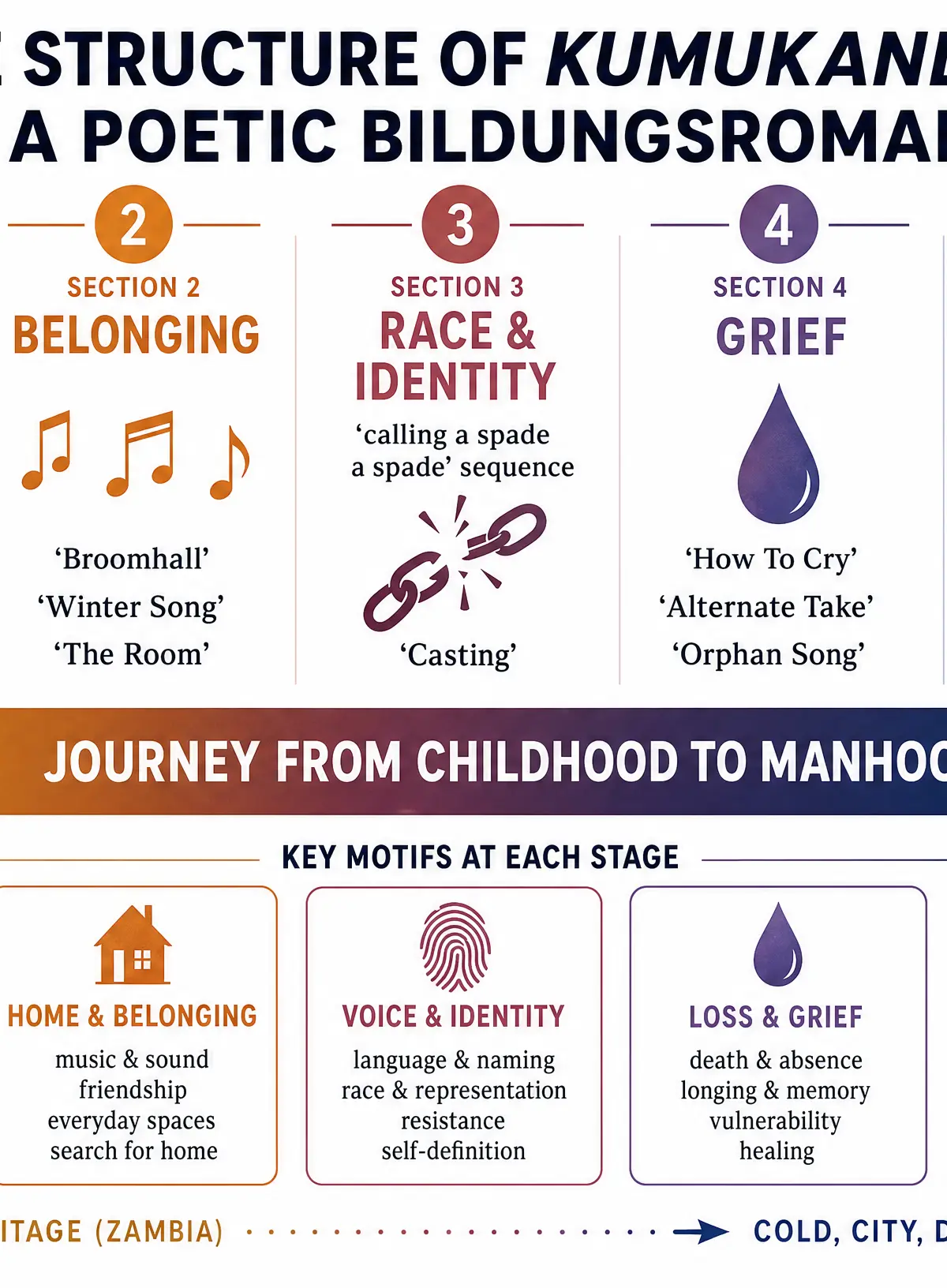
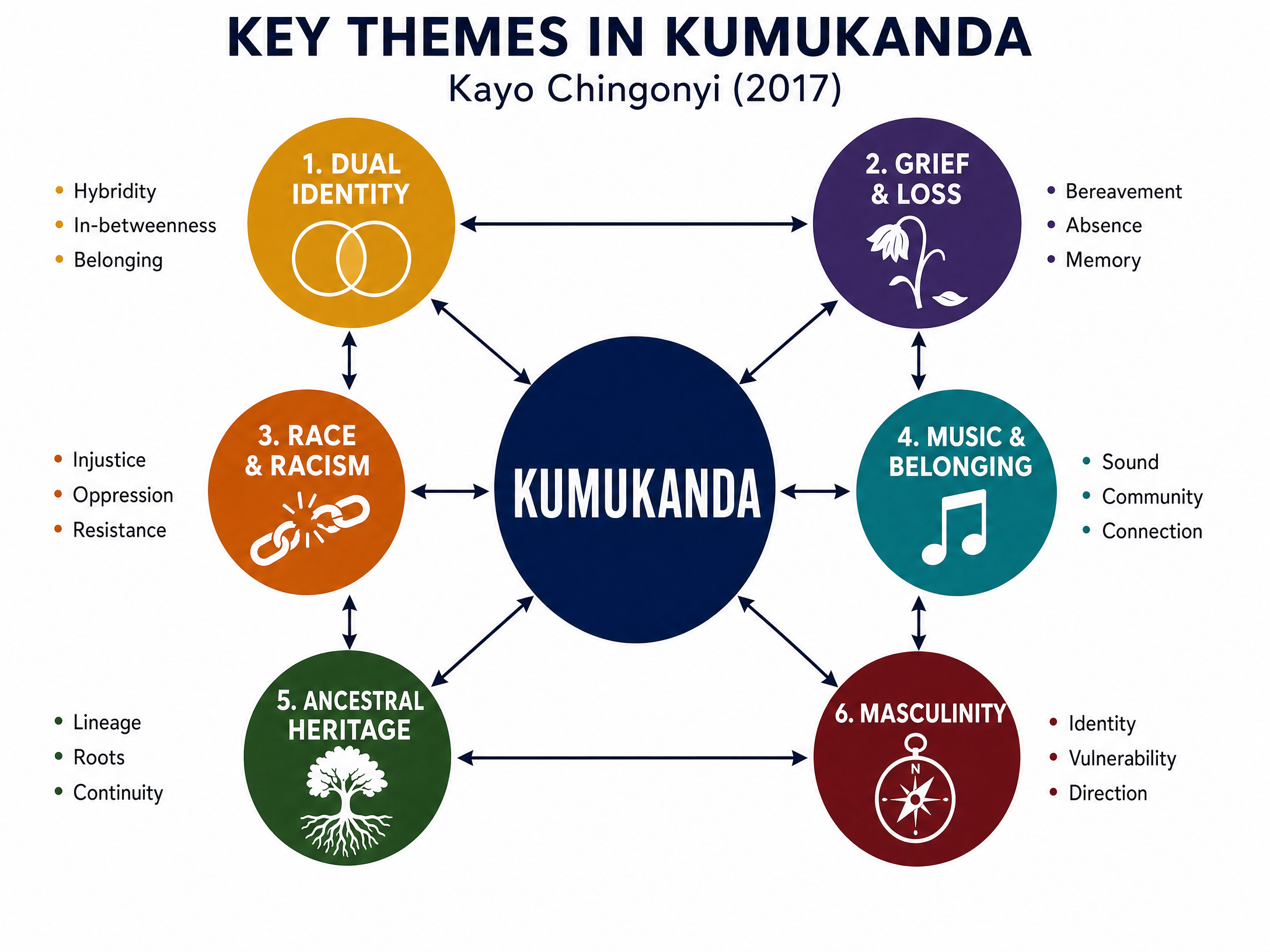
Theme 1: Dual Identity and 'In-betweenness'
The central tension of Kumukanda is the speaker's position between Zambian heritage and British upbringing. Chingonyi articulates the experience of being both and neither—a hybrid identity that cannot be easily categorised. This is often expressed through linguistic tension and geographical imagery.
Key Quotes:
- "I exist in the world as someone who both is and is not British." (Author's Note) - Establishes the foundational paradox of the collection.
- "Would he be strange to me as I to him" (Kumukanda) - Highlights the linguistic and cultural barrier between the speaker and his imagined ancestral self.
- "some words in this argot catch in the throat, seemingly made for someone else" - Demonstrates how language itself becomes a site of alienation and non-belonging.
Theme 2: Music as Community and Language
In the absence of his original culture, the speaker finds a surrogate initiation and community through music—specifically garage, grime, and hip-hop. Music functions not just as a theme but as a structural principle, influencing the rhythm and vocabulary of the poems.
Key Quotes:
- "Remember the days before your Walkman was banished to a life in the attic?" (Self-Portrait as a Garage Emcee) - Evokes nostalgia and the physical artifacts of musical discovery.
- "headphones that know Prokofiev as well as Prince Paul" (Casting) - Demonstrates the speaker's complex, multifaceted cultural literacy which defies industry stereotyping.
Theme 3: Race and Institutional Racism
Chingonyi exposes the myth of a 'post-racial' Britain. Through the calling a spade a spade sequence and poems about the acting industry, he documents the persistent, structural nature of racism and the burden of representation placed on Black artists.
Key Quotes:
- "Three years RADA, two years rep and I'm sick / of playing lean dark men who may have guns." (Casting) - A biting critique of the entertainment industry's racial profiling.
- "My agent says I have to use my street voice." (Casting) - Highlights the performative expectations of Blackness demanded by white institutions.
Theme 4: Grief, Loss, and Masculinity
The premature deaths of both parents force the speaker to grow up quickly. The collection interrogates traditional notions of masculinity, offering a more vulnerable alternative where public grief is necessary and valid.
Key Quotes:
- "I'm going to fold, as an overloaded trestle folds, in the middle of Romford Market and bawl" (How To Cry) - A powerful image of uncontrollable, public grief that subverts expectations of stoic masculinity.
- "For all I know death / is like watching a landscape dissolve / through the windows of an overheating / coach" (Orphan Song) - Reimagines death as a mundane but profound transition.
Character Analysis (The Poetic Persona)
The Speaker (Kayo Chingonyi)
Role: The autobiographical voice navigating the journey from a displaced six-year-old to an adult poet.
Key Traits: Observant, musically attuned, grieving, intellectually rigorous, culturally hybrid.
Character Arc: Moves from childhood isolation and reliance on cassette tapes for company, through encounters with institutional racism, to a mature, albeit fractured, acceptance of his dual heritage.
Essential Quotes:
- "father / and my father's father and my father's father's father" (Kumukanda)
- "just another brother who could rhyme" (Self-Portrait as a Garage Emcee)
Writer's Methods
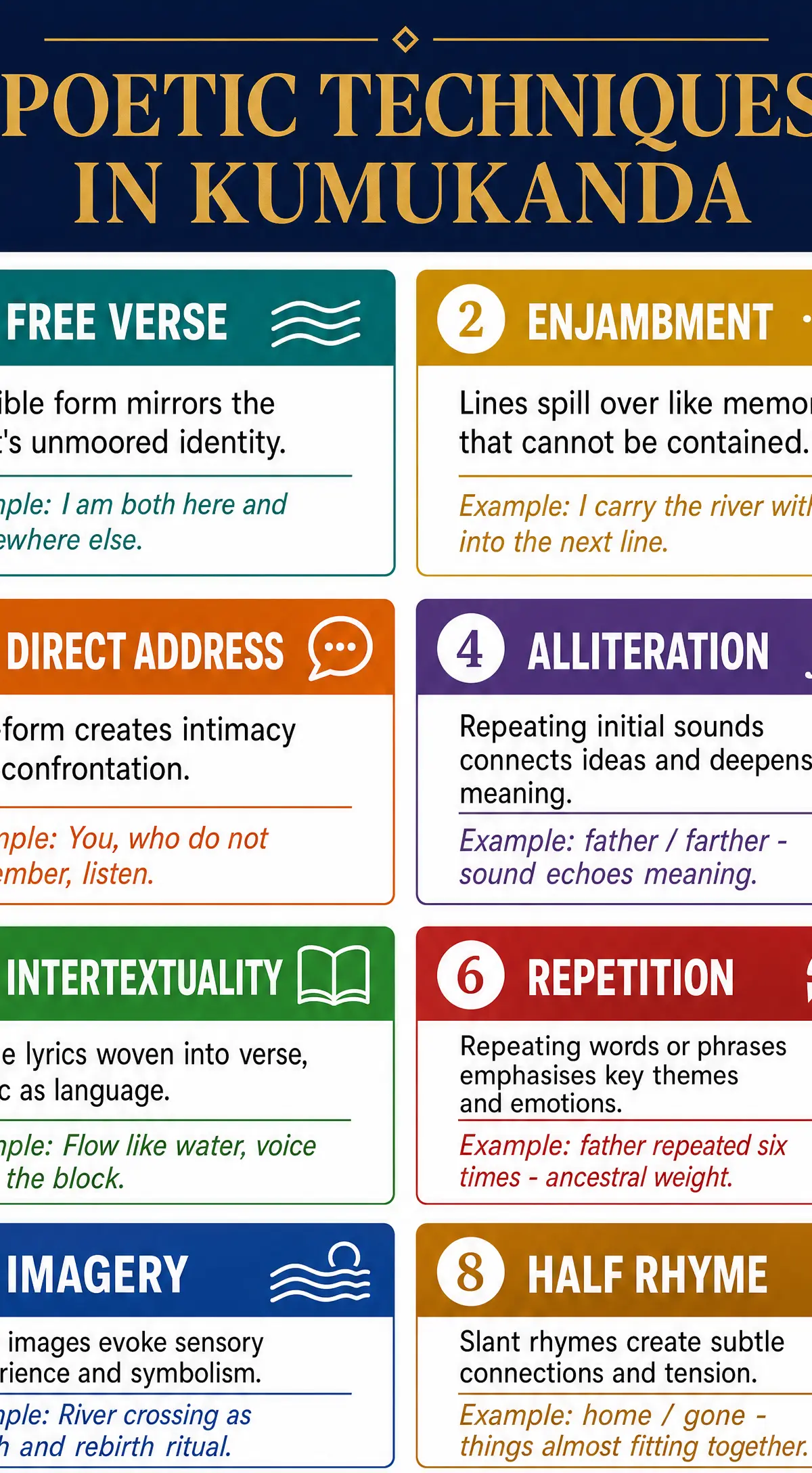
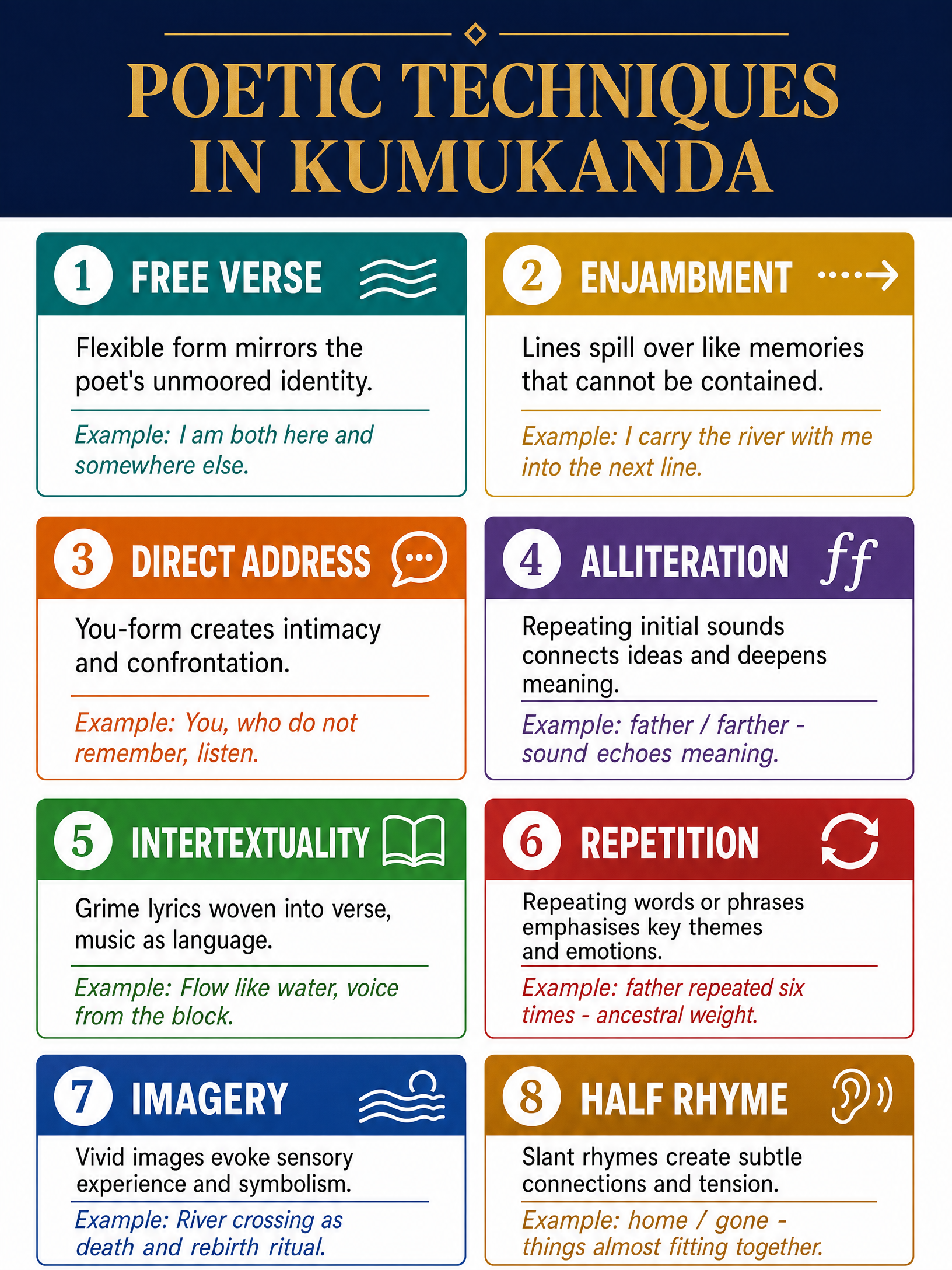
Chingonyi's poetic craft is characterised by a blend of classical literary techniques and contemporary musical influences:
- Free Verse and Enjambment: The frequent use of free verse mirrors the speaker's unmoored identity. Enjambment (lines running over without punctuation) creates a sense of spilling memory and continuous, unresolved thought, particularly effective in poems dealing with grief.
- Sonic Texture (Alliteration and Assonance): Influenced by his background as a DJ and MC, Chingonyi's verse is highly auditory. The repetition of the 'f' sound in the closing lines of Kumukanda ("father", "farther") creates an incantatory effect where sound echoes the meaning of distance and loss.
- Direct Address: The use of the second person ('you') in sequences like calling a spade a spade creates an uncomfortable intimacy, forcing the reader to confront the reality of racial slurs and micro-aggressions.
- Intertextuality: The poems are dense with references to other texts and music—from Lucky Dube and Prince Paul to Pinter and Lowell. This layered referencing enacts the speaker's complex cultural identity.
Context
To access the highest bands (AO3), candidates must integrate context seamlessly:
- Biographical Context: Chingonyi's birth in Zambia (1987), his move to the UK aged six following his father's death, and the loss of his mother at thirteen are central to the collection's exploration of grief and truncated initiation.
- Cultural Context (Luvale Traditions): The Mukanda is a genuine initiation rite for Luvale boys, involving seclusion, circumcision, and education in ancestral ways. The collection's premise rests on the absence of this ritual.
- Social Context (Black British Music): The 1990s and 2000s saw the rise of UK Garage and Grime—genres that provided vital spaces of expression and community for young Black Britons navigating systemic exclusion.
- Post-Colonial Context: The collection responds to the legacy of Empire, exploring how migration fractures identity and how language (English vs. Luvale) operates as a tool of both assimilation and alienation.
Visual Resources
3 diagrams and illustrations
Interactive Diagrams
1 interactive diagram to visualise key concepts
Conceptual Flow Outline
The Bildungsroman Arc of Kumukanda
Worked Examples
1 worked example — open one to explore the question and available guidance.
Practice Questions
Test your understanding — click to reveal model answers
Starting with 'Self-Portrait as a Garage Emcee', explore how Chingonyi presents the importance of music in the collection. (30 marks)
Hint: Consider how music acts as a substitute for lost cultural initiation and provides a sense of community.
How does Chingonyi present the experience of grief and loss in Kumukanda? (30 marks)
Hint: Look beyond just the loss of people to the loss of culture and language. Use 'How To Cry' and 'Orphan Song'.
Explore the significance of the title poem 'Kumukanda' to the collection as a whole. (30 marks)
Hint: Think about what the ritual represents and why its absence is the defining feature of the speaker's identity.
How does Chingonyi use form and structure to convey his themes in the collection? (30 marks)
Hint: Focus on free verse, enjambment, the sequence structure of 'calling a spade...', and the overall bildungsroman arc.