Cambridge International · IGCSE · English Literature
To Kill a Mockingbird
Harper Lee's 'To Kill a Mockingbird' is a profound exploration of racial injustice, moral courage, and the painful transition from childhood innocence to adult awareness. For IGCSE candidates, it offers rich opportunities to analyse complex narrative perspectives, striking symbolism, and powerful social commentary that remains deeply relevant today.
- 9 min read
- 2 worked examples
- 2 practice questions
- 8 key terms
Study Notes
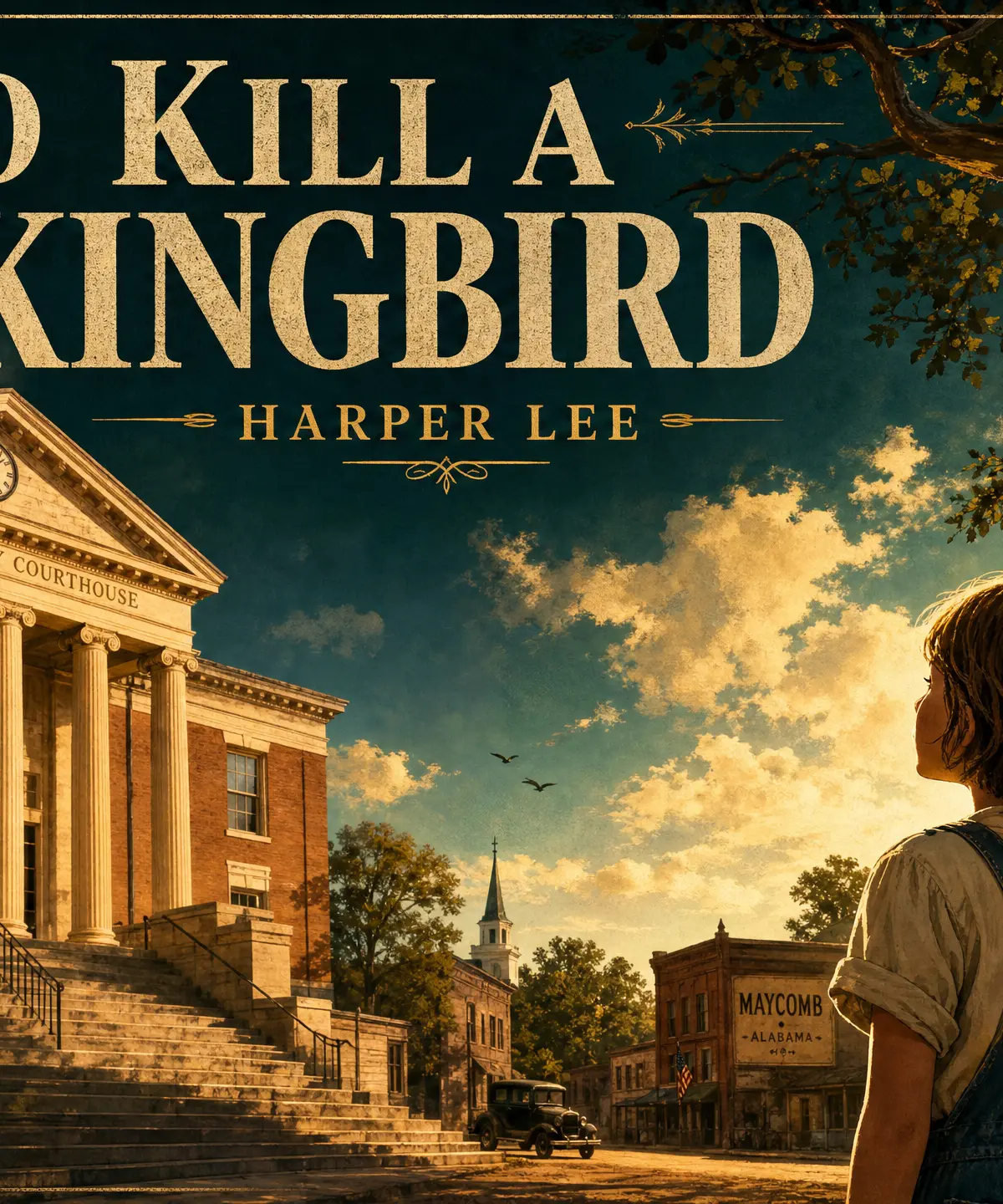
Overview
'To Kill a Mockingbird' is a cornerstone of the Cambridge IGCSE English Literature syllabus, offering a searing critique of prejudice in 1930s America. Examiners reward candidates who can move beyond the plot to analyse how Harper Lee constructs her narrative. The novel's power lies in its dual narrative voice—the innocent child experiencing events, and the wise adult reflecting upon them. This creates a pervasive dramatic irony that candidates must grasp to achieve high marks. Furthermore, a sophisticated understanding of the historical context (the Great Depression, Jim Crow laws, and entrenched Southern racism) is essential, but it must be seamlessly integrated into your analysis of characters and themes, not simply 'bolted on'.
Plot/Content Overview
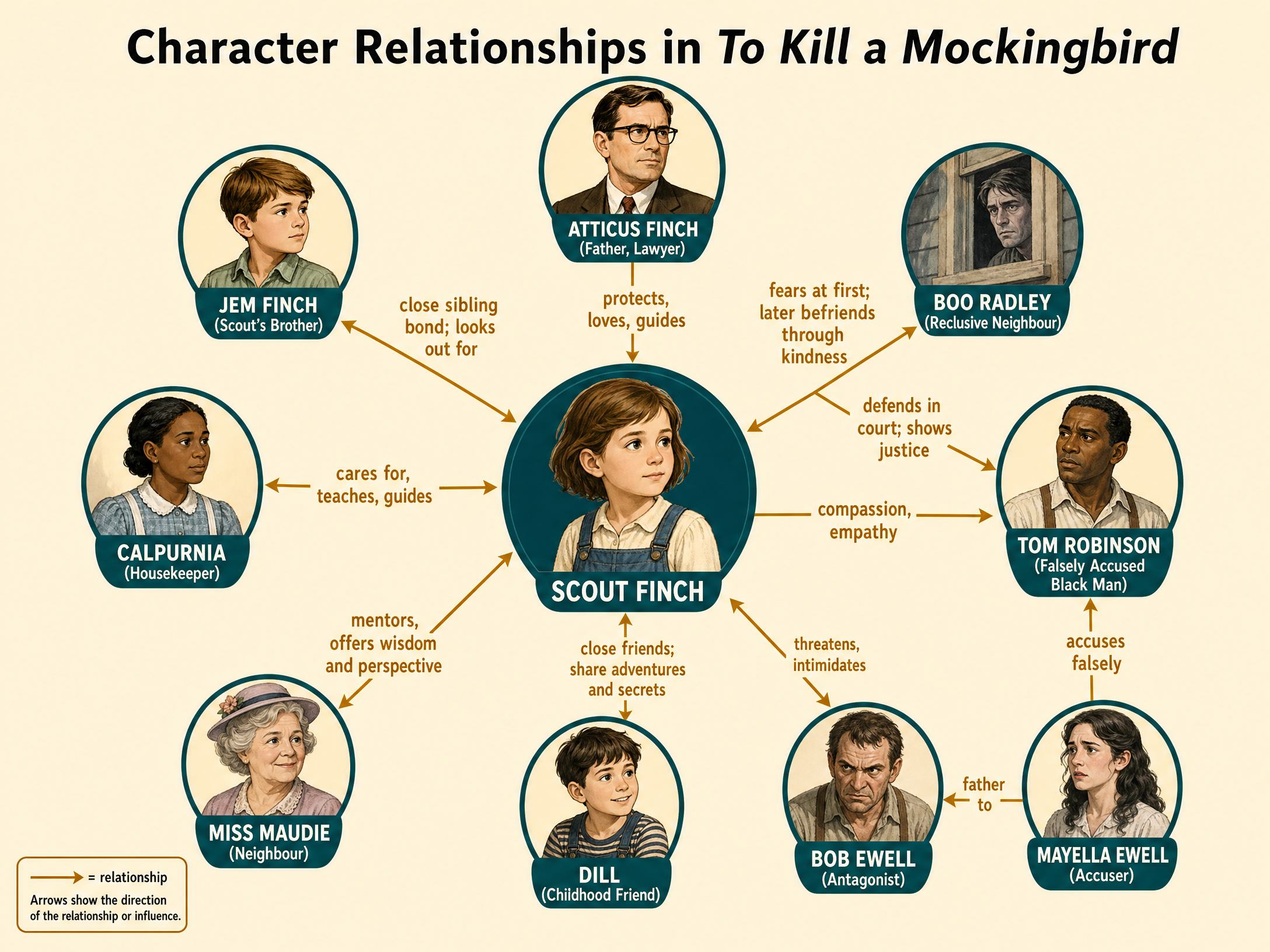
The novel is structured in two distinct but interconnected parts. Part One focuses on the childhood world of Scout, Jem, and Dill as they become fascinated by their reclusive neighbour, Arthur 'Boo' Radley. Their attempts to draw him out highlight their innocent, though sometimes cruel, curiosity. Part Two shifts focus to the adult world of Maycomb as Atticus Finch, the children's father, defends Tom Robinson, a Black man falsely accused of raping a white woman, Mayella Ewell. Despite Atticus destroying the prosecution's case and proving Tom's physical inability to commit the crime, the all-white jury convicts him, exposing the town's deeply ingrained racism. The two plot threads converge in the climax when Bob Ewell, seeking revenge against Atticus, attacks the children, only for them to be saved by Boo Radley. Scout finally understands Atticus's lesson about empathy as she stands on the Radley porch, seeing the world from Boo's perspective.
Themes
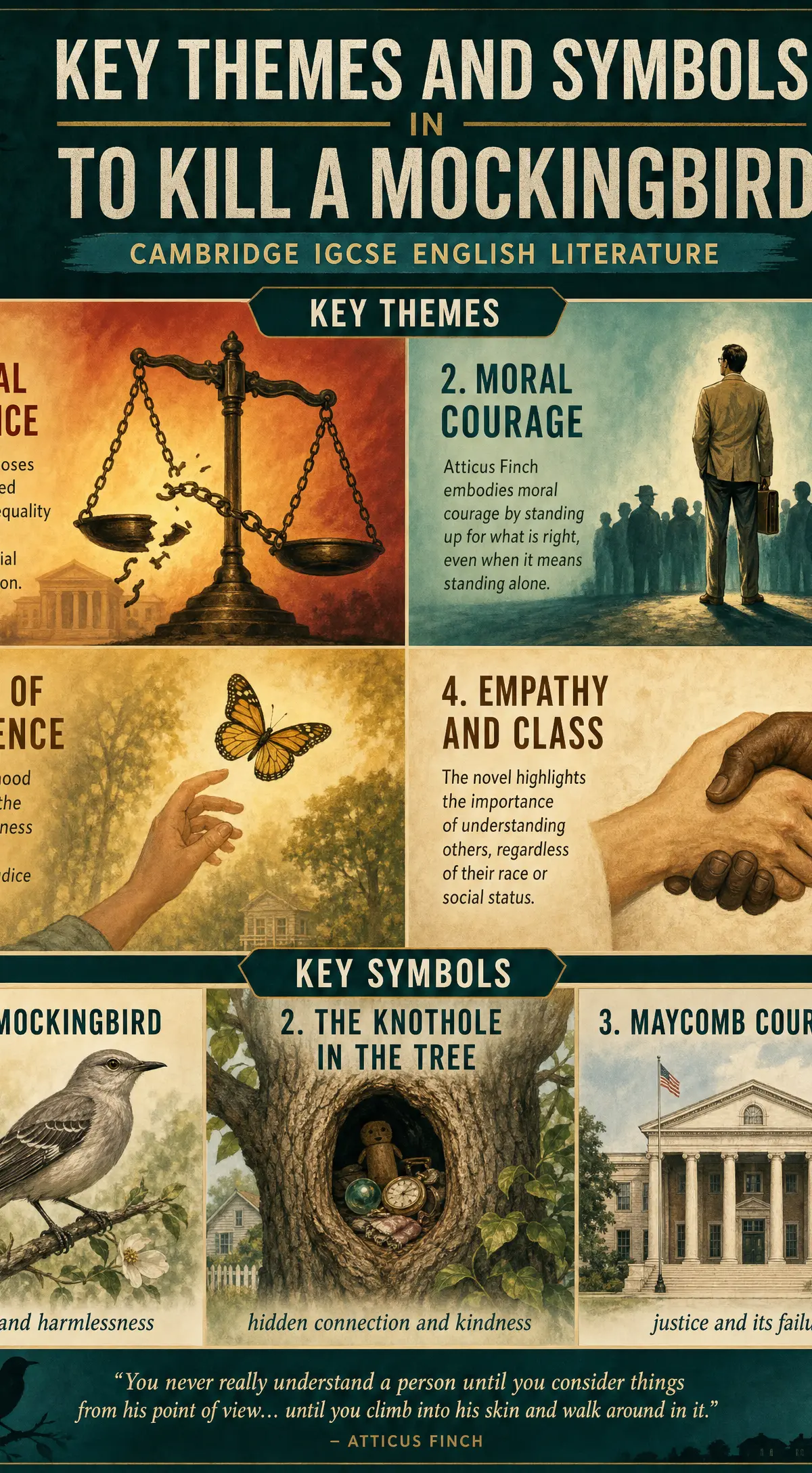
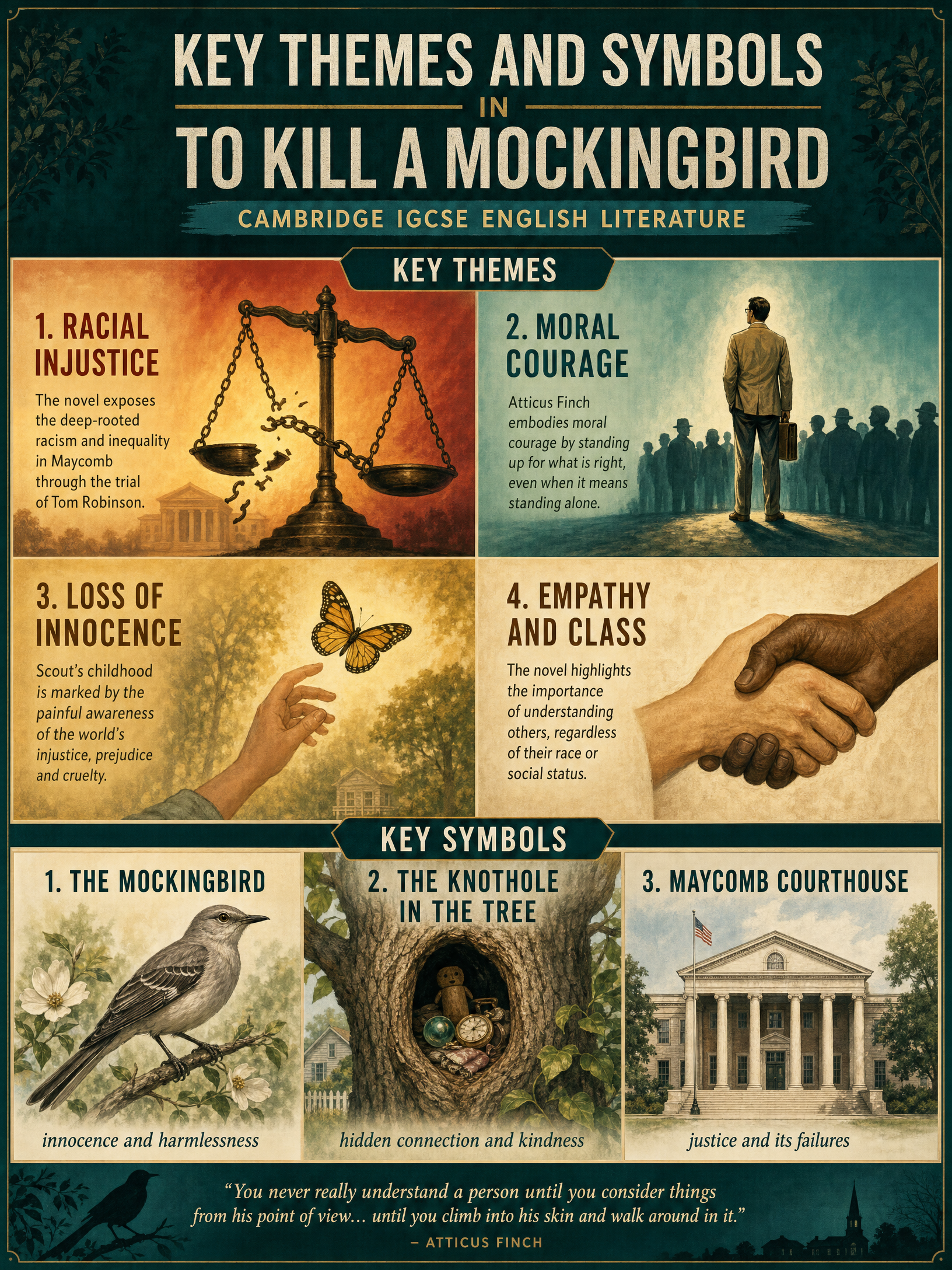
Theme 1: Racial Injustice and Prejudice
Harper Lee exposes the systemic racism of 1930s Alabama through the trial of Tom Robinson. The courtroom, ostensibly a place of objective truth, is corrupted by societal prejudice. Lee demonstrates how deeply ingrained these attitudes are; they are not just the domain of the overtly malicious Bob Ewell, but infect the 'ordinary' citizens of Maycomb who make up the jury.
Key Quotes:
- "The one place where a man ought to get a square deal is in a courtroom, be he any colour of the rainbow, but people have a way of carrying their resentments right into a jury box." (Chapter 23) - Atticus articulates the central tragedy of the novel: the failure of the legal system due to human prejudice.
- "Tom was a dead man the minute Mayella Ewell opened her mouth and screamed." (Chapter 25) - Scout's retrospective narration highlights the inevitability of the verdict, emphasising the inescapable nature of racial injustice in Maycomb.
Theme 2: Moral Courage
Courage in the novel is redefined by Atticus Finch. It is not the physical bravery of a man with a gun, but the moral fortitude to stand up for what is right, even when defeat is certain. Lee contrasts Atticus's quiet, principled stand with the cowardice of the lynch mob and the jury.
Key Quotes:
- "I wanted you to see what real courage is, instead of getting the idea that courage is a man with a gun in his hand. It's when you know you're licked before you begin but you begin anyway and you see it through no matter what." (Chapter 11) - Atticus uses Mrs Dubose's battle with addiction to teach Jem about true bravery, foreshadowing his own stance in the trial.
- "Before I can live with other folks I've got to live with myself. The one thing that doesn't abide by majority rule is a person's conscience." (Chapter 11) - Atticus explains his motivation for taking the case, elevating individual moral responsibility above societal consensus.
Theme 3: Loss of Innocence and the Mockingbird Symbol
The novel traces the painful transition from childhood innocence to adult experience. Scout and Jem are forced to confront the cruelty and unfairness of the adult world. The mockingbird serves as the central symbol for this theme, representing innocent beings who are destroyed by society.
Key Quotes:
- "Mockingbirds don't do one thing but make music for us to enjoy... they don't do one thing but sing their hearts out for us. That's why it's a sin to kill a mockingbird." (Chapter 10) - Miss Maudie explicitly defines the symbol. Tom Robinson and Boo Radley are the novel's primary 'mockingbirds'.
- "It was like watching Atticus walk into the street, raise a rifle to his shoulder and pull the trigger, but watching all the time knowing that the gun was empty." (Chapter 21) - Scout describes the moment the verdict is read, capturing the devastating realization of the jury's injustice and the end of her childhood illusion that right always prevails.
Theme 4: Empathy and Understanding
The antidote to the prejudice of Maycomb is empathy. Atticus teaches his children that true understanding only comes from adopting another person's perspective. This theme culminates in the final chapter when Scout stands on the Radley porch.
Key Quotes:
- "You never really understand a person until you consider things from his point of view... until you climb into his skin and walk around in it." (Chapter 3) - This is the philosophical core of the novel, introduced early and realised fully at the end.
- "Atticus was right. One time he said you never really know a man until you stand in his shoes and walk around in them. Just standing on the Radley porch was enough." (Chapter 31) - Scout demonstrates that she has internalised Atticus's lesson, showing her moral growth.
Character Analysis
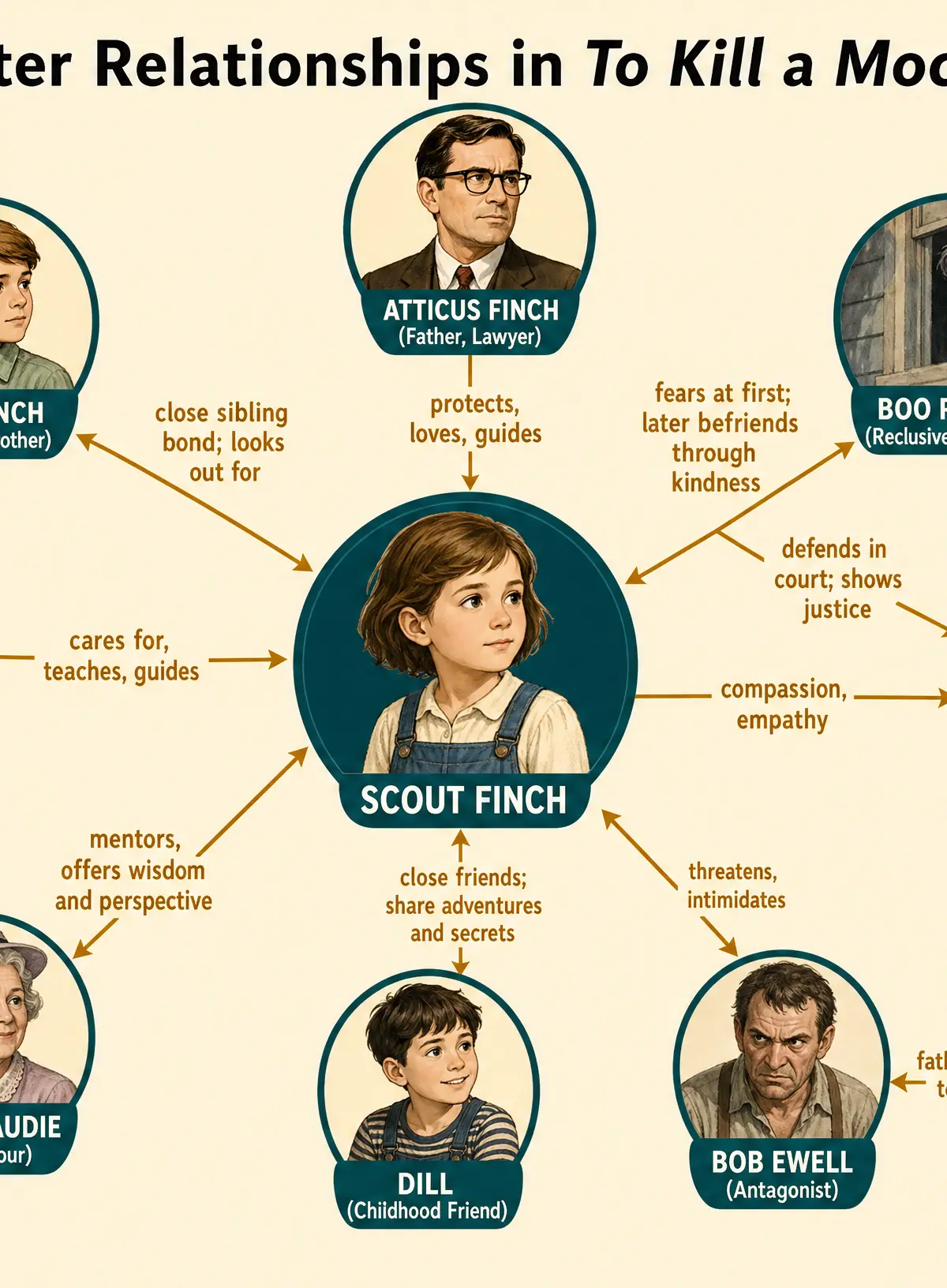
Scout (Jean Louise) Finch
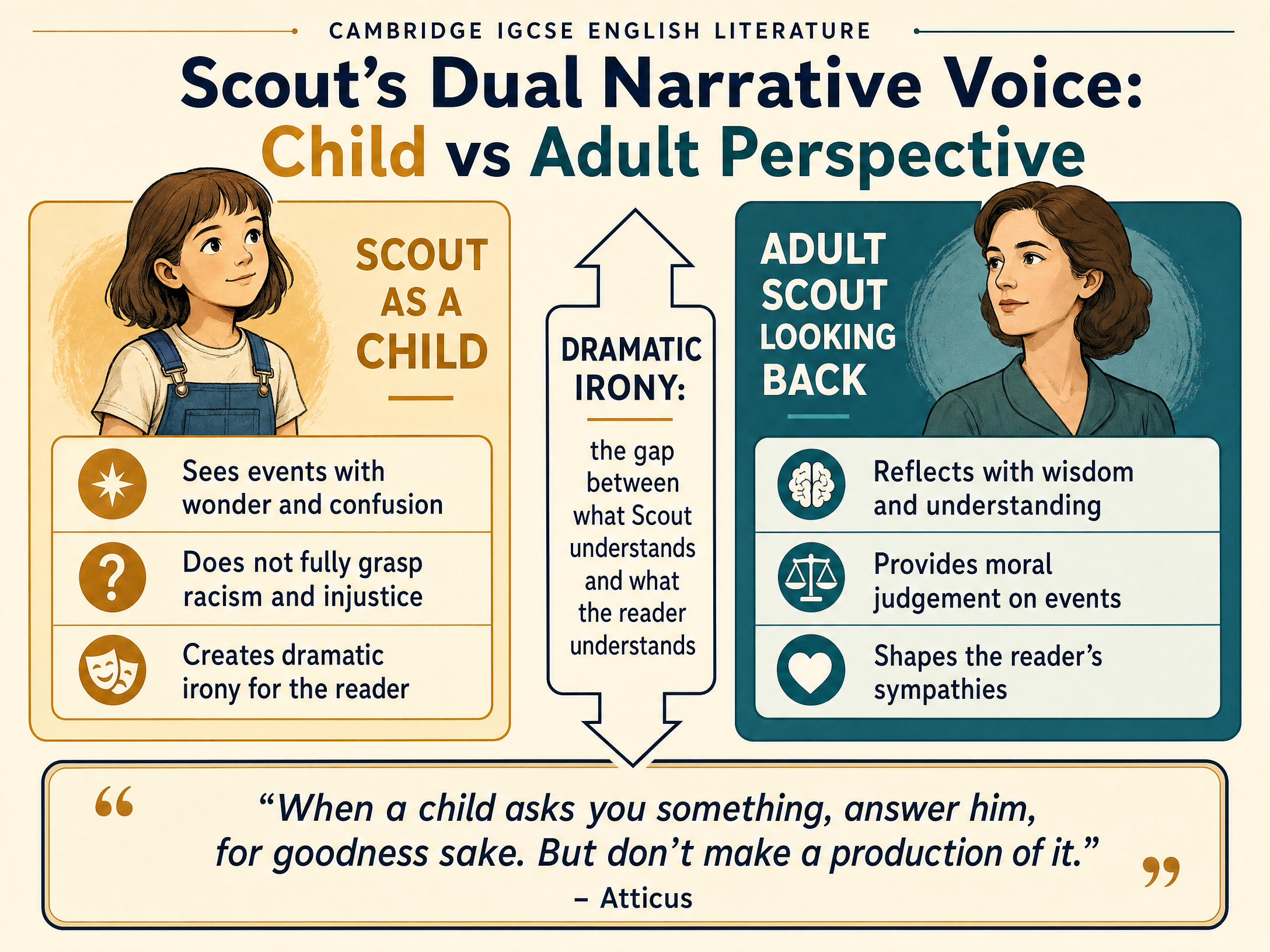
Role: The narrator and protagonist, providing both a naive child's perspective and an adult's retrospective wisdom.
Key Traits: Tomboyish, inquisitive, fiercely loyal, hot-tempered but capable of deep empathy.
Character Arc: Scout moves from a combative child who resolves disputes with her fists to a young woman who understands the complexities of human nature and the necessity of empathy, culminating in her gentle treatment of Boo Radley.
Essential Quotes:
- "I think there's just one kind of folks. Folks." (Chapter 23)
- "Well, it'd be sort of like shootin' a mockingbird, wouldn't it?" (Chapter 30)
Atticus Finch
Role: The moral centre of the novel, Scout and Jem's father, and Tom Robinson's defence attorney.
Key Traits: Principled, calm, egalitarian, courageous, and deeply committed to justice.
Character Arc: Atticus does not fundamentally change; rather, he is the steadfast anchor against which the town's prejudice and his children's growth are measured. His challenge is maintaining his integrity while guiding his children through the town's hostility.
Essential Quotes:
- "You never really understand a person until you consider things from his point of view..." (Chapter 3)
- "In our courts, when it's a white man's word against a black man's, the white man always wins. They're ugly, but those are the facts of life." (Chapter 23)
Arthur 'Boo' Radley
Role: The mysterious neighbour who functions as a literal 'mockingbird' and a catalyst for the children's moral development.
Key Traits: Reclusive, gentle, misunderstood, protective.
Character Arc: Boo transitions from a terrifying gothic phantom in the children's imaginations to a tangible, vulnerable human being who demonstrates profound kindness and ultimately saves their lives.
Essential Quotes:
- "Inside the house lived a malevolent phantom." (Chapter 1 - Scout's early perception)
- "Will you take me home?" (Chapter 31 - Boo's only spoken words, revealing his childlike vulnerability)
Writer's Methods
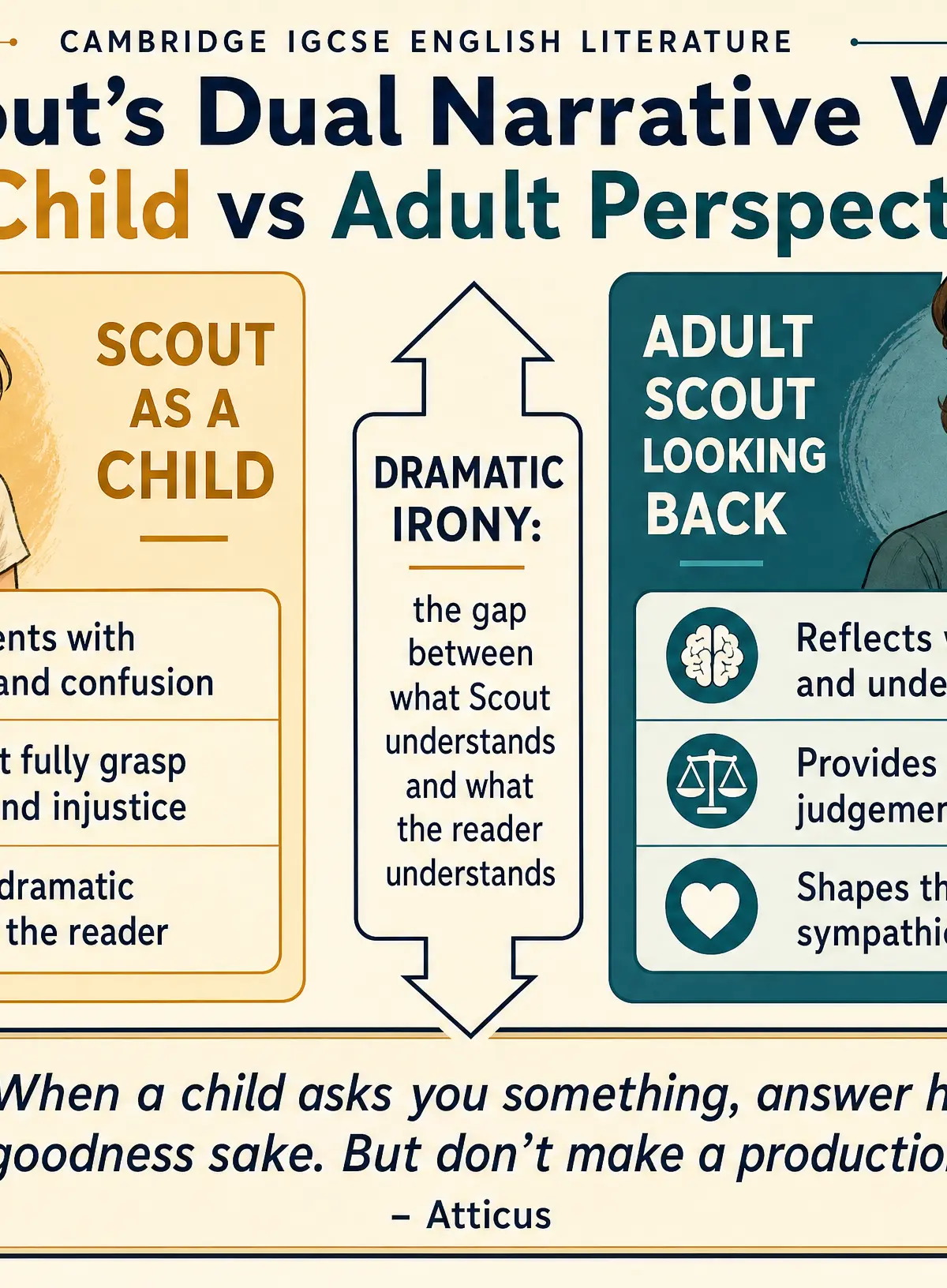
Dual Narrative Voice: Lee's most significant structural choice is the use of an adult narrator looking back at her childhood. This creates dramatic irony. The reader often understands the dark reality of situations (like the lynch mob outside the jail) that the child Scout perceives merely as a confusing social interaction. Examiners highly reward candidates who distinguish between the experiencing child and the reflecting adult.
Symbolism: The mockingbird is the central motif, representing innocence destroyed by evil. Lee also uses the mad dog (Tim Johnson) to symbolise the 'disease' of racism in Maycomb, which Atticus must confront alone.
Structure: The two-part structure mirrors the thematic shift from childhood innocence (the focus on Boo Radley) to adult experience (the trial of Tom Robinson). The climax masterfully weaves these two threads together when Boo intervenes in the adult world's violence to save the children.
Setting as Microcosm: Maycomb is described as a "tired old town." It functions as a microcosm of the American South in the 1930s, allowing Lee to explore national issues of race, class, and gender within a contained, familiar environment.
Context
To achieve high marks for AO3, candidates must integrate contextual understanding into their analysis. The novel is set in the 1930s during the Great Depression, a time of severe economic hardship that exacerbated social and racial tensions (seen in the extreme poverty of the Ewells and Cunninghams). More importantly, it is set in the era of Jim Crow laws, which enforced strict racial segregation in the Southern states. The legal system was inherently biased against Black Americans, making Tom Robinson's conviction a tragic inevitability rather than a surprise. The novel was published in 1960, during the height of the American Civil Rights Movement, making it a timely and potent commentary on the ongoing struggle for racial equality.

Worked Examples
2 worked examples — open one to explore the question and available guidance.
Practice Questions
Test your understanding — click to reveal model answers
Explore how Harper Lee presents the theme of social class and inequality in To Kill a Mockingbird. (30 marks)
Hint: Don't just focus on race. Consider the hierarchy among the white characters: the Finches, the Cunninghams, and the Ewells. How does Aunt Alexandra's view of class differ from Atticus's?
How does Harper Lee use the character of Bob Ewell to explore the dark side of Maycomb society? (30 marks)
Hint: Consider Bob Ewell not just as an individual villain, but as a symptom of the town's wider disease. How does his racism serve his own fragile ego?