Pearson Edexcel · GCSE · English Literature
19th-Century Novel (choice of: Jane Eyre, Great Expectations, Dr Jekyll and Mr Hyde, A Christmas Carol, Pride and Prejudice, Silas Marner, Frankenstein)
Master the 19th-Century Novel for Component 2, Section A with this comprehensive, multi-modal study guide. Explore how writers like Dickens, Stevenson, and Shelley used their characters to challenge Victorian society, and learn the exact exam techniques needed to secure top marks.
- 6 min read
- 1 worked example
- 2 practice questions
- 8 key terms
Study Notes
Overview
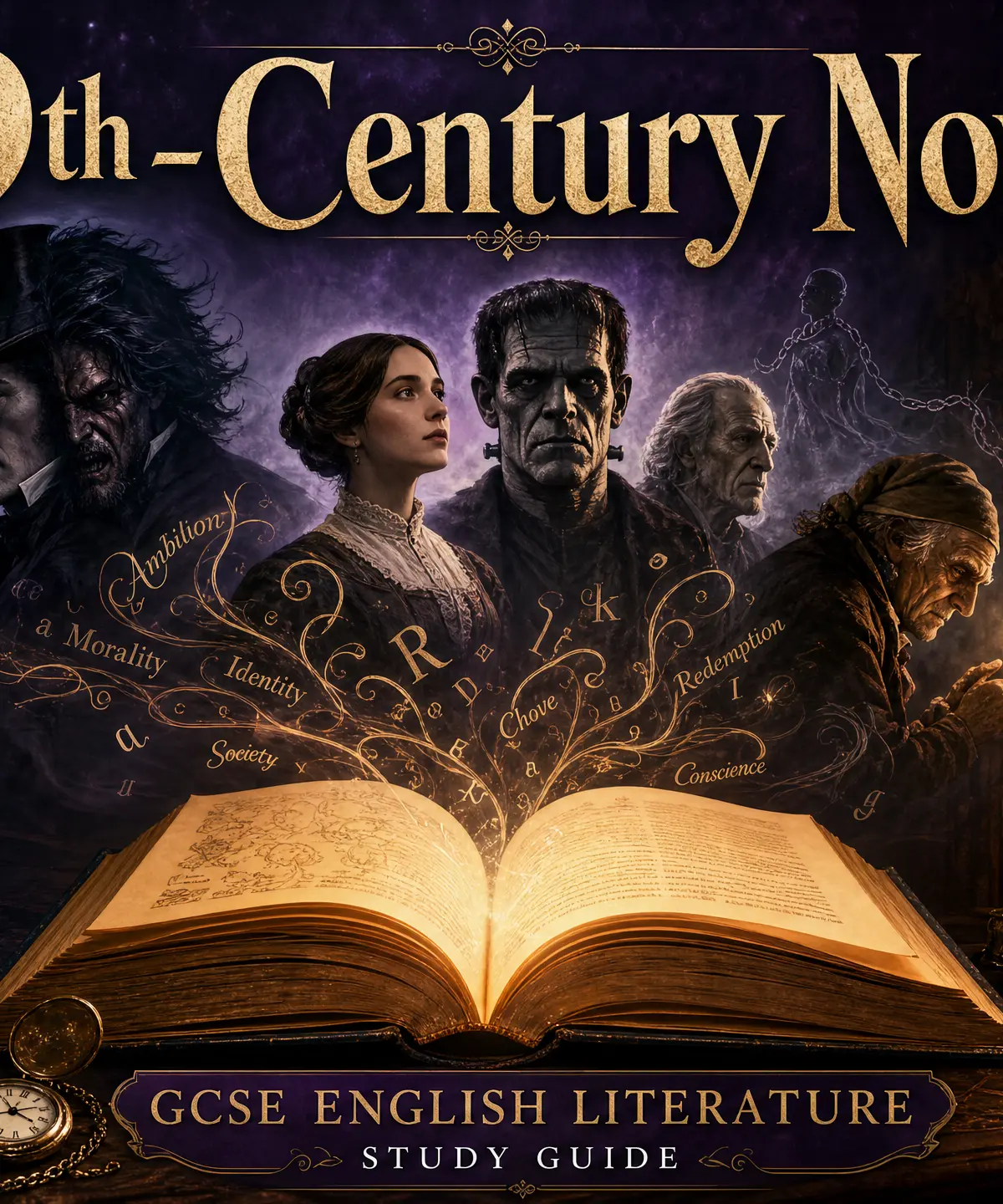
The 19th-Century Novel component requires candidates to demonstrate a profound understanding of how Victorian writers used fiction to explore the anxieties, inequalities, and moral questions of their era. Whether you are studying A Christmas Carol, Dr Jekyll and Mr Hyde, Frankenstein, Great Expectations, or Jane Eyre, examiners are looking for the same core skills: the ability to construct a conceptualised argument, seamlessly integrate historical context (AO3), and perceptively analyse the writer's methods (AO2).
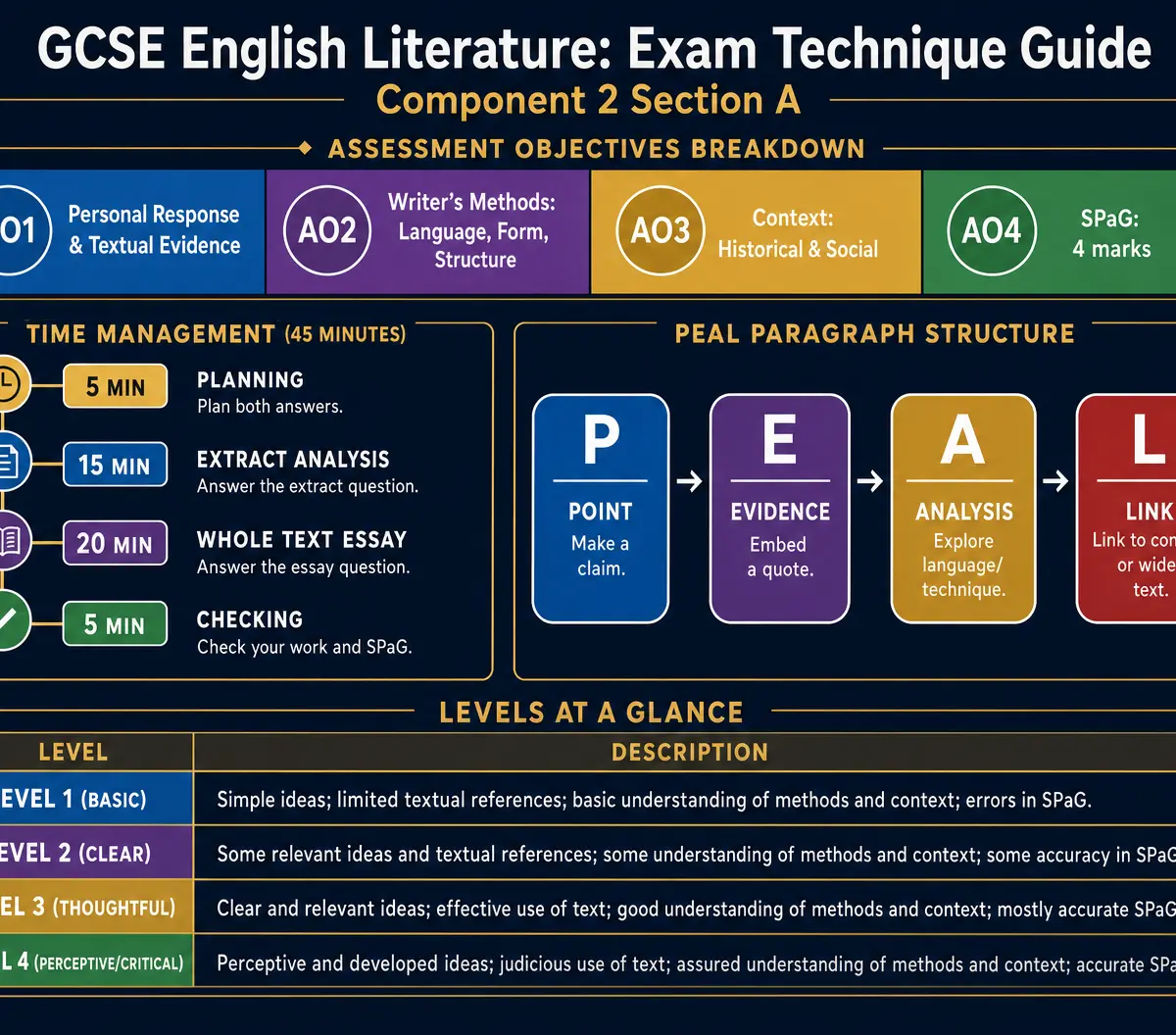
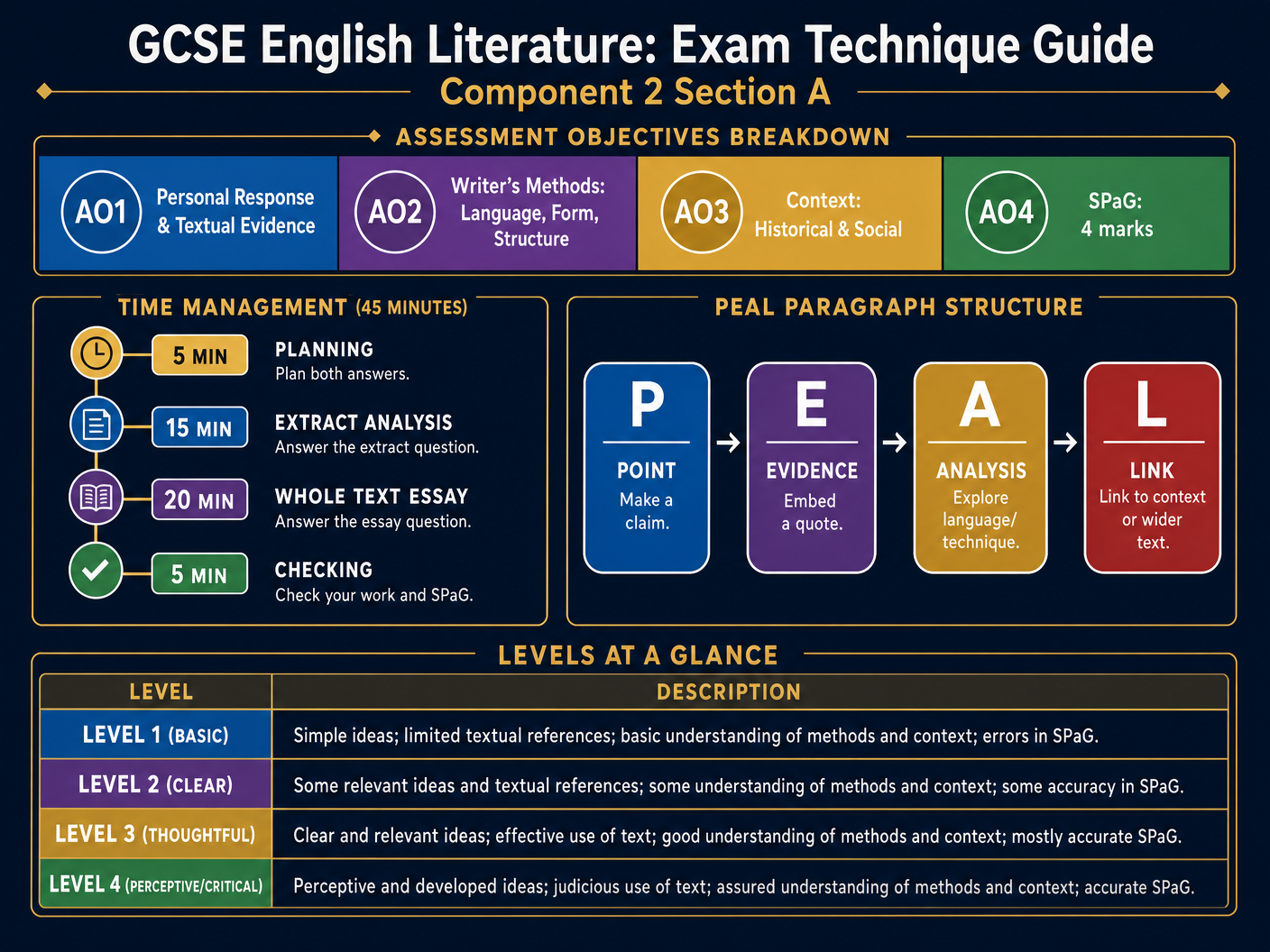
This guide provides a comprehensive framework for tackling the two-part exam structure. You must master both close language analysis for the extract question and whole-text understanding for the essay.
Listen to our comprehensive audio guide below for a deep dive into themes, context, and examiner expectations:
Core Thematic Framework
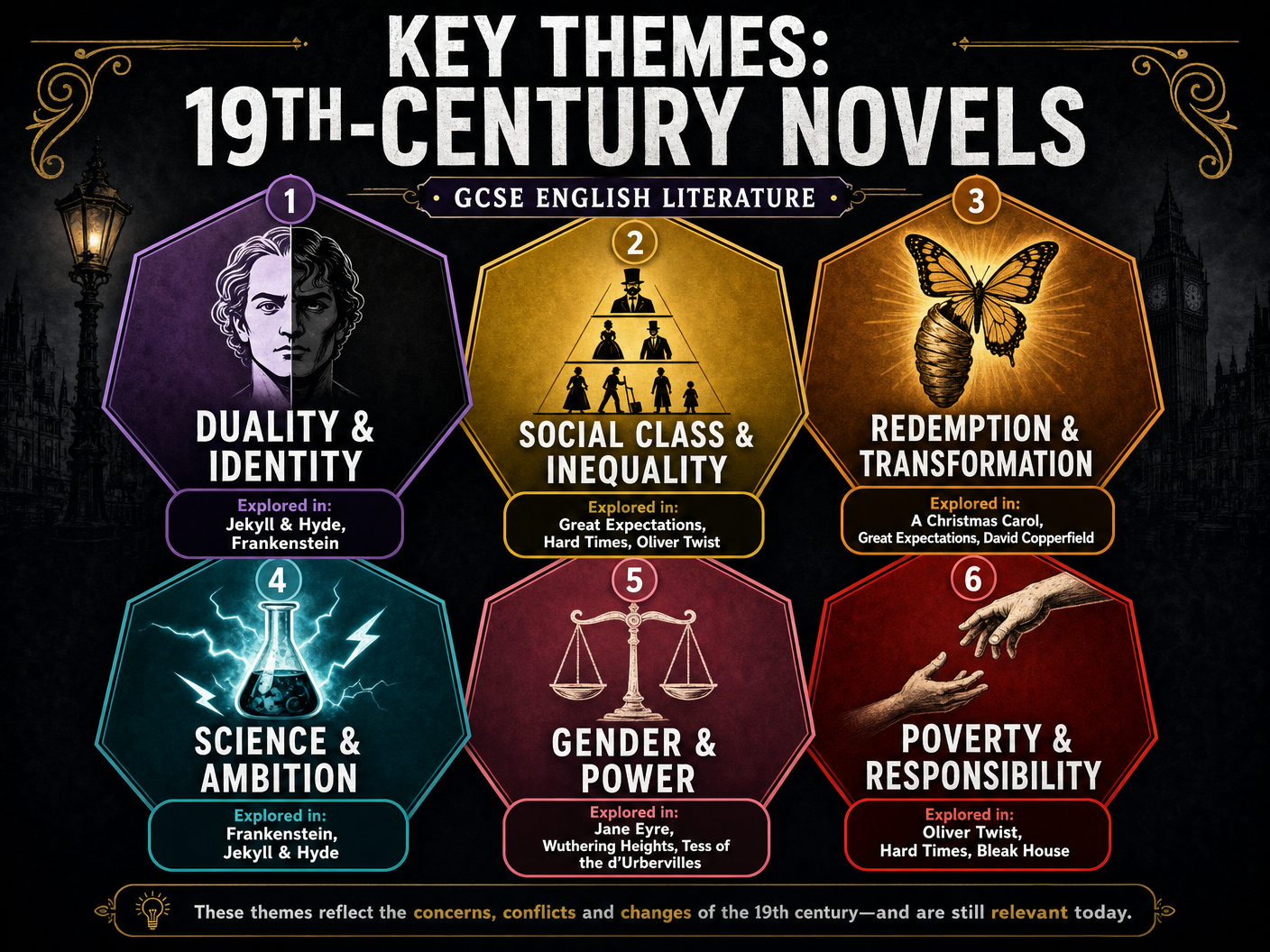
While each novel is unique, they all grapple with the fundamental tensions of the 19th century. Understanding these overarching themes will allow you to make sophisticated, synoptic links in your essays.
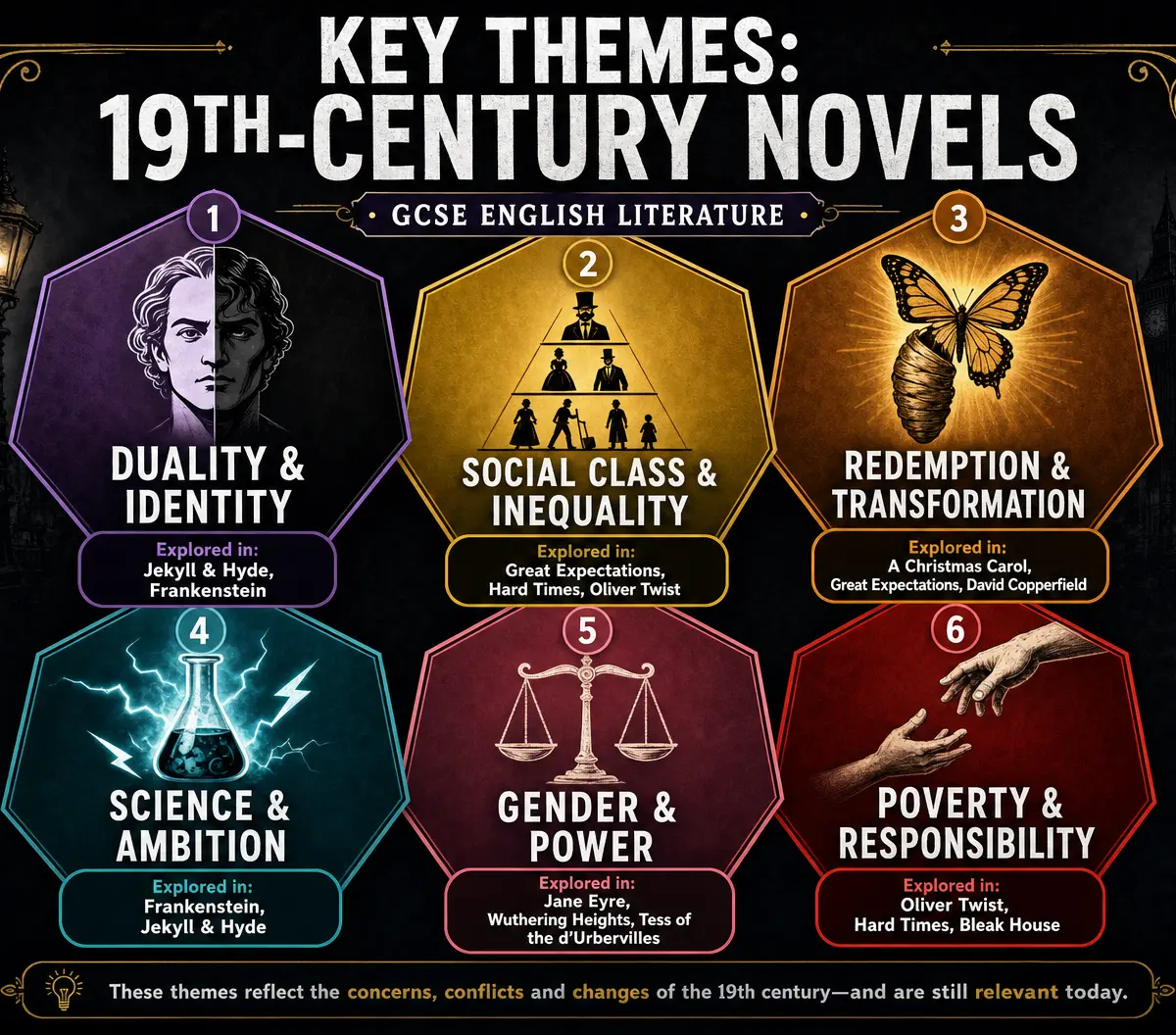
Theme 1: Duality and Identity
The Victorian era was characterised by strict social codes of respectability, which often masked darker realities. Writers explored the tension between the public face and the private self.
In Dr Jekyll and Mr Hyde: Stevenson literalises this conflict. Jekyll's desire to separate his moral and immoral sides reflects Victorian anxieties about evolution and the "beast within."
In Frankenstein: Shelley creates a psychological doubling between Victor and his Creature. Both are driven by obsessive ambition and both become isolated from society.
Key Quotes:
- "Man is not truly one, but truly two" (Jekyll and Hyde, Chapter 10) - Jekyll's realisation is the thesis statement of the novel. The repetition of "truly" emphasises the inescapable nature of this division.
- "I was benevolent and good; misery made me a fiend" (Frankenstein, Vol 2, Ch 2) - The Creature highlights how identity is shaped by society, reflecting Rousseau's idea of the 'noble savage' corrupted by civilisation.
Theme 2: Social Class and Inequality
The Industrial Revolution created unprecedented wealth but also devastating poverty. Writers used their novels as vehicles for social critique.
In A Christmas Carol: Dickens directly challenges the Malthusian view that the poor are a "surplus population." He forces his middle-class readers to confront the human cost of their indifference.
In Great Expectations: Dickens critiques the rigid class system by showing how Pip's pursuit of gentility corrupts his natural goodness.
Key Quotes:
- "Are there no prisons? ... Are there no workhouses?" (A Christmas Carol, Stave 1) - Scrooge's rhetorical questions echo the harsh utilitarian philosophy of the 1834 Poor Law.
- "I am what you have made me" (Great Expectations, Chapter 38) - Estella's coldness is a direct product of Miss Havisham's aristocratic manipulation, showing how the upper classes damage the young.
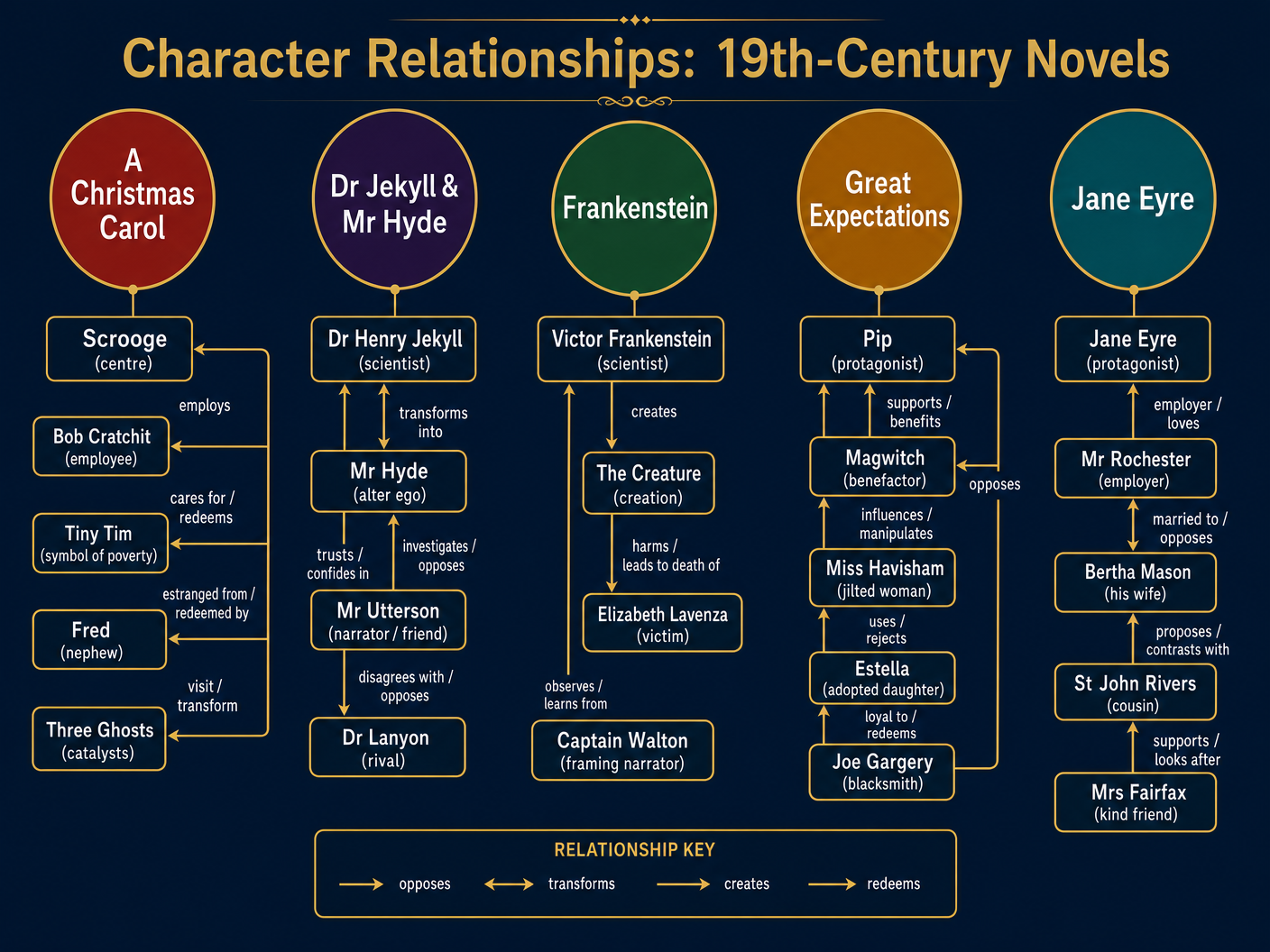
Character Relationships and Arcs
Characters in 19th-century novels rarely exist in isolation; they are defined by their relationships and their transformations.
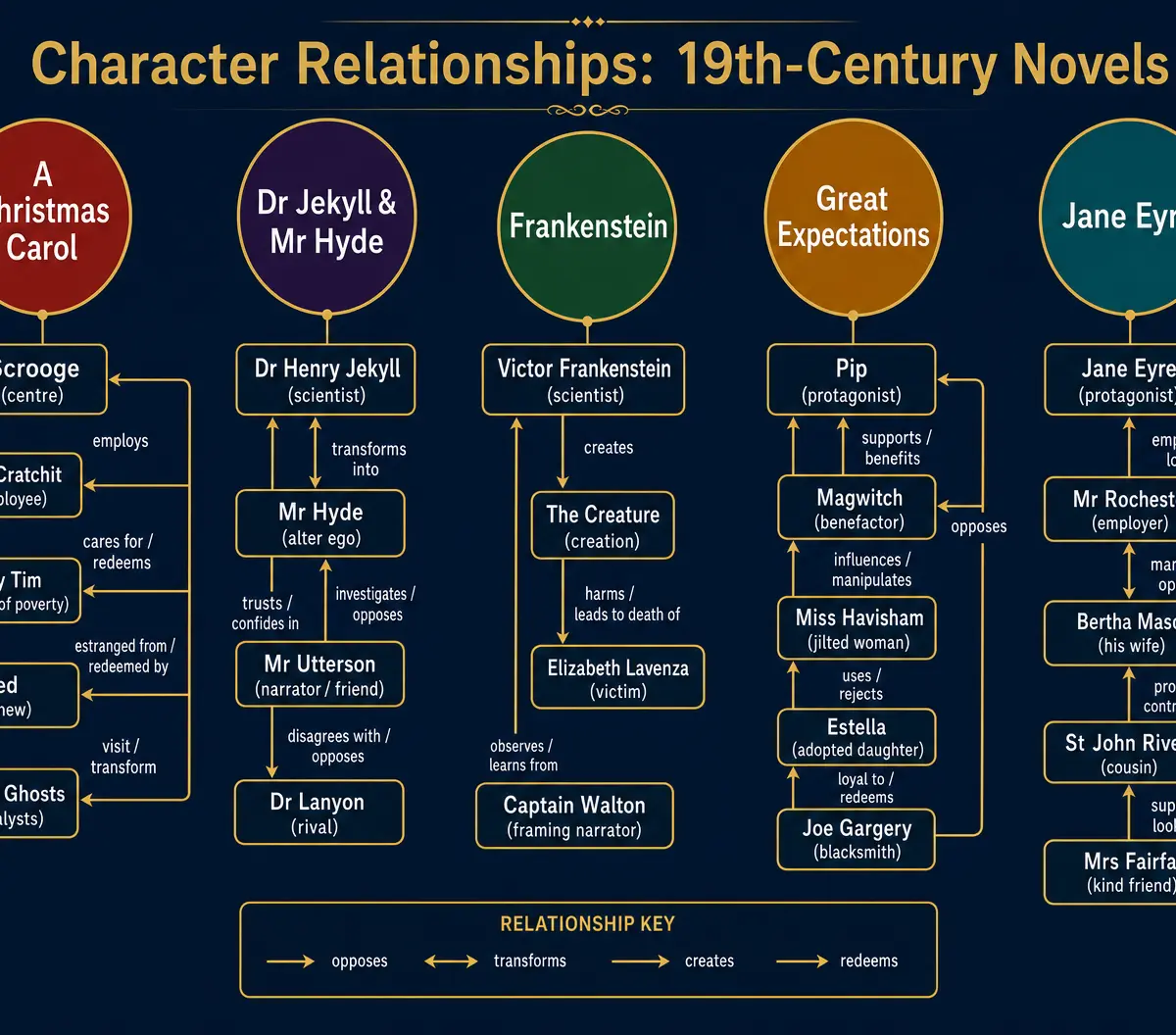
The Protagonist's Journey
Examiners frequently set questions on how a character develops. You must track their arc from the beginning, through the climax, to the resolution.
Scrooge (A Christmas Carol):
- Role: The miser who must learn social responsibility.
- Key Traits: Misanthropic, avaricious, isolated.
- Character Arc: Moves from spiritual death ("solitary as an oyster") to spiritual rebirth ("as light as a feather").
- Essential Quotes: "Hard and sharp as flint" (Stave 1); "I will honour Christmas in my heart" (Stave 4).
Jane Eyre (Jane Eyre):
- Role: The independent heroine challenging patriarchal norms.
- Key Traits: Passionate, principled, fiercely independent.
- Character Arc: Moves from oppressed orphan to an equal partner who asserts her own agency.
- Essential Quotes: "I am no bird; and no net ensnares me" (Vol 2, Ch 8); "Reader, I married him" (Vol 3, Ch 12).
Writer's Methods (AO2)
To achieve Level 5/6, you must move beyond "feature spotting" and analyse how methods create meaning.
Narrative Structure: Consider who is telling the story. Frankenstein uses a complex framed narrative (epistolary form) which creates distance and questions reliability. Jekyll and Hyde uses multiple perspectives (Utterson, Lanyon, Jekyll) to build mystery and reflect the fragmented nature of truth.
Setting and Pathetic Fallacy: Victorian writers use setting symbolically. The dense, suffocating fog in A Christmas Carol and Jekyll and Hyde represents moral blindness and secrecy. The wild, sublime landscapes in Frankenstein and Jane Eyre reflect the characters' turbulent internal states.
Context (AO3): The Victorian Worldview
Examiners reward context that is integrated into your analysis of the text.
- Religion vs. Science: Darwin's On the Origin of Species (1859) challenged biblical creation. Novels like Jekyll and Hyde reflect the fear of scientific overreach and the possibility of human degeneration.
- The "Woman Question": The Victorian ideal of the "Angel in the House" expected women to be submissive and domestic. Jane Eyre radically challenges this by giving its heroine a passionate, demanding voice.
Visual Resources
3 diagrams and illustrations
Interactive Diagrams
2 interactive diagrams to visualise key concepts
Conceptual Flow Outline
Scrooge's Arc of Redemption in A Christmas Carol
Conceptual Flow Outline
The Cycle of Duality in Dr Jekyll and Mr Hyde
Worked Examples
1 worked example — open one to explore the question and available guidance.
Practice Questions
Test your understanding — click to reveal model answers
Starting with this extract, explore how the writer presents the dangers of ambition. Write about:
- how ambition is presented in this extract
- how the dangers of ambition are presented in the novel as a whole.
Hint: Consider the difference between positive ambition (desire to improve) and hubris (desire to play God or subvert the natural order).
Explore how the writer presents the theme of social class and inequality in the novel.
Hint: Look beyond just the poorest characters. How do the wealthy characters behave, and what is the writer's attitude towards them?
Test your understanding of 19th-Century Novel (choice of: Jane Eyre, Great Expectations, Dr Jekyll and Mr Hyde, A Christmas Carol, Pride and Prejudice, Silas Marner, Frankenstein)
Active recall beats re-reading. Take an instant quiz now to test what you’ve learned and lock it into long-term memory.
7 days Premium · Then free forever · No card, no charge