Pearson Edexcel · GCSE · English Literature
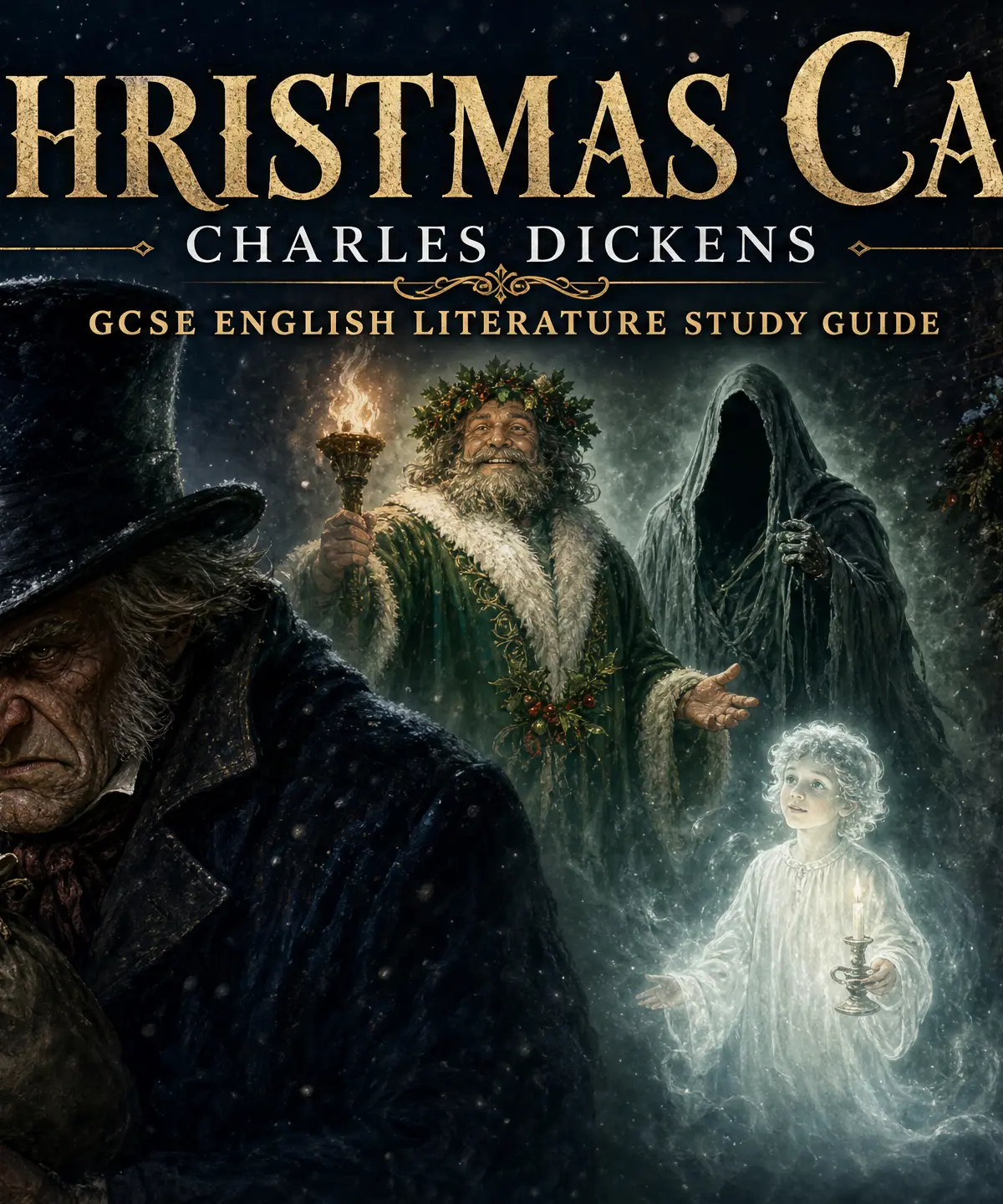
A Christmas Carol
Charles Dickens' 'A Christmas Carol' is a powerful moral fable that uses the supernatural to critique Victorian social inequality. Studying this novella rewards close analysis of Dickens' rich language and understanding of how his narrative structure drives Scrooge's dramatic transformation.
- 8 min read
- 2 worked examples
- 4 practice questions
- 8 key terms
Study Notes
Overview
'A Christmas Carol' is a didactic novella written by Charles Dickens in 1843, functioning as both a ghost story and a political allegory. Dickens wrote the text in response to the appalling conditions of the Victorian poor and the punitive New Poor Law of 1834. For examiners, the key to high marks lies in understanding Scrooge not as a real person, but as an authorial construct—a vehicle through which Dickens critiques the selfish attitudes of the wealthy elite. Candidates are rewarded for exploring how Dickens uses supernatural elements as a catalyst for moral change, and how the novella's five-stave structure deliberately mirrors the verses of a song, designed to be shared and to spread a message of social responsibility.
Plot/Content Overview
Stave 1: Marley's GhostEbenezer Scrooge is introduced as a miserly, cold-hearted money-lender who rejects his nephew Fred's Christmas invitation and refuses to donate to charity. On Christmas Eve, he is visited by the ghost of his former partner, Jacob Marley, who is condemned to wander the earth in heavy chains forged by his greed. Marley warns Scrooge that three spirits will visit him.
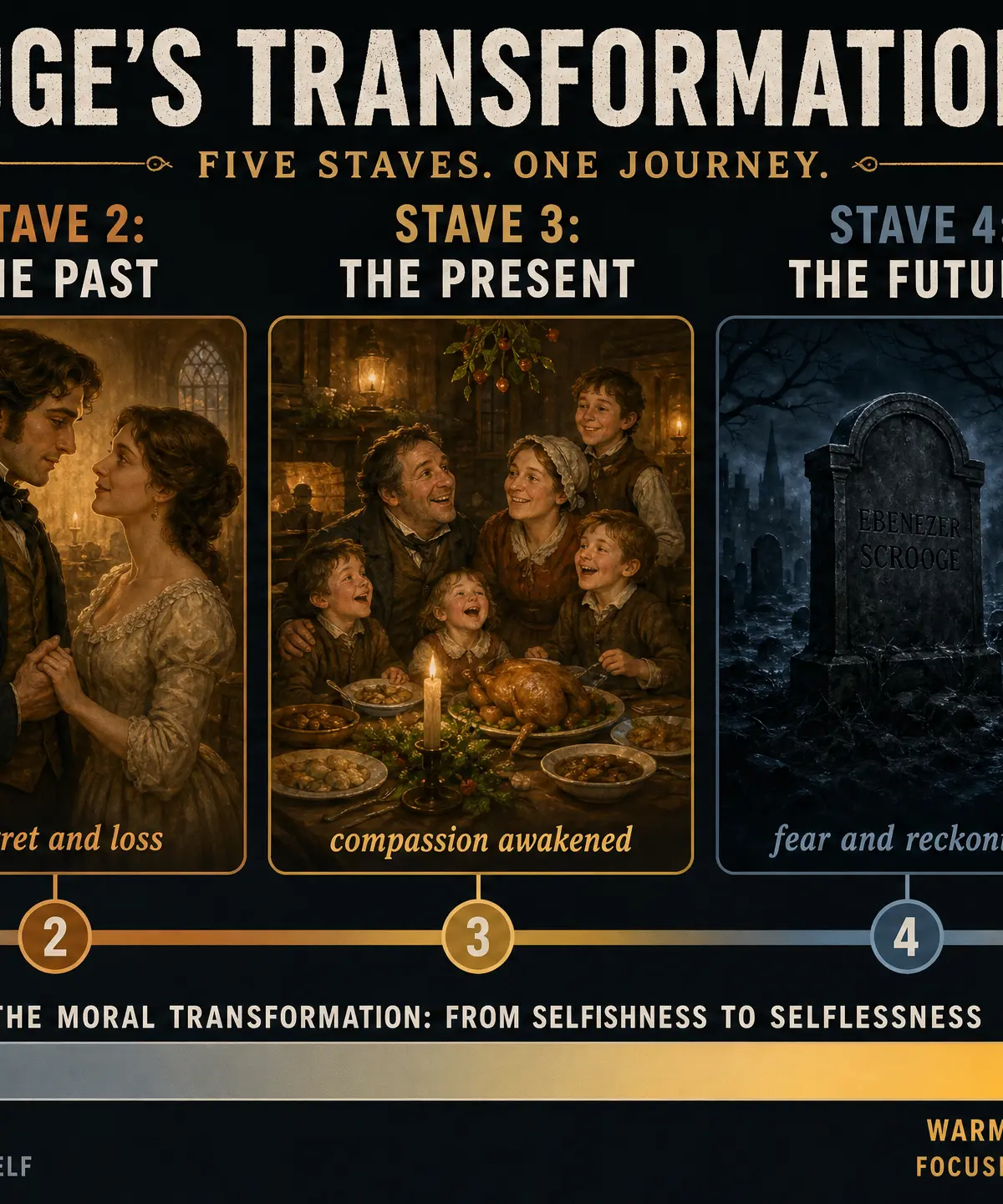
Stave 2: The First of the Three SpiritsThe Ghost of Christmas Past shows Scrooge his lonely childhood, his beloved sister Fan, his joyous apprenticeship under Mr. Fezziwig, and the moment his fiancée Belle leaves him because he has become consumed by the "master-passion" of Gain. Scrooge begins to feel regret.
Stave 3: The Second of the Three SpiritsThe Ghost of Christmas Present reveals the joy of Christmas across the city. Scrooge sees the impoverished but loving Cratchit family and is devastated to learn that Tiny Tim will die if things do not change. The spirit reveals two wretched children, Ignorance and Want, warning Scrooge of the doom they represent for society.
Stave 4: The Last of the SpiritsThe silent, ominous Ghost of Christmas Yet to Come shows Scrooge a future where he is dead, unmourned, and his belongings are stolen. He also sees the Cratchit family mourning the death of Tiny Tim. Scrooge begs for a chance to change his fate.
Stave 5: The End of ItScrooge wakes on Christmas morning, completely transformed. He sends a prize turkey to the Cratchits, donates generously to charity, and joins his nephew's party. He becomes a second father to Tiny Tim, who survives, and Scrooge embodies the spirit of Christmas for the rest of his life.
Themes
Theme 1: Social Responsibility and Poverty
Dickens uses the novella to argue that the wealthy have a moral obligation to care for the poor. He fiercely critiques the Malthusian economic view that the poor are a surplus population that should decrease. This theme is embodied in the contrast between Scrooge's initial dismissal of the poor and the warm, communal spirit of the Cratchits.
Key Quotes:
- "Are there no prisons? Are there no workhouses?" (Stave 1) - Scrooge voices the callous attitude of the Victorian establishment, using institutions of punishment as a substitute for charity.
- "This boy is Ignorance. This girl is Want. Beware them both..." (Stave 3) - Dickens personifies societal neglect, warning that failing to educate and care for the poor will lead to societal ruin.
Theme 2: Redemption and Transformation
Scrooge's journey from a "covetous old sinner" to a man who "knew how to keep Christmas well" is the central arc of the novella. Dickens suggests that no one is beyond saving, provided they are willing to reflect on their past, empathize with others in the present, and fear the consequences of their actions in the future.
Key Quotes:
- "I wear the chain I forged in life." (Stave 1) - Marley's warning establishes the Christian concept of free will and consequence.
- "I am as light as a feather, I am as happy as an angel..." (Stave 5) - A series of joyful similes that sharply contrast with the heavy, cold imagery of Stave 1, showing his complete rebirth.
Theme 3: Christmas and Christian Values
Dickens helped to popularize the modern idea of Christmas as a time of family, generosity, and forgiveness. He strips away strict religious dogma, focusing instead on practical Christian morality: charity, compassion, and fellowship.
Key Quotes:
- "...a good time; a kind, forgiving, charitable, pleasant time..." (Stave 1) - Fred's definition of Christmas acts as Dickens' own thesis statement for the season.
- "God bless us, every one!" (Stave 3/5) - Tiny Tim's inclusive blessing encapsulates the novella's message of universal love.
Character Analysis
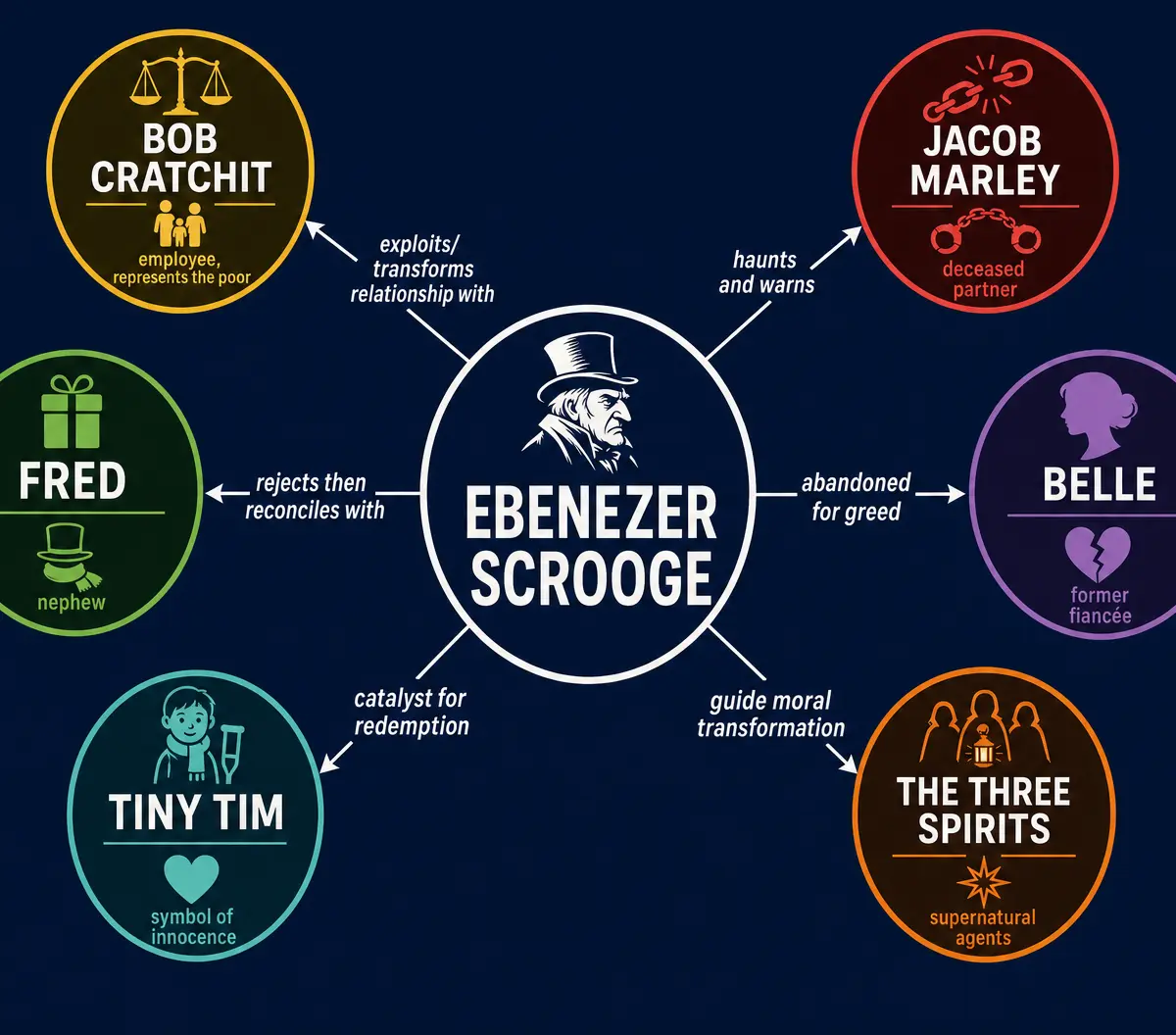
Ebenezer Scrooge
Role: The protagonist and the embodiment of Victorian capitalist greed. He acts as a proxy for the wealthy upper classes who Dickens sought to reform.
Key Traits: Miserly, isolated, cold, cynical, but ultimately capable of profound empathy.
Character Arc: Scrooge moves from total isolation ("solitary as an oyster") to complete integration into society. His transformation is catalyzed by fear, then pity, and finally a genuine desire to do good.
Essential Quotes:
- "Hard and sharp as flint, from which no steel had ever struck out generous fire..."
- "I will honour Christmas in my heart, and try to keep it all the year."
Bob Cratchit
Role: Scrooge's clerk. He represents the working poor—hardworking, exploited, yet morally superior to his wealthy employer.
Key Traits: Loving, grateful, subservient, optimistic.
Character Arc: Bob remains static in his goodness, but his circumstances change drastically due to Scrooge's transformation.
Essential Quotes:
- "The clerk, who cold as he was, was warmer than Scrooge..."
- "Mr Scrooge, the Founder of the Feast!"
The Ghosts (Past, Present, Yet to Come)
Role: Supernatural agents of change. They force Scrooge to confront memory, empathy, and mortality.
Key Traits:
- Past: Ephemeral, paradoxical (old and young).
- Present: Abundant, generous, fleeting.
- Yet to Come: Silent, grim, inevitable.
Essential Quotes:
- "It wore a tunic of the purest white..." (Past)
- "Come in! and know me better, man!" (Present)
- "The Spirit answered not, but pointed onward with its hand." (Yet to Come)
Writer's Methods
Structure: The five-stave structure mirrors a musical carol. Staves 1 and 5 act as bookends, showing the "before" and "after" of Scrooge, highlighting the completeness of his transformation.
Narrative Voice: The third-person omniscient narrator is intrusive, conversational, and highly opinionated. The narrator directly addresses the reader, guiding our moral judgement of Scrooge.
Imagery and Motif: Dickens uses the motifs of cold/warmth and dark/light to symbolize moral states. In Stave 1, the cold within Scrooge "froze his old features." By Stave 5, he is bathed in "Golden sunlight; Heavenly sky."
Symbolism and Allegory: Characters and objects represent larger concepts. Marley's chains symbolize greed; Ignorance and Want symbolize the consequences of societal neglect; the fire in Scrooge's office symbolizes his lack of human warmth.
Context
The Poor Law (1834): This law decreed that the poor could only receive help if they entered a workhouse. Conditions were deliberately harsh to deter people from seeking aid. Dickens hated this system, which treated poverty as a crime.
Malthusian Economics: Thomas Malthus argued that population growth would outpace food supply, and that poverty, disease, and starvation were necessary to keep the "surplus population" in check. Scrooge directly quotes Malthus when he suggests the poor should die to "decrease the surplus population."
Industrial Revolution: The rapid industrialization of Britain created a stark divide between the wealthy factory owners (like Scrooge) and the exploited working class (like the Cratchits). Dickens uses the novella to plead for better treatment of workers.
Visual Resources
2 diagrams and illustrations
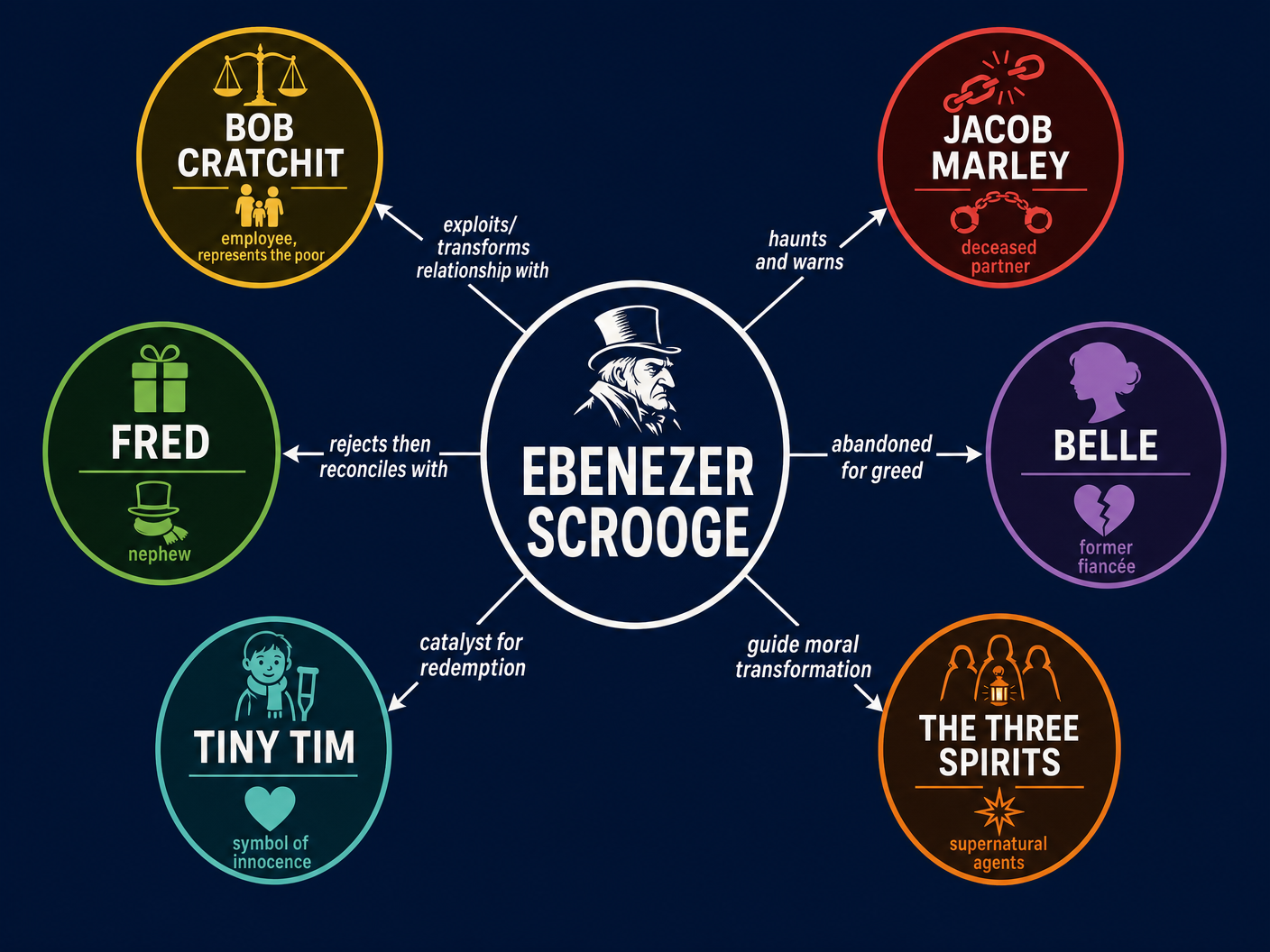
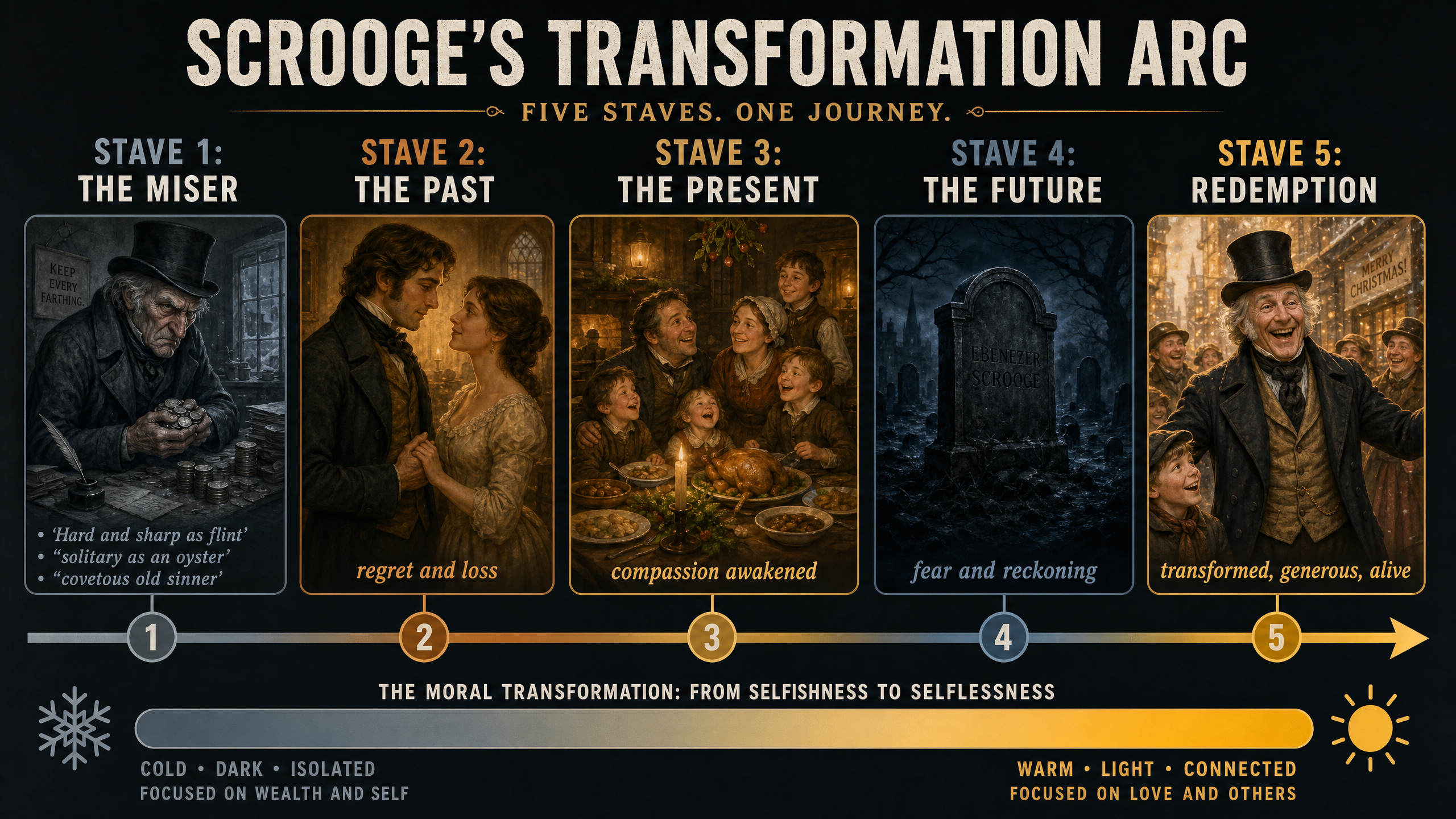
Interactive Diagrams
1 interactive diagram to visualise key concepts
Conceptual Flow Outline
The Structural Progression of Scrooge's Redemption
Worked Examples
2 worked examples — open one to explore the question and available guidance.
Practice Questions
Test your understanding — click to reveal model answers
Starting with this extract (the description of the Cratchit family Christmas dinner), explore how Dickens presents the importance of family. Write about the extract and the text as a whole.
Hint: Contrast the Cratchits' financial poverty with their emotional wealth. Compare this to Scrooge's isolation and Fred's family.
Explore how Dickens presents the theme of poverty in 'A Christmas Carol'.
Hint: Don't just talk about the Cratchits. Include the charity workers, Ignorance and Want, and the thieves in Stave 4.
How does Dickens use the settings of London to reflect the themes of the novella?
Hint: Look at the pathetic fallacy in Stave 1, the warmth of the shops in Stave 3, and the dark alleys of Stave 4.
Explore the significance of the supernatural in 'A Christmas Carol'.
Hint: Why did Dickens choose a ghost story format? What does each ghost specifically achieve?
Test your understanding of A Christmas Carol
Active recall beats re-reading. Take an instant quiz now to test what you’ve learned and lock it into long-term memory.
7 days Premium · Then free forever · No card, no charge