Pearson Edexcel · GCSE · English Literature
Understanding the Relationship Between a Text and its Context (AO3) – Component 2
Mastering AO3 (Context) is the secret to unlocking the highest grades in GCSE English Literature Component 2. This guide breaks down exactly how to weave historical, social, and literary context seamlessly into your analysis, proving to examiners that you understand how a writer's world shaped their text.
- 4 min read
- 2 worked examples
- 4 practice questions
- 8 key terms
Study Notes
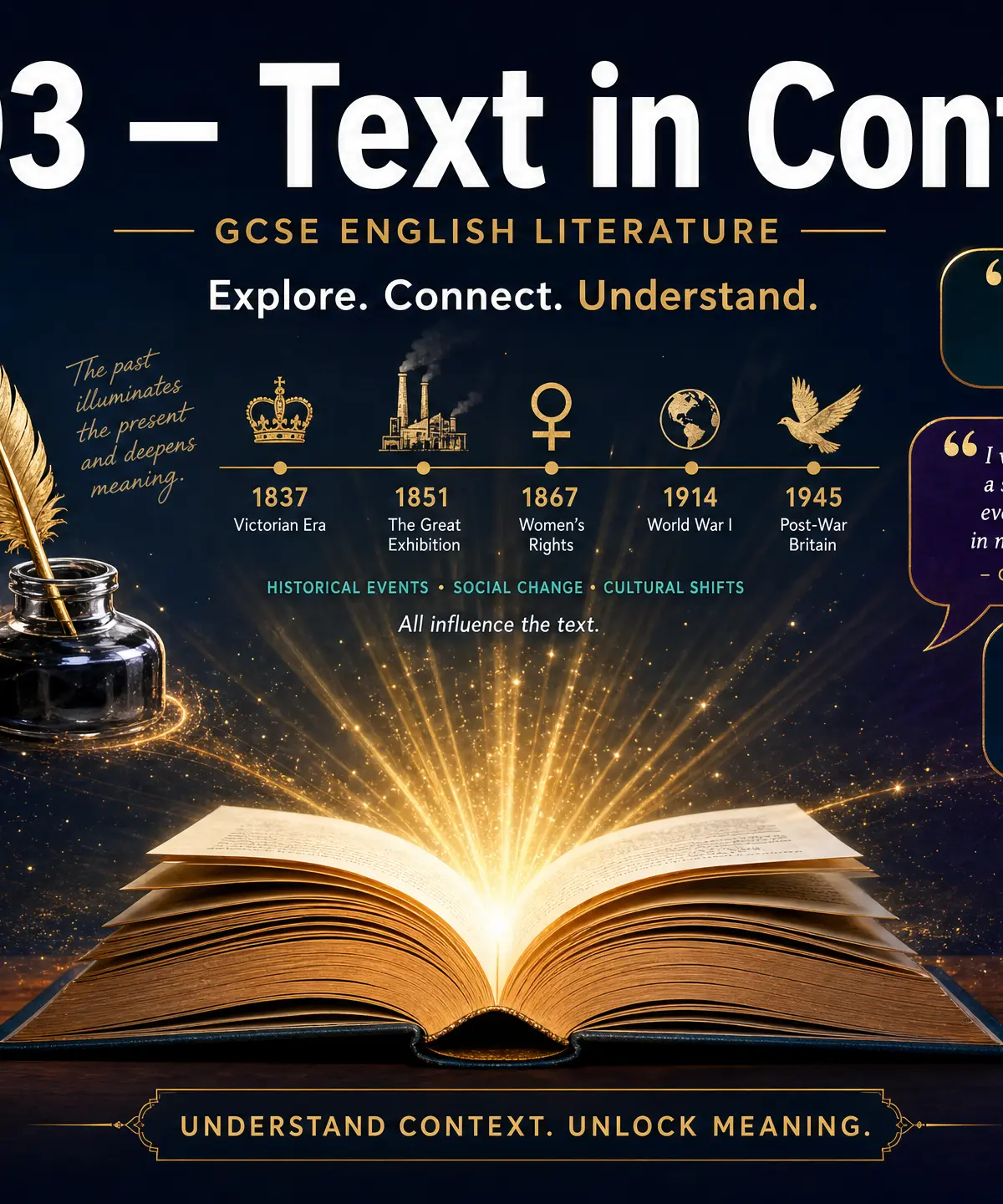
Overview
Assessment Objective 3 (AO3) requires candidates to "show understanding of the relationships between texts and the contexts in which they were written." In Component 2, this is where you elevate your essay from a simple character study to a sophisticated analysis of a writer's purpose. Examiners are not looking for a history lesson; they are looking for integrated context. This means explaining how the social, political, historical, or literary environment influenced the writer's choices, and how a contemporary audience might have reacted differently to a modern one.
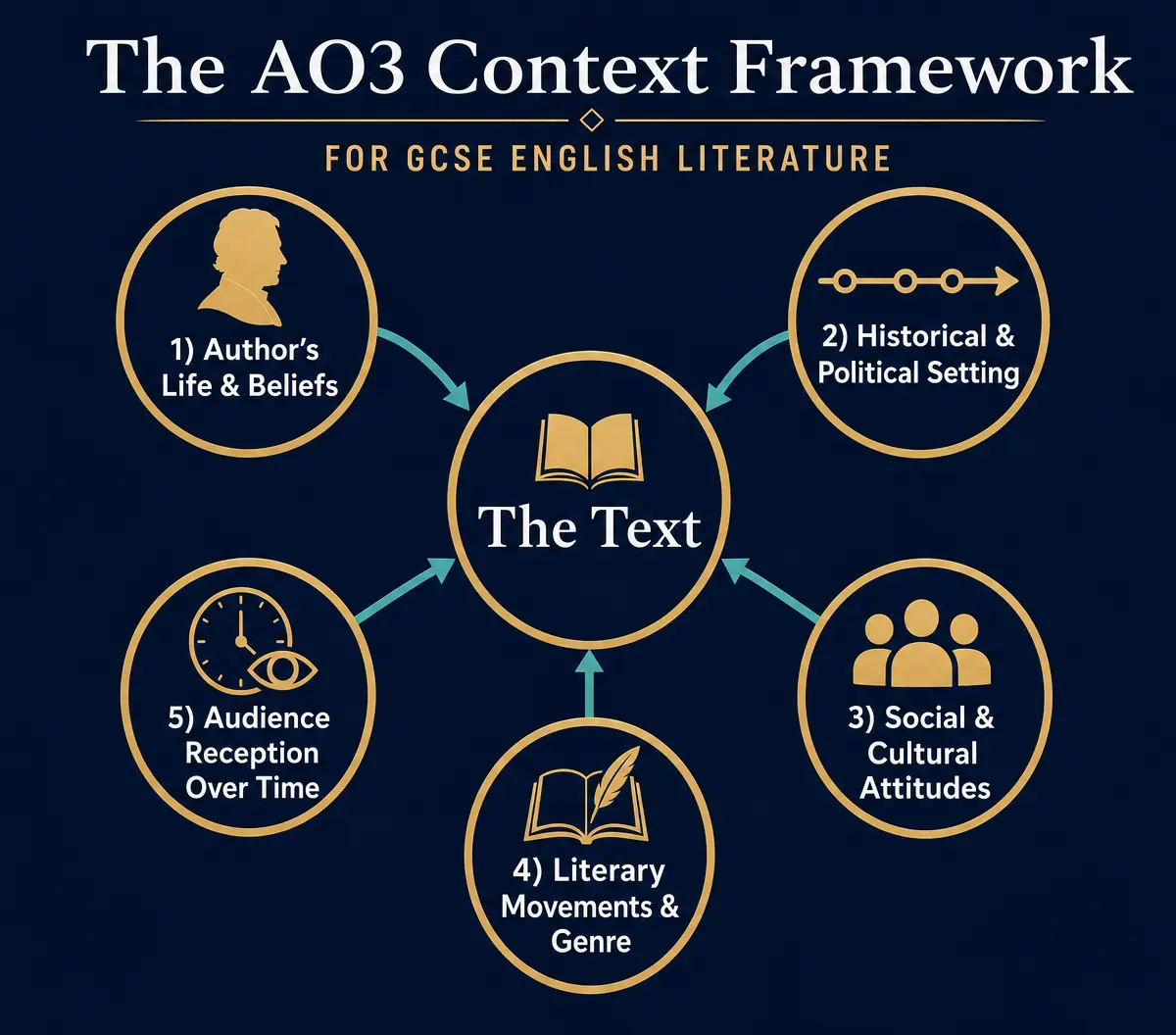
The Five Lenses of Context
To master AO3, you must look at your text through five distinct lenses:
1. The Author's Life and Beliefs
Understanding the author's background provides a crucial window into their intentions. A writer's political affiliations, upbringing, or personal tragedies often bleed into their work.
Examiner Tip: Do not write a biography. Only mention the author's life if it directly explains a choice they made in the text. For example, knowing Dickens worked in a blacking factory explains his visceral depiction of poverty.
2. Historical and Political Setting
When was the text written, and what major events were shaping the world? Texts are often responses to political upheaval, war, or economic shifts.
Examiner Tip: Use the phrase "Writing in the aftermath of..." to link the historical event to the text's mood or message.
3. Social and Cultural Attitudes
This lens focuses on the values, expectations, and prejudices of the society depicted in the text, as well as the society the author lived in. Consider attitudes towards class, gender, race, and religion.
Examiner Tip: Use words like "subvert," "challenge," or "reflect" to describe how the text interacts with societal norms.
4. Literary Movements and Genre
Texts do not exist in a vacuum; they belong to literary traditions (e.g., Gothic, Romanticism, Modernism). Understanding the conventions of these genres helps you analyse why a writer chose a specific form or structure.
Examiner Tip: If a writer breaks a genre convention, explain why. This shows perceptive analysis (AO2) combined with literary context (AO3).
5. Audience Reception Over Time
How would the original audience have reacted compared to a modern reader? This is a highly rewarded skill. A contemporary audience might have been shocked by a female character's independence, whereas a modern audience might view it as essential.
Examiner Tip: Use phrases like "A contemporary audience would have been unsettled by..." to demonstrate this awareness.
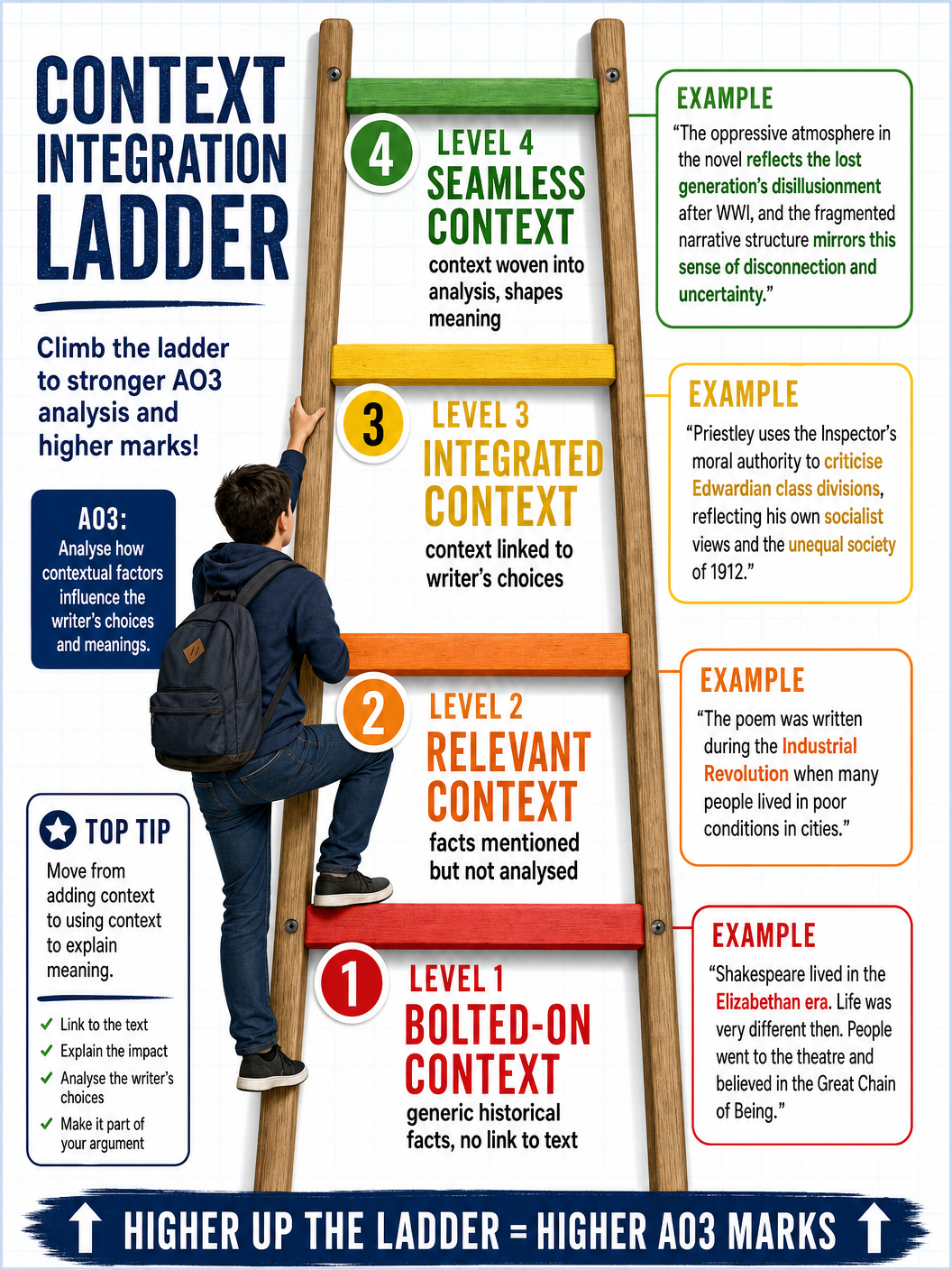
The Context Integration Ladder
Examiners use a levels-based mark scheme. Your goal is to climb from Level 1 to Level 4 by integrating context more deeply into your analysis.
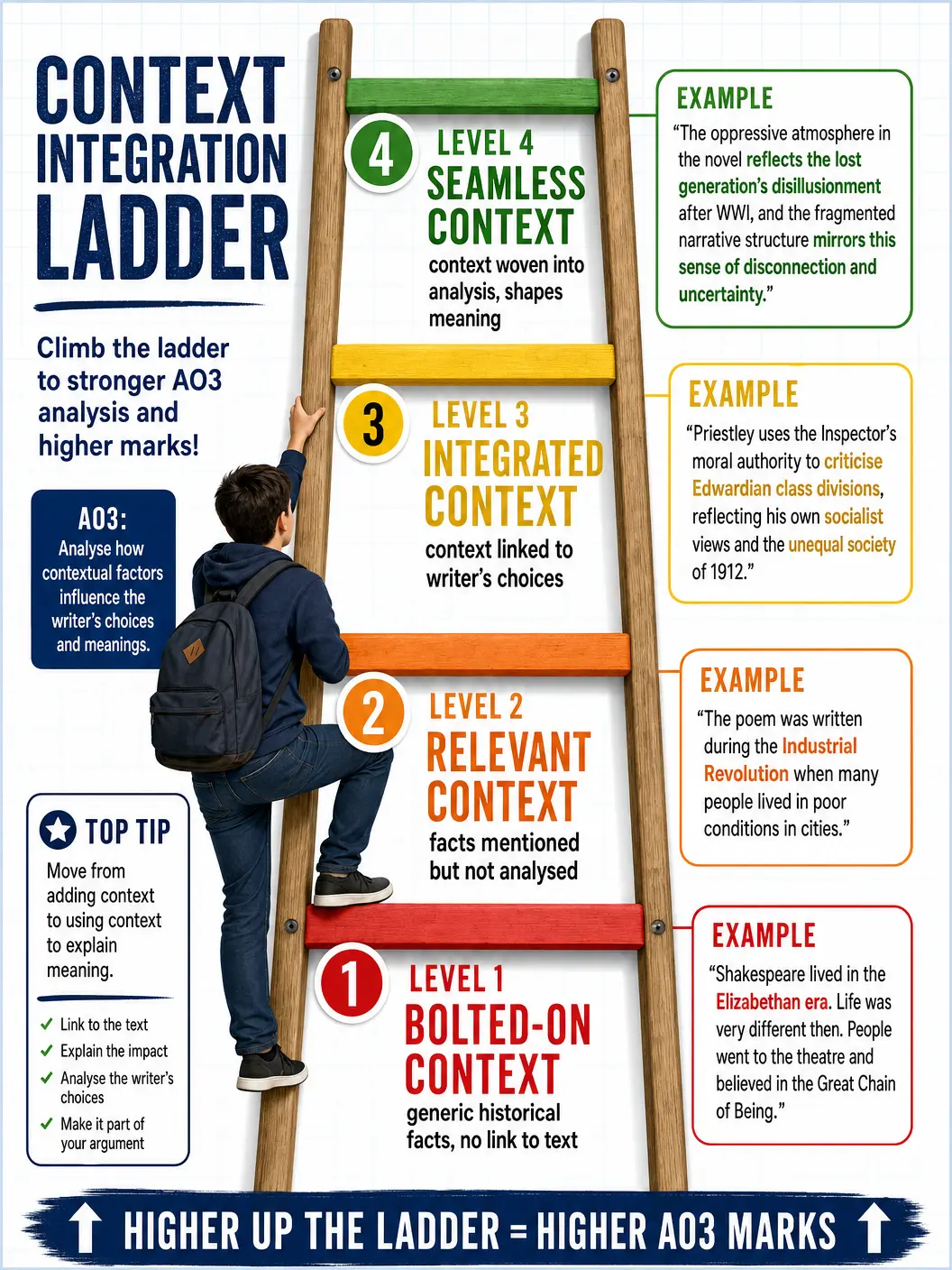
- Level 1 (Bolted-On): "Victorian society was very strict."
- Level 2 (Relevant): "The strict Victorian society meant women had few choices, which is why she acts this way."
- Level 3 (Integrated): "The writer uses her confined setting to reflect the restrictive nature of Victorian society, highlighting women's lack of agency."
- Level 4 (Seamless): "By confining the protagonist to the domestic sphere, the writer critiques the oppressive patriarchal structures of Victorian society, forcing the contemporary audience to confront the psychological toll of such subjugation."
Podcast Episode: Mastering AO3
Listen to our 10-minute deep dive into AO3, featuring expert tips, common pitfalls, and a quick-fire recall quiz.

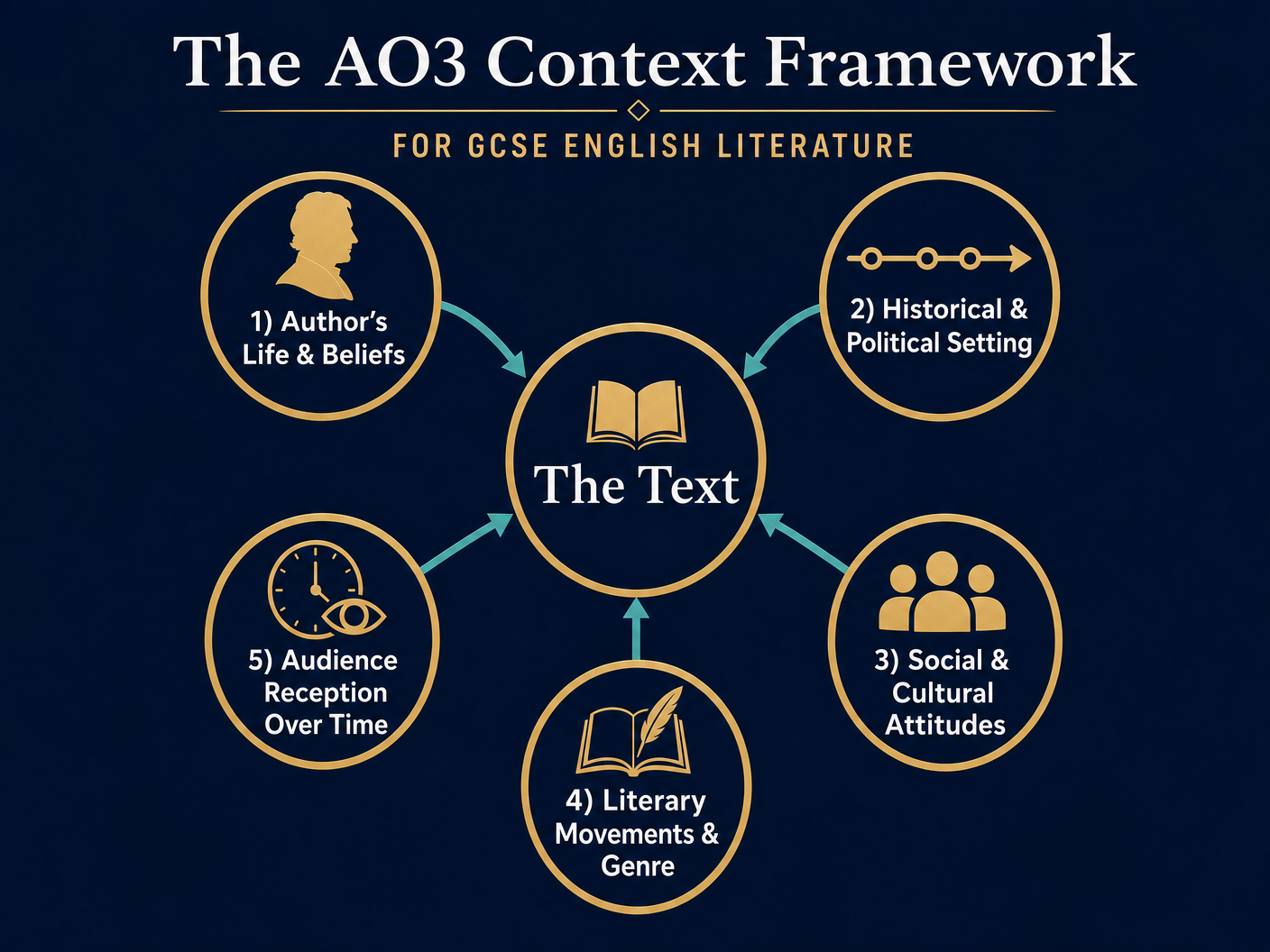
Interactive Diagrams
1 interactive diagram to visualise key concepts
Conceptual Flow Outline
The Flow of Context: How the outside world shapes the text and its reception.
Worked Examples
2 worked examples — open one to explore the question and available guidance.
Practice Questions
Test your understanding — click to reveal model answers
Explore how the writer uses setting to reflect the social tensions of the time. (30 marks + 4 AO4)
Hint: Don't just describe the setting. Explain *why* the writer chose it based on what was happening in society. Is it a microcosm?
How does the writer present the conflict between individual desires and societal expectations? (30 marks + 4 AO4)
Hint: Focus on a character who rebels. What were the 'societal expectations' of the time? How does the audience react to their rebellion?
Explore the significance of the ending of the text in relation to its contextual background. (30 marks + 4 AO4)
Hint: Does the ending restore order (supporting the status quo) or leave things unresolved (challenging society)?
How does the writer use minor characters to highlight the inequalities of their society? (30 marks + 4 AO4)
Hint: Minor characters often represent marginalized groups (the poor, women, minorities). How are they treated by the main characters?