A Complaint (William Wordsworth) Revision Notes

    Subject: English Literature | Level: GCSE | Exam Board: OCR

    This guide explores William Wordsworth's 'A Complaint', a poignant reflection on the painful transition from a vibrant friendship to a state of emotional poverty. It's a rewarding text for demonstrating your ability to analyse extended metaphors and understand the nuances of Romantic ideals about friendship.

    Revision Notes & Key Concepts

    ![Header image for William Wordsworth's 'A Complaint'](https://xnnrgnazirrqvdgfhvou.supabase.co/storage/v1/object/public/study-guide-assets/guide_d83cc592-6909-4ccd-8a86-a88a08157eda/header_image.png) ## Overview William Wordsworth’s 'A Complaint' is a short, fourteen-line lyrical poem that charts the speaker's profound sense of loss following the cooling of a close friendship. For the OCR GCSE English Literature exam, this poem is a gift for candidates who can confidently analyse its central extended metaphor: the transformation of a relationship from a dynamic, 'living' fountain to a 'comfortless', stagnant well. Examiners are looking for a clear understanding of this metaphor as a representation of the shift from spiritual wealth to emotional poverty. Credit is given for analysing the poem's tight structure, its shift in tense, and its melancholic tone. A strong response will also integrate contextual understanding of Romanticism, particularly the high value placed on intense emotional connections and the sanctity of friendship, possibly linking it to the well-documented rift between Wordsworth and his contemporary, Samuel Taylor Coleridge. The key to high marks is to sustain a comparative analysis with another poem from the 'Love and Relationships' cluster, focusing on how both texts explore themes of loss, memory, or estrangement. ![GCSE Study Podcast: William Wordsworth's 'A Complaint'](https://xnnrgnazirrqvdgfhvou.supabase.co/storage/v1/object/public/study-guide-assets/guide_d83cc592-6909-4ccd-8a86-a88a08157eda/a_complaint_podcast.wav) ## Plot/Content Overview The poem is not a narrative but a lyrical expression of feeling, structured in two distinct parts. * **Stanza 1 (Lines 1-7): The Past.** The speaker begins by stating bluntly, "There is a change, and I am poor." He reflects on a time when his friend's affection was like a "fountain" of "living water," a source of constant joy and vitality that he perhaps took for granted ("I lavish'd them, and did not fear"). This section is characterised by nostalgia and a sense of a vibrant, abundant past. * **Stanza 2 (Lines 8-14): The Present.** The tone shifts dramatically. The friendship is no longer a fountain but a "comfortless and hidden well." The speaker laments that while the love might still exist deep down ("I trust it is, — and never dry"), it is now inaccessible, sleeping "in silence and obscurity." The final rhetorical question, "What matter?", underscores his profound sense of desolation and the functional death of the connection. ## Themes ### Theme 1: The Pain of Loss and Change This is the central theme of the poem. Wordsworth presents the change not as a dramatic event, but as a slow, painful decay that leaves the speaker in a state of emotional poverty. The poem is a lament for what has been lost, a feeling of grief for a connection that was once life-giving but is now stagnant. **Key Quotes**: - "There is a change; — and I am poor" - The caesura (the pause created by the dash) forces the reader to stop and absorb the weight of this declaration. The poverty described is purely emotional. - "Such change, and at the very door / Of my fond heart, hath made me poor." - The repetition of "poor" at the end of the stanza emphasizes the totality of his loss. The phrase "at the very door" conveys the intimacy and shock of this change. ### Theme 2: Memory vs. Reality The poem is built on a stark contrast between the memory of the past and the reality of the present. The first stanza is a fond recollection of a joyful time, while the second is a bleak assessment of the current situation. This structural division highlights the speaker's inability to reconcile what was with what is. **Key Quotes**: - "A fountain, at my fond heart's door; / Whose only business was to flow" - This memory is of effortless, constant affection. - "Now, for that consecrated fount / Of murmuring, sparkling, living love, / What have I? shall I dare to tell? / A comfortless and hidden well." - The direct contrast is made explicit with the word "Now". The series of questions reveals his hesitation and pain in confronting the new reality. ## Writer's Methods * **Extended Metaphor**: This is the most important technique. The entire poem is built around the contrast between the fountain and the well. Candidates must analyse the specific connotations of each: the fountain represents life, dynamism, public joy, and abundance, while the well represents stagnation, darkness, hiddenness, and emotional death. Credit is given for exploring the semantic fields associated with each (e.g., 'sparkling', 'living' vs. 'hidden', 'sleep'). ![The Fountain vs. The Well: An Extended Metaphor](https://xnnrgnazirrqvdgfhvou.supabase.co/storage/v1/object/public/study-guide-assets/guide_d83cc592-6909-4ccd-8a86-a88a08157eda/fountain_well_metaphor.png) * **Structure**: The poem's structure is crucial. It is composed of two seven-line stanzas (septets). The first stanza focuses on the past, using past tense verbs. The second stanza shifts to the present, using present tense verbs. This clear structural shift mirrors the emotional journey of the speaker from nostalgic remembrance to painful present reality. Examiners reward candidates who can comment on this structural device. ![Analysis of Structure and Emotional Arc in 'A Complaint'](https://xnnrgnazirrqvdgfhvou.supabase.co/storage/v1/object/public/study-guide-assets/guide_d83cc592-6909-4ccd-8a86-a88a08157eda/poem_structure_analysis.png) * **Tone**: The tone is melancholic, resigned, and deeply sorrowful. It is not angry or bitter, which distinguishes it from other poems in the cluster like 'Neutral Tones'. The speaker is not accusing his friend but mourning the loss of their connection. The use of rhetorical questions ("What matter?") contributes to this sense of hopeless resignation. * **Caesura and Enjambment**: Wordsworth uses punctuation to control the pace and mood. The frequent use of caesurae (pauses within lines, often with dashes) creates a hesitant, pained rhythm, as if the speaker is struggling to articulate his grief. For example, "A well of love — it may be deep — / I trust it is, — and never dry:". ## Context * **Romanticism**: As a key figure in the Romantic movement, Wordsworth valued intense personal emotion, the power of nature, and the sanctity of the individual's inner world. Friendships, for the Romantics, were not casual but profound spiritual bonds. The grief expressed in the poem is therefore not trivial but a deep spiritual wound. This is crucial AO3 information. * **Biographical Context (Wordsworth and Coleridge)**: While not essential for high marks, understanding that the poem is likely inspired by Wordsworth's cooling friendship with fellow poet Samuel Taylor Coleridge can add a layer of depth. Their creative and personal relationship was incredibly intense and its breakdown caused Wordsworth significant pain. However, candidates must avoid simply narrating this story and instead link it to the poem's themes of lost intimacy and spiritual connection. * **Lyrical Poetry**: The poem is a lyric, a form that expresses personal emotions or feelings, typically spoken in the first person. Its purpose is not to tell a story but to explore a state of mind, which is exactly what 'A Complaint' does.

    Revision Podcast Transcript

    [INTRO - 1 MINUTE] Hello and welcome to GCSE English Literature Essentials! I'm your host, and today we're diving deep into one of the most emotionally powerful poems in the OCR Love and Relationships cluster: William Wordsworth's 'A Complaint'. Now, I know what you might be thinking — a complaint? Sounds a bit whiny, right? But trust me, this fourteen-line poem packs an absolute punch when it comes to exploring loss, change, and the devastating shift from spiritual connection to emotional isolation. And here's the thing: examiners LOVE this poem because it's deceptively simple on the surface but incredibly rich when you dig into the extended metaphor and Romantic context. So whether you're preparing for your Component 02 exam or just trying to get your head around what Wordsworth is actually saying here, stick with me for the next ten minutes. We'll break down the core concepts, explore the writer's methods, tackle those tricky exam skills, and I'll even throw in a quick-fire quiz at the end to test your recall. Let's get started! [CORE CONCEPTS - 5 MINUTES] Right, let's start with the big picture. 'A Complaint' is a Romantic poem written around 1806, and it's all about the speaker's grief over a friendship that has fundamentally changed. Now, biographical context alert: many scholars believe this poem reflects Wordsworth's deteriorating relationship with Samuel Taylor Coleridge, his close friend and fellow Romantic poet. But here's the crucial exam point — you don't need to write a biography of Wordsworth. What you DO need to understand is how Romantic poets valued intense personal emotion, the sanctity of friendship, and the idea that spiritual connection was just as important as romantic love. The poem is structured in two stanzas of seven lines each, and this structure is KEY. Stanza one is all about the past — what the relationship used to be. Stanza two is about the present — what it has become. And the shift between them? That's where the emotional devastation happens. Let's talk about the central metaphor, because this is where marks are won or lost. Wordsworth compares the past relationship to a fountain — and I want you to really visualize this. A fountain is dynamic, right? Water is flowing, sparkling, catching the light. It's public, it's joyful, it's life-giving. Wordsworth describes it as "living water" — that word "living" is doing so much work. It suggests vitality, energy, constant renewal. The relationship was overflowing with spiritual richness. But then — and here's the gut punch — in stanza two, that fountain has become a well. Not just any well, but a "comfortless" well. Wells are enclosed, hidden, dark. The water is stagnant, lifeless. The speaker says "the same dead scene" — notice that word "dead". This isn't just a change; it's a kind of death. The relationship still exists in form, but all the life has drained out of it. Now, let's zoom in on some key quotes you absolutely need to memorize. First line: "There is a change — and I am poor". That opening is so direct, so blunt. The dash creates a pause — you can almost hear the speaker's resignation. And "I am poor" isn't about money; it's about emotional and spiritual poverty. He's lost something irreplaceable. Then we get: "Thy friendship oft has made my heart to ache". This is fascinating because "ache" suggests a dull, persistent pain — not a sharp, sudden hurt. This grief has been building. It's chronic. And finally, the closing lines: "A comfortless and hidden well. / A well of love — it may be deep — / I trust it is, — and never dry: / What matter? if the waters sleep / In silence and obscurity." Okay, so even though the speaker acknowledges the love might still be there deep down, it doesn't matter because it's hidden, silent, obscure. It's functionally dead to him. That rhetorical question "What matter?" is so powerful — it's almost dismissive, but you can feel the pain underneath. [EXAM TIPS & COMMON MISTAKES - 2 MINUTES] Alright, let's talk exam strategy, because this is where you turn understanding into marks. First up: this poem will ALWAYS be compared with another poem from the cluster. You need to choose wisely. 'Neutral Tones' by Thomas Hardy is a brilliant pairing because both explore the death of a relationship, but Hardy's tone is bitter and resentful, whereas Wordsworth's is melancholic and resigned. 'When We Two Parted' by Byron also works well for exploring secrecy and loss. Here's a massive common mistake: candidates identify the fountain and well imagery but don't analyze what it MEANS. Don't just say "Wordsworth uses a metaphor of a fountain and a well." Say "Wordsworth's extended metaphor traces the transformation from dynamic, life-giving connection to stagnant, hidden grief, mirroring the speaker's emotional descent from spiritual wealth to isolation." Another error: treating this as a romantic breakup poem. It's not. This is about friendship, about platonic love, and that's actually really important in the Romantic movement. Wordsworth and his contemporaries believed that deep friendship was a spiritual bond. So when you're writing about context — AO3 — mention that Romantic poets elevated personal emotion and saw friendship as sacred. Time management: you've got about 45 minutes for this question. Spend 5-10 minutes planning your comparison. Make sure you're balancing your analysis — don't write three paragraphs on 'A Complaint' and then one rushed paragraph on your second poem. And here's a top-tier tip: focus on the structural shift between the stanzas. Examiners LOVE when you analyze structure, and the move from past tense to present tense, from memory to reality, is a gift for AO2. [QUICK-FIRE RECALL QUIZ - 1 MINUTE] Right, quick-fire quiz time! I'll ask three questions — pause the podcast and see if you can answer them without looking at your notes. Question one: What is the central extended metaphor in 'A Complaint', and what does each part represent? Question two: Identify the structural shift between stanza one and stanza two, and explain its effect. Question three: Name two poems from the cluster that would work well in comparison with 'A Complaint', and give one reason for each. Okay, how did you do? If you nailed all three, brilliant — you're exam-ready. If not, go back and review those sections. [SUMMARY & SIGN-OFF - 1 MINUTE] Let's wrap this up. 'A Complaint' is a deceptively simple poem that rewards close analysis. Remember: it's about the loss of spiritual connection in a friendship, not a romantic relationship. The fountain-to-well metaphor is your golden ticket to AO2 marks. The structural shift from past to present mirrors the emotional journey from richness to poverty. And when you're comparing, choose a poem that lets you explore tone, memory, or estrangement in a meaningful way. One final thought: Wordsworth's genius here is in the restraint. He doesn't rage or accuse. He simply observes the change and mourns what's been lost. That quiet devastation? That's what makes this poem so powerful. Thanks so much for listening to GCSE English Literature Essentials. If you found this helpful, make sure you're practicing those comparison skills and memorizing your key quotes. Good luck with your revision, and remember — examiners are looking for perceptive, critical analysis, not just feature-spotting. You've got this! Until next time, keep reading, keep analyzing, and keep earning those marks. Bye for now!

    Key Terms & Definitions

    Extended Metaphor
    A metaphor that is developed over several lines of writing or even throughout an entire work. In 'A Complaint', the comparison of the friendship to a fountain and then a well is an extended metaphor.
    Lyric Poetry
    A form of poetry that expresses personal emotions or feelings, typically spoken in the first person. 'A Complaint' is a lyric poem as it is a personal expression of the speaker's grief.
    Caesura
    A pause or break within a line of poetry, often marked by punctuation like a comma, dash, or full stop. For example, 'There is a change; — and I am poor.'
    Melancholy
    A feeling of pensive sadness, typically with no obvious cause. The tone of 'A Complaint' is deeply melancholic, expressing a quiet, persistent sorrow rather than anger.
    Semantic Field
    A group of words that are related in meaning. In 'A Complaint', there is a semantic field of vitality ('fountain', 'flow', 'sparkling', 'living') and a semantic field of stagnation ('well', 'hidden', 'sleep', 'dead scene').
    Rhetorical Question
    A question asked for effect or to make a point, rather than to get an answer. The final question, 'What matter?', is rhetorical.
    Romanticism
    An artistic, literary, and intellectual movement that originated in Europe toward the end of the 18th century, which emphasized intense emotion as an authentic source of aesthetic experience.
    Tone
    The general character or attitude of a piece of writing. The tone of 'A Complaint' is one of resignation, sorrow, and nostalgia.

    Worked Examples

    Practice Questions

    A Complaint (William Wordsworth)

    This guide explores William Wordsworth's 'A Complaint', a poignant reflection on the painful transition from a vibrant friendship to a state of emotional poverty. It's a rewarding text for demonstrating your ability to analyse extended metaphors and understand the nuances of Romantic ideals about friendship.

    7
    Min Read
    1
    Examples
    2
    Questions
    8
    Key Terms
    🎙 Podcast Episode
    A Complaint (William Wordsworth)
    0:00-0:00

    Study Notes

    Header image for William Wordsworth's 'A Complaint'

    Overview

    William Wordsworth’s 'A Complaint' is a short, fourteen-line lyrical poem that charts the speaker's profound sense of loss following the cooling of a close friendship. For the OCR GCSE English Literature exam, this poem is a gift for candidates who can confidently analyse its central extended metaphor: the transformation of a relationship from a dynamic, 'living' fountain to a 'comfortless', stagnant well. Examiners are looking for a clear understanding of this metaphor as a representation of the shift from spiritual wealth to emotional poverty. Credit is given for analysing the poem's tight structure, its shift in tense, and its melancholic tone. A strong response will also integrate contextual understanding of Romanticism, particularly the high value placed on intense emotional connections and the sanctity of friendship, possibly linking it to the well-documented rift between Wordsworth and his contemporary, Samuel Taylor Coleridge. The key to high marks is to sustain a comparative analysis with another poem from the 'Love and Relationships' cluster, focusing on how both texts explore themes of loss, memory, or estrangement.

    GCSE Study Podcast: William Wordsworth's 'A Complaint'

    Plot/Content Overview

    The poem is not a narrative but a lyrical expression of feeling, structured in two distinct parts.

    • Stanza 1 (Lines 1-7): The Past. The speaker begins by stating bluntly, "There is a change, and I am poor." He reflects on a time when his friend's affection was like a "fountain" of "living water," a source of constant joy and vitality that he perhaps took for granted ("I lavish'd them, and did not fear"). This section is characterised by nostalgia and a sense of a vibrant, abundant past.

    • Stanza 2 (Lines 8-14): The Present. The tone shifts dramatically. The friendship is no longer a fountain but a "comfortless and hidden well." The speaker laments that while the love might still exist deep down ("I trust it is, — and never dry"), it is now inaccessible, sleeping "in silence and obscurity." The final rhetorical question, "What matter?", underscores his profound sense of desolation and the functional death of the connection.

    Themes

    Theme 1: The Pain of Loss and Change

    This is the central theme of the poem. Wordsworth presents the change not as a dramatic event, but as a slow, painful decay that leaves the speaker in a state of emotional poverty. The poem is a lament for what has been lost, a feeling of grief for a connection that was once life-giving but is now stagnant.

    Key Quotes:

    • "There is a change; — and I am poor" - The caesura (the pause created by the dash) forces the reader to stop and absorb the weight of this declaration. The poverty described is purely emotional.
    • "Such change, and at the very door / Of my fond heart, hath made me poor." - The repetition of "poor" at the end of the stanza emphasizes the totality of his loss. The phrase "at the very door" conveys the intimacy and shock of this change.

    Theme 2: Memory vs. Reality

    The poem is built on a stark contrast between the memory of the past and the reality of the present. The first stanza is a fond recollection of a joyful time, while the second is a bleak assessment of the current situation. This structural division highlights the speaker's inability to reconcile what was with what is.

    Key Quotes:

    • "A fountain, at my fond heart's door; / Whose only business was to flow" - This memory is of effortless, constant affection.
    • "Now, for that consecrated fount / Of murmuring, sparkling, living love, / What have I? shall I dare to tell? / A comfortless and hidden well." - The direct contrast is made explicit with the word "Now". The series of questions reveals his hesitation and pain in confronting the new reality.

    Writer's Methods

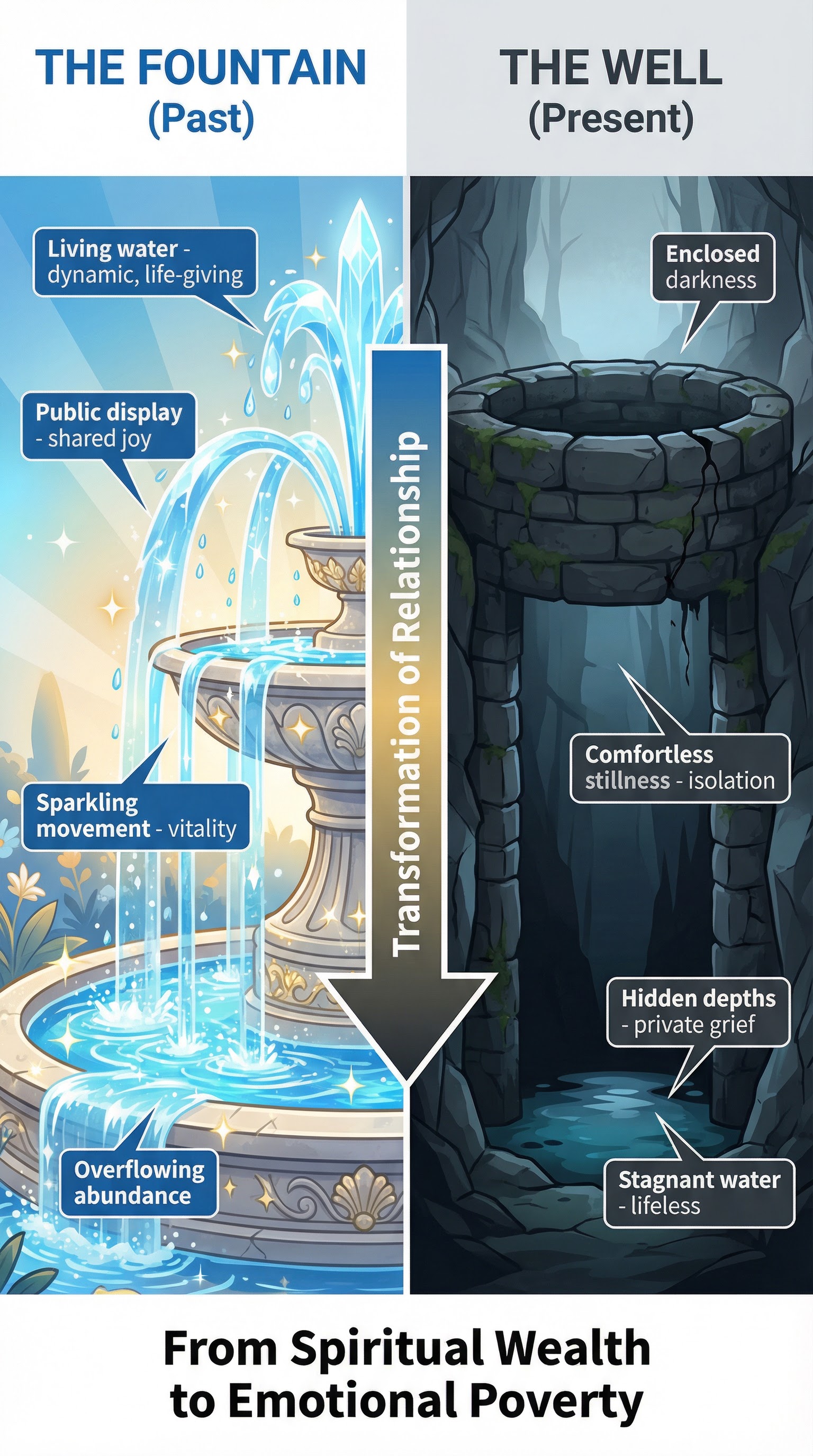
    • Extended Metaphor: This is the most important technique. The entire poem is built around the contrast between the fountain and the well. Candidates must analyse the specific connotations of each: the fountain represents life, dynamism, public joy, and abundance, while the well represents stagnation, darkness, hiddenness, and emotional death. Credit is given for exploring the semantic fields associated with each (e.g., 'sparkling', 'living' vs. 'hidden', 'sleep').
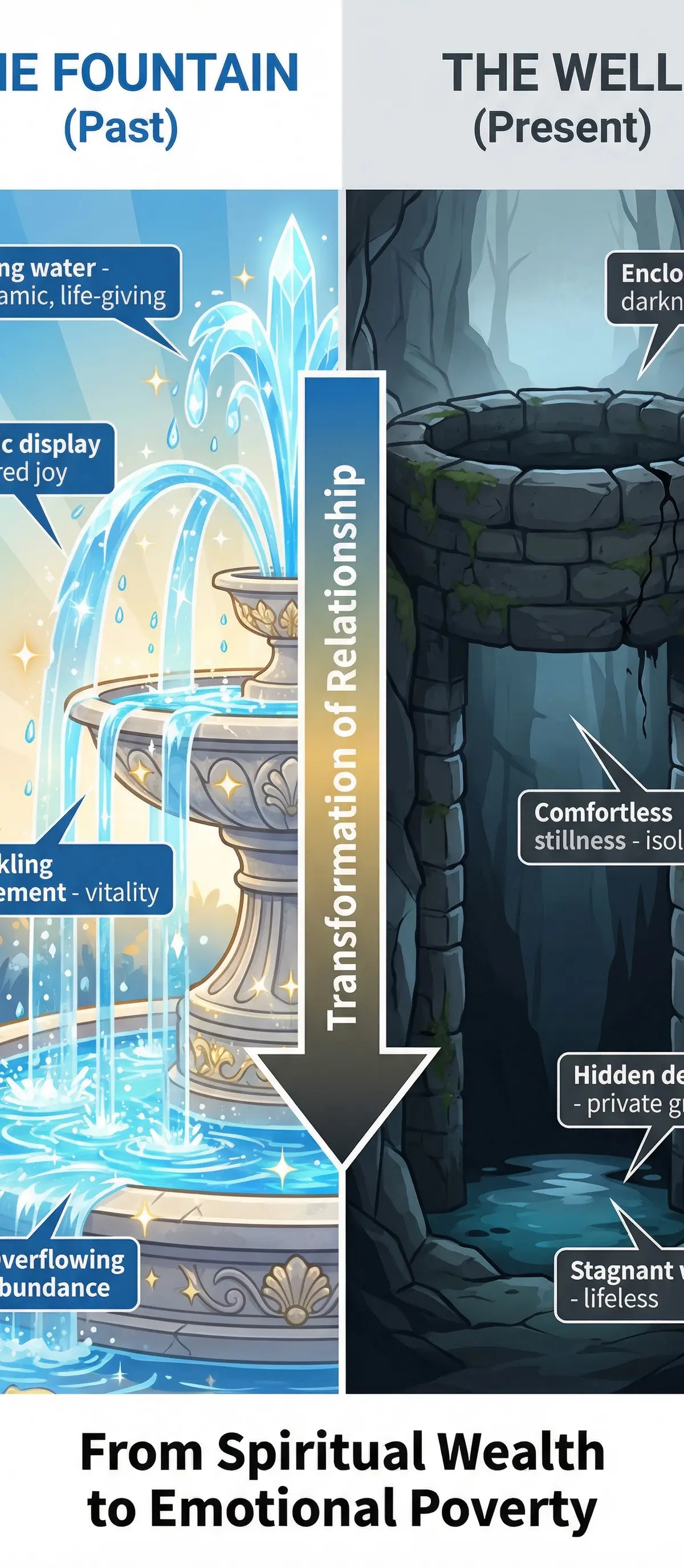
      The Fountain vs. The Well: An Extended Metaphor

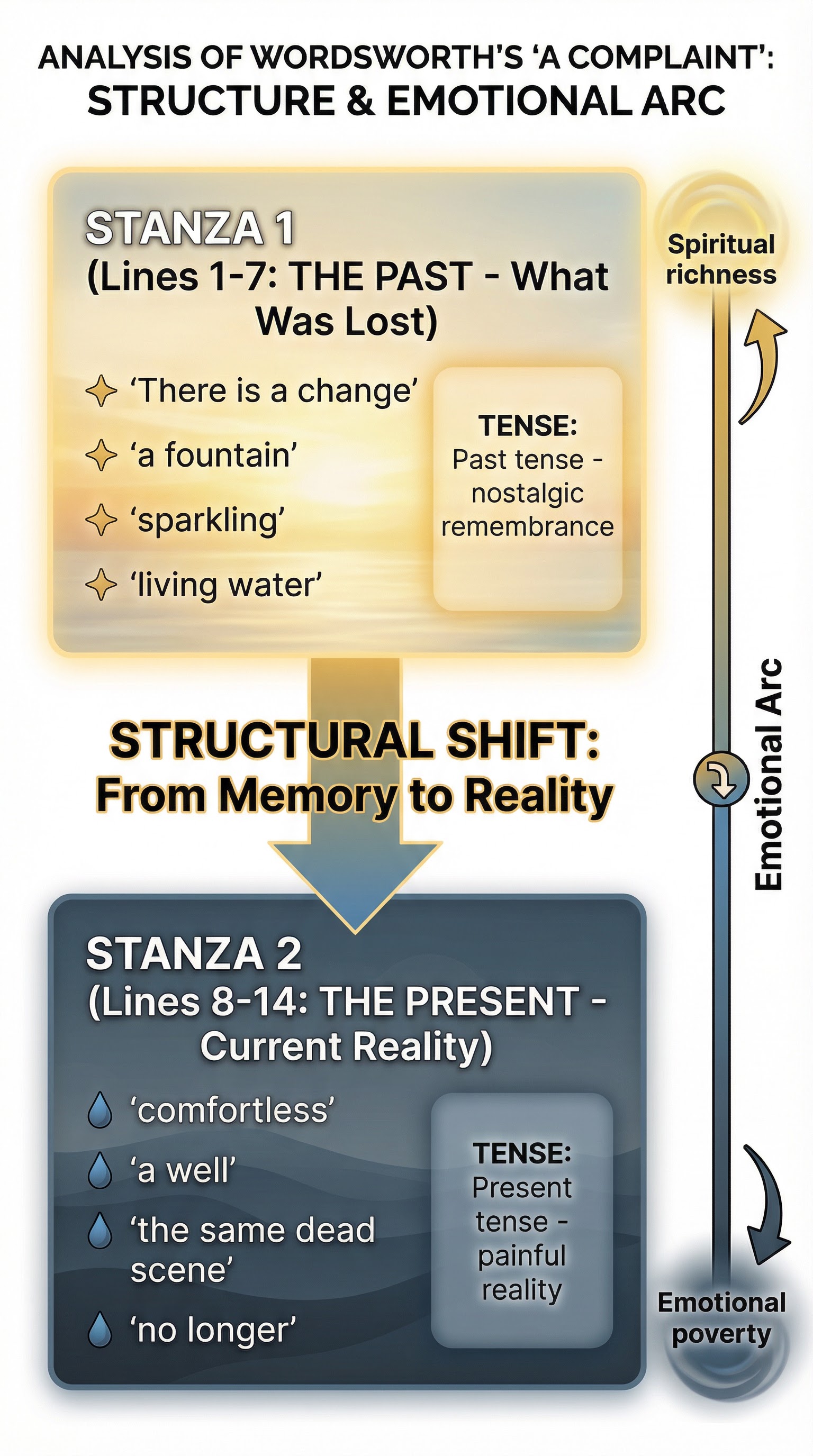
    • Structure: The poem's structure is crucial. It is composed of two seven-line stanzas (septets). The first stanza focuses on the past, using past tense verbs. The second stanza shifts to the present, using present tense verbs. This clear structural shift mirrors the emotional journey of the speaker from nostalgic remembrance to painful present reality. Examiners reward candidates who can comment on this structural device.
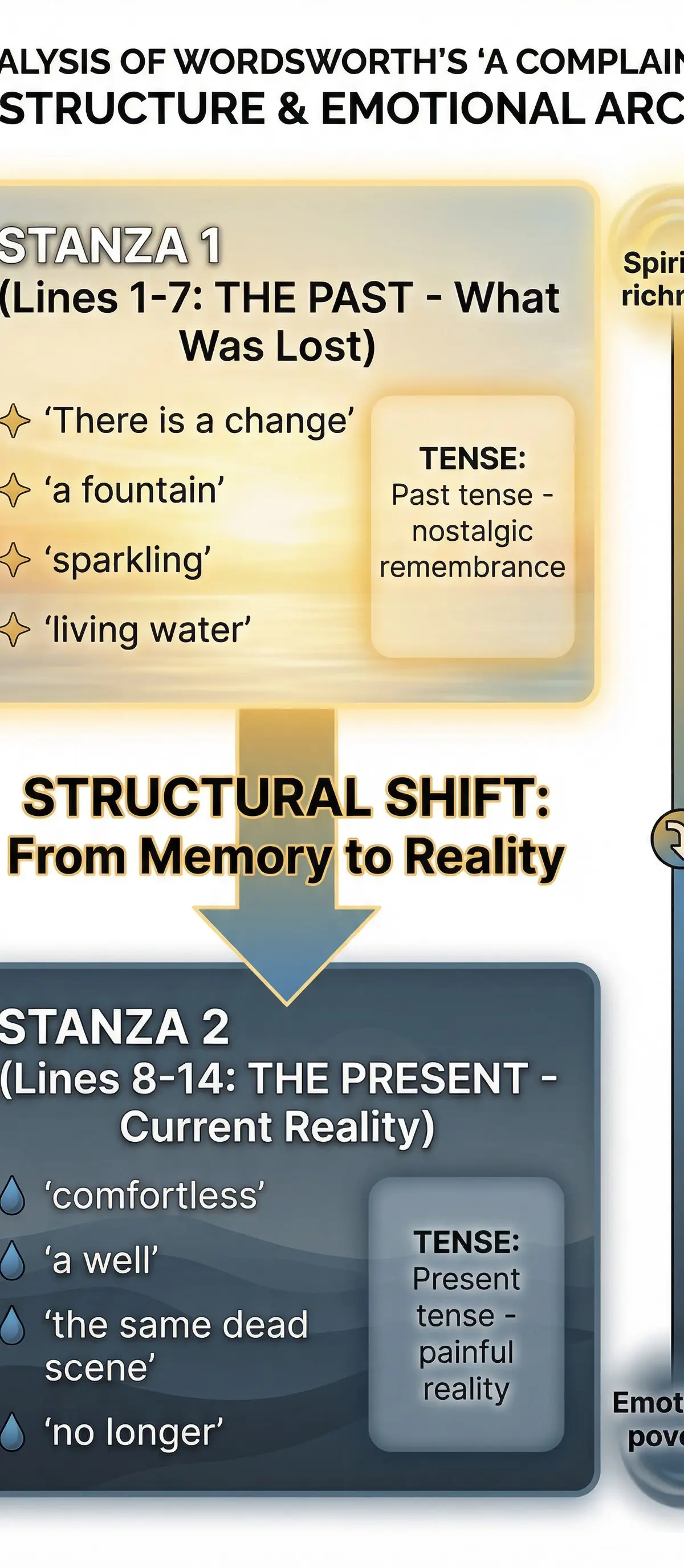
      Analysis of Structure and Emotional Arc in 'A Complaint'

    • Tone: The tone is melancholic, resigned, and deeply sorrowful. It is not angry or bitter, which distinguishes it from other poems in the cluster like 'Neutral Tones'. The speaker is not accusing his friend but mourning the loss of their connection. The use of rhetorical questions ("What matter?") contributes to this sense of hopeless resignation.

    • Caesura and Enjambment: Wordsworth uses punctuation to control the pace and mood. The frequent use of caesurae (pauses within lines, often with dashes) creates a hesitant, pained rhythm, as if the speaker is struggling to articulate his grief. For example, "A well of love — it may be deep — / I trust it is, — and never dry:".

    Context

    • Romanticism: As a key figure in the Romantic movement, Wordsworth valued intense personal emotion, the power of nature, and the sanctity of the individual's inner world. Friendships, for the Romantics, were not casual but profound spiritual bonds. The grief expressed in the poem is therefore not trivial but a deep spiritual wound. This is crucial AO3 information.

    • Biographical Context (Wordsworth and Coleridge): While not essential for high marks, understanding that the poem is likely inspired by Wordsworth's cooling friendship with fellow poet Samuel Taylor Coleridge can add a layer of depth. Their creative and personal relationship was incredibly intense and its breakdown caused Wordsworth significant pain. However, candidates must avoid simply narrating this story and instead link it to the poem's themes of lost intimacy and spiritual connection.

    • Lyrical Poetry: The poem is a lyric, a form that expresses personal emotions or feelings, typically spoken in the first person. Its purpose is not to tell a story but to explore a state of mind, which is exactly what 'A Complaint' does.
    Visual Resources

    2 diagrams and illustrations

    The Fountain vs. The Well: An Extended Metaphor
    The Fountain vs. The Well: An Extended Metaphor
    Analysis of Structure and Emotional Arc in 'A Complaint'
    Analysis of Structure and Emotional Arc in 'A Complaint'

    Interactive Diagrams

    1 interactive diagram to visualise key concepts

    This diagram shows the poem's central structural and thematic shift from the 'Fountain' of the past to the 'Well' of the present.

    Worked Examples

    1 detailed example with solutions and examiner commentary

    Practice Questions

    Test your understanding — click to reveal model answers

    Q1

    Explore how Wordsworth presents the speaker's feelings about a changed relationship in 'A Complaint'.

    30 marks
    standard

    Hint: Focus on the contrast between the past and the present. How does the central metaphor of water convey the speaker's feelings?

    Q2

    How does Wordsworth use language to present the speaker's sense of loss in 'A Complaint'?

    30 marks
    standard

    Hint: Focus on specific word choices. Look at the adjectives used to describe the fountain versus the well. Consider the effect of the first-person narrative.

    Key Terms

    Essential vocabulary to know