OCR · GCSE · English Literature
An Inspector Calls
J.B. Priestley's 'An Inspector Calls' is a gripping morality play that dissects the hypocrisy of the pre-war upper classes. Studying it is rewarding as it offers a masterclass in dramatic irony, characterisation as social commentary, and the power of theatre to provoke moral reflection.
- 11 min read
- 2 worked examples
- 4 practice questions
- 8 key terms
Study Notes
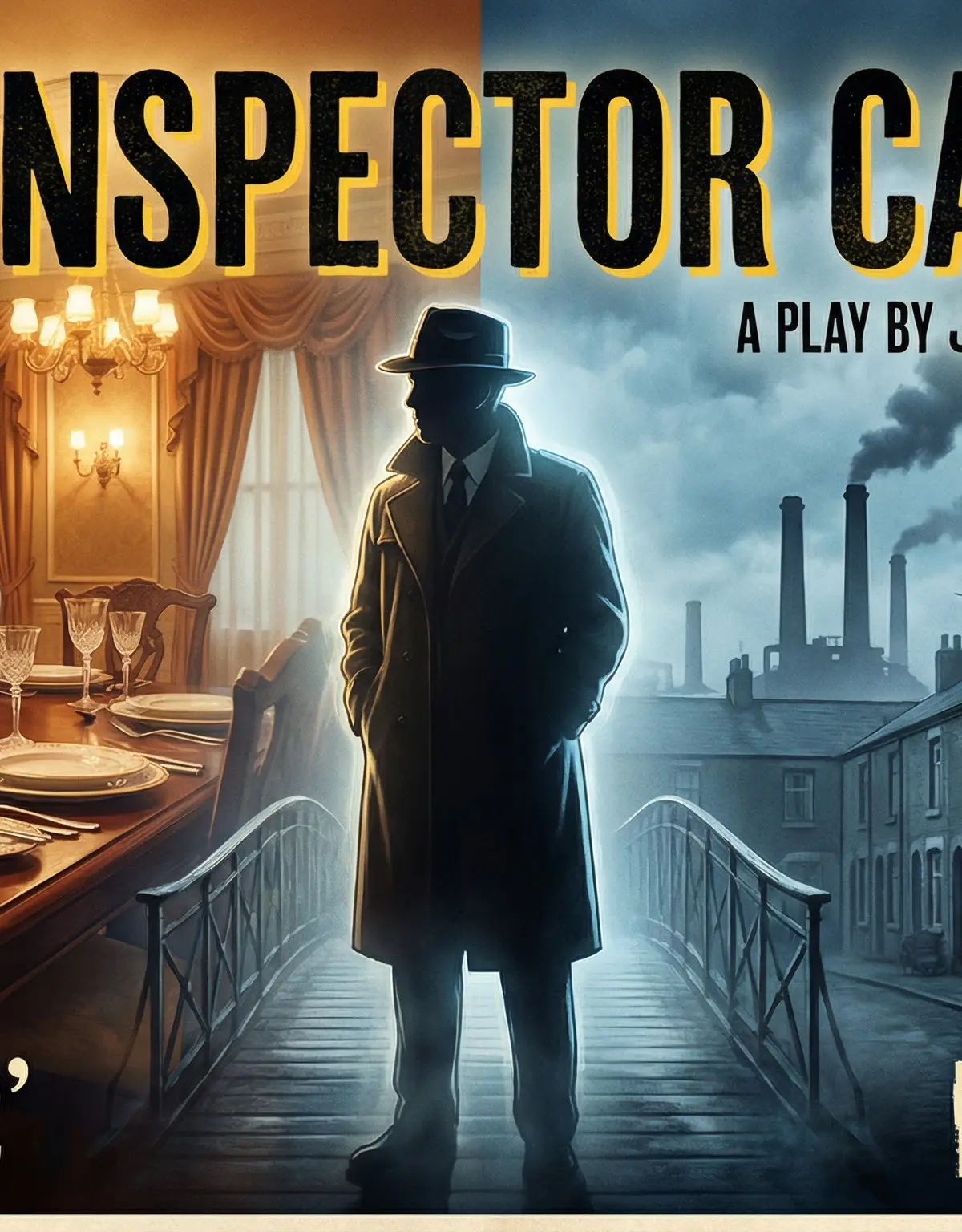
Overview
'An Inspector Calls' is a cornerstone of modern British drama, written by J.B. Priestley in 1945 but set in the seemingly stable world of 1912. This temporal gap is a deliberate device, allowing Priestley to use dramatic irony to critique the capitalist, individualistic attitudes of the Edwardian era from the perspective of a post-war society that had witnessed two world wars and the birth of the welfare state. For the OCR exam, candidates must move beyond simple plot summary and analyse the play as a political polemic. Examiners award high marks for responses that explore how Priestley uses characters as constructs and dramatic devices (staging, lighting, timing) to convey his socialist message of collective responsibility. A successful essay will integrate contextual understanding of the 1912/1945 dichotomy seamlessly into an argument about the play's methods and purpose.
Plot/Content Overview
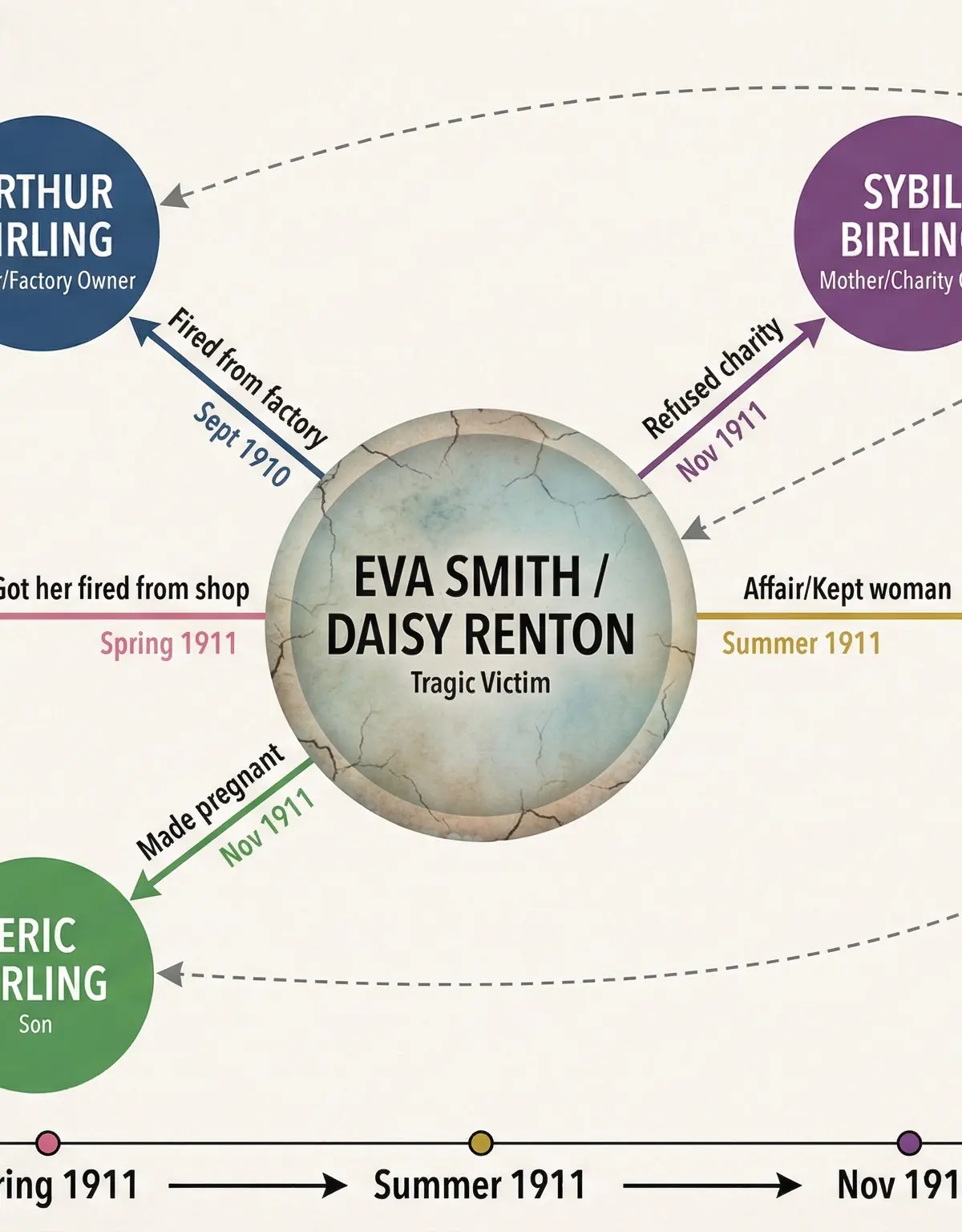
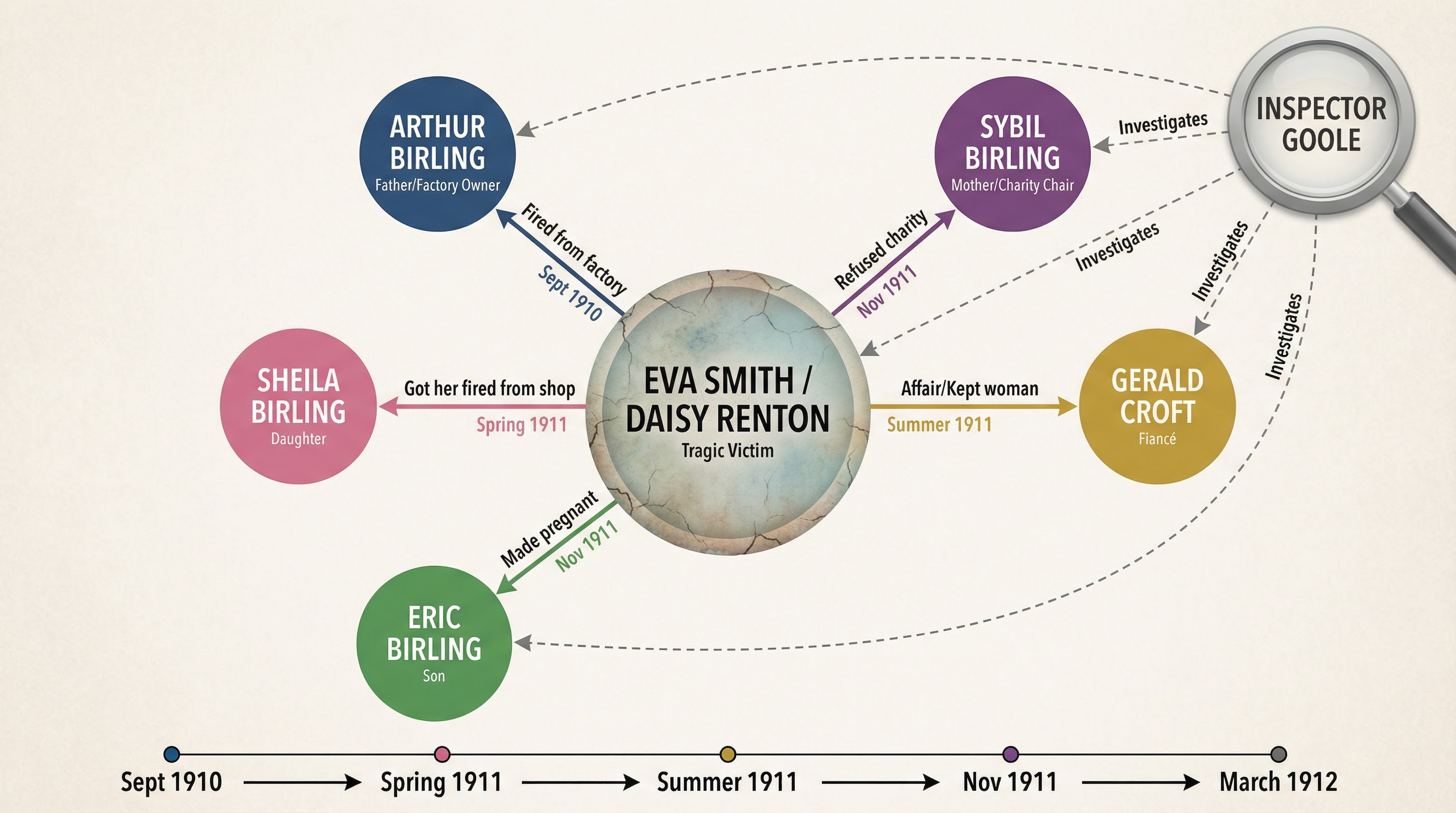
Act One: The play opens in the dining room of the prosperous Birling family in the industrial town of Brumley. Arthur Birling, his wife Sybil, their daughter Sheila, and son Eric are celebrating Sheila's engagement to Gerald Croft, son of a rival industrialist. Arthur Birling makes a series of pompous, ironically incorrect predictions about the future, dismissing the idea of war and promising continued prosperity. The celebration is interrupted by the arrival of Inspector Goole, who announces he is investigating the suicide of a young working-class woman, Eva Smith. He reveals that Mr. Birling sacked her from his factory two years prior for her role in a strike for higher wages. Sheila then confesses that she had Eva fired from a department store out of petty jealousy. The act ends with the revelation that Gerald Croft also knew Eva, under the name Daisy Renton.
Act Two: The Inspector continues his interrogation, focusing on Gerald. Gerald admits to having an affair with Daisy Renton the previous summer, keeping her as his mistress before abandoning her. Sheila is disturbed by the revelation and returns her engagement ring. The focus then shifts to Sybil Birling. As the head of a women's charity, she confesses to refusing help to a pregnant and destitute Eva Smith, who had appealed to the committee under a false name. Sybil remains cold and unrepentant, callously stating the girl had only herself to blame. The act climaxes with Sybil refusing to accept any responsibility and, under the Inspector's questioning, unknowingly blaming the 'drunken young man' who made Eva pregnant, declaring he should be held entirely responsible. As Sheila gasps in horror, Eric enters, his guilt clear.
Act Three: Eric confesses that he had a relationship with Eva, forced himself upon her, and stole money from his father's office to support her after she became pregnant. The family's hypocrisy and moral corruption are laid bare. The Inspector delivers his powerful final speech, warning them of the consequences of their actions in 'fire and blood and anguish' if they do not learn that 'we are members of one body'. He leaves. The family is shaken, but soon Mr. Birling and Gerald begin to question the Inspector's legitimacy. A phone call to the local police station confirms there is no Inspector Goole on the force. Another call to the infirmary reveals no girl has recently died by suicide. Relieved, Arthur, Sybil, and Gerald dismiss the entire event as a hoax. Only Sheila and Eric maintain that they are still guilty of their actions, regardless of the Inspector's identity. The play ends with a final, shocking telephone call: a girl has just died on her way to the infirmary after swallowing disinfectant, and a police inspector is on his way to ask some questions.
Themes
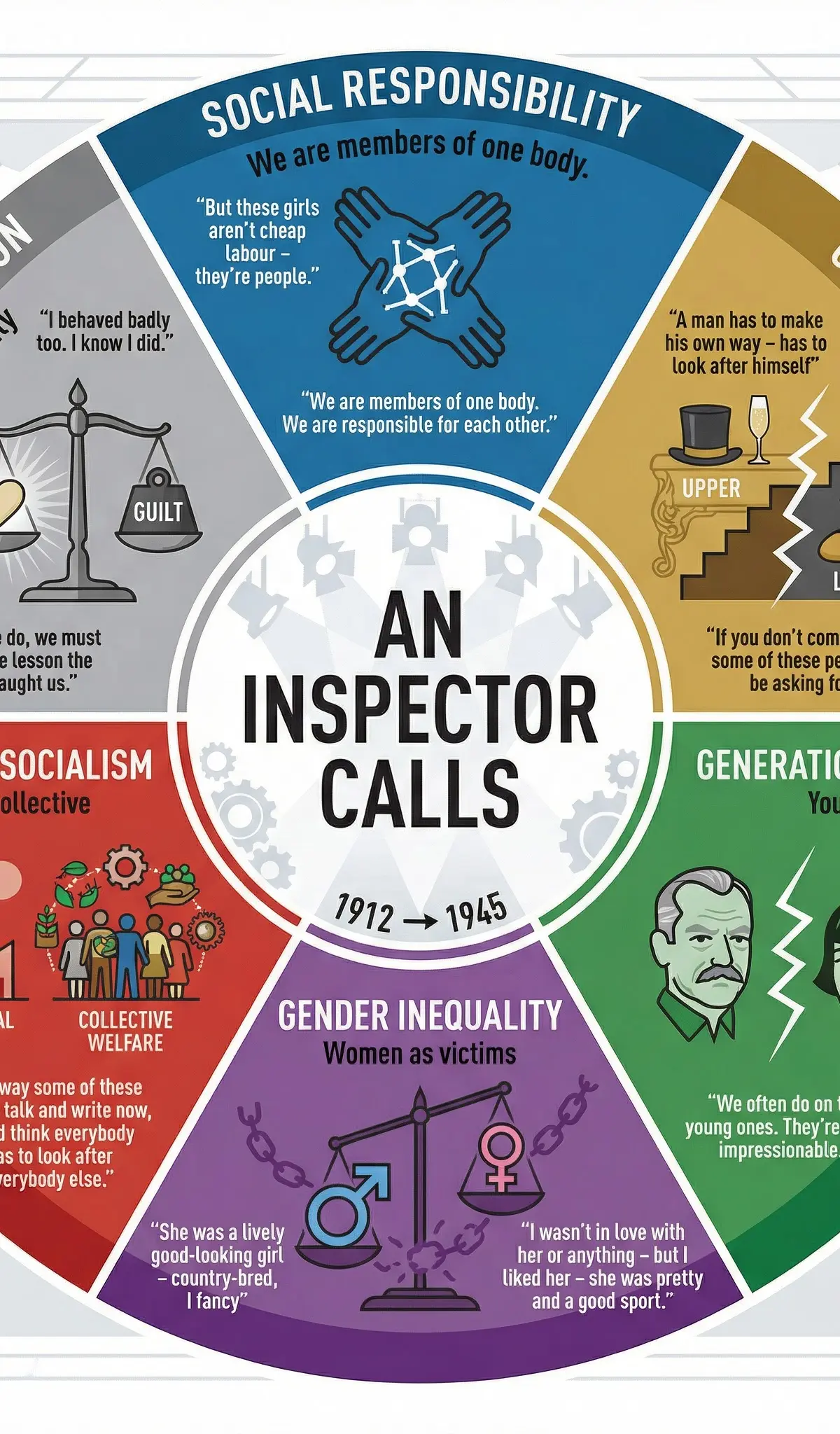
Theme 1: Social Responsibility
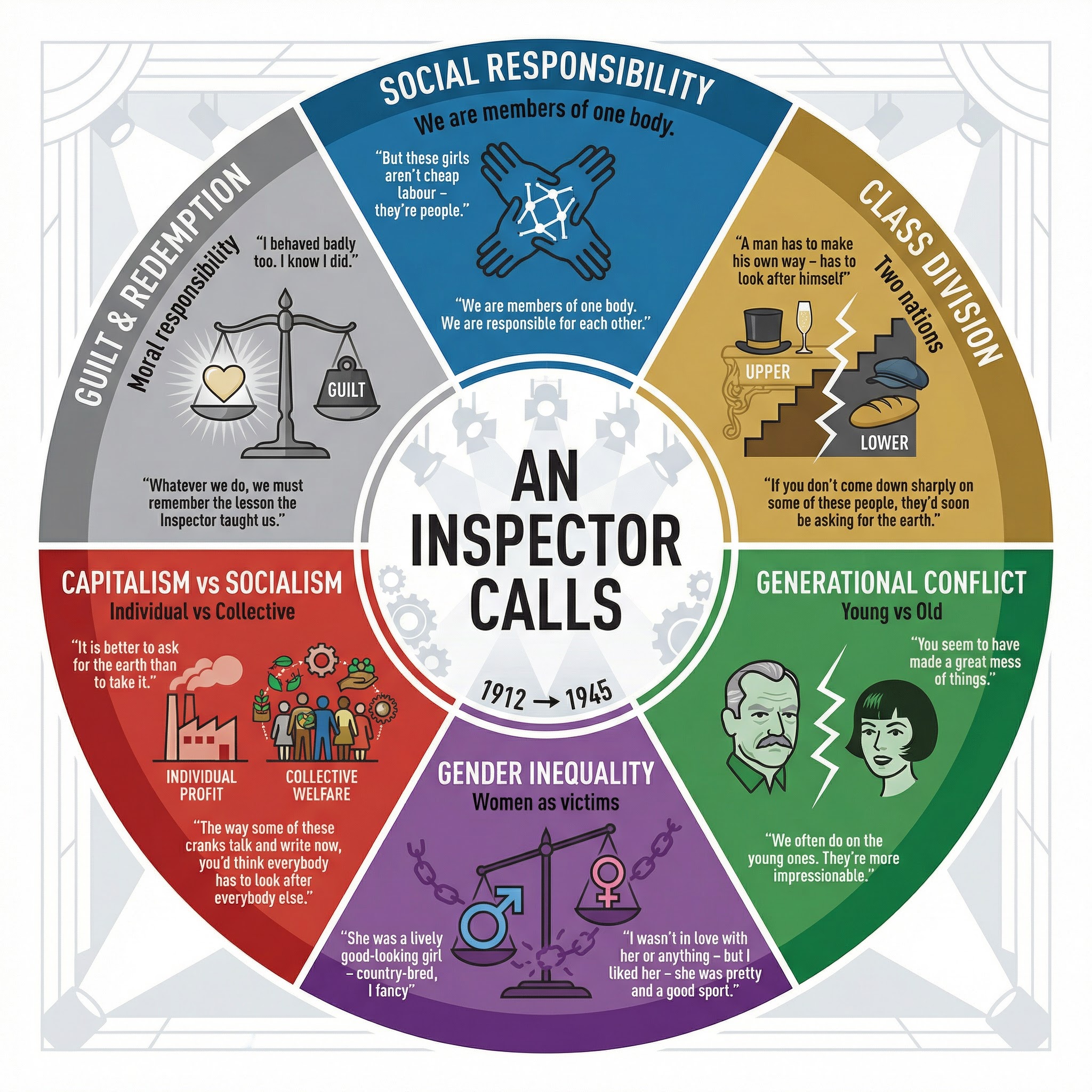
This is the central theme of the play. Priestley uses the Inspector as his mouthpiece to advocate for a socialist vision of society where individuals have a duty to care for one another. The Birlings represent the opposite: a capitalist, individualistic worldview.
Key Quotes:
- "We are members of one body. We are responsible for each other." (Act 3) - The Inspector's final, most important line, summarising the play's core message.
- "A man has to mind his own business and look after himself and his own." (Act 1) - Birling's capitalist creed, which the play systematically dismantles.
- "If men will not learn that lesson, then they will be taught it in fire and blood and anguish." (Act 3) - A prophetic warning, alluding to the coming world wars, suggesting that social inequality and individualism lead to conflict.
Theme 2: Class Division
The play exposes the vast gulf between the wealthy upper classes and the impoverished working classes in Edwardian England. The Birlings' treatment of Eva Smith is a microcosm of the exploitation inherent in the class system.
Key Quotes:
- "As if a girl of that sort would ever refuse money!" (Act 2) - Sybil Birling's prejudiced, class-based assumption about Eva's morals.
- "We're respectable citizens and not criminals." (Act 1) - Gerald's immediate distinction, implying that social standing places them above suspicion.
- "These girls aren't cheap labour - they're people." (Act 1) - Sheila's early sign of changing attitudes, challenging her father's dehumanising view of his workers.
Theme 3: Generational Conflict
Priestley creates a clear divide between the older generation (Arthur and Sybil) and the younger generation (Sheila and Eric). The parents are fixed in their ways, unable to accept responsibility, while the children are shown to be impressionable and capable of moral change.
Key Quotes:
- "You seem to have made a great impression on this child, Inspector." (Act 2) - Sybil's sarcastic comment to Sheila, highlighting the Inspector's influence on the young.
- "The famous younger generation who know it all. And they can't even take a joke." (Act 3) - Birling's mocking dismissal of his children's genuine remorse at the end of the play.
- "It frightens me the way you talk." (Act 3) - Sheila's horrified reaction to her parents' eagerness to forget their actions.
Character Analysis
Arthur Birling
Role: A symbol of arrogant, self-satisfied capitalism. He is a dramatic construct used by Priestley to represent the old guard whose selfish attitudes Priestley believed led to the social disasters of the 20th century.
Key Traits: Pompous, selfish, obsessed with social status, wilfully blind to reality.
Character Arc: He has no arc. He learns nothing and ends the play as he began, concerned only with his reputation and the potential for a knighthood. His lack of change serves Priestley's message.
Essential Quotes:
- "I'm talking as a hard-headed, practical man of business."
- "The Titanic... unsinkable, absolutely unsinkable."
- "There'll be a public scandal."
Sybil Birling
Role: Represents the hypocrisy and coldness of the upper-class matriarch. She is arguably the most cruel and unfeeling character, demonstrating the failure of a society where charity is a tool for social control, not compassion.
Key Traits: Cold, prejudiced, arrogant, wilfully ignorant of her family's failings.
Character Arc: Like her husband, she experiences no change. She refuses to accept any blame and her final lines show her to be completely unmoved by the evening's events.
Essential Quotes:
- "I used my influence to have it refused."
- "Go and look for the father of the child. It's his responsibility."
- "I was the only one of you who didn't give in to him."
Sheila Birling
Role: The proxy for the audience's conscience and the symbol of the younger generation's capacity for change. She begins as a naive, materialistic girl but develops into a mature, socially aware young woman.
Key Traits: Initially frivolous and jealous, becomes insightful, empathetic, and assertive.
Character Arc: Sheila has the most significant arc. She accepts her guilt immediately, learns from her mistakes, and becomes the moral centre of the family, echoing the Inspector's message.
Essential Quotes:
- "But these girls aren't cheap labour - they're people."
- "I behaved badly too. I know I did."
- "It frightens me the way you talk."
Eric Birling
Role: Represents the troubled and repressed side of the upper class. He is a victim of poor parenting and the pressures of Edwardian masculinity, leading to alcoholism and immoral behaviour. Like Sheila, he represents hope for the future.
Key Traits: Awkward, secretive, alcoholic, ultimately remorseful.
Character Arc: Eric's guilt is revealed last, and it is arguably the most shocking. He is ashamed of his actions and, like his sister, accepts responsibility and is appalled by his parents' attitude.
Essential Quotes:
- "I was in that state when a chap easily turns nasty."
- "You're not the kind of father a chap could go to when he's in trouble."
- "The money's not the important thing. It's what happened to the girl and what we all did to her that matters."
Inspector Goole
Role: The play's moral catalyst and Priestley's mouthpiece. He is not a realistic police officer but a dramatic device to force the characters (and the audience) to confront their social responsibilities.
Key Traits: Authoritative, mysterious, moral, omniscient.
Character Arc: He is a static character who arrives, serves his function, and leaves. His purpose is to drive the plot and deliver the play's message.
Essential Quotes:
- "It's my duty to ask questions."
- "Public men, Mr Birling, have responsibilities as well as privileges."
- "We are members of one body. We are responsible for each other."
Writer's Methods
Priestley uses a range of dramatic techniques to convey his message. High-level analysis of these methods is crucial for AO2.
- Structure: The play follows the classical unities of time, place, and action, taking place in one room over a few hours. This creates a claustrophobic, pressure-cooker atmosphere. The structure is that of a 'well-made play', with secrets revealed in a chain of cause and effect, building to a climax.
- Dramatic Irony: The audience knows the historical events that Mr. Birling confidently dismisses (WWI, the Titanic). This immediately undermines his authority and the capitalist ideology he represents.
- Staging and Lighting: The stage directions are vital. The lighting changes from 'pink and intimate' to 'brighter and harder' on the Inspector's arrival, symbolising the shift from comfortable illusion to harsh reality.
- Timing of Entrances and Exits: Characters enter and exit at crucial moments. Eric's re-entry just as his mother condemns the father of Eva's child is a key example of stagecraft creating dramatic tension.
- The Inspector's Final Speech: This is a direct address to the audience as much as to the characters. It breaks the fourth wall and delivers the play's socialist sermon.
Context
Integrating context (AO3) is about linking historical facts to the play's meaning.
- 1912 vs 1945: The play is a critique of the past from the perspective of the future. The 1945 audience had lived through two world wars and the Great Depression, and were in the process of building a new, more collectivist society with the NHS and welfare state. The play is a warning not to return to the selfish individualism of the Edwardian era.
- Capitalism vs Socialism: Priestley was a socialist. He uses Birling to represent the evils of unchecked capitalism, where profit is prioritised over people. The Inspector represents the socialist ideal of collective responsibility.
- Gender Roles: The play explores the vulnerability of women in a patriarchal society. Eva Smith is a victim of the men who use and discard her, and of the women (Sybil and Sheila) who punish her for her gender and class. Sheila's journey, however, suggests a move towards a more empowered female voice.
Visual Resources
2 diagrams and illustrations
Interactive Diagrams
1 interactive diagram to visualise key concepts
Conceptual Flow Outline
The Character Arc of Sheila Birling
Worked Examples
2 worked examples — open one to explore the question and available guidance.
Practice Questions
Test your understanding — click to reveal model answers
How does Priestley present the relationship between Gerald Croft and Sheila Birling in 'An Inspector Calls'?
Hint: Consider how their relationship changes from the start of the play to the end. Think about what their relationship represents in terms of class and gender.
Explore the importance of the character of Eva Smith in the play.
Hint: Remember that Eva Smith never appears on stage. Why is this significant? What does she represent?
How does Priestley use the setting of the dining room to create drama?
Hint: Think about the unities of time and place. Why is it significant that the entire play happens in one room?
To what extent do you think Sybil Birling is the most villainous character in the play?
Hint: This is an 'evaluate' question. You need to make a judgement. Compare her actions and attitude to other characters.
Test your understanding of An Inspector Calls
Active recall beats re-reading. Take an instant quiz now to test what you’ve learned and lock it into long-term memory.
7 days Premium · Then free forever · No card, no charge