OCR · GCSE · English Literature
Modern prose or drama
An Inspector Calls is a gripping, claustrophobic morality play disguised as a detective thriller. Studying this text rewards you for understanding how Priestley manipulates dramatic irony and tension to expose the hypocrisy of Edwardian capitalism and argue for collective social responsibility.
- 10 min read
- 2 worked examples
- 4 practice questions
- 8 key terms
Study Notes
Overview
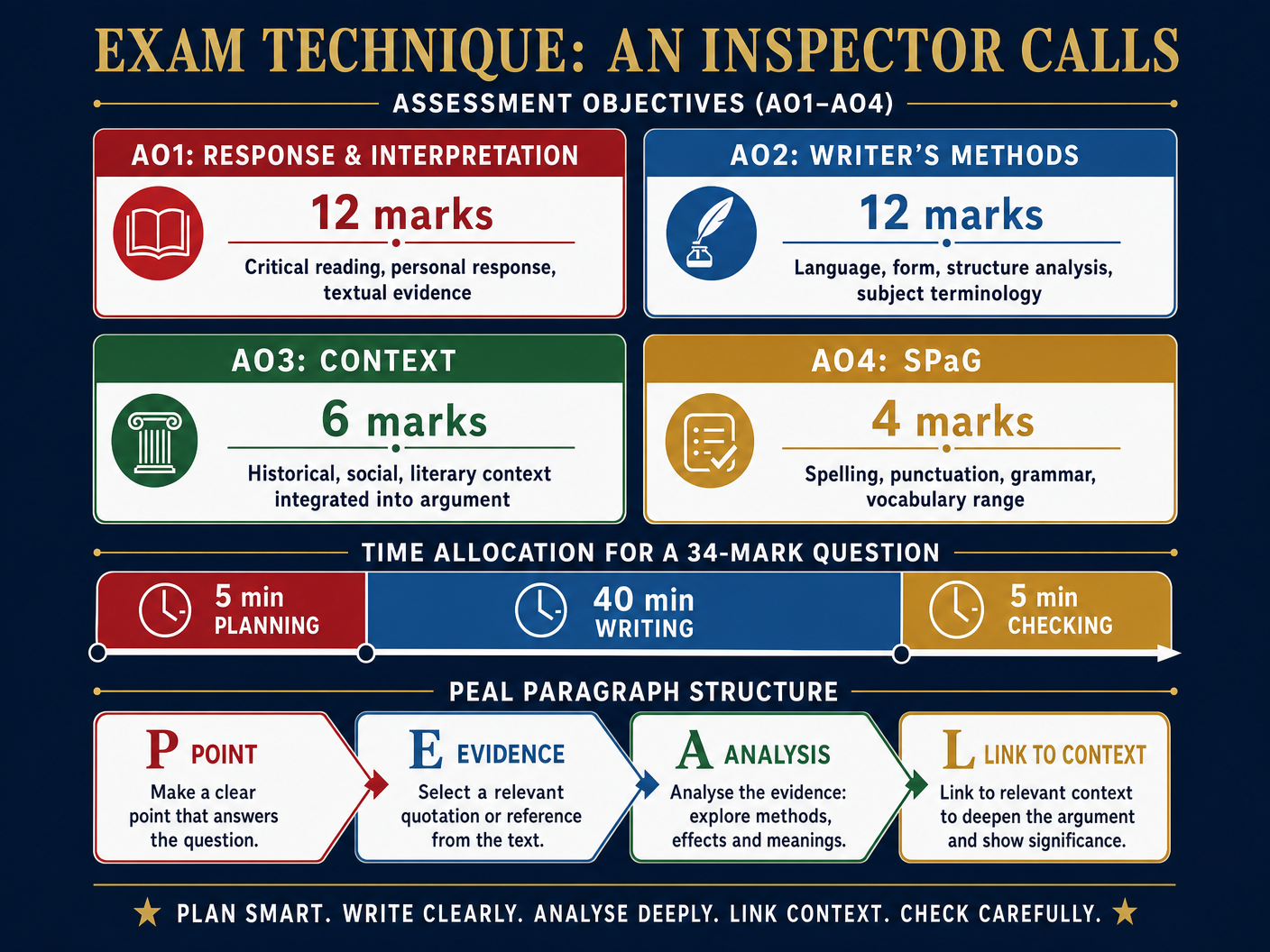
An Inspector Calls is a masterful piece of 20th-century drama that remains fiercely relevant today. Written in 1945 by J.B. Priestley, but set in 1912, the play uses the structure of a detective thriller to deliver a profound socialist critique of capitalist society. For GCSE candidates, this text is a goldmine for AO2 (writer's methods) and AO3 (context). Examiners consistently reward students who understand that the play is not a realistic portrayal of an investigation, but rather a carefully constructed political argument. The Inspector is not a real policeman; he is a dramatic device used to strip away the Birlings' comfortable illusions and force them—and the audience—to confront their complicity in the suffering of the working classes.
Plot/Content Overview
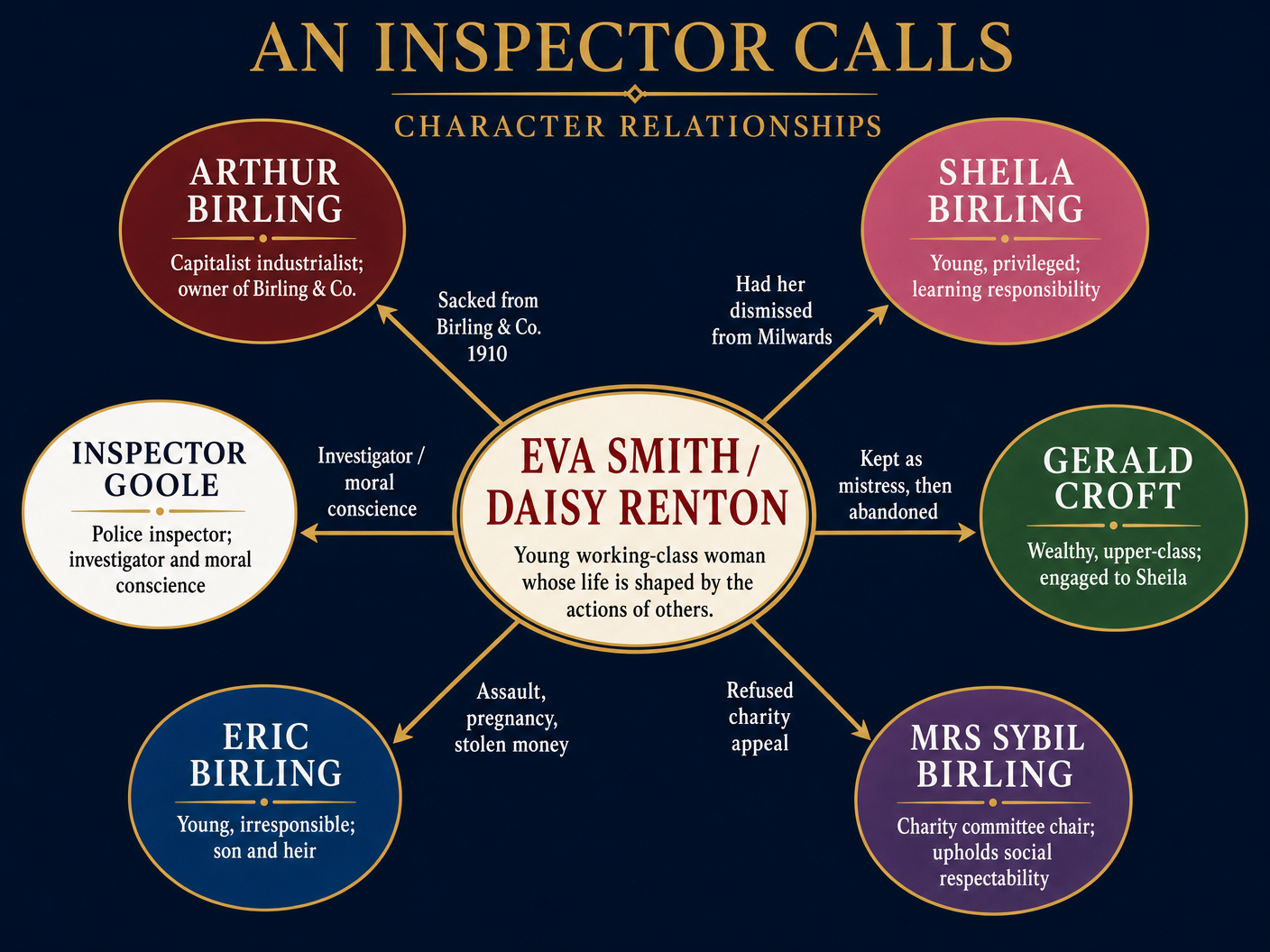
Act One: The play opens in the comfortable dining room of the Birling family in 1912. They are celebrating the engagement of Sheila Birling to Gerald Croft, uniting two wealthy manufacturing families. Arthur Birling delivers pompous, dramatically ironic speeches predicting a future of peace and prosperity. The mood is shattered by the arrival of Inspector Goole, who announces that a young working-class woman, Eva Smith, has died by suicide. The Inspector reveals that Birling sacked Eva from his factory for leading a strike for higher wages. He then reveals that Sheila later had Eva fired from her job at Milwards department store out of petty jealousy. The act ends with the Inspector turning his attention to Gerald.
Act Two: Gerald confesses that he met Eva (then using the name Daisy Renton) at the Palace bar, rescued her from a womaniser, and made her his mistress before abandoning her. Sheila breaks off their engagement, though she respects Gerald's honesty. The Inspector then questions Sybil Birling. It is revealed that she used her influence as chair of a local charity to deny financial help to the pregnant and destitute Eva. Sybil defiantly claims that the father of the child is entirely to blame and should be made an example of. The act ends with the horrifying realisation that the father is her own son, Eric.
Act Three: Eric confesses that he forced himself on Eva while drunk, got her pregnant, and stole money from his father's business to support her. The family's hypocrisy is fully exposed. The Inspector delivers a powerful final speech warning that if men do not learn that "we are members of one body," they will be taught in "fire and blood and anguish." After he leaves, the older Birlings and Gerald discover that Goole was not a real police inspector and that no girl has died at the infirmary. Arthur, Sybil, and Gerald are relieved and immediately revert to their old behaviour. Sheila and Eric, however, are permanently changed and insist that the moral lesson remains. The play ends with a shocking twist: the phone rings, and Birling announces that a girl has just died by suicide, and a police inspector is on his way to ask some questions.
Themes
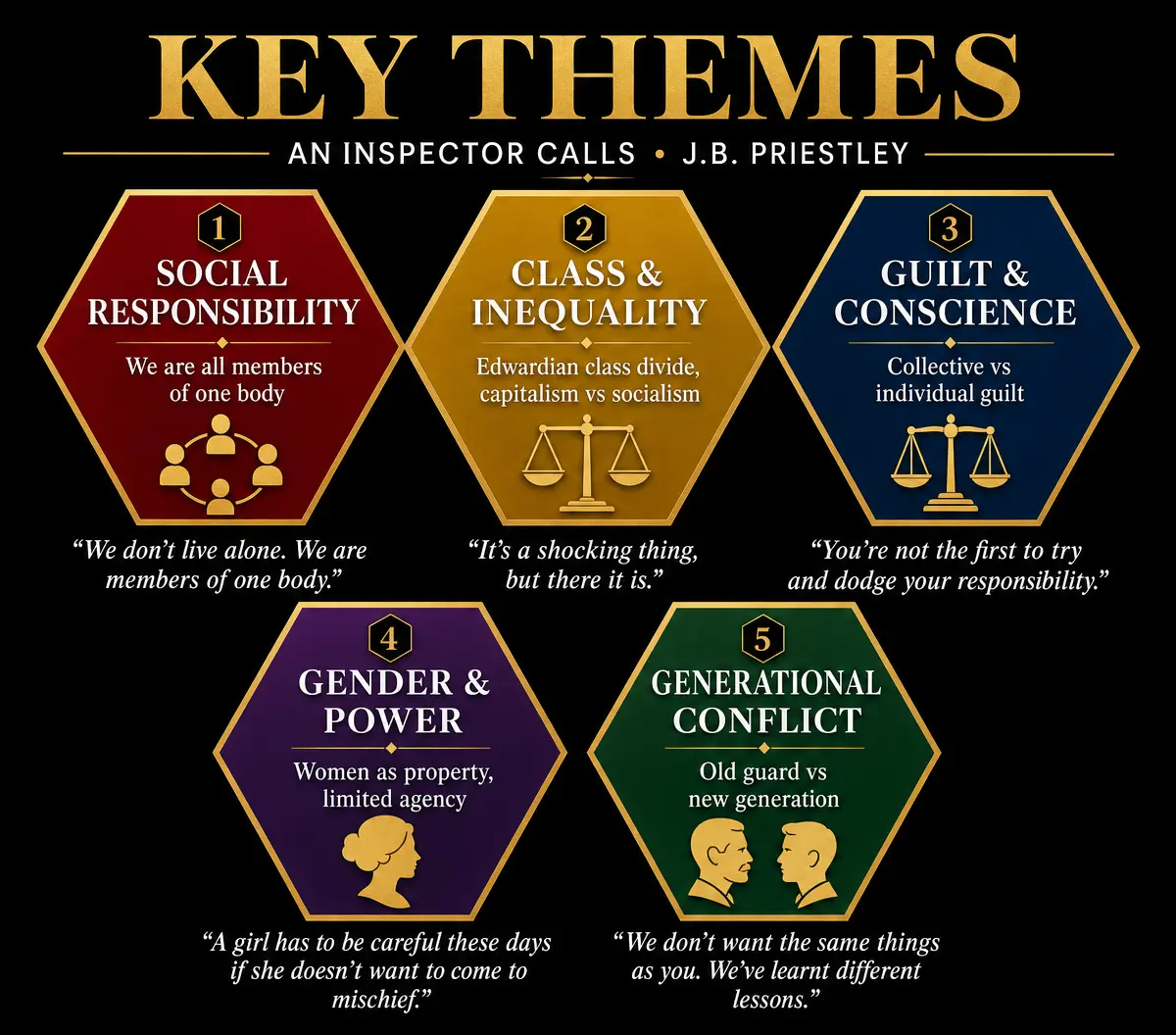
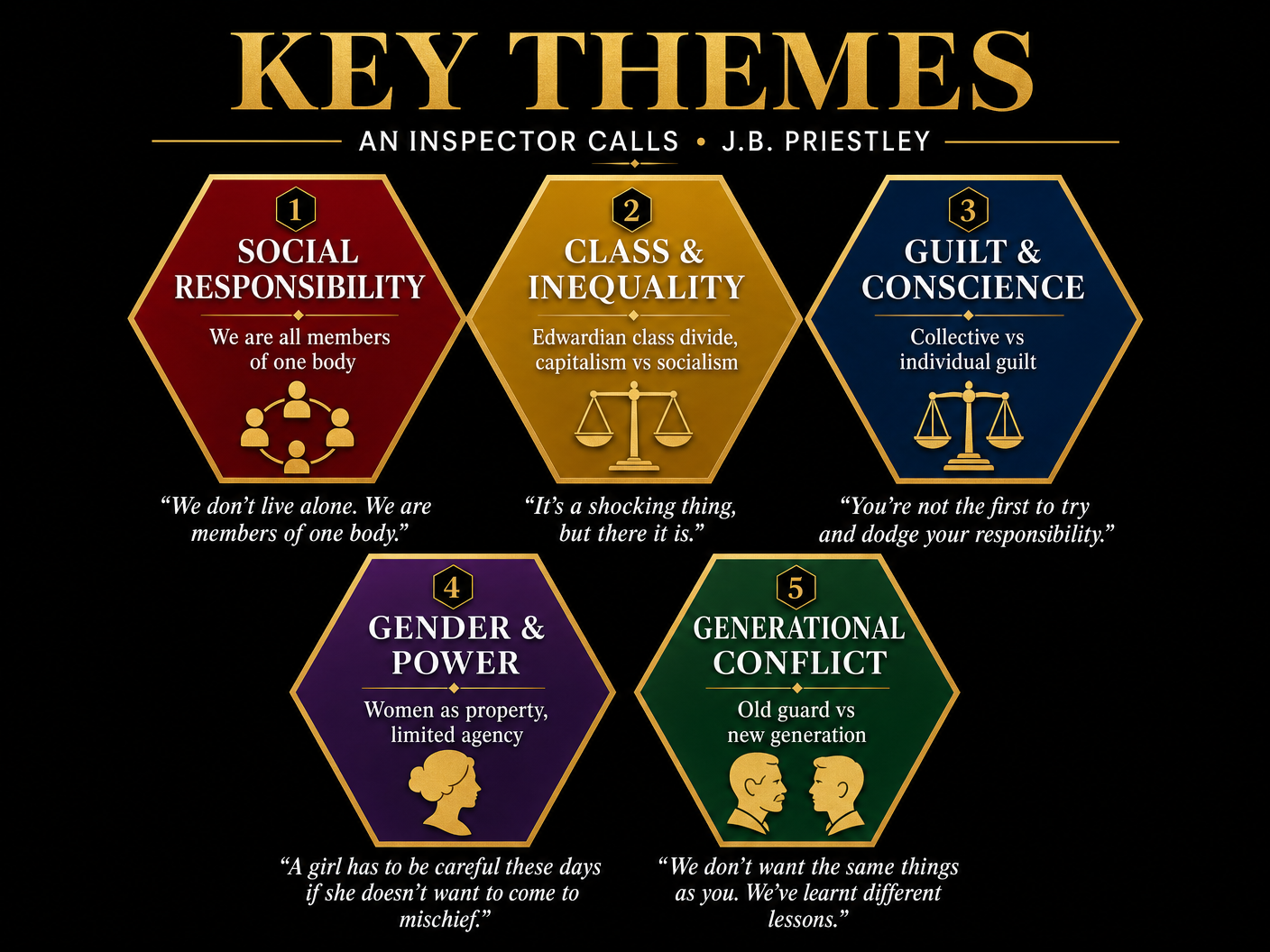
Theme 1: Social Responsibility
This is the central thematic pillar of the play. Priestley uses the narrative to argue that individuals do not exist in a vacuum; every action has consequences for others. The play contrasts Arthur Birling's capitalist individualism ("a man has to make his own way") with the Inspector's socialist collectivism ("We are members of one body"). Examiners reward candidates who trace how this theme separates the older generation (who reject responsibility) from the younger generation (who accept it).
Key Quotes:
- "We don't live alone. We are members of one body. We are responsible for each other." (Inspector, Act 3) - Priestley's core message, using the metaphor of a single body to emphasise total interconnectedness.
- "I can't accept any responsibility." (Arthur Birling, Act 1) - Demonstrates the callousness of the capitalist mindset.
- "It's what happened to the girl and what we all did to her that matters." (Eric, Act 3) - Shows the younger generation's capacity for moral growth.
Theme 2: Class and Inequality
Priestley exposes the rigid, hypocritical class system of Edwardian Britain. Eva Smith represents the working classes—voiceless, vulnerable, and entirely at the mercy of the wealthy. The Birlings' wealth insulates them from the consequences of their actions, while Eva's poverty leaves her exposed to exploitation. The play demonstrates how the upper classes abuse their power in every sphere: economic (Arthur), social (Sheila and Sybil), and sexual (Gerald and Eric).
Key Quotes:
- "If you don't come down sharply on some of these people, they'd soon be asking for the earth." (Arthur Birling, Act 1) - Reveals his view of the working class as a threat to be managed, not humans to be respected.
- "Girls of that class-" (Sybil Birling, Act 2) - Sybil's dismissive, generalising language shows her total lack of empathy and her belief in innate class superiority.
- "But these girls aren't cheap labour - they're people." (Sheila, Act 1) - The first sign of a crack in the Birlings' capitalist worldview.
Theme 3: Guilt and Conscience
The play functions as a moral trial. Priestley explores how different characters respond to guilt. The older generation use denial, justification, and legal technicalities to evade their conscience. The younger generation, conversely, allow their guilt to transform them. The Inspector acts as an externalised conscience, forcing the characters to confront the ugly reality behind their respectable facades.
Key Quotes:
- "I know I'm to blame - and I'm desperately sorry." (Sheila, Act 2) - Unqualified acceptance of guilt, contrasting sharply with her parents.
- "I was in that state when a chap easily turns nasty." (Eric, Act 3) - An attempt to normalise horrific behaviour, showing that even Eric initially tries to deflect total blame.
- "There's every excuse for what both your mother and I did." (Arthur Birling, Act 3) - The older generation's refusal to engage with their conscience.
Character Analysis
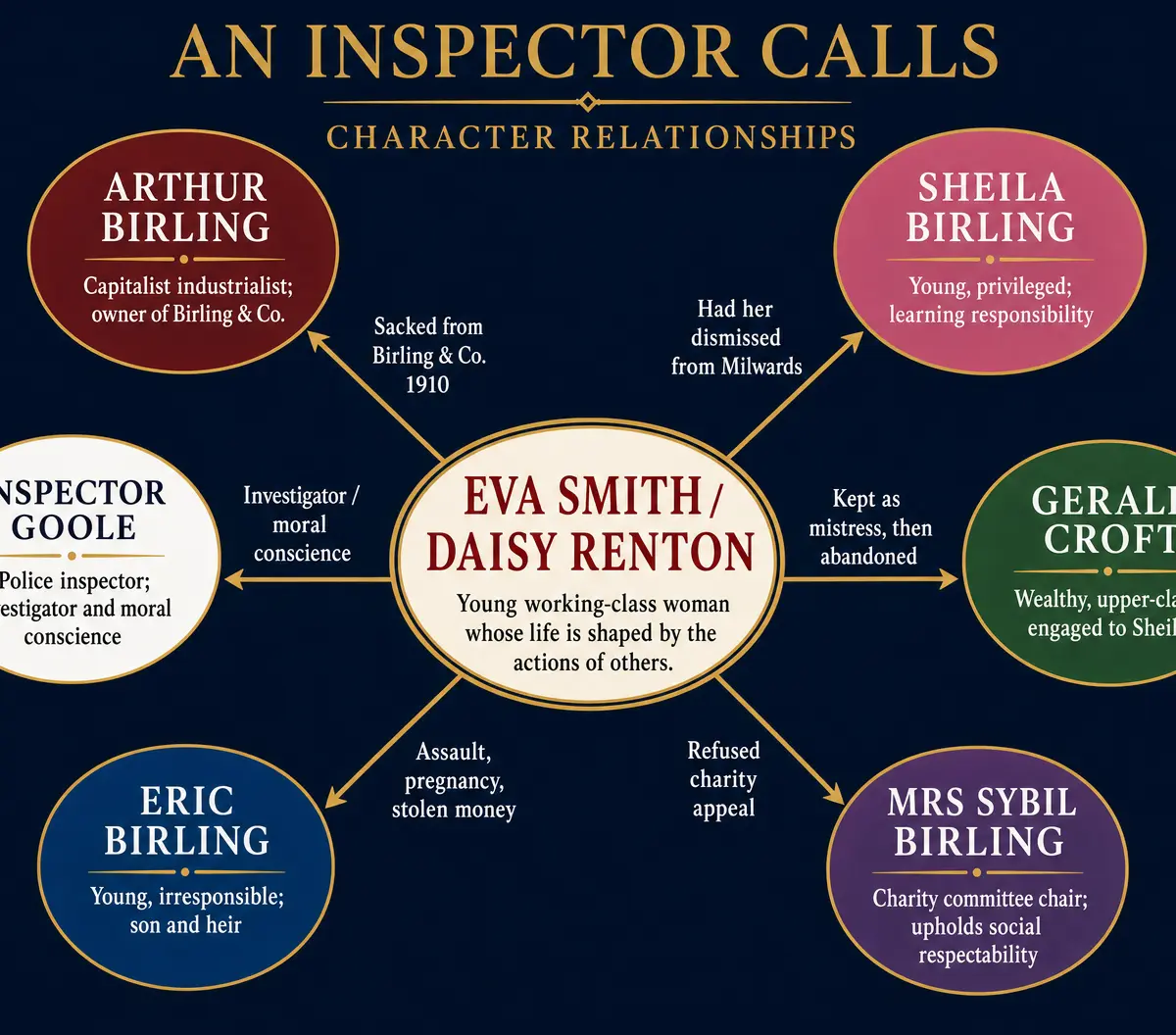
Inspector Goole
Role: The catalyst for the drama and Priestley's mouthpiece. He controls the pace, structure, and moral direction of the play.
Key Traits: Authoritative, commanding, omniscient, unimpressed by social status.
Character Arc: He does not change; rather, he forces change in others. He arrives as a disruptive force and leaves as a prophetic judge.
Essential Quotes:
- "He creates at once an impression of massiveness, solidity and purposefulness." (Stage direction, Act 1)
- "Public men, Mr Birling, have responsibilities as well as privileges." (Act 2)
- "They will be taught it in fire and blood and anguish." (Act 3)
Arthur Birling
Role: The embodiment of capitalist greed and Edwardian complacency.
Key Traits: Pompous, arrogant, insecure about his social status, self-interested.
Character Arc: Static. He learns nothing and remains entirely focused on his reputation and knighthood.
Essential Quotes:
- "A hard-headed practical man of business." (Act 1)
- "The Titanic... unsinkable, absolutely unsinkable." (Act 1)
- "There'll be a public scandal." (Act 3)
Sheila Birling
Role: The emotional core of the play and the symbol of hope for the future.
Key Traits: Initially superficial and vain, but ultimately perceptive, empathetic, and morally courageous.
Character Arc: Undergoes the most profound transformation, moving from a protected, naive girl to an independent, morally aware woman who challenges her parents.
Essential Quotes:
- "Oh - how horrible! Was it an accident?" (Act 1)
- "You mustn't try to build up a kind of wall between us and that girl." (Act 2)
- "It frightens me the way you talk." (Act 3)
Writer's Methods
Priestley uses a range of dramatic techniques to convey his message. Examiners specifically look for analysis of these methods (AO2):
1. Dramatic Irony: Priestley relies heavily on the audience knowing more than the characters. Birling's predictions about the Titanic and the impossibility of war make him look foolish to a 1945 audience, instantly undermining his capitalist worldview and positioning the audience to trust the Inspector instead.
2. The Unity of Time, Place, and Action: By confining the play to a single room in real-time, Priestley creates an intense, claustrophobic atmosphere. The Birlings cannot escape the Inspector's interrogation, just as society cannot escape its collective responsibility.
3. The Well-Made Play Structure: Priestley subverts the traditional "whodunit." Instead of finding one guilty person, the Inspector proves that everyone is guilty. The play is structured as a chain of events, reinforcing the theme of interconnectedness.
4. Stage Directions: The lighting shift from "pink and intimate" to "brighter and harder" is crucial. The Birlings are viewing the world through rose-tinted glasses until the Inspector arrives to shine a harsh light of interrogation upon them.
Context
Understanding context (AO3) is vital, but it must be integrated into your analysis of the text. Do not just write a history paragraph.
1912 vs 1945: The play is set in 1912, a time of rigid class divisions, extreme inequality, and complacency among the wealthy. It was written and first performed in 1945, just after two devastating world wars. Priestley deliberately uses this gap to highlight the catastrophic failure of the Edwardian capitalist mindset.
The Welfare State: In 1945, Britain was on the verge of electing a Labour government that would establish the welfare state (including the NHS). Priestley's play is a powerful piece of political propaganda urging the audience to vote for a society based on mutual support rather than individual greed.
The Position of Women: Eva Smith's vulnerability is a direct result of her gender and class in Edwardian Britain. Women did not have the vote, working-class women were paid a pittance, and there was no social safety net. Middle-class women like Sheila were expected to be obedient and marry well, rather than have independent careers.
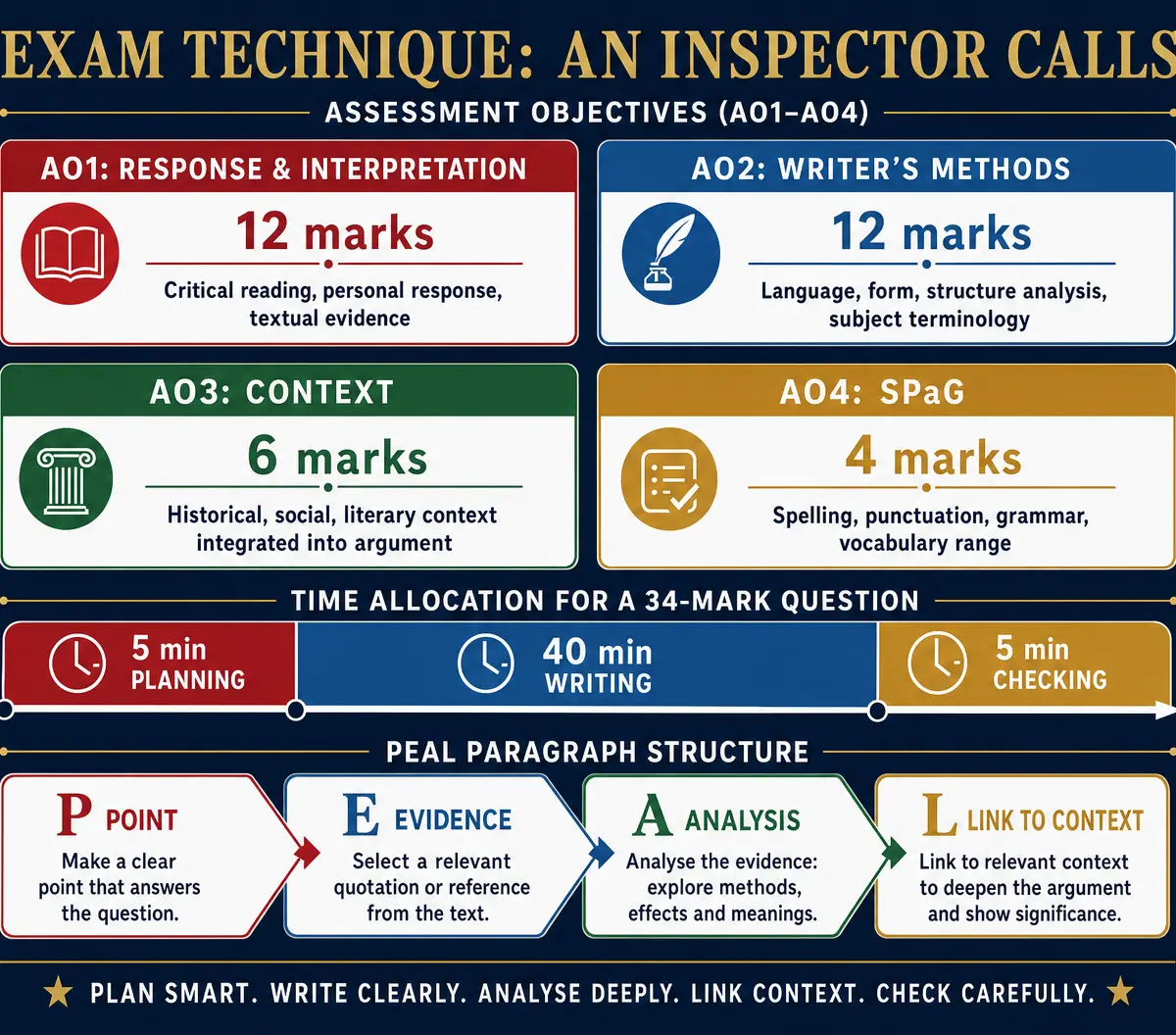
Visual Resources
3 diagrams and illustrations
Interactive Diagrams
1 interactive diagram to visualise key concepts
Conceptual Flow Outline
The Chain of Events leading to Eva Smith's death
Worked Examples
2 worked examples — open one to explore the question and available guidance.
Practice Questions
Test your understanding — click to reveal model answers
How does Priestley use the character of the Inspector to suggest ways that society could be improved? (30 marks + 4 AO4)
Hint: Focus on the Inspector as a mouthpiece for Priestley's socialism. Contrast his views with the Birlings' capitalism.
Explore how Priestley presents the differences between the older and younger generations in the play. (30 marks + 4 AO4)
Hint: Compare Arthur/Sybil's refusal to change with Sheila/Eric's acceptance of guilt.
How does Priestley present the theme of gender inequality in 'An Inspector Calls'? (30 marks + 4 AO4)
Hint: Look at how Eva is treated differently because she is a woman, and how Sheila is treated by her parents and Gerald.
How important is the setting of the Birling family dining room to the play as a whole? (30 marks + 4 AO4)
Hint: Think about the 'unity of place', claustrophobia, and the dining room as a microcosm of society.
Test your understanding of Modern prose or drama
Active recall beats re-reading. Take an instant quiz now to test what you’ve learned and lock it into long-term memory.
7 days Premium · Then free forever · No card, no charge