OCR · GCSE · English Literature
Shakespeare
Macbeth is a gripping psychological thriller about ambition, guilt, and the supernatural. Studying this play rewards candidates who can analyse how Shakespeare uses dramatic irony and powerful imagery to explore the destructive consequences of unchecked power.
- 7 min read
- 2 worked examples
- 2 practice questions
- 8 key terms
Study Notes
Overview
Shakespeare's Macbeth is a profound exploration of ambition, guilt, and the supernatural. For OCR Paper 2 Section A, examiners reward candidates who demonstrate a critical understanding of how Shakespeare uses dramatic form, structure, and language to present his ideas. You must show how the play functions as a piece of theatre written for a Jacobean audience, integrating context naturally into your analysis rather than 'bolting it on'. Whether tackling an extract-based or discursive question, a sustained, conceptualised argument supported by precise textual references is essential for reaching the top bands.
Listen to our comprehensive revision podcast to solidify your understanding of the play's core concepts and exam techniques:
Plot/Content Overview
Act 1: Returning from battle, Macbeth and Banquo meet three Witches who prophesy that Macbeth will become King. Driven by his own ambition and manipulated by Lady Macbeth, Macbeth resolves to murder King Duncan.
Act 2: Macbeth murders Duncan in his sleep. Duncan's sons, Malcolm and Donalbain, flee in fear, making Macbeth the prime suspect but allowing him to seize the crown.
Act 3: Paranoid about the Witches' prophecy that Banquo's descendants will be kings, Macbeth has Banquo murdered. At a banquet, Macbeth is tormented by Banquo's ghost, revealing his guilt and fracturing mind.
Act 4: Macbeth seeks out the Witches again. They offer deceptive prophecies that make him feel invincible. He orders the slaughter of Macduff's family. Meanwhile, Macduff joins Malcolm in England to raise an army.
Act 5: Lady Macbeth, consumed by guilt, sleepwalks and tries to wash imaginary blood from her hands before dying. The English army attacks, using branches from Birnam Wood as camouflage. Macduff, who was 'from his mother's womb untimely ripped', kills Macbeth. Malcolm is restored as the rightful King.
Themes
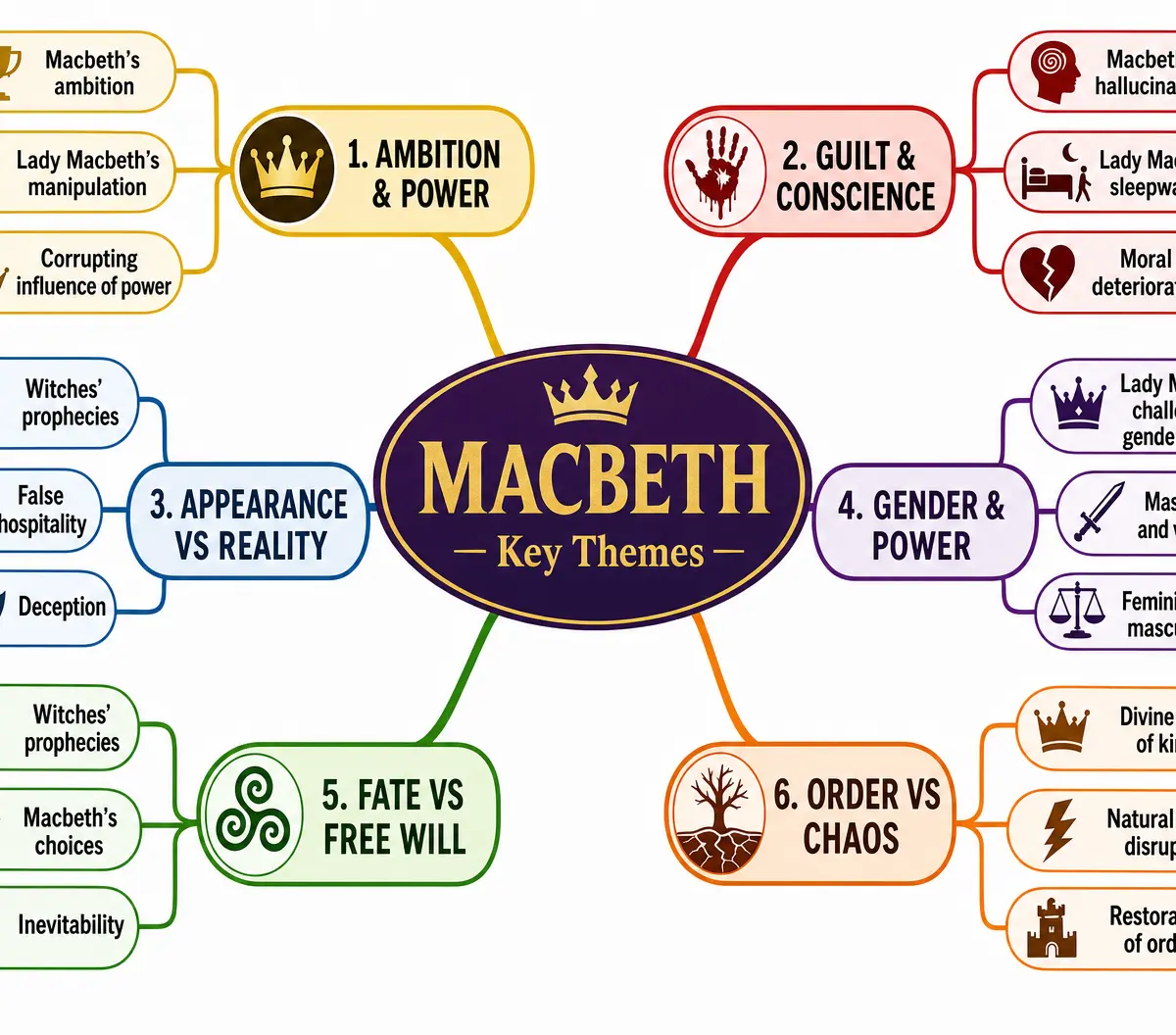
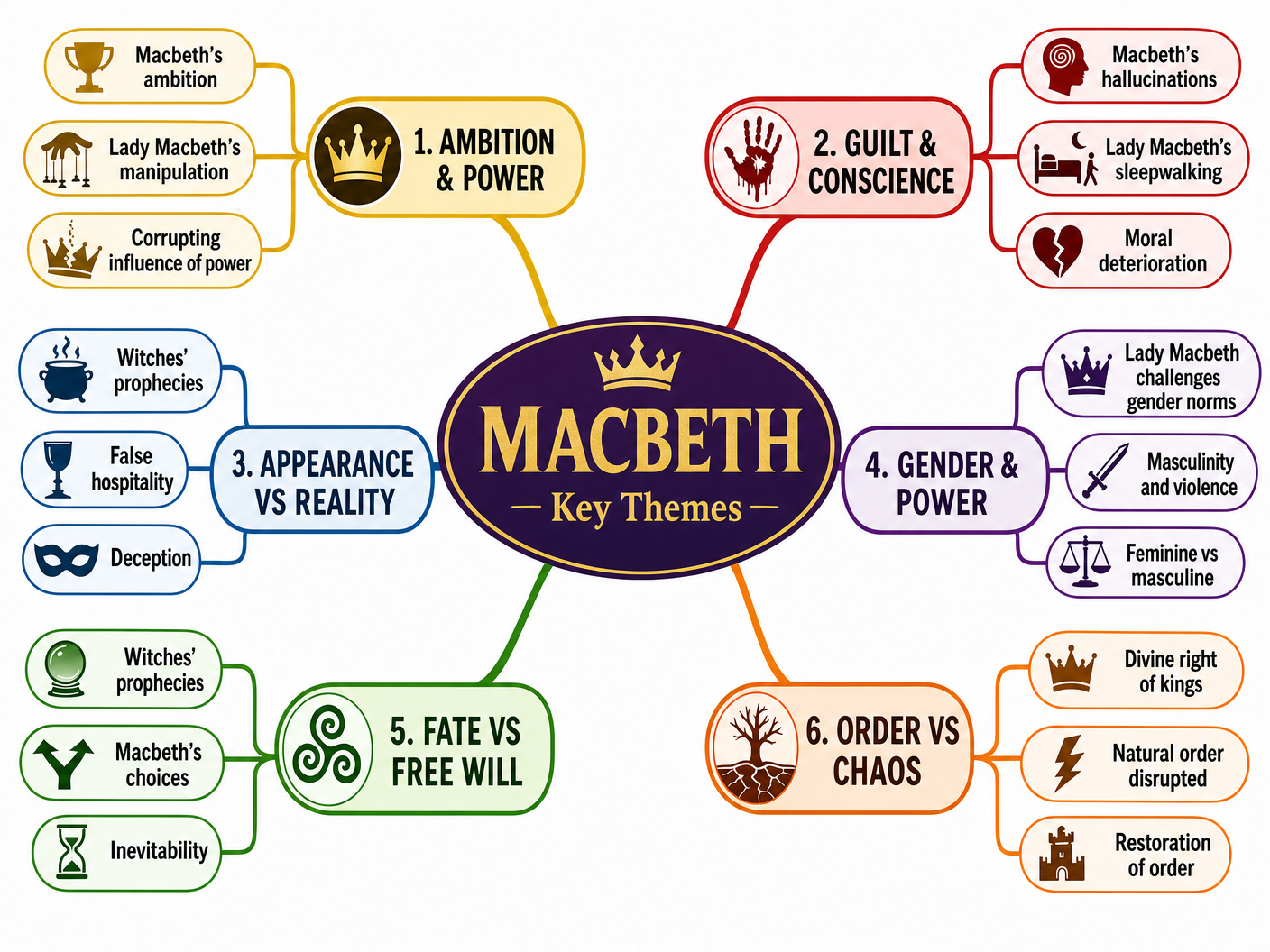
Theme 1: Ambition and Power
Shakespeare presents ambition not merely as a flaw, but as a destructive force when unconstrained by moral boundaries. Macbeth's 'vaulting ambition' corrupts his nobility, transforming him from a 'valiant cousin' to a 'dead butcher'. Examiners reward analysis of how ambition is presented as a sickness or unnatural force that disrupts the Divine Right of Kings.
Key Quotes:
- "I have no spur / To prick the sides of my intent, but only / Vaulting ambition, which o'erleaps itself" (Act 1, Scene 7) - The metaphor of horse-riding illustrates Macbeth's awareness that his ambition is uncontrollable and self-destructive.
- "Stars, hide your fires; / Let not light see my black and deep desires" (Act 1, Scene 4) - The juxtaposition of light and dark highlights Macbeth's moral conflict and desire to conceal his treasonous thoughts.
Theme 2: Guilt and Conscience
Guilt permeates the play, manifesting psychologically and physically. Shakespeare uses hallucinations—the dagger, Banquo's ghost, the blood on Lady Macbeth's hands—to symbolise the inescapable nature of a guilty conscience. A perceptive response will note the structural reversal: Macbeth's initial hesitation hardens into ruthlessness, while Lady Macbeth's initial ruthlessness crumbles into madness.
Key Quotes:
- "Will all great Neptune's ocean wash this blood / Clean from my hand?" (Act 2, Scene 2) - The hyperbolic reference to 'Neptune's ocean' emphasizes the magnitude of Macbeth's guilt, which cannot be cleansed.
- "Out, damned spot! out, I say!" (Act 5, Scene 1) - Lady Macbeth's fragmented prose and repetition reflect her psychological collapse, contrasting sharply with her earlier commanding blank verse.
Theme 3: Appearance vs Reality
The play is built on deception, initiated by the Witches' paradox "Fair is foul, and foul is fair." Characters constantly hide their true intentions. Shakespeare uses dramatic irony extensively, allowing the audience to see the 'serpent' beneath the 'innocent flower', creating profound tension.
Key Quotes:
- "Look like the innocent flower, / But be the serpent under't." (Act 1, Scene 5) - Lady Macbeth's imperative uses a biblical allusion to the Fall of Man, connecting their deception to original sin.
- "There's no art / To find the mind's construction in the face" (Act 1, Scene 4) - Duncan's tragic flaw is his inability to see past appearances, making his murder deeply ironic.
Character Analysis
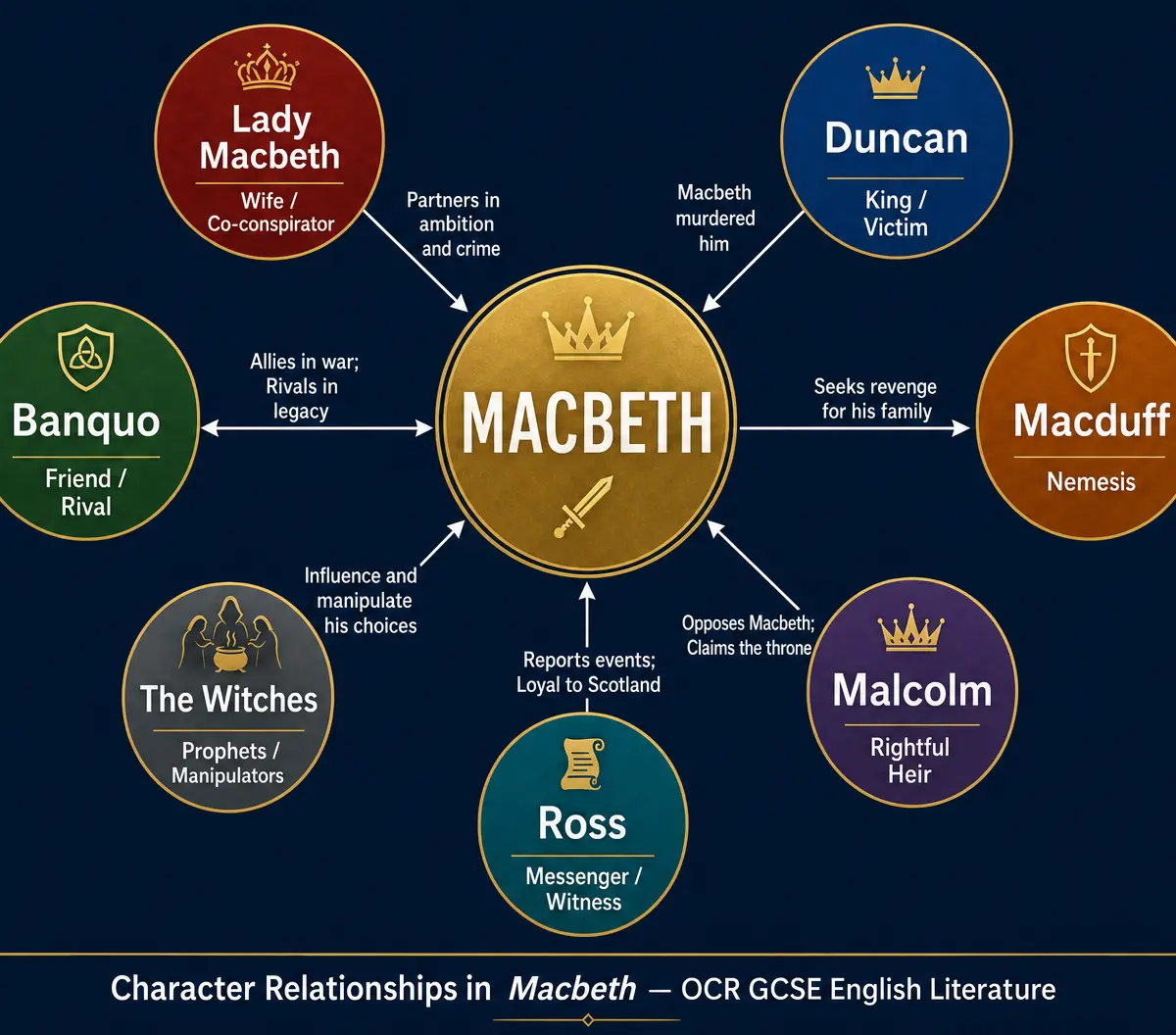
Macbeth
Role: The tragic hero whose fatal flaw (hamartia) is unchecked ambition.
Key Traits: Brave, ambitious, morally conflicted, paranoid, ultimately nihilistic.
Character Arc: Transitions from a loyal, heroic soldier to a hesitant murderer, then to a tyrannical, isolated king, ending in bleak despair.
Essential Quotes:
- "For brave Macbeth - well he deserves that name" (Act 1, Scene 2)
- "O, full of scorpions is my mind, dear wife!" (Act 3, Scene 2)
- "Life's but a walking shadow, a poor player / That struts and frets his hour upon the stage" (Act 5, Scene 5)
Lady Macbeth
Role: The catalyst for Duncan's murder; a subverter of Jacobean gender norms.
Key Traits: Manipulative, commanding, outwardly ruthless but inwardly fragile.
Character Arc: Begins as the dominant force driving the plot, but becomes isolated and destroyed by guilt as Macbeth acts independently.
Essential Quotes:
- "Come, you spirits / That tend on mortal thoughts, unsex me here" (Act 1, Scene 5)
- "My hands are of your colour, but I shame / To wear a heart so white." (Act 2, Scene 2)
- "Here's the smell of the blood still: all the perfumes of Arabia will not sweeten this little hand." (Act 5, Scene 1)
Writer's Methods
Examiners (AO2) require analysis of how Shakespeare shapes meaning:
- Dramatic Irony: Used to build tension, particularly when Duncan arrives at Macbeth's castle praising its 'pleasant seat'.
- Soliloquy: Essential for revealing the internal psychological conflict of characters, creating a sense of intimacy between the protagonist and the audience.
- Verse and Prose: Noble characters speak in iambic pentameter (blank verse). The Witches speak in trochaic tetrameter (disrupting the natural rhythm). Lady Macbeth's descent into madness is marked by her shift from verse to fragmented prose.
- Motifs: Blood (symbolising guilt), sleep (symbolising innocence and peace), and darkness (symbolising evil and the supernatural).
Context
For AO3, context must inform your interpretation, not dominate it:
- The Divine Right of Kings: The Jacobean belief that monarchs were appointed by God. Regicide was not just murder, but a crime against God and nature, leading to cosmic chaos (e.g., the unnatural events following Duncan's death).
- Witchcraft and the Supernatural: King James I wrote Daemonologie and actively hunted witches. Shakespeare includes the Witches to appeal to the King's interests and to create genuine terror for an audience that believed witches were real agents of the devil.
- The Gunpowder Plot (1605): The play reflects the anxiety and paranoia following the failed Catholic plot to blow up King James and Parliament. The theme of treason and equivocation (speaking ambiguously to deceive) resonates strongly with this event.
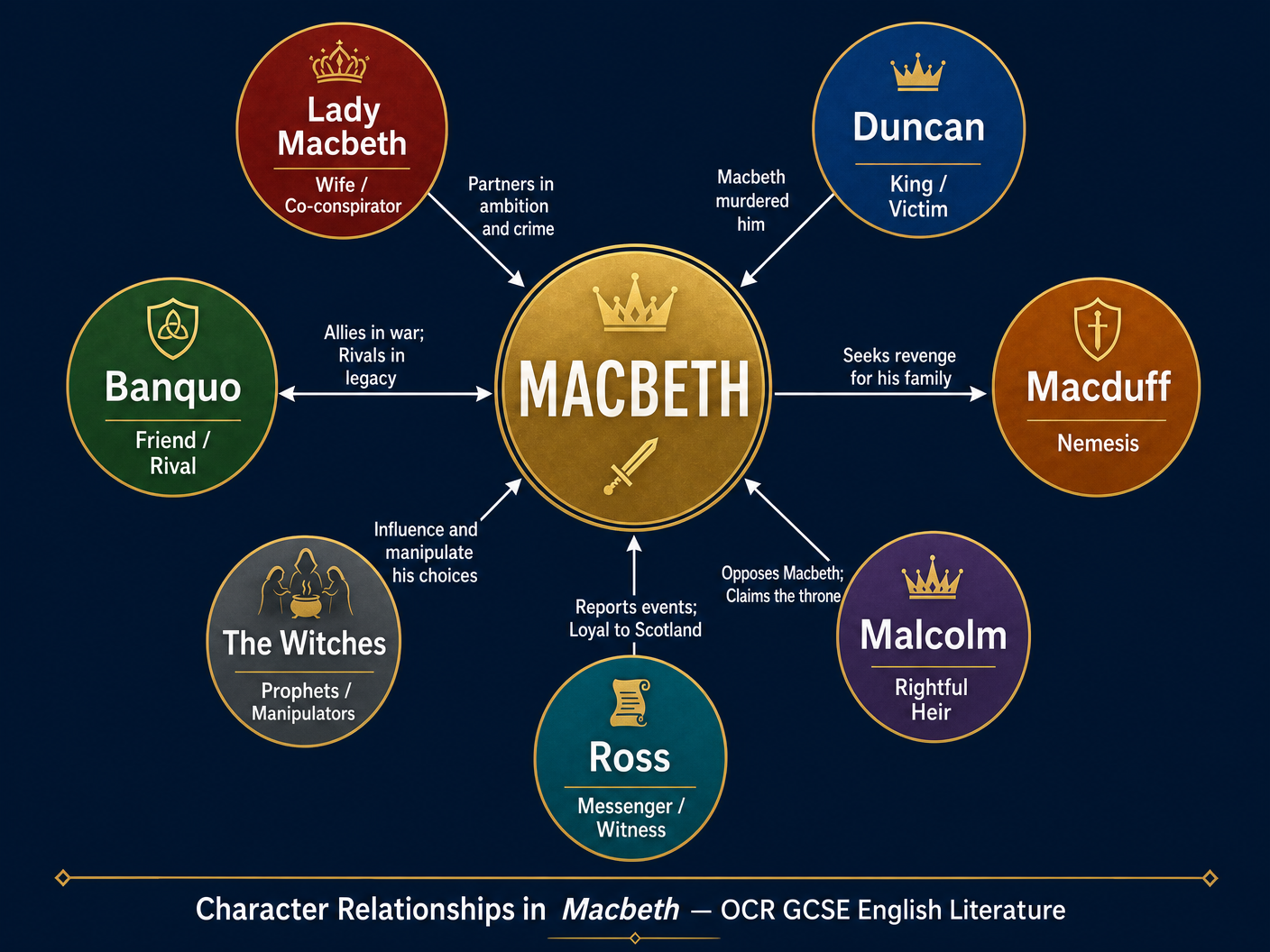
Interactive Diagrams
1 interactive diagram to visualise key concepts
Conceptual Flow Outline
Macbeth's Character Arc: The Descent into Tyranny
Worked Examples
2 worked examples — open one to explore the question and available guidance.
Practice Questions
Test your understanding — click to reveal model answers
Explore how Shakespeare presents the relationship between Macbeth and Lady Macbeth in the play. (30 marks + 4 AO4)
Hint: Consider how the power dynamic shifts structurally. Who holds the power in Act 1 versus Act 3?
How does Shakespeare use the Witches to create a sense of tension and fear? (30 marks + 4 AO4)
Hint: Link the Witches to the context of King James I and the theme of fate vs free will.
Test your understanding of Shakespeare
Active recall beats re-reading. Take an instant quiz now to test what you’ve learned and lock it into long-term memory.
7 days Premium · Then free forever · No card, no charge