Pearson Edexcel · A-Level · English Literature
Course version: 9ET0 · Version from Sept 2015
Poetry – Section A: Post-2000 Poetry – Poems of the Decade: An Anthology…
Full specification wording
Component 3: Poetry – Section A: Post-2000 Poetry – Poems of the Decade: An Anthology of the Forward Books of Poetry 2002–2011: On Her Blindness Adam Thorpe
Adam Thorpe's autobiographical 'On Her Blindness' records his mother's suffering, her resistance to the demand that disabled people present inspiring stoicism, and his own grief and guilt after…
Checked against the Pearson Edexcel 9ET0 specification (opens in a new tab) on .
- Point 19 of 20
- 4 key terms
Study notes
From the checked teaching notes for this specification point.
The idea
Adam Thorpe's autobiographical 'On Her Blindness' records his mother's suffering, her resistance to the demand that disabled people present inspiring stoicism, and his own grief and guilt after her death. The title echoes Milton's 'On His Blindness', but Thorpe writes in conversational free verse rather than sonnet form and offers no firm religious resolution. Twenty-two unrhymed couplets give painful memories a measured, restrained shape; enjambment carries sentences across those small units. A final single-line stanza breaks the pattern to imagine his mother 'watching, somewhere, in the end'. That possibility of restored sight is poignant precisely because it remains tentative rather than certain.
What earns the marks
- Analyse how the title invokes Milton while Thorpe's secular, autobiographical account resists a neat lesson of patient acceptance.
- Evaluate how 22 short unrhymed couplets and frequent enjambment contain grief and evoke careful, deliberate movement.
- Discuss the mother's own reported speech and dark humour as evidence of suffering that public narratives of stoicism fail to accommodate.
- Examine how the isolated twenty-third stanza makes the final imagined restoration of sight visible yet uncertain.
Common mistakes and how to put them right
Assuming the mother narrates the poem.
Put it right: Her son recalls and quotes her while also exposing his own grief, guilt and anger.
Describing the poem only as fragmented.
Put it right: Its 22 even couplets are notably controlled and restrained before the final singleton breaks the pattern.
Calling the ending a confident belief in an afterlife.
Put it right: Words such as 'somewhere' make the hope of restored sight faint and unresolved.
Exam tips
- State the exact form—23 stanzas, of which 22 are unrhymed couplets and the last is a single line—before analysing restraint and disruption.
- Use the mother's reported speech to distinguish her actual pain from the inspirational stoicism society expects her to perform.
- Compare the conversational free verse and uncertain final hope with the religious resolution associated with Milton's title.
Try the lesson
The start of the Component 3: Poetry – Section A: Post-2000 Poetry – Poems of the Decade: An Anthology of the Forward Books of Poetry 2002–2011: On Her Blindness Adam Thorpe lesson, made from checked teaching notes for this specification point.
Have a go first
'On Her Blindness' has 23 free-verse stanzas: 22 unrhymed couplets followed by a final one-line stanza. What is the strongest effect of that structure?
Listen
Adam Thorpe's autobiographical 'On Her Blindness' records his mother's suffering, her resistance to the demand that disabled people present inspiring stoicism, and his own grief and guilt after her death. The title echoes Milton's 'On His Blindness', but Thorpe writes in conversational free verse rather than sonnet form and offers no firm religious resolution. Twenty-two unrhymed couplets give painful memories a measured, restrained shape; enjambment carries sentences across those small units. A final single-line stanza breaks the pattern to imagine his mother 'watching, somewhere, in the end'. That possibility of restored sight is poignant precisely because it remains tentative rather than certain. A strong answer earns marks for these points. Analyse how the title invokes Milton while Thorpe's secular, autobiographical account resists a neat lesson of patient acceptance. Evaluate how 22 short unrhymed couplets and frequent enjambment contain grief and evoke careful, deliberate movement. Discuss the mother's own reported speech and dark humour as evidence of suffering that public narratives of stoicism fail to accommodate. Examine how the isolated twenty-third stanza makes the final imagined restoration of sight visible yet uncertain. A common slip: Assuming the mother narrates the poem. Instead, her son recalls and quotes her while also exposing his own grief, guilt and anger. Exam tip: State the exact form—23 stanzas, of which 22 are unrhymed couplets and the last is a single line—before analysing restraint and disruption.
See it
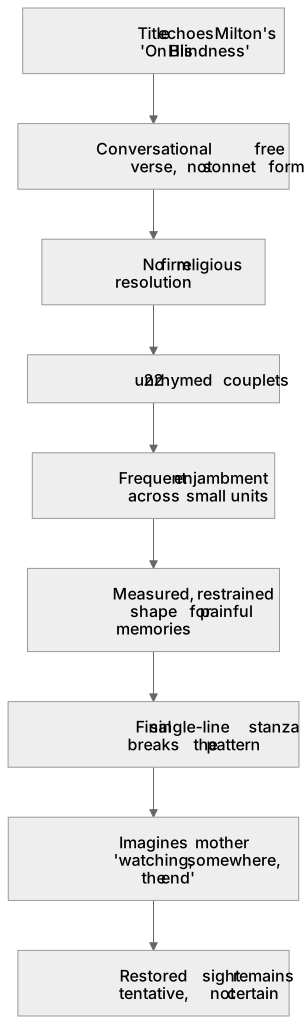
Key words
Say what each word means before you turn the card.
Stoicism
Try answering aloud or in your head before turning the card.
Enjambment
Try answering aloud or in your head before turning the card.
Miltonic allusion
Try answering aloud or in your head before turning the card.
Singleton
Try answering aloud or in your head before turning the card.
See every definition
- Stoicism
- The inspiring endurance that disabled people are expected to present, which the mother resists and which public narratives fail to accommodate.
- Enjambment
- A technique that carries sentences across the small units of the poem's unrhymed couplets.
- Miltonic allusion
- The echo of Milton's 'On His Blindness' in the title, which sharpens the absence of a certain spiritual resolution.
- Singleton
- The final single-line stanza that breaks the pattern of the twenty-two unrhymed couplets to imagine restored sight.
Label the diagram
Some boxes have lost their names. Pick the right name for each number.
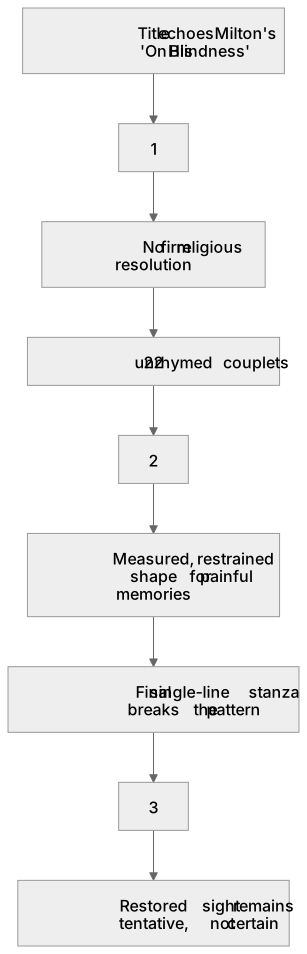
1Box 1
2Box 2
3Box 3
There is more to this lesson
The full lesson goes on to check your understanding and help you earn the marks. Create a free account to carry on, with your progress saved.
A week of Premium from your first lesson · Then the free plan continues · No card, no charge
Test your understanding of Component 3: Poetry – Section A: Post-2000 Poetry – Poems of the Decade: An Anthology of the Forward Books of Poetry 2002–2011: On Her Blindness Adam Thorpe
Active recall beats re-reading. Take an instant quiz now to test what you’ve learned and lock it into long-term memory.
A week of Premium from your first lesson · Then the free plan continues · No card, no charge