Pearson Edexcel · A-Level · English Literature
Course version: 9ET0 · Version from Sept 2015
Poetry – Section B: Specified Poetry Pre- or Post-1900 – Post-1900 – The…
Full specification wording
Component 3: Poetry – Section B: Specified Poetry Pre- or Post-1900 – Post-1900 – The Modernist Period – T S Eliot: Selected Poems (Faber, 2009): V. What the Thunder said
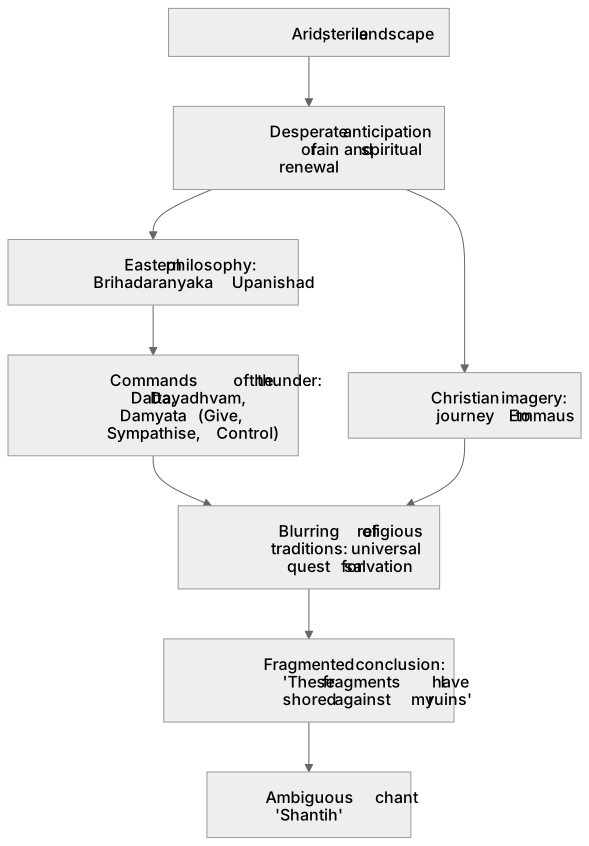
Part V of 'The Waste Land', 'What the Thunder said', serves as the poem's climax, shifting from an arid, sterile landscape to the desperate anticipation of rain and spiritual renewal.
Checked against the Pearson Edexcel 9ET0 specification (opens in a new tab) on .
- Point 5 of 7
- 4 key terms
Study notes
From the checked teaching notes for this specification point.
The idea
Part V of 'The Waste Land', 'What the Thunder said', serves as the poem's climax, shifting from an arid, sterile landscape to the desperate anticipation of rain and spiritual renewal. Eliot draws heavily on Eastern philosophy, specifically the Brihadaranyaka Upanishad, introducing the commands of the thunder: 'Datta, Dayadhvam, Damyata' (Give, Sympathise, Control). The section also weaves in Christian imagery, such as the journey to Emmaus, blurring religious traditions to highlight a universal quest for salvation. The fragmented conclusion, 'These fragments I have shored against my ruins', epitomises the Modernist struggle to construct meaning from a fractured post-war European civilisation, ending with the ambiguous chant 'Shantih'.
What earns the marks
- Analyse the use of the arid landscape as a metaphor for spiritual and cultural barrenness in post-war Europe.
- Evaluate Eliot's integration of Eastern and Western religious allusions, such as the Upanishads and the resurrection of Christ.
- Examine the structural fragmentation in the final stanza and how it reflects the collapse of traditional narratives.
- Discuss the significance of the thunder's commands (Datta, Dayadhvam, Damyata) as potential solutions to the wasteland's paralysis.
Common mistakes and how to put them right
Assuming 'Shantih' provides a definitive, optimistic resolution.
Put it right: Interpret 'Shantih' as an ambiguous ending that may offer fleeting peace or simply highlight the impossibility of true resolution.
Treating the religious allusions as purely Christian.
Put it right: Acknowledge Eliot's syncretism, specifically his heavy reliance on Hindu scriptures alongside Christian imagery.
Ignoring the shift in tone and rhythm in this section.
Put it right: Analyse how the incantatory rhythms and repetitive structures mimic the sound of approaching thunder and heighten the sense of urgency.
Exam tips
- Connect the physical thirst described in the opening stanzas to the spiritual thirst of the Modernist era.
- Use the phrase 'These fragments I have shored against my ruins' to anchor discussions about Modernist poetic form and intertextuality.
- Compare the imagery of water in this section with its destructive presentation in 'Death by Water' to show Eliot's complex symbolism.
Try the lesson
The start of the Component 3: Poetry – Section B: Specified Poetry Pre- or Post-1900 – Post-1900 – The Modernist Period – T S Eliot: Selected Poems (Faber, 2009): V. What the Thunder said lesson, made from checked teaching notes for this specification point.
Have a go first
Which of the following best describes the dominant physical landscape depicted at the beginning of 'What the Thunder said'?
Listen
Part V of 'The Waste Land', 'What the Thunder said', serves as the poem's climax, shifting from an arid, sterile landscape to the desperate anticipation of rain and spiritual renewal. Eliot draws heavily on Eastern philosophy, specifically the Brihadaranyaka Upanishad, introducing the commands of the thunder: 'Datta, Dayadhvam, Damyata' (Give, Sympathise, Control). The section also weaves in Christian imagery, such as the journey to Emmaus, blurring religious traditions to highlight a universal quest for salvation. The fragmented conclusion, 'These fragments I have shored against my ruins', epitomises the Modernist struggle to construct meaning from a fractured post-war European civilisation, ending with the ambiguous chant 'Shantih'. A strong answer earns marks for these points. Analyse the use of the arid landscape as a metaphor for spiritual and cultural barrenness in post-war Europe. Evaluate Eliot's integration of Eastern and Western religious allusions, such as the Upanishads and the resurrection of Christ. Examine the structural fragmentation in the final stanza and how it reflects the collapse of traditional narratives. Discuss the significance of the thunder's commands (Datta, Dayadhvam, Damyata) as potential solutions to the wasteland's paralysis. A common slip: Assuming 'Shantih' provides a definitive, optimistic resolution. Instead, Interpret 'Shantih' as an ambiguous ending that may offer fleeting peace or simply highlight the impossibility of true resolution. Exam tip: Connect the physical thirst described in the opening stanzas to the spiritual thirst of the Modernist era.
See it
Key words
Say what each word means before you turn the card.
Spiritual barrenness
Try answering aloud or in your head before turning the card.
Syncretism
Try answering aloud or in your head before turning the card.
Quest for salvation
Try answering aloud or in your head before turning the card.
Cultural fragmentation
Try answering aloud or in your head before turning the card.
See every definition
- Spiritual barrenness
- The arid, sterile landscape of the poem's climax, used as a metaphor for the spiritual and cultural barrenness of post-war Europe.
- Syncretism
- The blurring of religious traditions, as Eliot weaves Eastern philosophy and Christian imagery together to highlight a universal quest for salvation.
- Quest for salvation
- The universal search highlighted by the poem's blending of religious traditions, anticipated through the desperate waiting for rain and spiritual renewal.
- Cultural fragmentation
- The fractured state of post-war European civilisation, epitomised by the Modernist struggle to construct meaning from ruins.
Label the diagram
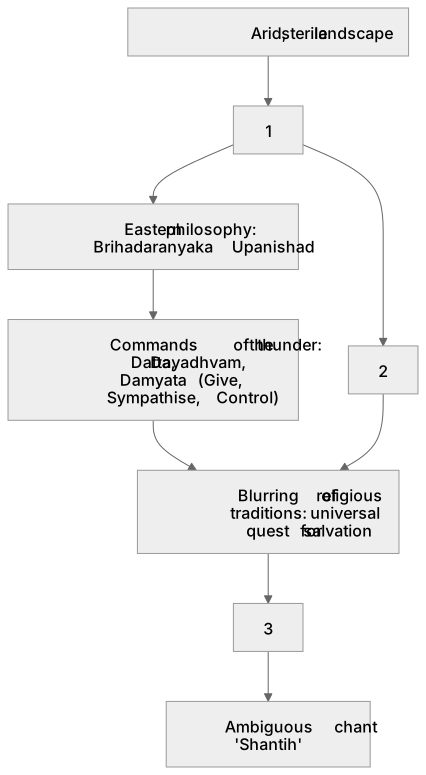
Some boxes have lost their names. Pick the right name for each number.
1Box 1
2Box 2
3Box 3
There is more to this lesson
The full lesson goes on to check your understanding and help you earn the marks. Create a free account to carry on, with your progress saved.
A week of Premium from your first lesson · Then the free plan continues · No card, no charge
Test your understanding of Component 3: Poetry – Section B: Specified Poetry Pre- or Post-1900 – Post-1900 – The Modernist Period – T S Eliot: Selected Poems (Faber, 2009): V. What the Thunder said
Active recall beats re-reading. Take an instant quiz now to test what you’ve learned and lock it into long-term memory.
A week of Premium from your first lesson · Then the free plan continues · No card, no charge