Pearson Edexcel · A-Level · English Literature
Course version: 9ET0 · Version from Sept 2015
Poetry – Section B: Specified Poetry Pre- or Post-1900 – Post-1900 – The…
Full specification wording
Component 3: Poetry – Section B: Specified Poetry Pre- or Post-1900 – Post-1900 – The Modernist Period – The Great Modern Poets, editor Michael Schmidt (Quercus, 2014): Landscape with the Fall of Icarus
William Carlos Williams's "Landscape with the Fall of Icarus" is an ekphrastic poem responding to Pieter Bruegel's painting.
Checked against the Pearson Edexcel 9ET0 specification (opens in a new tab) on .
- Point 8 of 21
- 4 key terms
Study notes
From the checked teaching notes for this specification point.
The idea
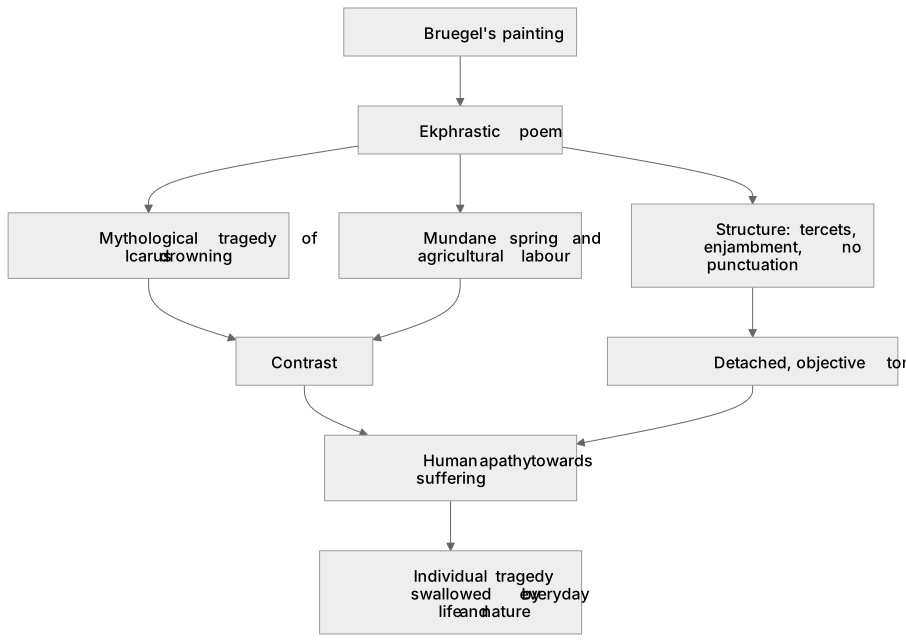
William Carlos Williams's "Landscape with the Fall of Icarus" is an ekphrastic poem responding to Pieter Bruegel's painting. It explores human apathy towards the suffering of others by contrasting the mythological tragedy of Icarus drowning with the mundane continuation of spring and agricultural labour. The poem exemplifies Williams's Modernist approach, using stark, unadorned language to highlight how individual tragedies are swallowed by the vast, uncaring progression of the natural world and everyday life.
What earns the marks
- Analyse the poem as an ekphrastic work, noting how Williams translates Bruegel's visual composition into poetic form.
- Evaluate the use of enjambment and lack of punctuation to create a continuous, flowing rhythm that mimics the unstoppable progression of time and nature.
- Discuss the contrast between the grand mythological subject (Icarus) and the mundane, everyday focus of the poem (the ploughman, the sun).
- Examine the detached, objective tone and how it underscores the theme of human indifference to individual suffering.
Common mistakes and how to put them right
Focusing entirely on the myth of Icarus without referencing the Bruegel painting.
Put it right: Explicitly discuss the poem as an ekphrastic response to the specific details of Bruegel's artwork.
Misinterpreting the tone as highly emotional or tragic.
Put it right: Recognise and analyse the deliberately detached, matter-of-fact tone that highlights apathy.
Overlooking the structural choices, such as the use of tercets.
Put it right: Analyse how the short, enjambed tercets force a rapid reading pace, reflecting how quickly the tragedy is passed over.
Exam tips
- Use the term 'ekphrasis' to demonstrate advanced critical vocabulary when discussing the poem's relationship to the painting.
- Contrast the poem's treatment of myth with traditional, romanticised depictions to highlight Williams's Modernist perspective.
- Pay close attention to the final stanza, analysing how the phrase "unsignificantly / off the coast" encapsulates the poem's central theme of insignificance.
Try the lesson
The start of the Component 3: Poetry – Section B: Specified Poetry Pre- or Post-1900 – Post-1900 – The Modernist Period – The Great Modern Poets, editor Michael Schmidt (Quercus, 2014): Landscape with the Fall of Icarus lesson, made from checked teaching notes for this specification point.
Have a go first
Which literary term best describes William Carlos Williams's "Landscape with the Fall of Icarus" because it provides a vivid, textual response to a specific painting by Pieter Bruegel?
Listen
William Carlos Williams's "Landscape with the Fall of Icarus" is an ekphrastic poem responding to Pieter Bruegel's painting. It explores human apathy towards the suffering of others by contrasting the mythological tragedy of Icarus drowning with the mundane continuation of spring and agricultural labour. The poem exemplifies Williams's Modernist approach, using stark, unadorned language to highlight how individual tragedies are swallowed by the vast, uncaring progression of the natural world and everyday life. A strong answer earns marks for these points. Analyse the poem as an ekphrastic work, noting how Williams translates Bruegel's visual composition into poetic form. Evaluate the use of enjambment and lack of punctuation to create a continuous, flowing rhythm that mimics the unstoppable progression of time and nature. Discuss the contrast between the grand mythological subject (Icarus) and the mundane, everyday focus of the poem (the ploughman, the sun). Examine the detached, objective tone and how it underscores the theme of human indifference to individual suffering. A common slip: Focusing entirely on the myth of Icarus without referencing the Bruegel painting. Instead, Explicitly discuss the poem as an ekphrastic response to the specific details of Bruegel's artwork. Exam tip: Use the term 'ekphrasis' to demonstrate advanced critical vocabulary when discussing the poem's relationship to the painting.
See it
Key words
Say what each word means before you turn the card.
Ekphrastic
Try answering aloud or in your head before turning the card.
Apathy and Indifference
Try answering aloud or in your head before turning the card.
The Mundane vs The Mythic
Try answering aloud or in your head before turning the card.
Enjambment
Try answering aloud or in your head before turning the card.
See every definition
- Ekphrastic
- Describes a poem that responds to a painting, here translating Bruegel's visual composition into poetic form.
- Apathy and Indifference
- The human lack of concern towards the suffering of others, shown by contrasting Icarus's drowning with the continuation of spring and agricultural labour.
- The Mundane vs The Mythic
- The contrast between the grand mythological subject of Icarus and the everyday focus of the poem, such as the ploughman and the sun.
- Enjambment
- Short lines running on without punctuation, creating a continuous, flowing rhythm that mimics the unstoppable progression of time and nature.
Label the diagram
Some boxes have lost their names. Pick the right name for each number.
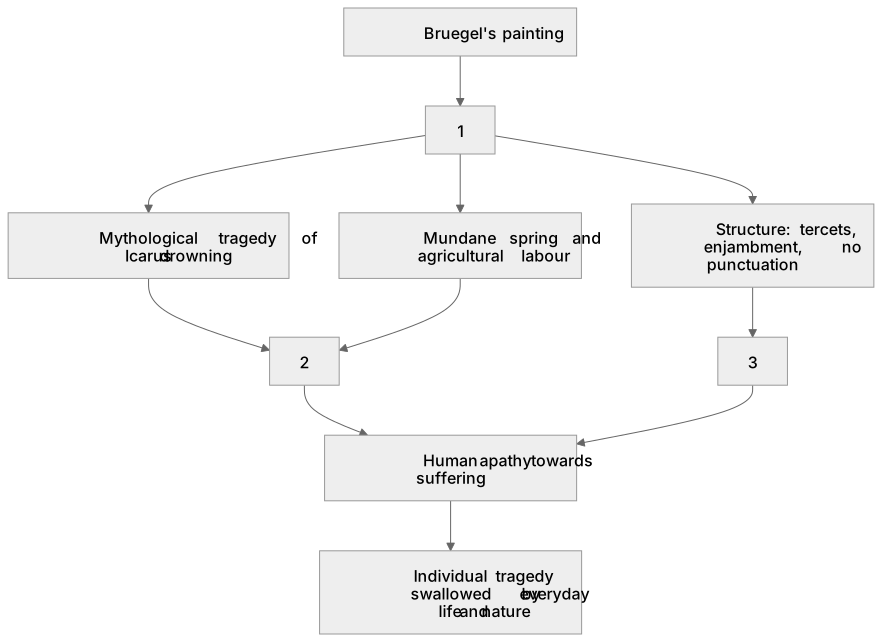
1Box 1
2Box 2
3Box 3
There is more to this lesson
The full lesson goes on to check your understanding and help you earn the marks. Create a free account to carry on, with your progress saved.
A week of Premium from your first lesson · Then the free plan continues · No card, no charge
Test your understanding of Component 3: Poetry – Section B: Specified Poetry Pre- or Post-1900 – Post-1900 – The Modernist Period – The Great Modern Poets, editor Michael Schmidt (Quercus, 2014): Landscape with the Fall of Icarus
Active recall beats re-reading. Take an instant quiz now to test what you’ve learned and lock it into long-term memory.
A week of Premium from your first lesson · Then the free plan continues · No card, no charge