Pearson Edexcel · A-Level · English Literature
Course version: 9ET0 · Version from Sept 2015
Poetry – Section B: Specified Poetry Pre- or Post-1900 – Post-1900 – The…
Full specification wording
Component 3: Poetry – Section B: Specified Poetry Pre- or Post-1900 – Post-1900 – The Modernist Period – The Great Modern Poets, editor Michael Schmidt (Quercus, 2014): Out, Out
Robert Frost's 'Out, Out—' (alluding to Macbeth's soliloquy on the brevity of life) explores the tragic, sudden death of a young boy working with a buzz saw in rural Vermont.
Checked against the Pearson Edexcel 9ET0 specification (opens in a new tab) on .
- Point 6 of 21
- 4 key terms
Study notes
From the checked teaching notes for this specification point.
The idea
Robert Frost's 'Out, Out—' (alluding to Macbeth's soliloquy on the brevity of life) explores the tragic, sudden death of a young boy working with a buzz saw in rural Vermont. The poem contrasts the beautiful, indifferent natural setting with the brutal, mechanical violence of the saw, which seems to take on a predatory life of its own ('Leaped out at the boy's hand'). Frost uses blank verse to create a conversational yet inexorable rhythm, culminating in the boy's desperate plea and subsequent death. The chilling final lines ('And they, since they / Were not the one dead, turned to their affairs') highlight the harsh pragmatism of rural life and the isolation of individual suffering within the Modernist context.
What earns the marks
- Analyze the personification of the buzz saw and its predatory, animalistic qualities.
- Evaluate the significance of the title's allusion to Shakespeare's Macbeth regarding the fragility and meaninglessness of life.
- Explore the contrast between the idyllic Vermont landscape and the brutal, industrial reality of the boy's labour.
- Discuss the impact of the detached, pragmatic ending on the poem's overall tone and Modernist themes of alienation.
Common mistakes and how to put them right
Assuming the poem is purely anti-technology.
Put it right: Recognise that the tragedy stems from the intersection of human error, child labour, and mechanical danger, rather than just technology itself.
Misinterpreting the family's reaction at the end as pure callousness.
Put it right: Understand their reaction as a reflection of the harsh, pragmatic necessity of survival in rural, working-class environments.
Ignoring the poem's form.
Put it right: Analyze how Frost's use of blank verse creates a narrative flow that mimics natural speech while driving relentlessly toward the tragic climax.
Exam tips
- Connect the poem's themes of isolation and the fragility of life to broader Modernist concerns when comparing it with other poems in the anthology.
- Closely analyze the sensory language, particularly the auditory imagery of the saw ('snarled and rattled'), to demonstrate how Frost builds tension.
- Use the allusion in the title as a framing device for your essay to discuss the overarching theme of mortality.
Try the lesson
The start of the Component 3: Poetry – Section B: Specified Poetry Pre- or Post-1900 – Post-1900 – The Modernist Period – The Great Modern Poets, editor Michael Schmidt (Quercus, 2014): Out, Out lesson, made from checked teaching notes for this specification point.
Have a go first
In Robert Frost's poem "Out, Out-", the title is an allusion to a Shakespearean soliloquy. What central theme does this allusion primarily establish?
Listen
Robert Frost's 'Out, Out—' (alluding to Macbeth's soliloquy on the brevity of life) explores the tragic, sudden death of a young boy working with a buzz saw in rural Vermont. The poem contrasts the beautiful, indifferent natural setting with the brutal, mechanical violence of the saw, which seems to take on a predatory life of its own ('Leaped out at the boy's hand'). Frost uses blank verse to create a conversational yet inexorable rhythm, culminating in the boy's desperate plea and subsequent death. The chilling final lines ('And they, since they / Were not the one dead, turned to their affairs') highlight the harsh pragmatism of rural life and the isolation of individual suffering within the Modernist context. A strong answer earns marks for these points. Analyze the personification of the buzz saw and its predatory, animalistic qualities. Evaluate the significance of the title's allusion to Shakespeare's Macbeth regarding the fragility and meaninglessness of life. Explore the contrast between the idyllic Vermont landscape and the brutal, industrial reality of the boy's labour. Discuss the impact of the detached, pragmatic ending on the poem's overall tone and Modernist themes of alienation. A common slip: Assuming the poem is purely anti-technology. Instead, Recognise that the tragedy stems from the intersection of human error, child labour, and mechanical danger, rather than just technology itself. Exam tip: Connect the poem's themes of isolation and the fragility of life to broader Modernist concerns when comparing it with other poems in the anthology.
See it
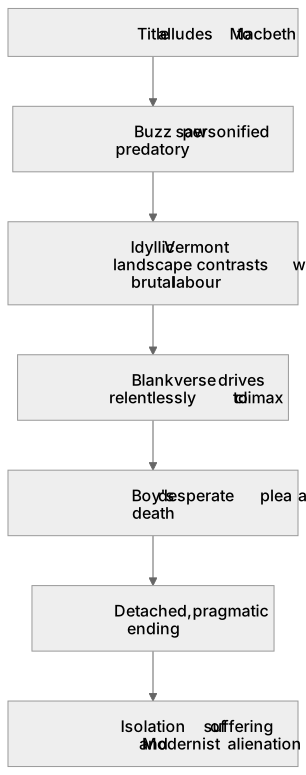
Put it in order
Put these steps in the order they happen.
- 1. Isolation of suffering and Modernist alienation
- 2. Detached, pragmatic ending
- 3. Idyllic Vermont landscape contrasts with brutal labour
- 4. Boy's desperate plea and death
- 5. Title alludes to Macbeth
- 6. Buzz saw personified as predatory
- 7. Blank verse drives relentlessly to climax
Key words
Say what each word means before you turn the card.
Mortality and the fragility of life
Try answering aloud or in your head before turning the card.
The indifference of nature and society
Try answering aloud or in your head before turning the card.
Child labour and lost innocence
Try answering aloud or in your head before turning the card.
The intrusion of mechanisation
Try answering aloud or in your head before turning the card.
See every definition
- Mortality and the fragility of life
- A theme framed by the title's allusion to Macbeth's soliloquy on the brevity of life, and by the boy's sudden death.
- The indifference of nature and society
- The contrast between the beautiful, indifferent natural setting and the harsh pragmatism of rural life, which isolates individual suffering.
- Child labour and lost innocence
- The boy's labour in rural Vermont, where tragedy stems from the intersection of human error, child labour and mechanical danger.
- The intrusion of mechanisation
- The brutal, mechanical violence of the buzz saw, which seems to take on a predatory life of its own.
Label the diagram
Some boxes have lost their names. Pick the right name for each number.
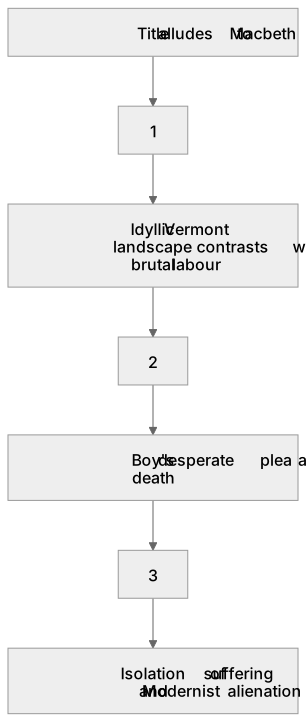
1Box 1
2Box 2
3Box 3
There is more to this lesson
The full lesson goes on to check your understanding and help you earn the marks. Create a free account to carry on, with your progress saved.
A week of Premium from your first lesson · Then the free plan continues · No card, no charge
Test your understanding of Component 3: Poetry – Section B: Specified Poetry Pre- or Post-1900 – Post-1900 – The Modernist Period – The Great Modern Poets, editor Michael Schmidt (Quercus, 2014): Out, Out
Active recall beats re-reading. Take an instant quiz now to test what you’ve learned and lock it into long-term memory.
A week of Premium from your first lesson · Then the free plan continues · No card, no charge