Pearson Edexcel · A-Level · English Literature
Course version: 9ET0 · Version from Sept 2015
Poetry – Section B: Specified Poetry Pre- or Post-1900 – Post-1900 – The…
Full specification wording
Component 3: Poetry – Section B: Specified Poetry Pre- or Post-1900 – Post-1900 – The Movement – The Oxford Book of Twentieth Century English Verse, editor Philip Larkin with foreword by Andrew Motion (OUP, 1973): Felo De Se
The poem ‘Felo De Se’ delves into the dark, complex psychological landscape of suicide, utilising its archaic legal title to contrast the institutional condemnation of the act with the profound…
Checked against the Pearson Edexcel 9ET0 specification (opens in a new tab) on .
- Point 2 of 18
- 4 key terms
Study notes
From the checked teaching notes for this specification point.
The idea
The poem ‘Felo De Se’ delves into the dark, complex psychological landscape of suicide, utilising its archaic legal title to contrast the institutional condemnation of the act with the profound personal despair of the individual. By analysing the tension between societal judgment and intimate psychological suffering, learners can connect the poem to the anthology’s wider exploration of post-1900 existential angst, mortality, and the often-isolating reality of the modern human condition.
What earns the marks
- Examine the significance of the title 'Felo De Se' and its legalistic implications regarding suicide as a crime.
- Analyse the use of imagery and metaphor to convey the depth of the speaker's psychological despair and isolation.
- Evaluate how the poem's form and rhythm reflect the internal turmoil and fatalistic trajectory of the subject.
- Draw comparative links between this poem's treatment of mortality and other post-1900 poems in the anthology.
Common mistakes and how to put them right
Focusing solely on the narrative of suicide without analysing the poetic methods used to construct it.
Put it right: Anchor thematic discussions in specific structural and linguistic analysis.
Overlooking the irony or significance of the Latin legal title.
Put it right: Discuss how the title frames the deeply personal act of suicide within a cold, societal or legal context.
Treating the poem's speaker and the poet as definitively the same person.
Put it right: Refer to the 'speaker' or 'persona' to maintain critical distance when discussing the psychological state depicted.
Exam tips
- Contrast the clinical or legalistic title with the emotional intensity of the poem's imagery in your essays.
- Use this poem to discuss the shift in twentieth-century poetry towards more taboo, psychologically raw subject matter.
- Compare the theme of self-destruction in 'Felo De Se' with the physical decay depicted in other anthology poems.
Try the lesson
The start of the Component 3: Poetry – Section B: Specified Poetry Pre- or Post-1900 – Post-1900 – The Movement – The Oxford Book of Twentieth Century English Verse, editor Philip Larkin with foreword by Andrew Motion (OUP, 1973): Felo De Se lesson, made from checked teaching notes for this specification point.
Have a go first
In the context of poetry, what is the literal legal meaning of the Latin title "Felo De Se", which frames the subject matter of the poem?
Listen
The poem ‘Felo De Se’ delves into the dark, complex psychological landscape of suicide, utilising its archaic legal title to contrast the institutional condemnation of the act with the profound personal despair of the individual. By analysing the tension between societal judgment and intimate psychological suffering, learners can connect the poem to the anthology’s wider exploration of post-1900 existential angst, mortality, and the often-isolating reality of the modern human condition. A strong answer earns marks for these points. Examine the significance of the title 'Felo De Se' and its legalistic implications regarding suicide as a crime. Analyse the use of imagery and metaphor to convey the depth of the speaker's psychological despair and isolation. Evaluate how the poem's form and rhythm reflect the internal turmoil and fatalistic trajectory of the subject. Draw comparative links between this poem's treatment of mortality and other post-1900 poems in the anthology. A common slip: Focusing solely on the narrative of suicide without analysing the poetic methods used to construct it. Instead, anchor thematic discussions in specific structural and linguistic analysis. Exam tip: Contrast the clinical or legalistic title with the emotional intensity of the poem's imagery in your essays.
See it
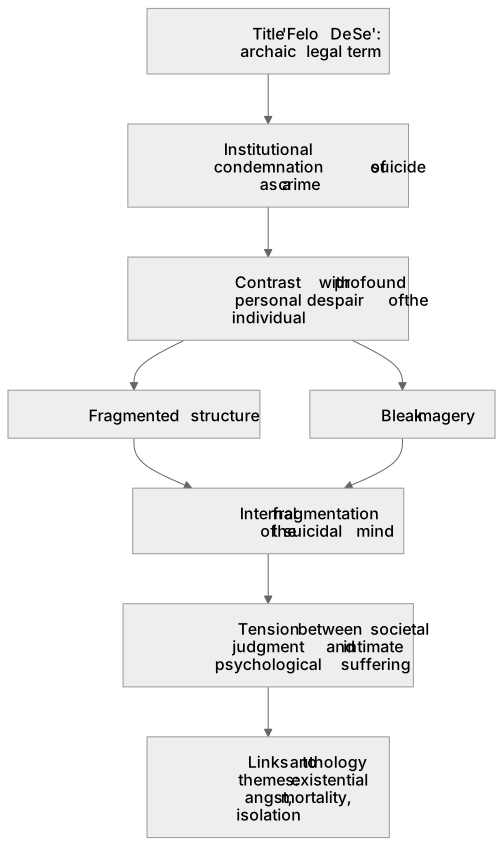
Key words
Say what each word means before you turn the card.
Suicide and Mortality
Try answering aloud or in your head before turning the card.
Psychological Despair
Try answering aloud or in your head before turning the card.
Societal Judgement
Try answering aloud or in your head before turning the card.
Existential Isolation
Try answering aloud or in your head before turning the card.
See every definition
- Suicide and Mortality
- The poem explores the dark, complex psychological landscape of suicide, connecting it to the anthology's wider exploration of post-1900 existential angst and mortality.
- Psychological Despair
- The profound personal despair of the individual is contrasted with the institutional condemnation of the act, and conveyed through fragmented structure and bleak imagery.
- Societal Judgement
- The tension between societal judgment and intimate psychological suffering frames the deeply personal act of suicide within a cold, societal or legal context.
- Existential Isolation
- The poem connects to the anthology's wider exploration of the often-isolating reality of the modern human condition and post-1900 existential angst.
Label the diagram
Some boxes have lost their names. Pick the right name for each number.
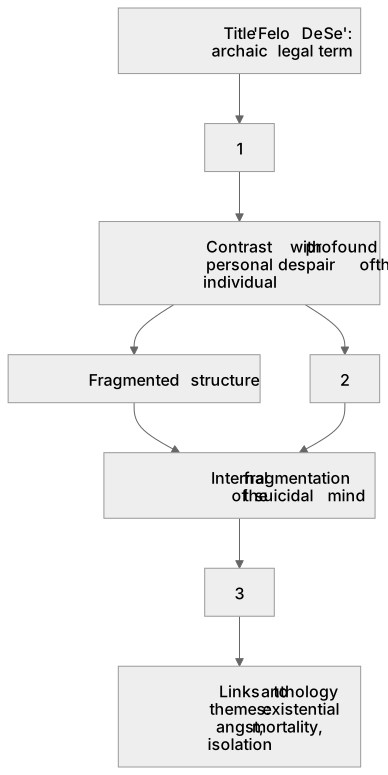
1Box 1
2Box 2
3Box 3
There is more to this lesson
The full lesson goes on to check your understanding and help you earn the marks. Create a free account to carry on, with your progress saved.
A week of Premium from your first lesson · Then the free plan continues · No card, no charge
Test your understanding of Component 3: Poetry – Section B: Specified Poetry Pre- or Post-1900 – Post-1900 – The Movement – The Oxford Book of Twentieth Century English Verse, editor Philip Larkin with foreword by Andrew Motion (OUP, 1973): Felo De Se
Active recall beats re-reading. Take an instant quiz now to test what you’ve learned and lock it into long-term memory.
A week of Premium from your first lesson · Then the free plan continues · No card, no charge