Pearson Edexcel · A-Level · English Literature
Course version: 9ET0 · Version from Sept 2015
Poetry – Section B: Specified Poetry Pre- or Post-1900 – Pre-1900 –…
Full specification wording
Component 3: Poetry – Section B: Specified Poetry Pre- or Post-1900 – Pre-1900 – Metaphysical Poetry – John Donne Selected Poems (Penguin Classics, 2006): A Hymn to God the Father
John Donne’s ‘A Hymn to God the Father’ is a profound metaphysical poem exploring the speaker’s anxiety regarding original sin, personal transgression, and divine forgiveness.
Checked against the Pearson Edexcel 9ET0 specification (opens in a new tab) on .
- Point 22 of 22
- 4 key terms
Study notes
From the checked teaching notes for this specification point.
The idea
John Donne’s ‘A Hymn to God the Father’ is a profound metaphysical poem exploring the speaker’s anxiety regarding original sin, personal transgression, and divine forgiveness. Written late in Donne’s life, the poem employs a repetitive structure, asking God if He will forgive various categories of sin. A defining feature is the recurring pun on the poet’s own surname in the refrain ‘When thou hast done, thou hast not done’, reflecting his fear that his sins are insurmountable.
What earns the marks
- Analyse the use of puns, specifically on 'done' and 'Sun/Son', to convey theological anxiety and resolution.
- Evaluate the poem's structure, noting the repetitive questioning and refrain that build a sense of accumulating sin.
- Explore the contextual significance of Donne's religious background and his late-life anxieties about death and salvation.
- Discuss the metaphysical conceit or wit in treating divine forgiveness as a legalistic or transactional negotiation.
Common mistakes and how to put them right
Treating the pun on 'done' merely as a humorous wordplay.
Put it right: Analyse the pun as a serious metaphysical device expressing deep spiritual anxiety and the inescapable nature of his identity as a sinner.
Ignoring the shift in tone in the final stanza.
Put it right: Ensure you contrast the despair of the first two stanzas with the resolution brought by the 'Sun/Son' in the final stanza.
Discussing Donne's biography without linking it to the text.
Put it right: Integrate contextual knowledge of Donne's ordination and illness directly with his poetic choices and thematic concerns.
Exam tips
- Focus on the interplay between the strict rhyme scheme (ABABAB) and the conversational, pleading tone of the speaker.
- Use the pun on 'Sun' to discuss how Donne blends the physical universe with Christian theology.
- Compare the tone of this late poem with Donne's earlier, more secular or romantic metaphysical poetry if making wider connections.
Try the lesson
The start of the Component 3: Poetry – Section B: Specified Poetry Pre- or Post-1900 – Pre-1900 – Metaphysical Poetry – John Donne Selected Poems (Penguin Classics, 2006): A Hymn to God the Father lesson, made from checked teaching notes for this specification point.
Have a go first
In 'A Hymn to God the Father', which literary device does John Donne use repeatedly in the refrain "When thou hast done, thou hast not done"?
Listen
John Donne’s ‘A Hymn to God the Father’ is a profound metaphysical poem exploring the speaker’s anxiety regarding original sin, personal transgression, and divine forgiveness. Written late in Donne’s life, the poem employs a repetitive structure, asking God if He will forgive various categories of sin. A defining feature is the recurring pun on the poet’s own surname in the refrain ‘When thou hast done, thou hast not done’, reflecting his fear that his sins are insurmountable. A strong answer earns marks for these points. Analyse the use of puns, specifically on 'done' and 'Sun/Son', to convey theological anxiety and resolution. Evaluate the poem's structure, noting the repetitive questioning and refrain that build a sense of accumulating sin. Explore the contextual significance of Donne's religious background and his late-life anxieties about death and salvation. Discuss the metaphysical conceit or wit in treating divine forgiveness as a legalistic or transactional negotiation. A common slip: Treating the pun on 'done' merely as a humorous wordplay. Instead, Analyse the pun as a serious metaphysical device expressing deep spiritual anxiety and the inescapable nature of his identity as a sinner. Exam tip: Focus on the interplay between the strict rhyme scheme (ABABAB) and the conversational, pleading tone of the speaker.
See it
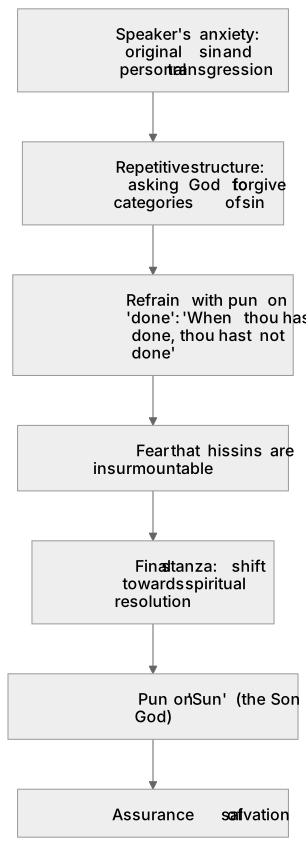
Put it in order
Put these steps in the order they happen.
- 1. Assurance of salvation
- 2. Pun on 'Sun' (the Son of God)
- 3. Refrain with pun on 'done': 'When thou hast done, thou hast not done'
- 4. Final stanza: shift towards spiritual resolution
- 5. Speaker's anxiety: original sin and personal transgression
- 6. Repetitive structure: asking God to forgive categories of sin
- 7. Fear that his sins are insurmountable
Key words
Say what each word means before you turn the card.
Sin and Salvation
Try answering aloud or in your head before turning the card.
Divine Forgiveness
Try answering aloud or in your head before turning the card.
Mortality and Fear
Try answering aloud or in your head before turning the card.
Identity and Naming
Try answering aloud or in your head before turning the card.
See every definition
- Sin and Salvation
- The poem explores the speaker's anxiety regarding original sin and personal transgression, and moves towards assurance of salvation in the final stanza.
- Divine Forgiveness
- The speaker asks God whether He will forgive various categories of sin, treating divine forgiveness as a legalistic or transactional negotiation.
- Mortality and Fear
- The poem reflects Donne's late-life anxieties about death and salvation, with fear that his sins are insurmountable.
- Identity and Naming
- A recurring pun on the poet's own surname in the refrain reflects his fear that his sins are insurmountable and the inescapable nature of his identity as a sinner.
Label the diagram
Some boxes have lost their names. Pick the right name for each number.
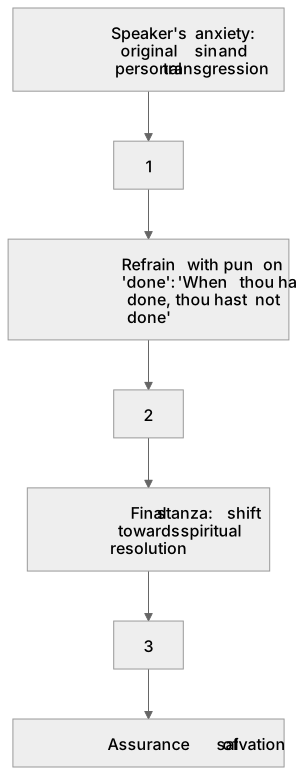
1Box 1
2Box 2
3Box 3
There is more to this lesson
The full lesson goes on to check your understanding and help you earn the marks. Create a free account to carry on, with your progress saved.
A week of Premium from your first lesson · Then the free plan continues · No card, no charge
Test your understanding of Component 3: Poetry – Section B: Specified Poetry Pre- or Post-1900 – Pre-1900 – Metaphysical Poetry – John Donne Selected Poems (Penguin Classics, 2006): A Hymn to God the Father
Active recall beats re-reading. Take an instant quiz now to test what you’ve learned and lock it into long-term memory.
A week of Premium from your first lesson · Then the free plan continues · No card, no charge