Pearson Edexcel · A-Level · English Literature
Course version: 9ET0 · Version from Sept 2015
Poetry – Section B: Specified Poetry Pre- or Post-1900 – Pre-1900 –…
Full specification wording
Component 3: Poetry – Section B: Specified Poetry Pre- or Post-1900 – Pre-1900 – Metaphysical Poetry – John Donne Selected Poems (Penguin Classics, 2006): Love’s Alchemy
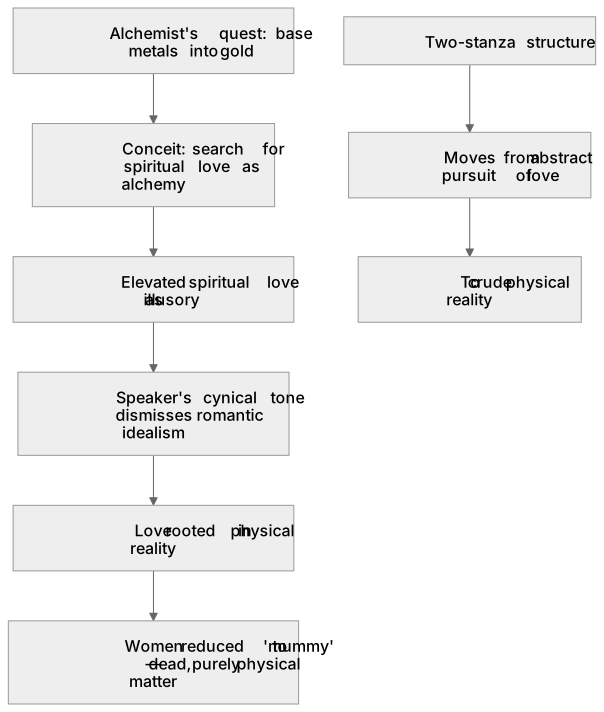
Love's Alchemy by John Donne critiques the idealisation of spiritual love, arguing that such elevated concepts are as illusory as the alchemist's quest to turn base metals into gold.
Checked against the Pearson Edexcel 9ET0 specification (opens in a new tab) on .
- Point 12 of 22
- 4 key terms
Study notes
From the checked teaching notes for this specification point.
The idea
Love's Alchemy by John Donne critiques the idealisation of spiritual love, arguing that such elevated concepts are as illusory as the alchemist's quest to turn base metals into gold. Donne uses the conceit of alchemy to mock those claiming to have found a purely spiritual connection, asserting instead that love is rooted in physical reality. The speaker adopts a cynical tone, dismissing romantic idealism as a fraudulent pursuit.
What earns the marks
- Analyse the central conceit comparing the search for spiritual love to the futile pseudo-science of alchemy.
- Evaluate the speaker's cynical tone and use of aggressive, colloquial language to dismantle romantic idealism.
- Explore the contextual significance of alchemy in the Jacobean era as a symbol of deception and unattainable perfection.
- Examine the poem's misogynistic conclusion, specifically the reduction of women to 'mummy' (a physical, lifeless object).
Common mistakes and how to put them right
Assuming the poem celebrates love.
Put it right: Recognise that the speaker is deeply cynical and dismisses spiritual love as a fraudulent illusion.
Misinterpreting the term 'mummy'.
Put it right: Understand 'mummy' refers to the medicinal use of embalmed bodies in the seventeenth century, symbolising dead, purely physical matter.
Ignoring the poem's structure.
Put it right: Analyse how the two-stanza structure mirrors the speaker's argument, moving from the abstract pursuit of love to its crude physical reality.
Exam tips
- Compare the cynical tone of 'Love's Alchemy' with Donne's more celebratory poems, such as 'The Sun Rising', to demonstrate his varied perspectives on love.
- Use specific quotations, like 'centric happiness', to discuss how Donne mocks the philosophical and scientific jargon of his time.
- Link the poem's themes of deception and illusion to the broader Metaphysical poetry movement's interest in the tension between the physical and spiritual worlds.
Try the lesson
The start of the Component 3: Poetry – Section B: Specified Poetry Pre- or Post-1900 – Pre-1900 – Metaphysical Poetry – John Donne Selected Poems (Penguin Classics, 2006): Love’s Alchemy lesson, made from checked teaching notes for this specification point.
Have a go first
What is the central argument presented by the speaker in John Donne's 'Love's Alchemy'?
Listen
Love's Alchemy by John Donne critiques the idealisation of spiritual love, arguing that such elevated concepts are as illusory as the alchemist's quest to turn base metals into gold. Donne uses the conceit of alchemy to mock those claiming to have found a purely spiritual connection, asserting instead that love is rooted in physical reality. The speaker adopts a cynical tone, dismissing romantic idealism as a fraudulent pursuit. A strong answer earns marks for these points. Analyse the central conceit comparing the search for spiritual love to the futile pseudo-science of alchemy. Evaluate the speaker's cynical tone and use of aggressive, colloquial language to dismantle romantic idealism. Explore the contextual significance of alchemy in the Jacobean era as a symbol of deception and unattainable perfection. Examine the poem's misogynistic conclusion, specifically the reduction of women to 'mummy' (a physical, lifeless object). A common slip: Assuming the poem celebrates love. Instead, recognise that the speaker is deeply cynical and dismisses spiritual love as a fraudulent illusion. Exam tip: Compare the cynical tone of 'Love's Alchemy' with Donne's more celebratory poems, such as 'The Sun Rising', to demonstrate his varied perspectives on love.
See it
Key words
Say what each word means before you turn the card.
Cynicism and disillusionment
Try answering aloud or in your head before turning the card.
The physical versus the spiritual
Try answering aloud or in your head before turning the card.
Science and alchemy
Try answering aloud or in your head before turning the card.
Gender and misogyny
Try answering aloud or in your head before turning the card.
See every definition
- Cynicism and disillusionment
- The speaker's tone in dismissing romantic idealism as a fraudulent pursuit, treating spiritual love as illusory.
- The physical versus the spiritual
- The tension between elevated spiritual love and love rooted in physical reality, which the poem explores.
- Science and alchemy
- The conceit comparing the search for spiritual love to the futile pseudo-science of alchemy, a symbol of deception and unattainable perfection.
- Gender and misogyny
- The poem's misogynistic conclusion, reducing women to 'mummy', a physical, lifeless object, reflecting Jacobean anxieties about gender.
Label the diagram
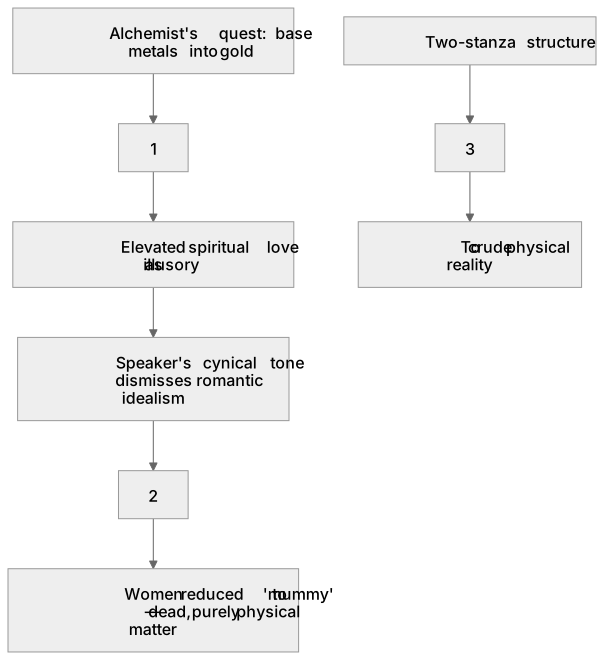
Some boxes have lost their names. Pick the right name for each number.
1Box 1
2Box 2
3Box 3
There is more to this lesson
The full lesson goes on to check your understanding and help you earn the marks. Create a free account to carry on, with your progress saved.
A week of Premium from your first lesson · Then the free plan continues · No card, no charge
Test your understanding of Component 3: Poetry – Section B: Specified Poetry Pre- or Post-1900 – Pre-1900 – Metaphysical Poetry – John Donne Selected Poems (Penguin Classics, 2006): Love’s Alchemy
Active recall beats re-reading. Take an instant quiz now to test what you’ve learned and lock it into long-term memory.
A week of Premium from your first lesson · Then the free plan continues · No card, no charge