Pearson Edexcel · A-Level · English Literature
Course version: 9ET0 · Version from Sept 2015
Poetry – Section B: Specified Poetry Pre- or Post-1900 – Pre-1900 –…
Full specification wording
Component 3: Poetry – Section B: Specified Poetry Pre- or Post-1900 – Pre-1900 – Metaphysical Poetry – Metaphysical Poetry, editor Colin Burrow (Penguin, 2006): Elegy: To his Mistress Going to Bed
John Donne's "Elegy: To his Mistress Going to Bed" is a persuasive, erotic poem celebrating physical love and the act of undressing.
Checked against the Pearson Edexcel 9ET0 specification (opens in a new tab) on .
- Point 9 of 23
- 4 key terms
Study notes
From the checked teaching notes for this specification point.
The idea
John Donne's "Elegy: To his Mistress Going to Bed" is a persuasive, erotic poem celebrating physical love and the act of undressing. The speaker uses a series of imperative commands to guide his lover's disrobing, blending sexual desire with theological and colonial imagery. A central conceit compares the woman's body to "my America! my new-found-land", reflecting Renaissance exploration and the speaker's desire for conquest and discovery. Written in rhyming couplets of iambic pentameter, the poem maintains a rhythmic, driving momentum. Donne elevates physical intimacy to a spiritual level, arguing that true revelation requires stripping away worldly coverings, just as the soul must be laid bare.
What earns the marks
- Analyse the use of colonial and exploratory conceits to represent sexual conquest and wonder.
- Evaluate the blending of sacred and profane imagery, such as comparing the woman's clothing to religious vestments.
- Examine the rhetorical structure and the use of imperative verbs to create a persuasive, urgent tone.
- Discuss the significance of the iambic pentameter couplets in driving the poem's momentum and mirroring the physical act described.
Common mistakes and how to put them right
Reading the poem solely as an expression of male dominance.
Put it right: Acknowledge the mutual joy and the elevation of the female body to a site of spiritual and geographical wonder.
Overlooking the Neoplatonic elements.
Put it right: Discuss how the physical unclothing parallels the Neoplatonic idea of the soul shedding its earthly garments to achieve true enlightenment.
Misinterpreting the tone as purely aggressive.
Put it right: Identify the playful, celebratory, and awestruck elements within the speaker's persuasive rhetoric.
Exam tips
- Connect the poem's exploratory imagery to the historical context of Renaissance voyages and the discovery of the Americas.
- Contrast the celebratory tone of physical love here with the cynical or spiritual approaches found in other Metaphysical poems.
- Quote specific imperatives to demonstrate how the speaker attempts to control the pacing of the encounter.
Try the lesson
The start of the Component 3: Poetry – Section B: Specified Poetry Pre- or Post-1900 – Pre-1900 – Metaphysical Poetry – Metaphysical Poetry, editor Colin Burrow (Penguin, 2006): Elegy: To his Mistress Going to Bed lesson, made from checked teaching notes for this specification point.
Have a go first
In John Donne's 'Elegy: To his Mistress Going to Bed', which geographical metaphor does the speaker use to describe his mistress's body?
Listen
John Donne's "Elegy: To his Mistress Going to Bed" is a persuasive, erotic poem celebrating physical love and the act of undressing. The speaker uses a series of imperative commands to guide his lover's disrobing, blending sexual desire with theological and colonial imagery. A central conceit compares the woman's body to "my America! my new-found-land", reflecting Renaissance exploration and the speaker's desire for conquest and discovery. Written in rhyming couplets of iambic pentameter, the poem maintains a rhythmic, driving momentum. Donne elevates physical intimacy to a spiritual level, arguing that true revelation requires stripping away worldly coverings, just as the soul must be laid bare. A strong answer earns marks for these points. Analyse the use of colonial and exploratory conceits to represent sexual conquest and wonder. Evaluate the blending of sacred and profane imagery, such as comparing the woman's clothing to religious vestments. Examine the rhetorical structure and the use of imperative verbs to create a persuasive, urgent tone. Discuss the significance of the iambic pentameter couplets in driving the poem's momentum and mirroring the physical act described. A common slip: Reading the poem solely as an expression of male dominance. Instead, Acknowledge the mutual joy and the elevation of the female body to a site of spiritual and geographical wonder. Exam tip: Connect the poem's exploratory imagery to the historical context of Renaissance voyages and the discovery of the Americas.
See it
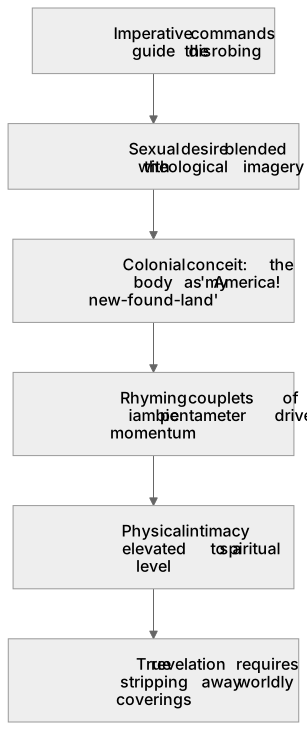
Put it in order
Put these steps in the order they happen.
- 1. Colonial conceit: the body as 'my America! my new-found-land'
- 2. Sexual desire blended with theological imagery
- 3. Imperative commands guide the disrobing
- 4. True revelation requires stripping away worldly coverings
- 5. Physical intimacy elevated to a spiritual level
- 6. Rhyming couplets of iambic pentameter drive momentum
Key words
Say what each word means before you turn the card.
Erotic love and sexuality
Try answering aloud or in your head before turning the card.
Exploration and discovery
Try answering aloud or in your head before turning the card.
The sacred and the profane
Try answering aloud or in your head before turning the card.
Persuasion and rhetoric
Try answering aloud or in your head before turning the card.
See every definition
- Erotic love and sexuality
- The poem is a persuasive, erotic celebration of physical love and the act of undressing, in which sexual desire is blended with theological and colonial imagery.
- Exploration and discovery
- A central conceit compares the woman's body to 'my America! my new-found-land', reflecting Renaissance exploration and the speaker's desire for conquest and discovery.
- The sacred and the profane
- Physical intimacy is elevated to a spiritual level, arguing that true revelation requires stripping away worldly coverings, just as the soul must be laid bare.
- Persuasion and rhetoric
- The speaker uses a series of imperative commands to guide his lover's disrobing, creating a persuasive, urgent tone.
Label the diagram
Some boxes have lost their names. Pick the right name for each number.
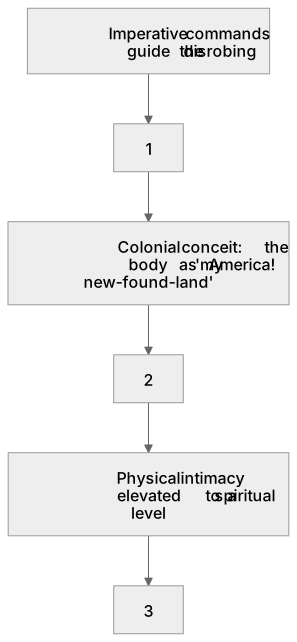
1Box 1
2Box 2
3Box 3
There is more to this lesson
The full lesson goes on to check your understanding and help you earn the marks. Create a free account to carry on, with your progress saved.
A week of Premium from your first lesson · Then the free plan continues · No card, no charge
Test your understanding of Component 3: Poetry – Section B: Specified Poetry Pre- or Post-1900 – Pre-1900 – Metaphysical Poetry – Metaphysical Poetry, editor Colin Burrow (Penguin, 2006): Elegy: To his Mistress Going to Bed
Active recall beats re-reading. Take an instant quiz now to test what you’ve learned and lock it into long-term memory.
A week of Premium from your first lesson · Then the free plan continues · No card, no charge