Pearson Edexcel · A-Level · English Literature
Course version: 9ET0 · Version from Sept 2015
Poetry – Section B: Specified Poetry Pre- or Post-1900 – Pre-1900 – The…
Full specification wording
Component 3: Poetry – Section B: Specified Poetry Pre- or Post-1900 – Pre-1900 – The Medieval Period – English Mystery Plays: A Selection, editor Peter Happé (Penguin Classics, 1975): Noah (Chester) Anon
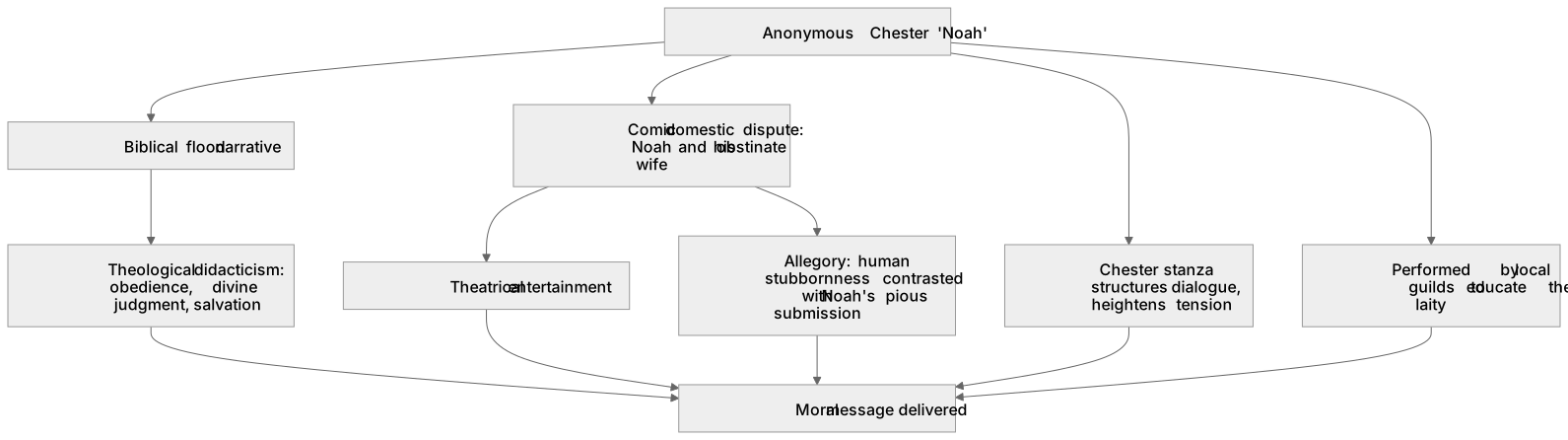
The anonymous Chester mystery play 'Noah' dramatises the biblical flood narrative, blending theological didacticism with medieval vernacular entertainment.
Checked against the Pearson Edexcel 9ET0 specification (opens in a new tab) on .
- Point 1 of 3
- 4 key terms
Study notes
From the checked teaching notes for this specification point.
The idea
The anonymous Chester mystery play 'Noah' dramatises the biblical flood narrative, blending theological didacticism with medieval vernacular entertainment. Originally performed by local guilds, it educated the laity on salvation. The play is notable for its comic domestic dispute between Noah and his obstinate wife, who refuses to board the ark. This comedic subplot serves a dual purpose: it provides theatrical entertainment while allegorically contrasting human stubbornness with Noah’s pious submission to God’s will.
What earns the marks
- Analyses the dramatic function of the comedic conflict between Noah and his wife.
- Explores the theological themes of obedience, divine judgment, and salvation within the play.
- Evaluates the use of the Chester stanza and its effect on the rhythm and pacing of the dialogue.
- Contextualises the play within the medieval tradition of guild performances and cycle dramas.
Common mistakes and how to put them right
Treating the play solely as a comedy without acknowledging its serious theological purpose.
Put it right: Balance the analysis of the comedic domestic dispute with its allegorical representation of human sin and divine obedience.
Attributing the play to a specific named author.
Put it right: Refer to the playwright as anonymous, acknowledging the collaborative and evolving nature of the medieval mystery cycles.
Ignoring the poetic form in favour of purely narrative analysis.
Put it right: Explicitly analyse the rhyme scheme and meter, such as the Chester stanza, to show how form enhances the dramatic delivery.
Exam tips
- Contrast Noah's pious language with his wife's colloquial and stubborn dialogue to highlight characterisation.
- Discuss the staging and original audience (the laity) to demonstrate an understanding of the play's contextual purpose.
- Use specific quotations to illustrate how the anonymous author balances humour with the solemnity of the biblical flood.
Try the lesson
The start of the Component 3: Poetry – Section B: Specified Poetry Pre- or Post-1900 – Pre-1900 – The Medieval Period – English Mystery Plays: A Selection, editor Peter Happé (Penguin Classics, 1975): Noah (Chester) Anon lesson, made from checked teaching notes for this specification point.
Have a go first
In the Chester mystery play of Noah, what is the primary reason Noah's wife initially refuses to board the ark?
Listen
The anonymous Chester mystery play 'Noah' dramatises the biblical flood narrative, blending theological didacticism with medieval vernacular entertainment. Originally performed by local guilds, it educated the laity on salvation. The play is notable for its comic domestic dispute between Noah and his obstinate wife, who refuses to board the ark. This comedic subplot serves a dual purpose: it provides theatrical entertainment while allegorically contrasting human stubbornness with Noah’s pious submission to God’s will. A strong answer earns marks for these points. Analyses the dramatic function of the comedic conflict between Noah and his wife. Explores the theological themes of obedience, divine judgment, and salvation within the play. Evaluates the use of the Chester stanza and its effect on the rhythm and pacing of the dialogue. Contextualises the play within the medieval tradition of guild performances and cycle dramas. A common slip: Treating the play solely as a comedy without acknowledging its serious theological purpose. Instead, Balance the analysis of the comedic domestic dispute with its allegorical representation of human sin and divine obedience. Exam tip: Contrast Noah's pious language with his wife's colloquial and stubborn dialogue to highlight characterisation.
See it
Key words
Say what each word means before you turn the card.
Divine obedience versus human stubbornness
Try answering aloud or in your head before turning the card.
Gender dynamics and domestic conflict
Try answering aloud or in your head before turning the card.
Salvation and judgment
Try answering aloud or in your head before turning the card.
Theatricality and medieval performance
Try answering aloud or in your head before turning the card.
See every definition
- Divine obedience versus human stubbornness
- The allegorical contrast between Noah's pious submission to God's will and his obstinate wife's refusal to board the ark.
- Gender dynamics and domestic conflict
- The comic domestic dispute between Noah and his obstinate wife, which provides theatrical entertainment while carrying allegorical meaning.
- Salvation and judgment
- The theological themes the play explores, educating the laity on salvation and divine judgment within the biblical flood narrative.
- Theatricality and medieval performance
- The play's origin in performance by local guilds, blending theological didacticism with medieval vernacular entertainment for the laity.
Label the diagram
Some boxes have lost their names. Pick the right name for each number.
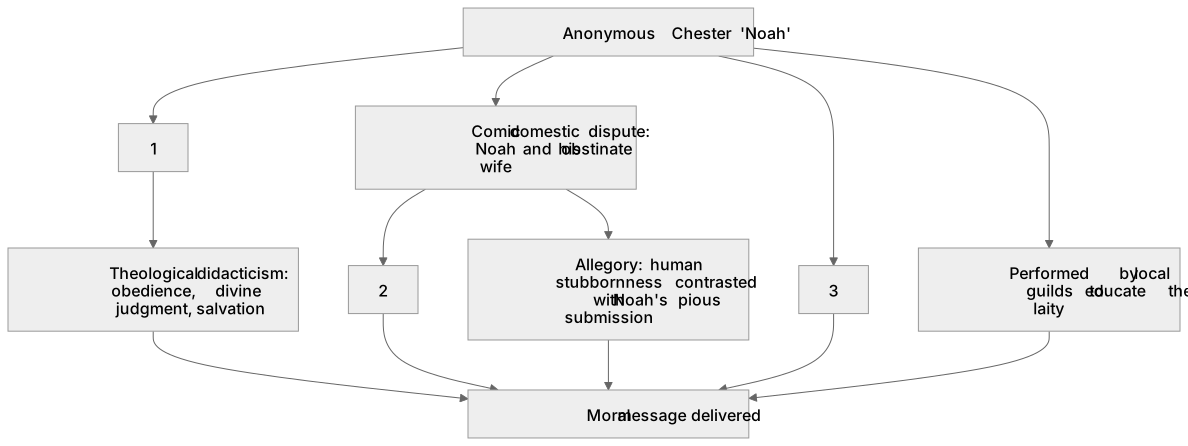
1Box 1
2Box 2
3Box 3
There is more to this lesson
The full lesson goes on to check your understanding and help you earn the marks. Create a free account to carry on, with your progress saved.
A week of Premium from your first lesson · Then the free plan continues · No card, no charge
Test your understanding of Component 3: Poetry – Section B: Specified Poetry Pre- or Post-1900 – Pre-1900 – The Medieval Period – English Mystery Plays: A Selection, editor Peter Happé (Penguin Classics, 1975): Noah (Chester) Anon
Active recall beats re-reading. Take an instant quiz now to test what you’ve learned and lock it into long-term memory.
A week of Premium from your first lesson · Then the free plan continues · No card, no charge