Pearson Edexcel · A-Level · English Literature
Course version: 9ET0 · Version from Sept 2015
Poetry – Section B: Specified Poetry Pre- or Post-1900 – Pre-1900 – The…
Full specification wording
Component 3: Poetry – Section B: Specified Poetry Pre- or Post-1900 – Pre-1900 – The Romantic Period – Selected Poems: John Keats, editor John Barnard (Penguin Classics, 2007): To Sleep
"To Sleep" is a powerful sonnet in which Keats personifies sleep as a gentle force offering vital escape from the anxieties of waking consciousness.
Checked against the Pearson Edexcel 9ET0 specification (opens in a new tab) on .
- 4 key terms
Study notes
From the checked teaching notes for this specification point.
The idea
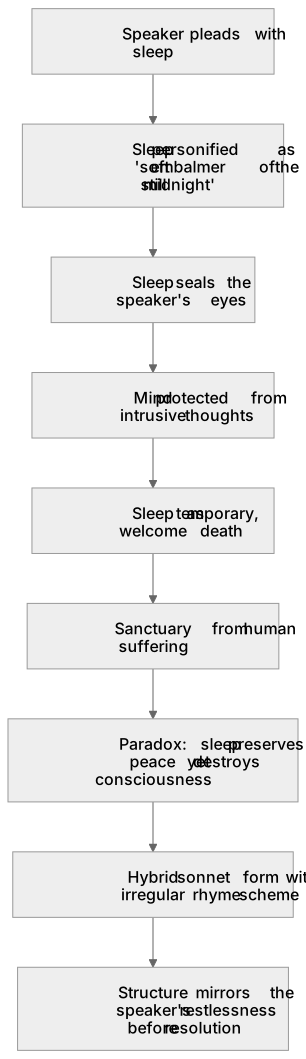
"To Sleep" is a powerful sonnet in which Keats personifies sleep as a gentle force offering vital escape from the anxieties of waking consciousness. The speaker pleads with sleep, the "soft embalmer of the still midnight", to seal his eyes and protect his mind from intrusive thoughts. Keats employs rich, dark imagery to present sleep as a temporary, welcome death providing sanctuary from human suffering. The poem's structure innovatively blends elements of Shakespearean and Petrarchan sonnet forms, mirroring the speaker's restless state before finding resolution.
What earns the marks
- Analyse the personification of sleep as a 'soft embalmer' and its dual connotations of death and preservation.
- Examine the hybrid sonnet structure and how the irregular rhyme scheme reflects the speaker's psychological restlessness.
- Discuss the use of sibilance and soft consonant sounds to mimic the soothing, hypnotic onset of sleep.
- Evaluate the theme of escapism and the speaker's desperation to avoid the intrusive thoughts of his own waking mind.
Common mistakes and how to put them right
Assuming the poem is a standard Petrarchan sonnet.
Put it right: Identify the structural irregularities and explain how they reflect the speaker's agitation.
Overlooking the darker connotations of the imagery.
Put it right: Analyse words like 'embalmer' to show how Keats links sleep closely with death.
Treating the poem merely as a gentle lullaby.
Put it right: Explore the underlying anxiety and the speaker's active struggle against his own consciousness.
Exam tips
- Link the desire for unconsciousness in 'To Sleep' to similar themes in 'Ode to a Nightingale' for strong cross-referencing.
- Analyse the enjambment across lines to demonstrate how the speaker's thoughts spill over, contrasting with the desired stillness of sleep.
- Focus on the sensory language, particularly the tactile and auditory imagery, used to invoke the physical presence of sleep.
Try the lesson
The start of the Component 3: Poetry – Section B: Specified Poetry Pre- or Post-1900 – Pre-1900 – The Romantic Period – Selected Poems: John Keats, editor John Barnard (Penguin Classics, 2007): To Sleep lesson, made from checked teaching notes for this specification point.
Have a go first
In John Keats's sonnet "To Sleep", how is the central subject of the poem primarily addressed by the speaker?
Listen
To Sleep" is a powerful sonnet in which Keats personifies sleep as a gentle force offering vital escape from the anxieties of waking consciousness. The speaker pleads with sleep, the "soft embalmer of the still midnight", to seal his eyes and protect his mind from intrusive thoughts. Keats employs rich, dark imagery to present sleep as a temporary, welcome death providing sanctuary from human suffering. The poem's structure innovatively blends elements of Shakespearean and Petrarchan sonnet forms, mirroring the speaker's restless state before finding resolution. A strong answer earns marks for these points. Analyse the personification of sleep as a 'soft embalmer' and its dual connotations of death and preservation. Examine the hybrid sonnet structure and how the irregular rhyme scheme reflects the speaker's psychological restlessness. Discuss the use of sibilance and soft consonant sounds to mimic the soothing, hypnotic onset of sleep. Evaluate the theme of escapism and the speaker's desperation to avoid the intrusive thoughts of his own waking mind. A common slip: Assuming the poem is a standard Petrarchan sonnet. Instead, identify the structural irregularities and explain how they reflect the speaker's agitation. Exam tip: Link the desire for unconsciousness in 'To Sleep' to similar themes in 'Ode to a Nightingale' for strong cross-referencing.
See it
Key words
Say what each word means before you turn the card.
Consciousness versus Unconsciousness
Try answering aloud or in your head before turning the card.
Mortality and Death
Try answering aloud or in your head before turning the card.
Suffering and Escapism
Try answering aloud or in your head before turning the card.
The Power of the Mind
Try answering aloud or in your head before turning the card.
See every definition
- Consciousness versus Unconsciousness
- The paradox of sleep as both a preserver of peace and a destroyer of consciousness, which students must analyse.
- Mortality and Death
- A broader Keatsian exploration to which the poem connects, with sleep presented as a temporary, welcome death.
- Suffering and Escapism
- The theme of the speaker's desperation to avoid the intrusive thoughts of his own waking mind.
- The Power of the Mind
- The speaker's active struggle against his own consciousness, which the poem's underlying anxiety reveals.
Label the diagram
Some boxes have lost their names. Pick the right name for each number.
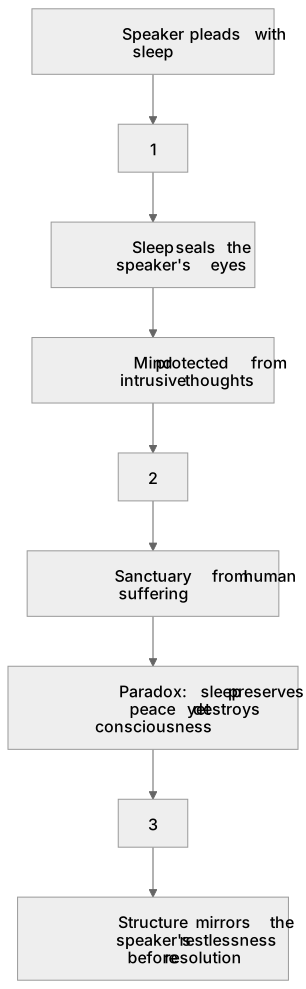
1Box 1
2Box 2
3Box 3
There is more to this lesson
The full lesson goes on to check your understanding and help you earn the marks. Create a free account to carry on, with your progress saved.
A week of Premium from your first lesson · Then the free plan continues · No card, no charge
Test your understanding of Component 3: Poetry – Section B: Specified Poetry Pre- or Post-1900 – Pre-1900 – The Romantic Period – Selected Poems: John Keats, editor John Barnard (Penguin Classics, 2007): To Sleep
Active recall beats re-reading. Take an instant quiz now to test what you’ve learned and lock it into long-term memory.
A week of Premium from your first lesson · Then the free plan continues · No card, no charge