Pearson Edexcel · A-Level · English Literature
Course version: 9ET0 · Version from Sept 2015
Poetry – Section B: Specified Poetry Pre- or Post-1900 – Pre-1900 – The…
Full specification wording
Component 3: Poetry – Section B: Specified Poetry Pre- or Post-1900 – Pre-1900 – The Victorian Period – Christina Rossetti Selected Poems, editor Dinah Roe (Penguin, 2008): At Home
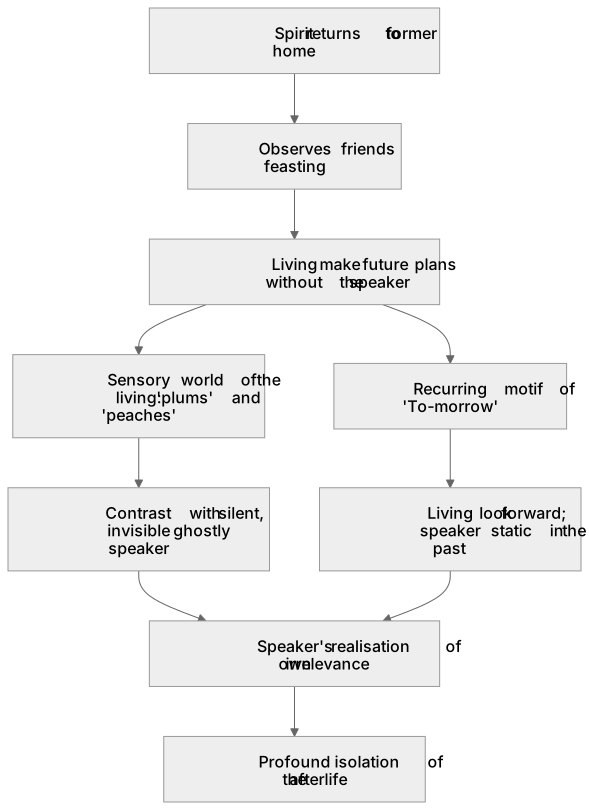
'At Home' explores the profound isolation of the afterlife and the painful reality of being forgotten by the living.
Checked against the Pearson Edexcel 9ET0 specification (opens in a new tab) on .
- Point 7 of 18
- 4 key terms
Study notes
From the checked teaching notes for this specification point.
The idea
'At Home' explores the profound isolation of the afterlife and the painful reality of being forgotten by the living. The poem is narrated by a spirit who returns to their former home, only to observe their friends feasting and making future plans without them. Rossetti contrasts the vibrant, sensory world of the living—characterised by 'plums' and 'peaches'—with the silent, invisible state of the ghostly speaker. The recurring motif of 'To-morrow' highlights the living's forward-looking perspective, which sharply contrasts with the speaker's static existence in the past.
What earns the marks
- Analyse the contrast between the sensory, vibrant language used for the living and the ethereal, silent existence of the ghostly speaker.
- Evaluate the structural repetition of 'To-morrow' and how it emphasises the living's focus on the future, excluding the dead.
- Explore the use of the first-person spectral narrator to evoke feelings of alienation, grief, and the inevitability of being forgotten.
- Discuss the poem's context within Victorian mourning culture and Rossetti's own Tractarian beliefs regarding the soul's sleep.
Common mistakes and how to put them right
Misinterpreting the living friends as malicious.
Put it right: Understand that their moving on is a natural, albeit painful, part of the human experience, not an intentional slight.
Overlooking the significance of the title.
Put it right: Analyse how 'At Home' is deeply ironic, as the speaker is entirely alienated in their former domestic space.
Ignoring the sensory imagery.
Put it right: Explicitly contrast the physical consumption of fruit by the living with the immateriality of the ghost.
Exam tips
- Link the theme of memory and being forgotten to other Rossetti poems like 'Remember' or 'Song (When I am dead, my dearest)'.
- Analyse the shift in tone from the observation of the living to the speaker's internal realisation of their own irrelevance.
- Discuss how the regular rhyme scheme and meter create a sense of inevitability and the relentless passage of time.
Try the lesson
The start of the Component 3: Poetry – Section B: Specified Poetry Pre- or Post-1900 – Pre-1900 – The Victorian Period – Christina Rossetti Selected Poems, editor Dinah Roe (Penguin, 2008): At Home lesson, made from checked teaching notes for this specification point.
Have a go first
In Christina Rossetti's poem 'At Home', what is the central situation of the speaker?
Listen
At Home' explores the profound isolation of the afterlife and the painful reality of being forgotten by the living. The poem is narrated by a spirit who returns to their former home, only to observe their friends feasting and making future plans without them. Rossetti contrasts the vibrant, sensory world of the living—characterised by 'plums' and 'peaches'—with the silent, invisible state of the ghostly speaker. The recurring motif of 'To-morrow' highlights the living's forward-looking perspective, which sharply contrasts with the speaker's static existence in the past. A strong answer earns marks for these points. Analyse the contrast between the sensory, vibrant language used for the living and the ethereal, silent existence of the ghostly speaker. Evaluate the structural repetition of 'To-morrow' and how it emphasises the living's focus on the future, excluding the dead. Explore the use of the first-person spectral narrator to evoke feelings of alienation, grief, and the inevitability of being forgotten. Discuss the poem's context within Victorian mourning culture and Rossetti's own Tractarian beliefs regarding the soul's sleep. A common slip: Misinterpreting the living friends as malicious. Instead, understand that their moving on is a natural, albeit painful, part of the human experience, not an intentional slight. Exam tip: Link the theme of memory and being forgotten to other Rossetti poems like 'Remember' or 'Song (When I am dead, my dearest)'.
See it
Key words
Say what each word means before you turn the card.
Isolation and alienation
Try answering aloud or in your head before turning the card.
Memory and forgetting
Try answering aloud or in your head before turning the card.
Death and the afterlife
Try answering aloud or in your head before turning the card.
Time and transience
Try answering aloud or in your head before turning the card.
See every definition
- Isolation and alienation
- The profound isolation of the afterlife and the speaker's alienation in their former domestic space, where they are entirely alienated.
- Memory and forgetting
- The painful reality of being forgotten by the living, who move on as a natural part of human experience.
- Death and the afterlife
- The silent, invisible state of the ghostly speaker, contrasted with the vibrant, sensory world of the living.
- Time and transience
- The living's forward-looking perspective, emphasised by the recurring motif of 'To-morrow', which contrasts with the speaker's static existence in the past.
Label the diagram
Some boxes have lost their names. Pick the right name for each number.
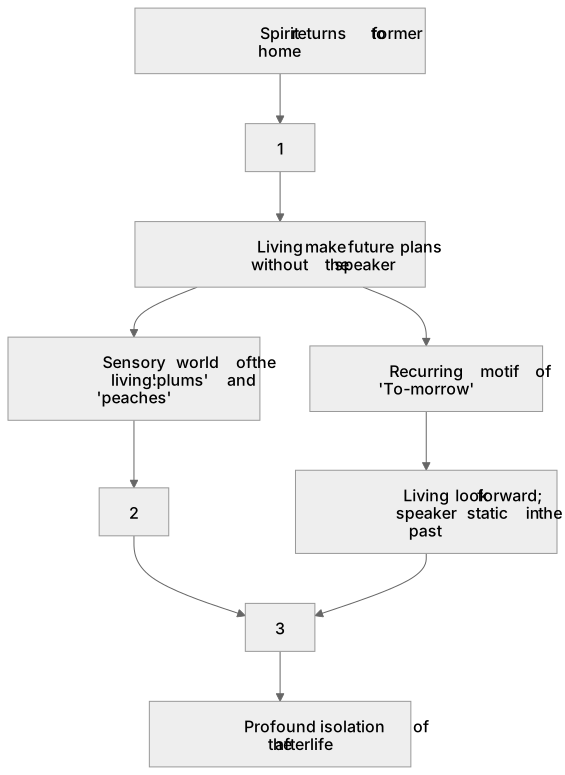
1Box 1
2Box 2
3Box 3
There is more to this lesson
The full lesson goes on to check your understanding and help you earn the marks. Create a free account to carry on, with your progress saved.
A week of Premium from your first lesson · Then the free plan continues · No card, no charge
Test your understanding of Component 3: Poetry – Section B: Specified Poetry Pre- or Post-1900 – Pre-1900 – The Victorian Period – Christina Rossetti Selected Poems, editor Dinah Roe (Penguin, 2008): At Home
Active recall beats re-reading. Take an instant quiz now to test what you’ve learned and lock it into long-term memory.
A week of Premium from your first lesson · Then the free plan continues · No card, no charge