Pearson Edexcel · A-Level · English Literature
Course version: 9ET0 · Version from Sept 2015
Poetry – Section B: Specified Poetry Pre- or Post-1900 – Pre-1900 – The…
Full specification wording
Component 3: Poetry – Section B: Specified Poetry Pre- or Post-1900 – Pre-1900 – The Victorian Period – Christina Rossetti Selected Poems, editor Dinah Roe (Penguin, 2008): Our Mothers, lovely women pitiful
In 'Our Mothers, lovely women pitiful', Christina Rossetti explores the spiritual and earthly legacy of maternal figures, blending Victorian ideals of womanhood with profound theological reflection.
Checked against the Pearson Edexcel 9ET0 specification (opens in a new tab) on .
- Point 17 of 18
- 4 key terms
Study notes
From the checked teaching notes for this specification point.
The idea
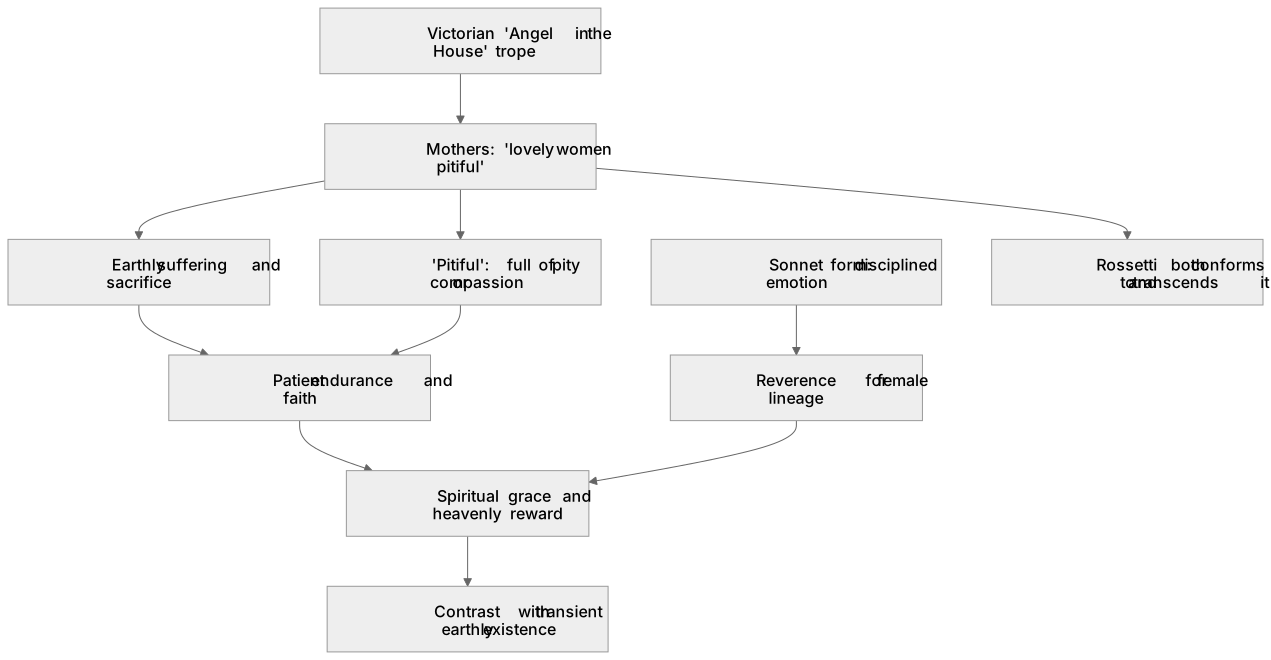
In 'Our Mothers, lovely women pitiful', Christina Rossetti explores the spiritual and earthly legacy of maternal figures, blending Victorian ideals of womanhood with profound theological reflection. The poem functions as a tribute to female lineage, acknowledging the suffering and sacrifices ('pitiful') inherent in motherhood while elevating these women to a state of spiritual grace. Rossetti contrasts the transient nature of earthly existence with the eternal reward of heaven, using the mothers as exemplars of patient endurance and faith.
What earns the marks
- Analysis of the adjective 'pitiful' as denoting both deserving of pity due to earthly suffering and being full of pity or compassion.
- Exploration of how Rossetti elevates the domestic sphere of motherhood to a realm of spiritual significance and martyrdom.
- Evaluation of the sonnet form as a vehicle for expressing disciplined emotion and reverence for female lineage.
- Connections made to Victorian gender roles, specifically the 'Angel in the House' trope, and how Rossetti both conforms to and transcends it.
Common mistakes and how to put them right
Misinterpreting 'pitiful' solely as a derogatory term.
Put it right: It must be understood in its archaic sense of being full of pity or compassion.
Treating the poem as purely biographical.
Put it right: While Rossetti had a strong bond with her mother, the poem speaks to a broader, collective female experience.
Exam tips
- Compare the depiction of female suffering and endurance in this poem with Rossetti's other works, such as 'Goblin Market' or 'Remember'.
- Analyse the specific metrical variations in the sonnet to show how Rossetti disrupts traditional rhythms to emphasise emotional weight.
- Use the context of Tractarianism and the Oxford Movement to enrich your discussion of the poem's spiritual and sacrificial themes.
Try the lesson
The start of the Component 3: Poetry – Section B: Specified Poetry Pre- or Post-1900 – Pre-1900 – The Victorian Period – Christina Rossetti Selected Poems, editor Dinah Roe (Penguin, 2008): Our Mothers, lovely women pitiful lesson, made from checked teaching notes for this specification point.
Have a go first
In the phrase "Our Mothers, lovely women pitiful", what is the primary effect of the speaker's use of the first-person plural possessive "Our"?
Listen
In 'Our Mothers, lovely women pitiful', Christina Rossetti explores the spiritual and earthly legacy of maternal figures, blending Victorian ideals of womanhood with profound theological reflection. The poem functions as a tribute to female lineage, acknowledging the suffering and sacrifices ('pitiful') inherent in motherhood while elevating these women to a state of spiritual grace. Rossetti contrasts the transient nature of earthly existence with the eternal reward of heaven, using the mothers as exemplars of patient endurance and faith. A strong answer earns marks for these points. Analysis of the adjective 'pitiful' as denoting both deserving of pity due to earthly suffering and being full of pity or compassion. Exploration of how Rossetti elevates the domestic sphere of motherhood to a realm of spiritual significance and martyrdom. Evaluation of the sonnet form as a vehicle for expressing disciplined emotion and reverence for female lineage. Connections made to Victorian gender roles, specifically the 'Angel in the House' trope, and how Rossetti both conforms to and transcends it. Exam tip: Compare the depiction of female suffering and endurance in this poem with Rossetti's other works, such as 'Goblin Market' or 'Remember'.
See it
Key words
Say what each word means before you turn the card.
Maternal sacrifice
Try answering aloud or in your head before turning the card.
Female lineage and solidarity
Try answering aloud or in your head before turning the card.
Earthly suffering versus heavenly reward
Try answering aloud or in your head before turning the card.
Victorian ideals of womanhood
Try answering aloud or in your head before turning the card.
See every definition
- Maternal sacrifice
- The suffering and sacrifices inherent in motherhood, which the poem acknowledges while elevating these women to a state of spiritual grace.
- Female lineage and solidarity
- The tribute the poem pays to female lineage, speaking to a broader, collective female experience rather than a purely biographical one.
- Earthly suffering versus heavenly reward
- The contrast between the transient nature of earthly existence and the eternal reward of heaven, with the mothers as exemplars of patient endurance and faith.
- Victorian ideals of womanhood
- The Victorian gender roles the poem blends with theological reflection, specifically the 'Angel in the House' trope, which Rossetti both conforms to and transcends.
Label the diagram
Some boxes have lost their names. Pick the right name for each number.
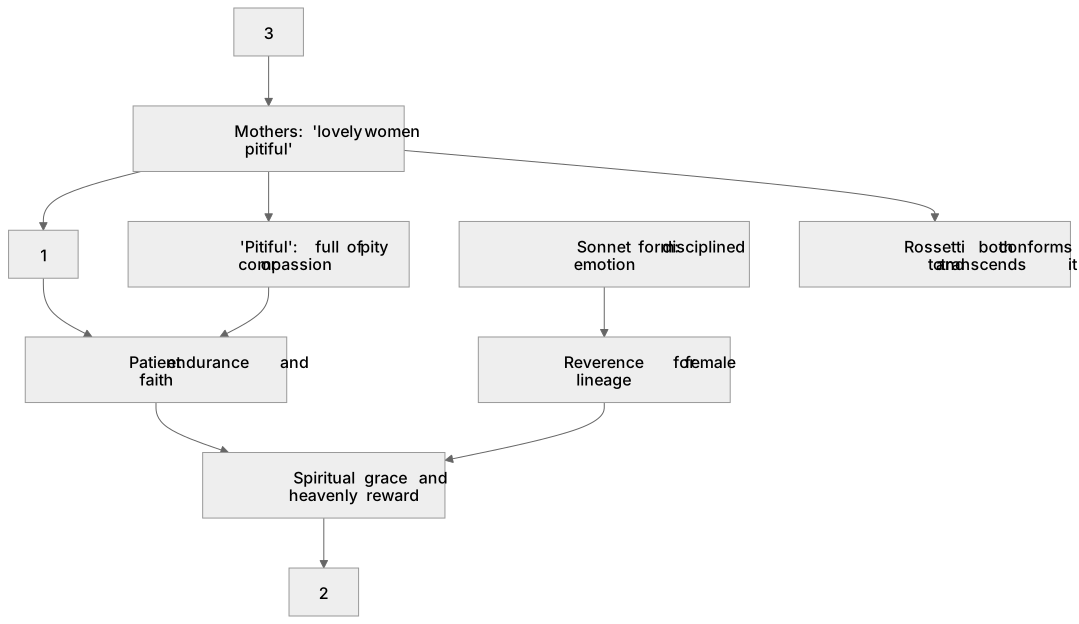
1Box 1
2Box 2
3Box 3
There is more to this lesson
The full lesson goes on to check your understanding and help you earn the marks. Create a free account to carry on, with your progress saved.
A week of Premium from your first lesson · Then the free plan continues · No card, no charge
Test your understanding of Component 3: Poetry – Section B: Specified Poetry Pre- or Post-1900 – Pre-1900 – The Victorian Period – Christina Rossetti Selected Poems, editor Dinah Roe (Penguin, 2008): Our Mothers, lovely women pitiful
Active recall beats re-reading. Take an instant quiz now to test what you’ve learned and lock it into long-term memory.
A week of Premium from your first lesson · Then the free plan continues · No card, no charge