Pearson Edexcel · A-Level · English Literature
Course version: 9ET0 · Version from Sept 2015
Poetry – Section B: Specified Poetry Pre- or Post-1900 – Pre-1900 – The…
Full specification wording
Component 3: Poetry – Section B: Specified Poetry Pre- or Post-1900 – Pre-1900 – The Victorian Period – The New Oxford Book of Victorian Verse, editor Christopher Ricks (OUP, 2008): A Birthday
Christina Rossetti's 'A Birthday' is a two-stanza lyric poem celebrating the arrival of profound love or spiritual awakening.
Checked against the Pearson Edexcel 9ET0 specification (opens in a new tab) on .
- Point 11 of 17
- 4 key terms
Study notes
From the checked teaching notes for this specification point.
The idea
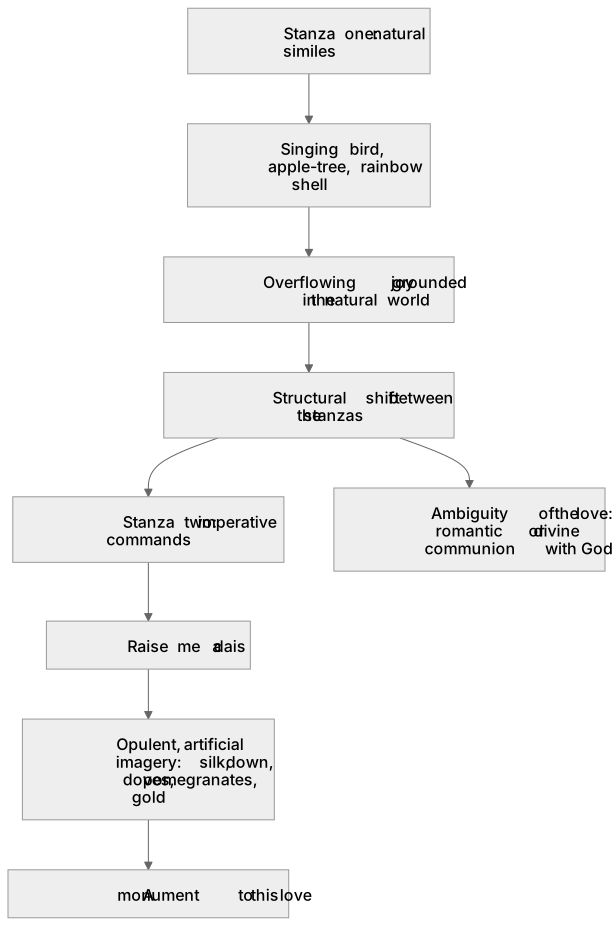
Christina Rossetti's 'A Birthday' is a two-stanza lyric poem celebrating the arrival of profound love or spiritual awakening. The first stanza uses natural similes ('singing bird', 'apple-tree', 'rainbow shell') to express the speaker's overflowing joy, grounding the emotion in the natural world. The second stanza shifts to imperative commands ('Raise me a dais'), demanding opulent, artificial imagery (silk, down, doves, pomegranates, gold) to construct a monument to this love.
What earns the marks
- Analyse the structural shift between the natural similes of stanza one and the imperative, crafted imagery of stanza two.
- Evaluate the use of anaphora ('My heart is like...') to build a sense of overwhelming, inexpressible joy.
- Explore the ambiguity of the 'love' that has come, discussing both secular romantic interpretations and Tractarian spiritual readings.
- Examine the significance of the opulent, almost Orientalist imagery in the second stanza (vair, purple dyes, pomegranates) as a reflection of Victorian aestheticism.
Common mistakes and how to put them right
Assuming the poem is exclusively about romantic love.
Put it right: Acknowledge the strong possibility of a spiritual or religious interpretation, given Rossetti's devout Anglicanism.
Ignoring the structural divide between the stanzas.
Put it right: Explicitly contrast the organic, natural imagery of the first stanza with the artificial, constructed imagery of the second.
Misinterpreting 'birthday' as a literal chronological age milestone.
Put it right: Explain that 'birthday' functions metaphorically to represent a spiritual rebirth or the beginning of a new life through love.
Exam tips
- Compare the sensory natural imagery in 'A Birthday' with other Victorian poems that use nature to reflect internal emotional states.
- Use the term 'anaphora' when discussing the repetition of 'My heart is like' to show how the speaker struggles to find a single adequate comparison.
- Link the rich, decorative imagery of the second stanza to the influence of the Pre-Raphaelite Brotherhood's visual aesthetics.
Try the lesson
The start of the Component 3: Poetry – Section B: Specified Poetry Pre- or Post-1900 – Pre-1900 – The Victorian Period – The New Oxford Book of Victorian Verse, editor Christopher Ricks (OUP, 2008): A Birthday lesson, made from checked teaching notes for this specification point.
Have a go first
In the first stanza of Christina Rossetti's 'A Birthday', how does the speaker primarily express the depth of her joy?
Listen
Christina Rossetti's 'A Birthday' is a two-stanza lyric poem celebrating the arrival of profound love or spiritual awakening. The first stanza uses natural similes ('singing bird', 'apple-tree', 'rainbow shell') to express the speaker's overflowing joy, grounding the emotion in the natural world. The second stanza shifts to imperative commands ('Raise me a dais'), demanding opulent, artificial imagery (silk, down, doves, pomegranates, gold) to construct a monument to this love. A strong answer earns marks for these points. Analyse the structural shift between the natural similes of stanza one and the imperative, crafted imagery of stanza two. Evaluate the use of anaphora ('My heart is like...') to build a sense of overwhelming, inexpressible joy. Explore the ambiguity of the 'love' that has come, discussing both secular romantic interpretations and Tractarian spiritual readings. Examine the significance of the opulent, almost Orientalist imagery in the second stanza (vair, purple dyes, pomegranates) as a reflection of Victorian aestheticism. A common slip: Assuming the poem is exclusively about romantic love. Instead, acknowledge the strong possibility of a spiritual or religious interpretation, given Rossetti's devout Anglicanism. Exam tip: Compare the sensory natural imagery in 'A Birthday' with other Victorian poems that use nature to reflect internal emotional states.
See it
Key words
Say what each word means before you turn the card.
Spiritual rebirth
Try answering aloud or in your head before turning the card.
The natural world vs artifice
Try answering aloud or in your head before turning the card.
Overwhelming joy
Try answering aloud or in your head before turning the card.
Divine vs romantic love
Try answering aloud or in your head before turning the card.
See every definition
- Spiritual rebirth
- The metaphorical meaning of 'birthday', representing the beginning of a new life through love rather than a literal chronological age milestone.
- The natural world vs artifice
- The contrast between the organic, natural similes of the first stanza and the opulent, artificial imagery of the second, which constructs a monument to love.
- Overwhelming joy
- The speaker's overflowing emotion, expressed through natural similes and built by anaphora as a sense of inexpressible joy.
- Divine vs romantic love
- The ambiguity of the 'love' that has come, read either as secular romantic love or as a divine communion with God typical of Victorian religious poetry.
Label the diagram
Some boxes have lost their names. Pick the right name for each number.
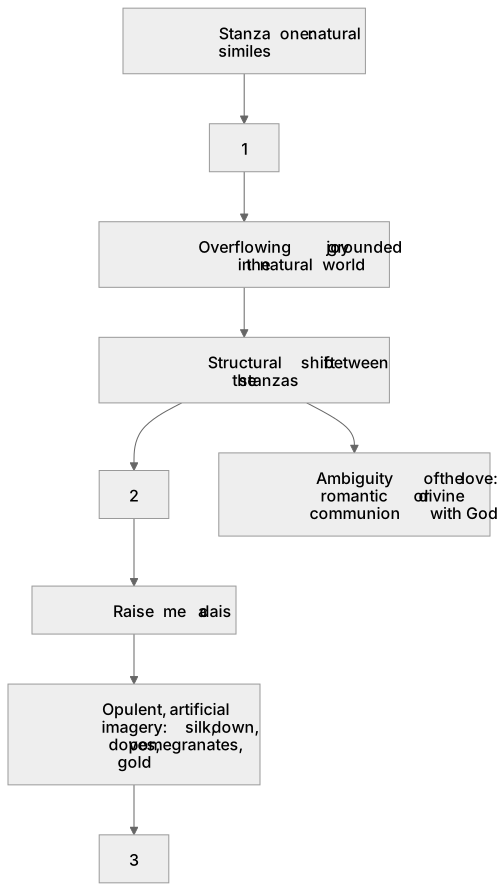
1Box 1
2Box 2
3Box 3
There is more to this lesson
The full lesson goes on to check your understanding and help you earn the marks. Create a free account to carry on, with your progress saved.
A week of Premium from your first lesson · Then the free plan continues · No card, no charge
Test your understanding of Component 3: Poetry – Section B: Specified Poetry Pre- or Post-1900 – Pre-1900 – The Victorian Period – The New Oxford Book of Victorian Verse, editor Christopher Ricks (OUP, 2008): A Birthday
Active recall beats re-reading. Take an instant quiz now to test what you’ve learned and lock it into long-term memory.
A week of Premium from your first lesson · Then the free plan continues · No card, no charge