Pearson Edexcel · A-Level · English Literature
Course version: 9ET0 · Version from Sept 2015
Poetry – Section B: Specified Poetry Pre- or Post-1900 – Pre-1900 – The…
Full specification wording
Component 3: Poetry – Section B: Specified Poetry Pre- or Post-1900 – Pre-1900 – The Victorian Period – The New Oxford Book of Victorian Verse, editor Christopher Ricks (OUP, 2008): The Darkling Thrush
Thomas Hardy's 'The Darkling Thrush' (written at the turn of the 20th century) is a pivotal Victorian poem exploring the transition from the 19th to the 20th century.
Checked against the Pearson Edexcel 9ET0 specification (opens in a new tab) on .
- Point 17 of 17
- 4 key terms
Study notes
From the checked teaching notes for this specification point.
The idea
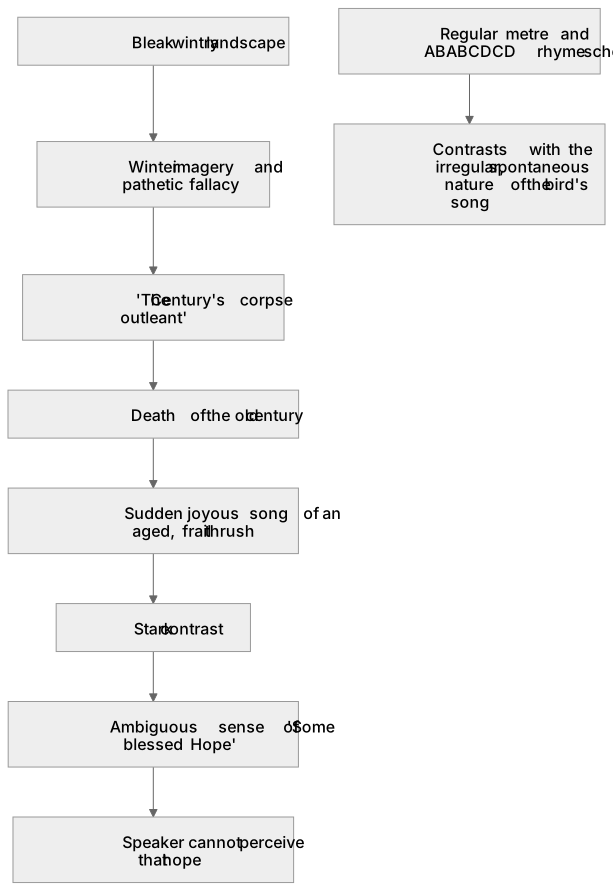
Thomas Hardy's 'The Darkling Thrush' (written at the turn of the 20th century) is a pivotal Victorian poem exploring the transition from the 19th to the 20th century. The speaker stands in a bleak, wintry landscape, symbolising the death of the old century ('The Century's corpse outleant'). The sudden, joyous song of an aged, frail thrush introduces a stark contrast, offering an ambiguous sense of 'Some blessed Hope' that the speaker cannot perceive. Contextually, it reflects late-Victorian pessimism and the decline of religious certainty.
What earns the marks
- Analyse Hardy's use of pathetic fallacy and winter imagery to represent the death of the 19th century.
- Evaluate the structural contrast between the rigid, traditional ballad metre and the spontaneous, hopeful song of the thrush.
- Explore the significance of the thrush as a symbol of fragile, irrational hope amidst late-Victorian pessimism.
- Connect the poem's themes of religious doubt and existential bleakness to the broader context of the Victorian period.
Common mistakes and how to put them right
Assuming the poem is purely optimistic at the end.
Put it right: Acknowledge the ambiguity of the ending, as the speaker remains unaware of the reason for the thrush's hope.
Ignoring the specific historical context.
Put it right: Explicitly link the poem to the transition from the 19th to the 20th century, as it was written in December 1900.
Focusing only on imagery without discussing form.
Put it right: Analyse how the regular ABABCDCD rhyme scheme and alternating iambic metre contribute to the poem's melancholic, hymn-like tone.
Exam tips
- Compare the bleak landscape in the first two stanzas with the sudden auditory shift in the third stanza to demonstrate structural awareness.
- Use the phrase 'The Century's corpse outleant' to discuss Hardy's personification of time and his pessimistic view of the passing era.
- Link the poem's exploration of nature to other Victorian poets' anxieties about industrialisation and the loss of faith.
Try the lesson
The start of the Component 3: Poetry – Section B: Specified Poetry Pre- or Post-1900 – Pre-1900 – The Victorian Period – The New Oxford Book of Victorian Verse, editor Christopher Ricks (OUP, 2008): The Darkling Thrush lesson, made from checked teaching notes for this specification point.
Have a go first
In Thomas Hardy's 'The Darkling Thrush', what does the speaker explicitly compare the winter landscape to in the second stanza?
Listen
Thomas Hardy's 'The Darkling Thrush' (written at the turn of the 20th century) is a pivotal Victorian poem exploring the transition from the 19th to the 20th century. The speaker stands in a bleak, wintry landscape, symbolising the death of the old century ('The Century's corpse outleant'). The sudden, joyous song of an aged, frail thrush introduces a stark contrast, offering an ambiguous sense of 'Some blessed Hope' that the speaker cannot perceive. Contextually, it reflects late-Victorian pessimism and the decline of religious certainty. A strong answer earns marks for these points. Analyse Hardy's use of pathetic fallacy and winter imagery to represent the death of the 19th century. Evaluate the structural contrast between the rigid, traditional ballad metre and the spontaneous, hopeful song of the thrush. Explore the significance of the thrush as a symbol of fragile, irrational hope amidst late-Victorian pessimism. Connect the poem's themes of religious doubt and existential bleakness to the broader context of the Victorian period. A common slip: Assuming the poem is purely optimistic at the end. Instead, acknowledge the ambiguity of the ending, as the speaker remains unaware of the reason for the thrush's hope. Exam tip: Compare the bleak landscape in the first two stanzas with the sudden auditory shift in the third stanza to demonstrate structural awareness.
See it
Key words
Say what each word means before you turn the card.
Late-Victorian pessimism and doubt
Try answering aloud or in your head before turning the card.
The transition of time and the turn of the century
Try answering aloud or in your head before turning the card.
Nature as a source of ambiguous hope
Try answering aloud or in your head before turning the card.
Isolation and the human condition
Try answering aloud or in your head before turning the card.
See every definition
- Late-Victorian pessimism and doubt
- A mood reflecting the decline of religious certainty, which the poem reflects contextually.
- The transition of time and the turn of the century
- The move from the 19th to the 20th century, which the poem explores and which the speaker marks with 'The Century's corpse outleant'.
- Nature as a source of ambiguous hope
- The frail thrush's joyous song offers 'Some blessed Hope' that the speaker cannot perceive, leaving the ending ambiguous.
- Isolation and the human condition
- The speaker's existential bleakness and religious doubt, connected to the broader context of the Victorian period.
Label the diagram
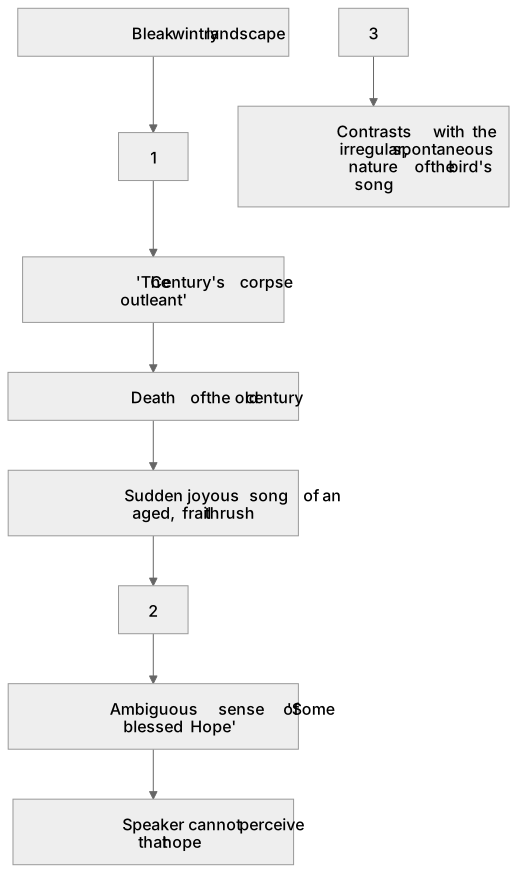
Some boxes have lost their names. Pick the right name for each number.
1Box 1
2Box 2
3Box 3
There is more to this lesson
The full lesson goes on to check your understanding and help you earn the marks. Create a free account to carry on, with your progress saved.
A week of Premium from your first lesson · Then the free plan continues · No card, no charge
Test your understanding of Component 3: Poetry – Section B: Specified Poetry Pre- or Post-1900 – Pre-1900 – The Victorian Period – The New Oxford Book of Victorian Verse, editor Christopher Ricks (OUP, 2008): The Darkling Thrush
Active recall beats re-reading. Take an instant quiz now to test what you’ve learned and lock it into long-term memory.
A week of Premium from your first lesson · Then the free plan continues · No card, no charge