Pearson Edexcel · GCSE · English Literature
19th-Century Novel
Master Mary Shelley's Frankenstein with this comprehensive, exam-focused study guide. Explore the tragic consequences of ambition, the complexities of creation, and the profound questions of monstrosity to secure top marks in your GCSE English Literature exam.
- 9 min read
- 2 worked examples
- 4 practice questions
- 8 key terms
Study Notes
Overview
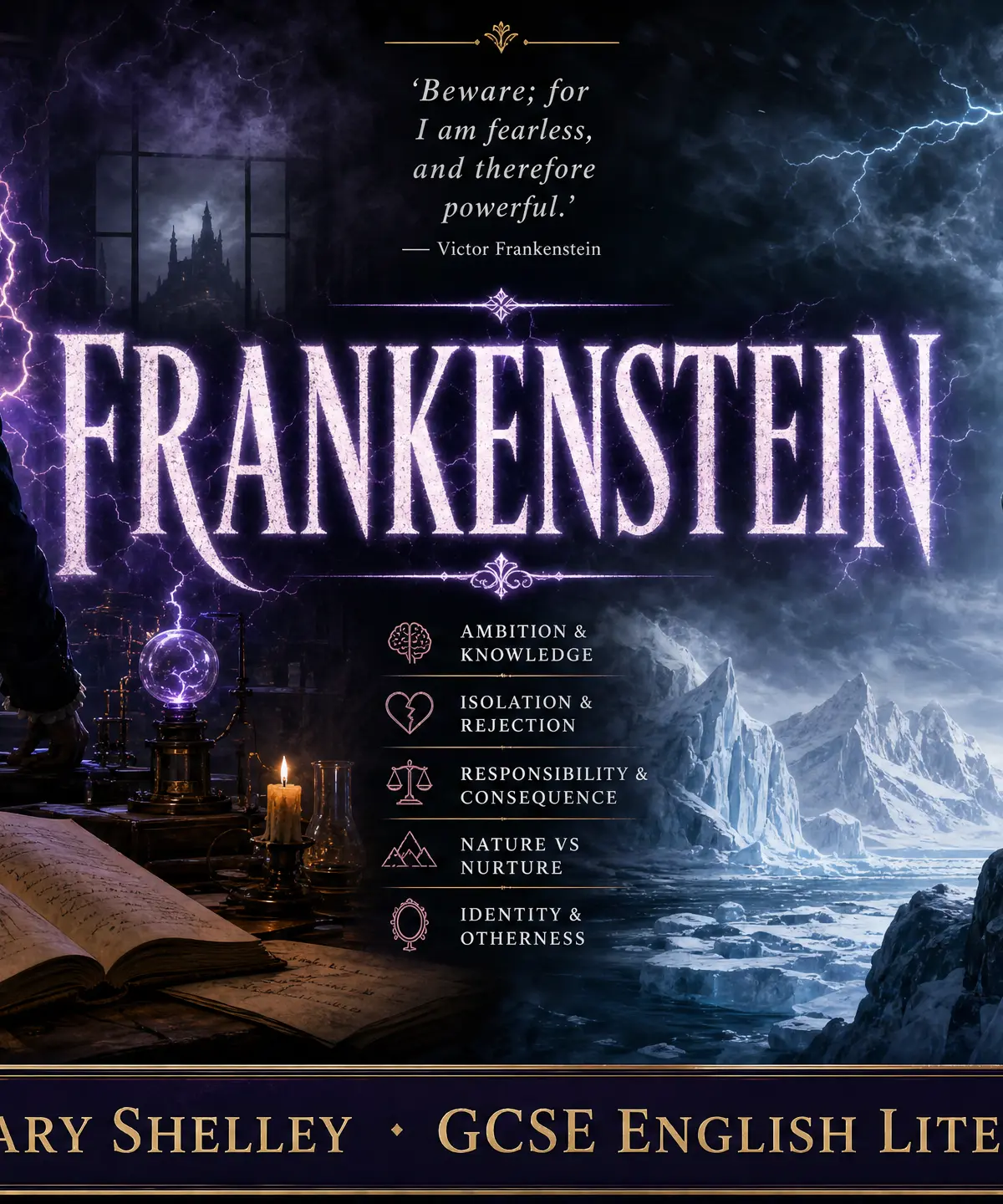
Mary Shelley's Frankenstein; or, The Modern Prometheus (1818) is a foundational text of both the Gothic and Science Fiction genres. Written during the Romantic period, it reflects contemporary anxieties about scientific advancement, the limits of human knowledge, and the responsibilities of creators. For GCSE English Literature examiners, a high-level response must go beyond simply retelling the plot. Candidates are expected to analyse Shelley's complex narrative structure (the frame narrative), her sophisticated use of language to evoke the sublime, and the profound moral ambiguities surrounding Victor and his Creature.
Listen to our 10-minute audio guide for a deep dive into the core themes and exam strategies:
Plot/Content Overview
Letters 1-4 (Walton's Narrative): Robert Walton, an ambitious Arctic explorer, writes to his sister. His ship becomes trapped in ice, and his crew rescues a near-frozen, emaciated man: Victor Frankenstein.
Chapters 1-10 (Victor's Narrative): Victor recounts his idyllic childhood in Geneva with his adopted sister/fiancée, Elizabeth, and best friend, Henry Clerval. At university in Ingolstadt, Victor becomes obsessed with discovering the secret of life. He builds a creature from scavenged body parts and animates it, but immediately flees in horror at its ugliness. Months later, Victor learns his youngest brother, William, has been murdered. Justine Moritz, a servant, is framed and executed. Victor, knowing the Creature is responsible, flees to the Alps where the Creature confronts him.
Chapters 11-16 (The Creature's Narrative): The Creature explains his early days of confusion and his gradual education while secretly observing the De Lacey family. He learns language, reads Paradise Lost, and discovers the tragedy of his own existence. When he finally reveals himself, the De Laceys attack him. Embittered by total rejection, he vows revenge on his creator, murders William, and frames Justine. He demands Victor create a female companion for him.
Chapters 17-24 (Victor's Narrative Resumes): Victor agrees, travels to Scotland to build the female, but destroys it before bringing it to life, fearing a race of monsters. The Creature vows to be with Victor on his wedding night. The Creature murders Clerval, and Victor is briefly imprisoned. Victor marries Elizabeth, but the Creature murders her. Victor's father dies of grief. Victor dedicates the rest of his life to hunting the Creature across the globe, leading him to the Arctic.
Walton in Continuation: Victor finishes his tale and dies. The Creature boards the ship, mourns his creator, expresses his own self-loathing, and departs into the ice to build his own funeral pyre.
Themes
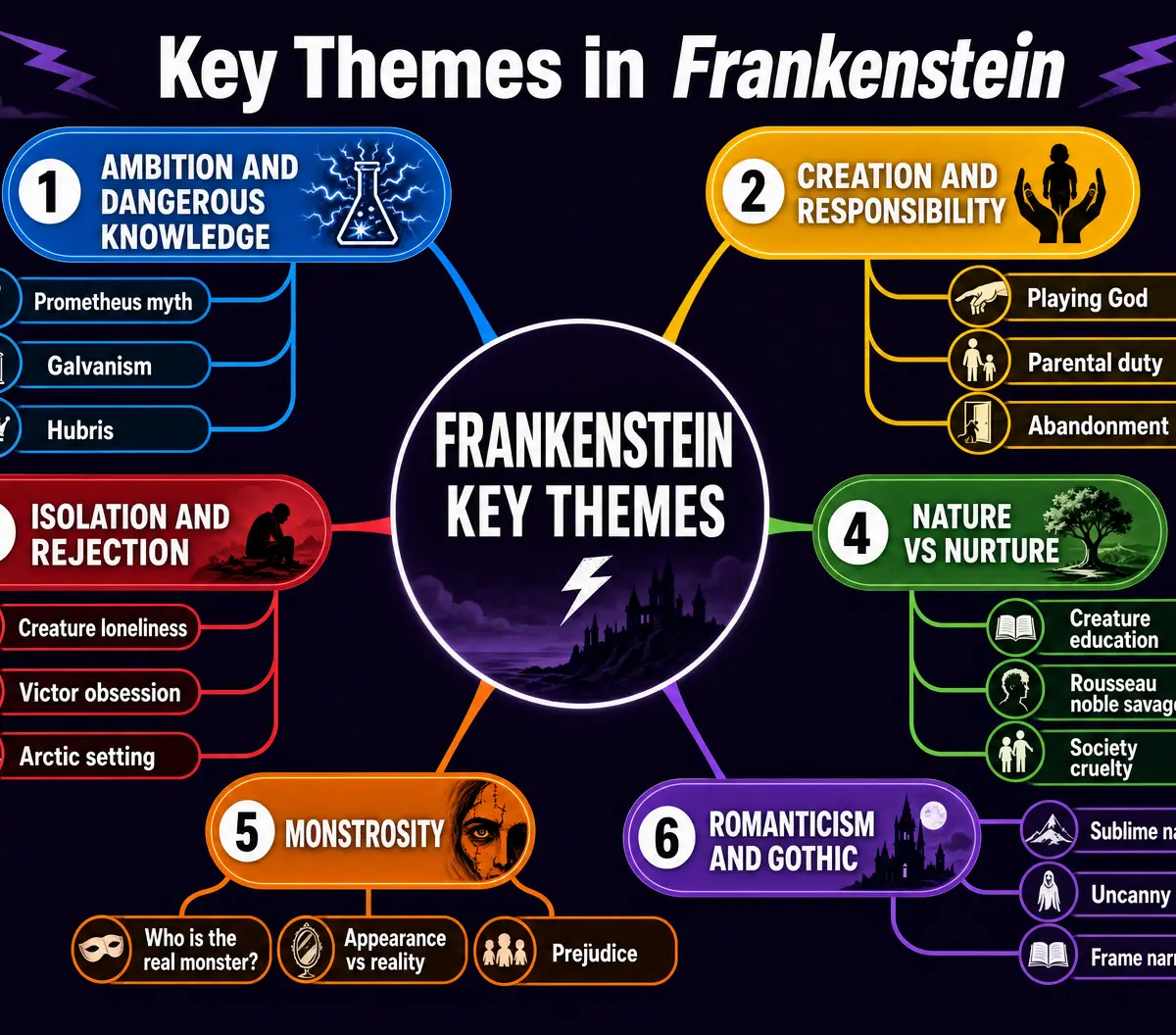
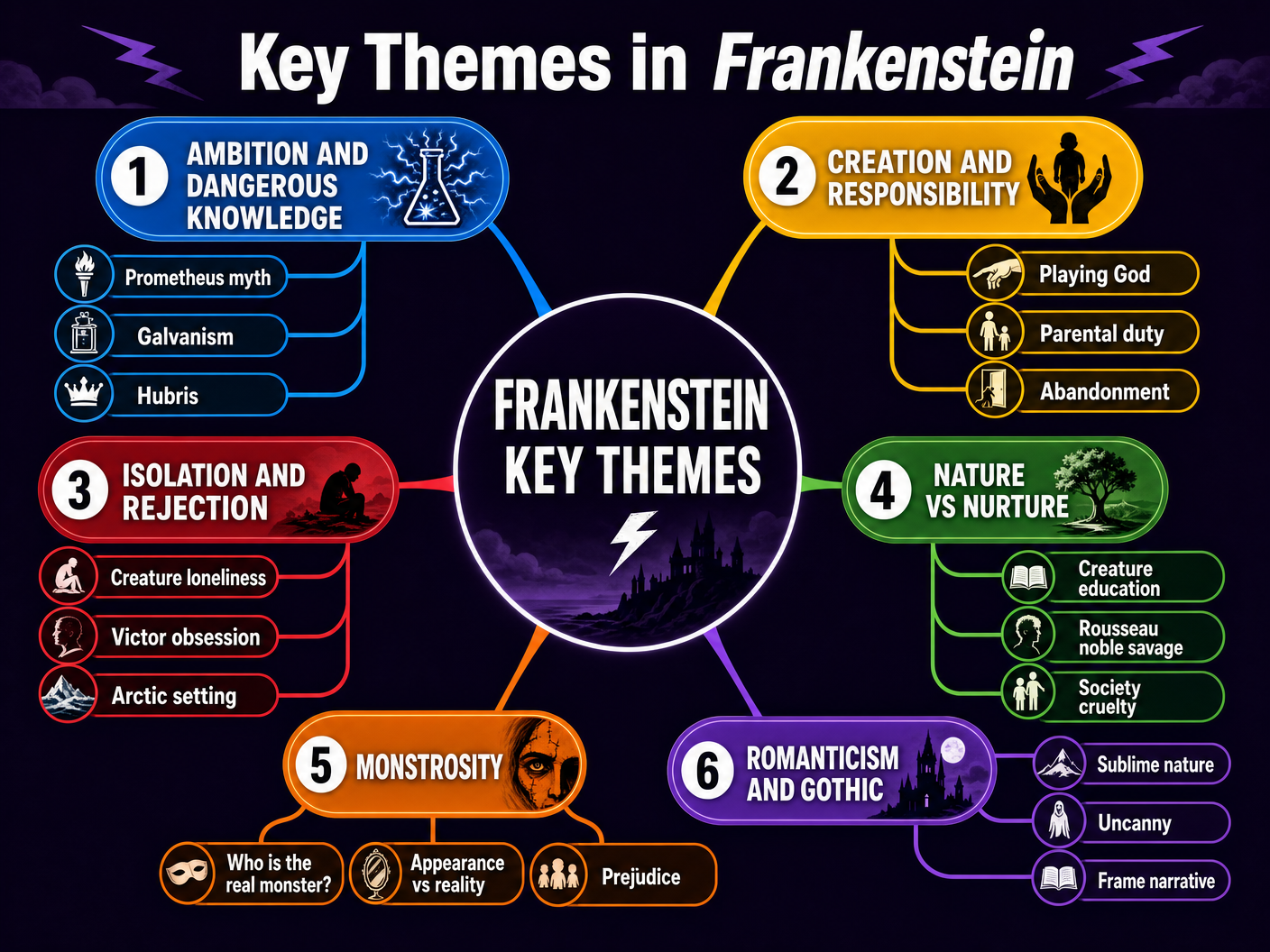
Theme 1: Ambition and Dangerous Knowledge
Shelley critiques the Enlightenment ideal of limitless scientific progress without ethical boundaries. Victor's hubris (excessive pride) leads him to usurp the role of God (or nature) in creating life. This connects directly to the novel's subtitle, 'The Modern Prometheus'. Like Prometheus, who stole fire from the gods and was eternally punished, Victor suffers for crossing natural boundaries.
Key Quotes:
- "I will pioneer a new way, explore unknown powers, and unfold to the world the deepest mysteries of creation." (Chapter 3) - The verbs 'pioneer', 'explore', and 'unfold' highlight Victor's arrogance and his belief in his own messianic destiny.
- "Learn from me, if not by my precepts, at least by my example, how dangerous is the acquirement of knowledge" (Chapter 4) - Victor acts as a didactic narrator here, explicitly stating the moral of his tale to Walton.
Theme 2: Creation and Responsibility
Victor's primary crime is not the creation of the monster, but his immediate abandonment of it. Shelley questions the duties a creator owes to their creation, reflecting contemporary debates about parental responsibility (particularly Rousseau's theories) and God's relationship with humanity.
Key Quotes:
- "I had worked hard for nearly two years, for the sole purpose of infusing life into an inanimate body... but now that I had finished, the beauty of the dream vanished, and breathless horror and disgust filled my heart." (Chapter 5) - The juxtaposition of 'beauty' and 'horror' emphasises Victor's superficiality; he rejects his creation purely based on aesthetics.
- "I ought to be thy Adam, but I am rather the fallen angel, whom thou drivest from joy for no misdeed." (Chapter 10) - The Creature uses biblical allusion (Paradise Lost) to articulate his unjust rejection, highlighting Victor's failure as a 'creator' God.
Theme 3: Isolation and Rejection
Almost every tragedy in the novel stems from isolation. Victor isolates himself voluntarily to pursue his science, leading to his moral degradation. The Creature is isolated involuntarily by society's prejudice, which transforms his innate goodness into violent hatred.
Key Quotes:
- "I am malicious because I am miserable. Am I not shunned and hated by all mankind?" (Chapter 17) - The Creature uses logical, balanced syntax to explain his psychological state. Shelley argues that society creates its own monsters through cruelty.
- "I, the miserable and the abandoned, am an abortion, to be spurned at, and kicked, and trampled on." (Chapter 24) - The violent triplet of verbs ('spurned', 'kicked', 'trampled') conveys the physical and emotional abuse the Creature has suffered.
Character Analysis
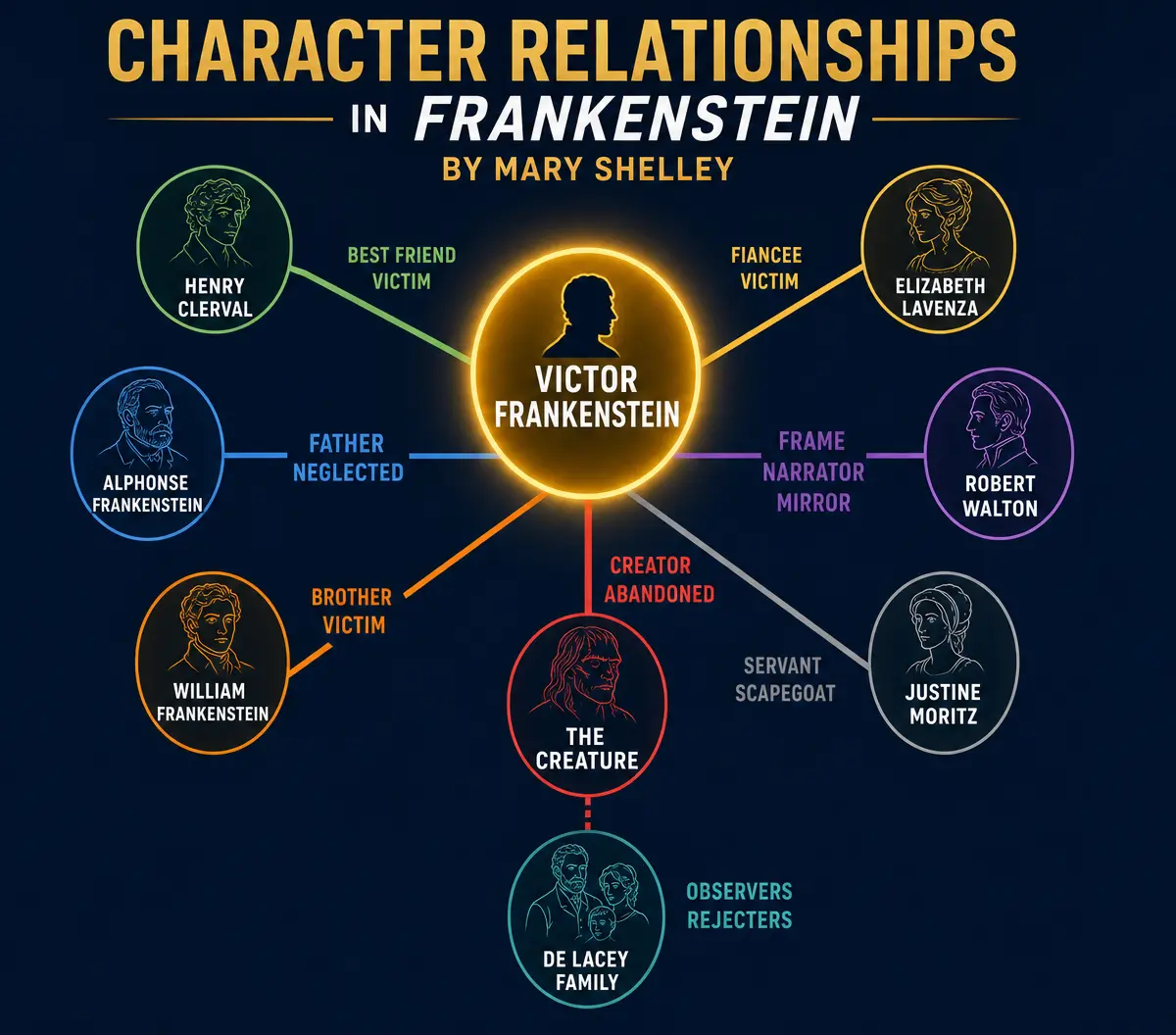
Victor Frankenstein
Role: The protagonist and primary narrator; the 'Modern Prometheus'.
Key Traits: Ambitious, obsessive, eloquent, self-pitying, irresponsible.
Character Arc: Shifts from an idealistic, brilliant student to an obsessed, isolated creator, and finally to a guilt-ridden, vengeful wreck. He never fully accepts responsibility for his actions, often blaming 'fate' or 'destiny'.
Essential Quotes:
- "Destiny was too potent, and her immutable laws had decreed my utter and terrible destruction." (Chapter 2) - Shows Victor's tendency to evade responsibility by blaming external forces.
- "A new species would bless me as its creator and source; many happy and excellent natures would owe their being to me." (Chapter 4) - Highlights his supreme arrogance and desire for godlike worship.
The Creature
Role: Victor's creation and the antagonist; the most complex voice in the novel.
Key Traits: Physically terrifying but articulate, deeply emotional, rational, ultimately vengeful.
Character Arc: Begins as a 'tabula rasa' (blank slate), innately benevolent. Through constant rejection by Victor and society, he becomes embittered and murderous, ultimately hating himself as much as his creator.
Essential Quotes:
- "I was benevolent and good; misery made me a fiend. Make me happy, and I shall again be virtuous." (Chapter 10) - A clear articulation of Rousseau's philosophy that man is born good but corrupted by society.
- "You are my creator, but I am your master;—obey!" (Chapter 20) - Shows the complete inversion of the creator/creation power dynamic.
Robert Walton
Role: The frame narrator; a foil/mirror to Victor.
Key Traits: Ambitious, lonely, driven by glory, but ultimately capable of listening to reason.
Character Arc: Begins with the same dangerous ambition as Victor, risking his crew's lives for discovery. However, he learns from Victor's tragic tale and turns back, choosing human life over scientific glory.
Essential Quotes:
- "I preferred glory to every enticement that wealth placed in my path." (Letter 1) - Establishes his similarity to Victor.
- "I have consented to return if we are not destroyed." (Chapter 24) - Marks his divergence from Victor's path of self-destruction.
Writer's Methods
The Frame Narrative (Epistolary Structure): The story is told through Walton's letters, which enclose Victor's narrative, which encloses the Creature's narrative. This 'Russian Doll' structure forces the reader to evaluate the reliability of each narrator. It also creates a sense of claustrophobia and inescapable fate.
The Sublime (Setting): Shelley uses vast, terrifying natural landscapes (the icy Arctic, the towering Alps, the stormy Orkney islands) to reflect the psychological turmoil of the characters. This is a key feature of Romantic literature. The sheer scale of nature diminishes Victor's scientific achievements, reminding him of his insignificance.
Biblical and Literary Allusions: The text is heavily reliant on references to Milton's Paradise Lost and the myth of Prometheus. These elevate the story from a simple horror tale to a profound philosophical and theological debate about creation, rebellion, and punishment.
Context
Romanticism vs. Enlightenment: The Enlightenment (18th century) championed reason, science, and logic. Romanticism (late 18th/early 19th century) reacted against this, valuing emotion, nature, and the sublime. Shelley's novel is a Romantic critique of unchecked Enlightenment science.
Galvanism: In the late 1700s, Luigi Galvani demonstrated that electrical currents could make dead frog legs twitch. This sparked public debate about whether electricity was the 'spark of life'. Shelley taps into these contemporary fears about science crossing into the realm of the divine.
Rousseau and the 'Noble Savage': Jean-Jacques Rousseau argued that humans are inherently good in their natural state but are corrupted by society. The Creature perfectly embodies this theory: he is born benevolent but turned murderous by the cruelty of human society.
Visual Resources
2 diagrams and illustrations
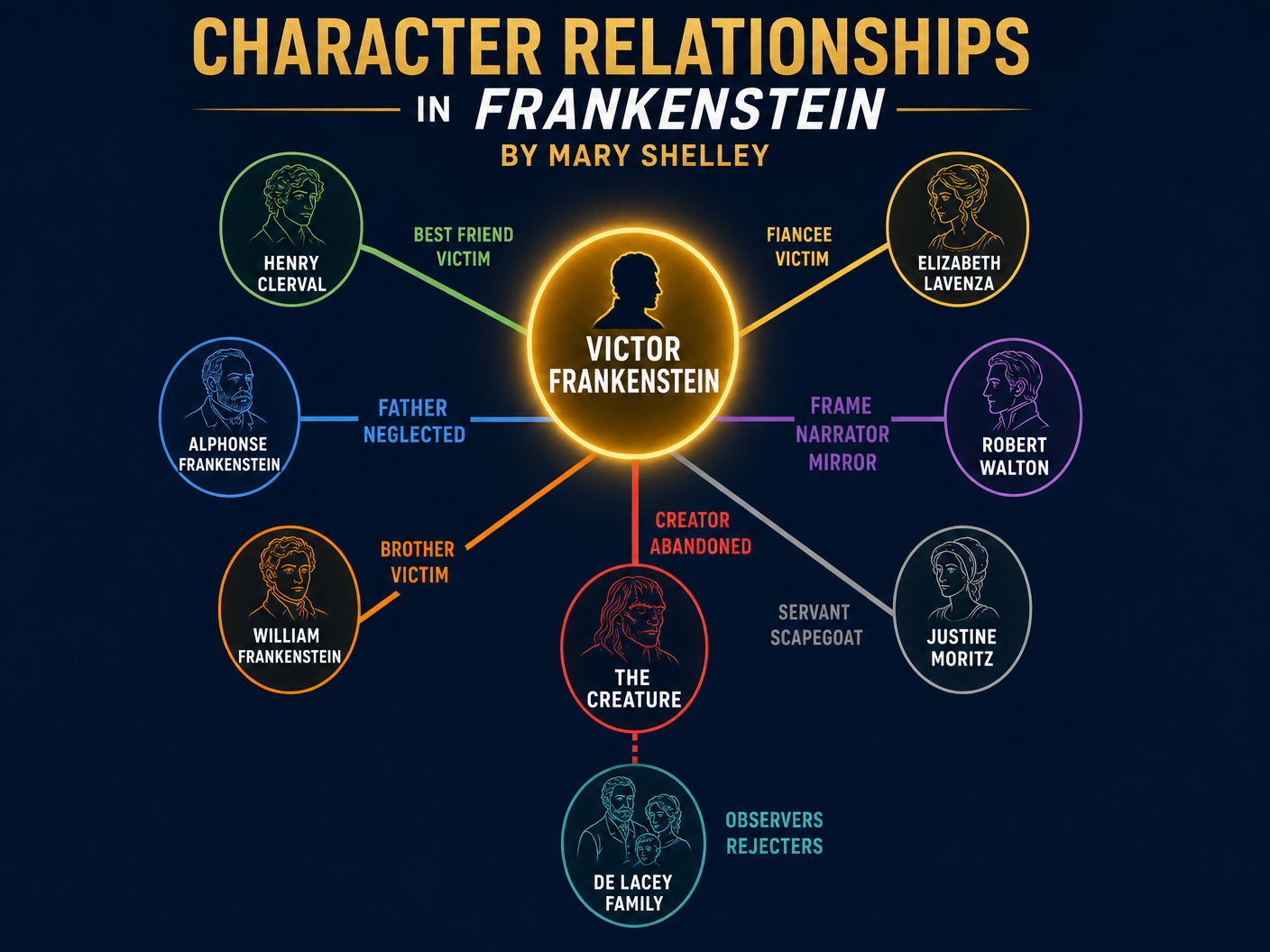
Interactive Diagrams
1 interactive diagram to visualise key concepts
Conceptual Flow Outline
The Cycle of Destruction in Frankenstein
Worked Examples
2 worked examples — open one to explore the question and available guidance.
Practice Questions
Test your understanding — click to reveal model answers
How does Shelley present the dangers of ambition in Frankenstein?
Hint: Compare Victor's ambition to create life with Walton's ambition to explore the Arctic. How do their paths differ?
Explore how Shelley presents the relationship between Victor and the Creature.
Hint: Think about the power dynamic. Who is really in control by the end of the novel?
How does Shelley use settings to reflect the mood and themes of the novel?
Hint: Look at the contrast between the laboratory, the Alps, and the Arctic.
Explore the significance of the female characters in Frankenstein.
Hint: Consider how Elizabeth and Justine are treated. Are they active participants or passive victims?
Test your understanding of 19th-Century Novel
Active recall beats re-reading. Take an instant quiz now to test what you’ve learned and lock it into long-term memory.
7 days Premium · Then free forever · No card, no charge