Pearson Edexcel · GCSE · English Literature
Post-1914 Prose or Drama
Master George Orwell's devastating political allegory with this comprehensive GCSE study guide. From Napoleon's tyrannical rise to the manipulation of language, learn exactly how to analyze Orwell's methods and secure top-band marks.
- 10 min read
- 2 worked examples
- 4 practice questions
- 8 key terms
Study Notes
Overview
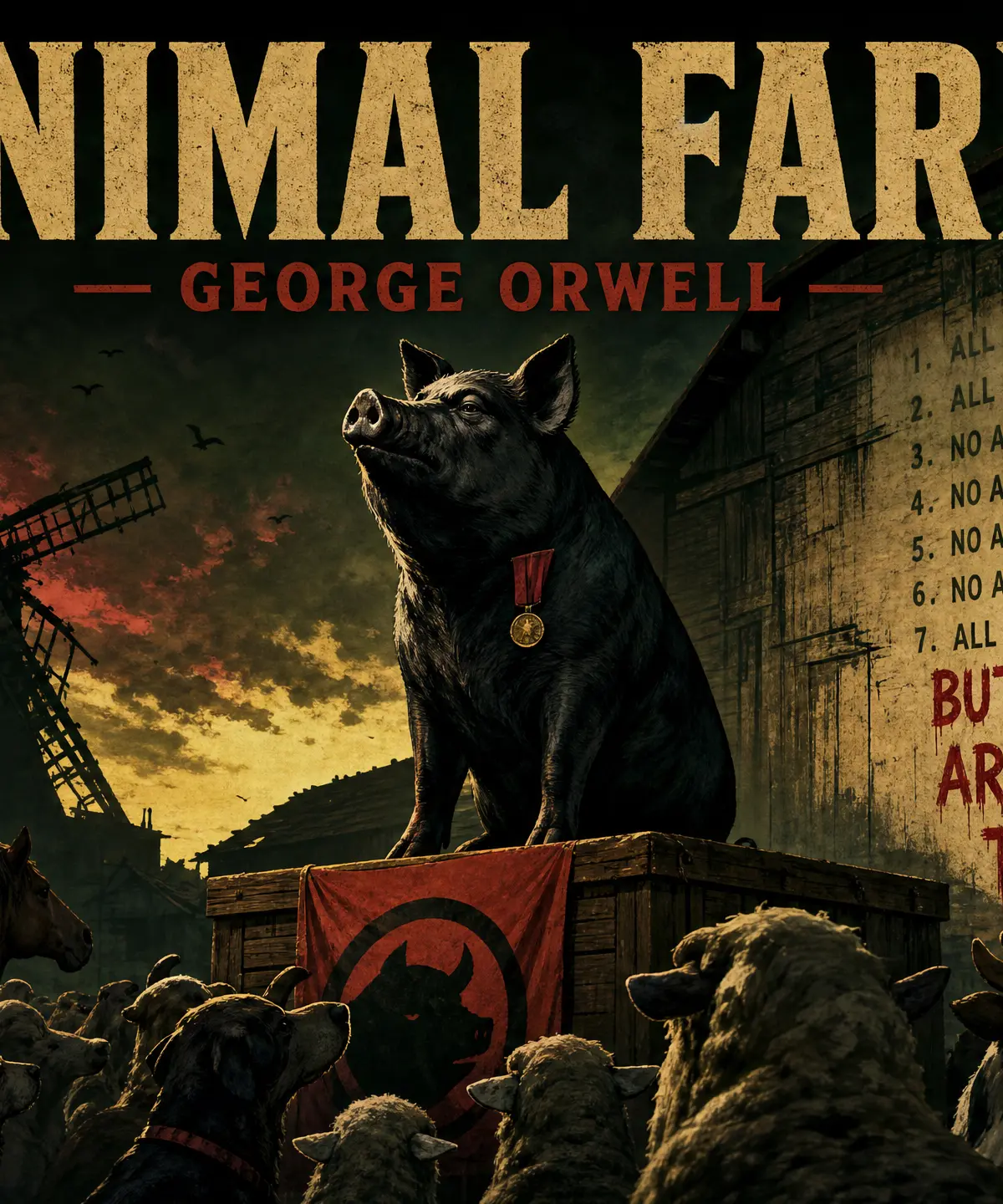
Animal Farm is a brilliantly crafted allegorical novella that uses a simple farmyard setting to deliver a scathing critique of the Russian Revolution and the subsequent rise of Stalinism. For GCSE Literature candidates, it offers rich opportunities for high-level analysis. Examiners consistently reward students who can move beyond the surface narrative to explore Orwell's sophisticated use of form, structure, and language to convey his political message. A top-band response must seamlessly integrate historical context—not as bolted-on facts, but as the driving force behind character motivations and thematic development. This guide will equip you with the critical vocabulary and conceptual understanding needed to achieve Level 6.
Listen to our comprehensive revision podcast for a deep dive into the text:

Plot/Content Overview
**The Rebellion (Chapters 1-2)**Old Major, the prize boar, shares his vision of a world without human oppression and teaches the animals the song 'Beasts of England'. Following his death, the animals, led by the pigs Snowball and Napoleon, successfully overthrow the cruel Mr. Jones. They establish 'Animal Farm' and paint the Seven Commandments of Animalism on the barn wall, the most crucial being: "All animals are equal."
**The Early Success and the Battle of the Cowshed (Chapters 3-4)**The animals manage the farm efficiently. Snowball attempts to educate them and forms committees, while Napoleon secretly takes away a litter of puppies to raise himself. Mr. Jones attempts to retake the farm, but Snowball's brilliant tactics secure a victory at the Battle of the Cowshed.
**The Rise of Napoleon (Chapter 5)**Tensions between Snowball and Napoleon peak over Snowball's plan to build a windmill. Just as the animals are about to vote in Snowball's favour, Napoleon unleashes his fully-grown, vicious dogs, chasing Snowball off the farm forever. Napoleon declares himself leader, abolishes Sunday meetings, and claims the windmill idea was his all along.
**The Consolidation of Power (Chapters 6-7)**The animals work like slaves to build the windmill. Napoleon begins trading with humans, breaking early resolutions. When a storm destroys the windmill, Napoleon scapegoats Snowball. Food shortages lead to a hens' rebellion, which is ruthlessly crushed. Napoleon stages a horrific purge, forcing animals to confess to crimes they didn't commit before his dogs slaughter them.
**The Betrayal of Animalism (Chapters 8-10)**The pigs move into the farmhouse, sleep in beds, drink alcohol, and alter the Commandments to justify their actions. After the windmill is destroyed again in the Battle of the Windmill, Boxer, the most loyal worker, collapses. Napoleon sells him to the knacker's yard to buy whisky, while Squealer claims Boxer died in a hospital. Years pass. The pigs now walk on two legs and carry whips. The Commandments are reduced to one: "ALL ANIMALS ARE EQUAL, BUT SOME ANIMALS ARE MORE EQUAL THAN OTHERS." In the final scene, the animals look from pig to man and cannot tell the difference.
Themes
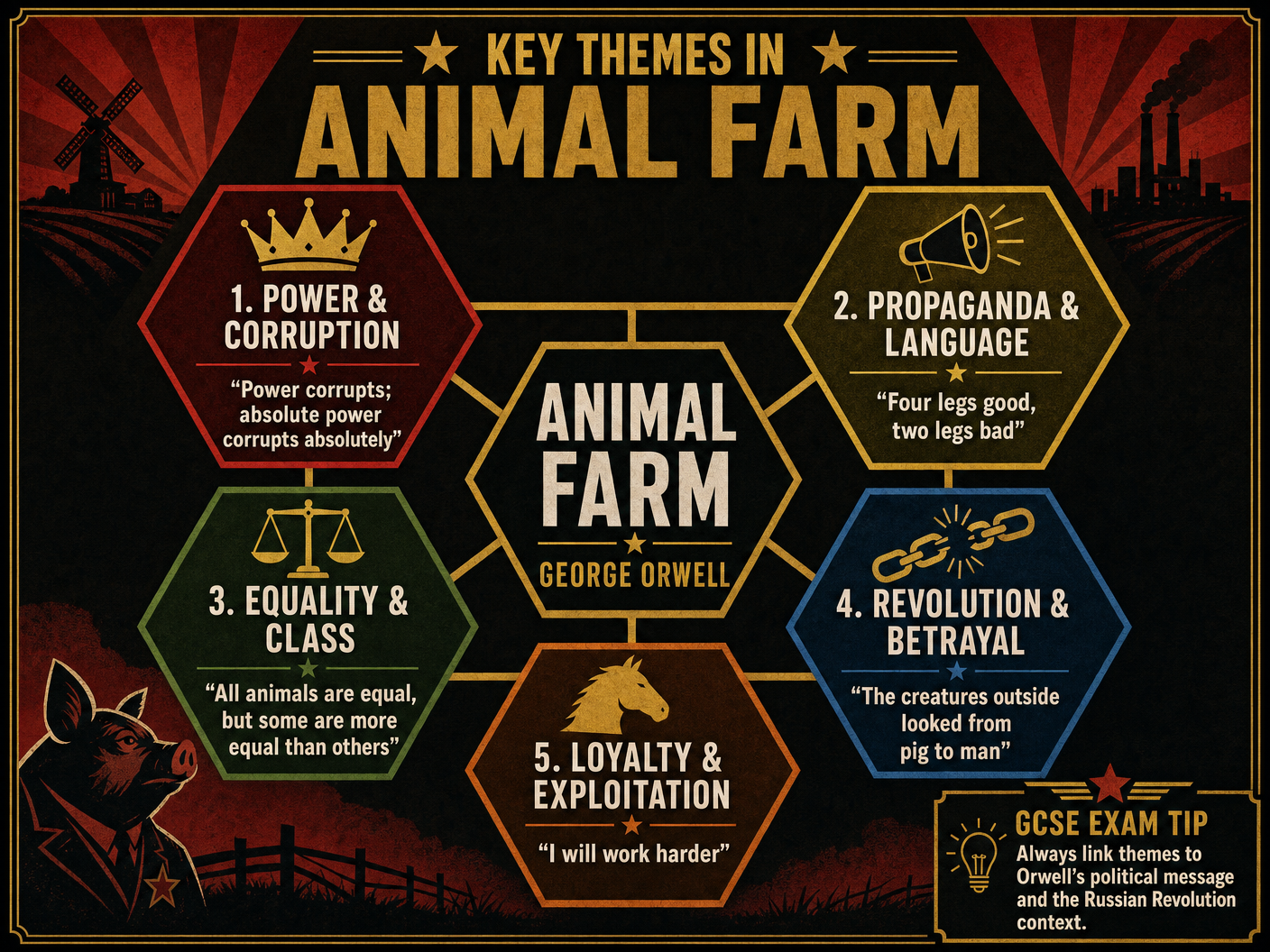
Theme 1: Power & Corruption
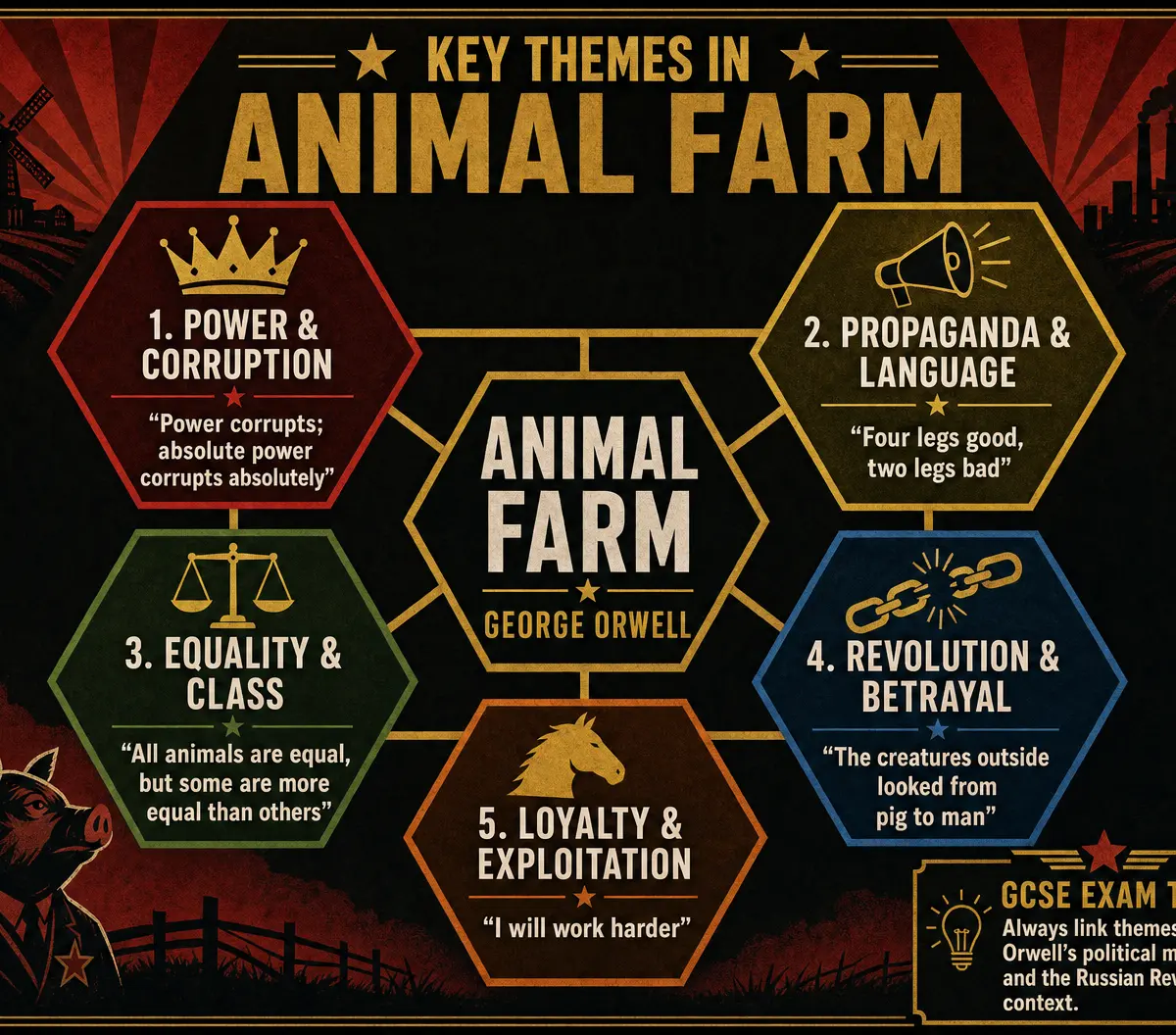
Orwell's central thesis is that absolute power inevitably corrupts those who hold it. The novella traces the tragic trajectory of a revolution built on noble ideals that decays into a dictatorship even more oppressive than the regime it replaced. Napoleon's gradual acquisition of privileges (milk, apples, beds, alcohol) mirrors the corruption of the Soviet elite.
Key Quotes:
- "The creatures outside looked from pig to man, and from man to pig, and from pig to man again; but already it was impossible to say which was which." (Chapter 10) - This circular structure highlights the complete betrayal of the revolution. The visual merging of pig and human represents the ultimate corruption of power.
- "ALL ANIMALS ARE EQUAL, BUT SOME ANIMALS ARE MORE EQUAL THAN OTHERS." (Chapter 10) - The ultimate paradox. The addition of the qualifying clause destroys the original meaning, showing how language is manipulated by the powerful to justify inequality.
Theme 2: Propaganda & Language
Orwell demonstrates how those in power control reality by controlling language. Squealer is the embodiment of this theme, constantly rewriting history and manipulating the uneducated animals. The simplification of complex ideas into mindless slogans prevents critical thought.
Key Quotes:
- "Four legs good, two legs bad." (Chapter 3) - This maxim reduces the complexities of Animalism into a simplistic chant. The sheep's bleating of this phrase is used to drown out any opposition or debate.
- "Squealer could turn black into white." (Chapter 2) - A powerful metaphor for the capability of propaganda to distort the truth entirely. It shows the danger of an uneducated populace unable to challenge official narratives.
Theme 3: Class & Exploitation
The novel exposes the hypocrisy of systems that claim to be classless. The pigs quickly establish themselves as the new ruling class, exploiting the labour of the working animals (represented by Boxer) while enjoying the fruits of their toil.
Key Quotes:
- "I will work harder!" (Chapter 3) - Boxer's tragic motto highlights the vulnerability of the working class. His physical strength is immense, but his lack of intellect makes him easily exploitable.
- "The pigs did not actually work, but directed and supervised the others." (Chapter 3) - This early division of labour foreshadows the entrenched class system that will eventually dominate the farm.
Character Analysis
Napoleon
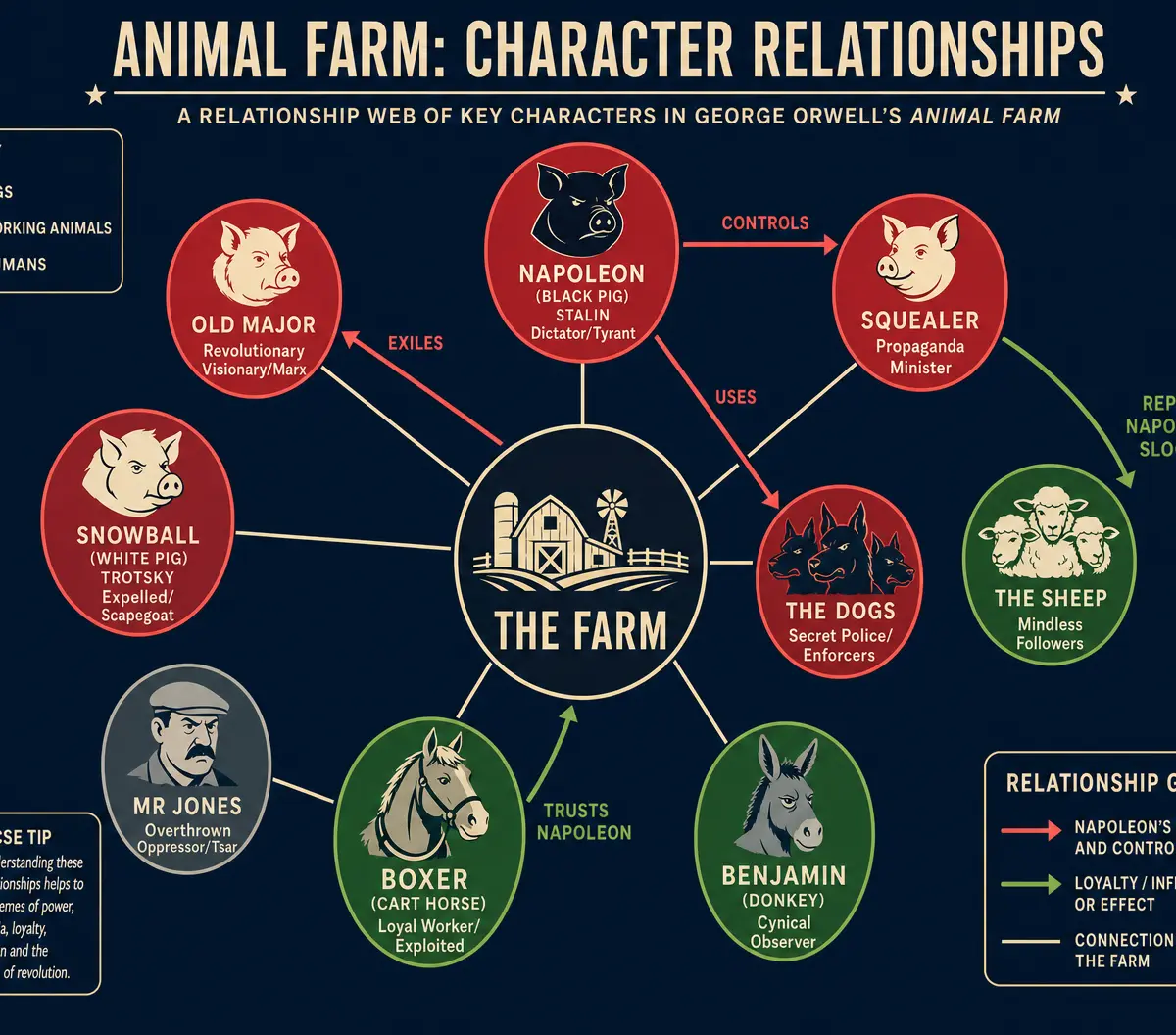
Role: The tyrannical leader; allegorical representation of Joseph Stalin.
Key Traits: Ruthless, cunning, manipulative, power-hungry, silent but deadly.
Character Arc: Evolves from a background revolutionary figure to an absolute dictator who mirrors the human oppressor Mr. Jones.
Essential Quotes:
- "Napoleon was a large, rather fierce-looking Berkshire boar... not much of a talker, but with a reputation for getting his own way." (Chapter 2)
- "He announced that from now on the Sunday-morning Meetings would come to an end." (Chapter 5)
Snowball
Role: The intellectual revolutionary; allegorical representation of Leon Trotsky.
Key Traits: Intelligent, eloquent, idealistic, innovative, but ultimately naive about power.
Character Arc: Leads the farm successfully initially, but is outmanoeuvred and exiled by Napoleon, becoming the permanent scapegoat.
Essential Quotes:
- "Snowball was a more vivacious pig than Napoleon, quicker in speech and more inventive..." (Chapter 2)
- "Snowball conjured up pictures of fantastic machines which would do their work for them..." (Chapter 5)
Boxer
Role: The dedicated, uneducated workforce; allegorical representation of the Russian proletariat (working class).
Key Traits: Immensely strong, deeply loyal, unquestioning, tragic.
Character Arc: Works himself to the point of collapse for the farm, only to be betrayed and sold to his death by the pigs he trusted.
Essential Quotes:
- "His two slogans, 'I will work harder' and 'Napoleon is always right', seemed to him a sufficient answer to all problems." (Chapter 6)
- "Boxer was the admiration of everybody. He had been a hard worker even in Jones's time, but now he seemed more like three horses than one." (Chapter 3)
Squealer
Role: The propaganda minister; allegorical representation of the Soviet press (Pravda).
Key Traits: Persuasive, deceptive, slippery, sycophantic.
Character Arc: Serves as Napoleon's mouthpiece throughout, constantly altering the truth to maintain the pigs' power.
Essential Quotes:
- "He was a brilliant talker, and when he was arguing some difficult point he had a way of skipping from side to side and whisking his tail which was somehow very persuasive." (Chapter 2)
- "Surely, comrades, you do not want Jones back?" (Chapter 3)
Writer's Methods
Allegory and FableOrwell uses the beast fable format—a simple story about animals—to make his complex political critique accessible and universally relevant. The allegorical mapping (pigs = Bolshevik leadership, dogs = secret police, sheep = mindless masses) allows him to satirize the Soviet Union clearly and devastatingly.
Narrative VoiceThe third-person omniscient narrator adopts a detached, objective tone. This deadpan delivery contrasts sharply with the horrific events occurring, heightening the emotional impact and the sense of dramatic irony, as the reader understands the pigs' manipulation long before the animals do.
Structural IronyThe novella's structure is perfectly circular. It begins with the animals oppressed by humans and ends with them oppressed by pigs who have become indistinguishable from humans. This cyclical structure formally reinforces Orwell's pessimistic view of revolution.
SymbolismOrwell employs powerful symbols: the Windmill represents the grueling, often futile push for industrialization; the whip represents the return of oppression; and the Seven Commandments symbolize the corruption of revolutionary ideals through language.
Context
**The Russian Revolution (1917)**The overthrow of Tsar Nicholas II (Mr. Jones) by the Bolsheviks, leading to the creation of the Soviet Union. Old Major's dream represents the Marxist-Leninist ideals that sparked the revolution.
StalinismFollowing Lenin's death, Joseph Stalin (Napoleon) and Leon Trotsky (Snowball) vied for power. Stalin exiled Trotsky and established a brutal totalitarian regime characterized by purges, show trials (the slaughter of the animals in Chapter 7), and intense propaganda.
Orwell's Political ViewsA democratic socialist, Orwell fought in the Spanish Civil War where he witnessed firsthand the betrayal of socialist ideals by Soviet-backed communists. He wrote Animal Farm specifically to destroy what he called "the Soviet myth"—the belief among Western intellectuals that Russia was a true socialist utopia.
Visual Resources
2 diagrams and illustrations
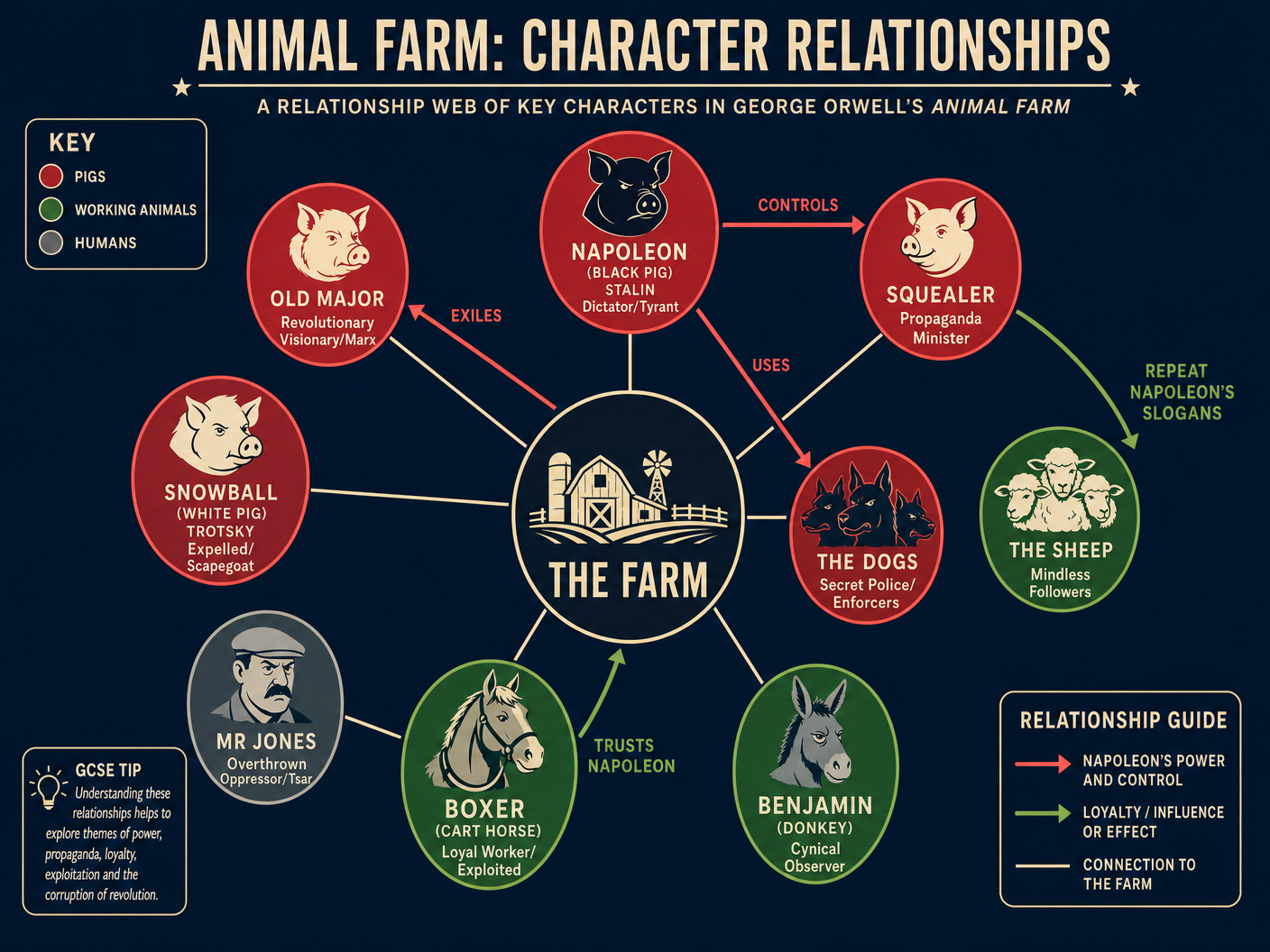
Interactive Diagrams
1 interactive diagram to visualise key concepts
Conceptual Flow Outline
The Cyclical Structure of Revolution in Animal Farm
Worked Examples
2 worked examples — open one to explore the question and available guidance.
Practice Questions
Test your understanding — click to reveal model answers
How does Orwell explore the theme of education and intelligence in Animal Farm? (30 marks)
Hint: Consider how the pigs use their literacy to control the other animals, and how the animals' inability to read prevents them from rebelling.
Starting with this extract (Chapter 1, Old Major's speech), explore how Orwell presents the idea of rebellion. (30 marks)
Hint: Contrast the idealistic vision of rebellion in the extract with the grim reality of the rebellion's aftermath later in the novel.
Explore the significance of Boxer in the novel. (30 marks)
Hint: Boxer is more than just a horse; think about what group of people he represents and why his fate is so tragic.
How does Orwell use the setting of the farm to convey his political message? (30 marks)
Hint: Think about the farm as a microcosm (a miniature version) of society or a country.