Pearson Edexcel · GCSE · English Literature
Shakespeare
Much Ado About Nothing is a brilliant comedy that hides dark truths about reputation, gender, and deception beneath its witty surface. Studying this play rewards candidates who can unpick how Shakespeare uses language and structure to critique the patriarchal society of Elizabethan England while delivering a masterful romantic plot.
- 7 min read
- 1 worked example
- 4 practice questions
- 8 key terms
Study Notes
Overview
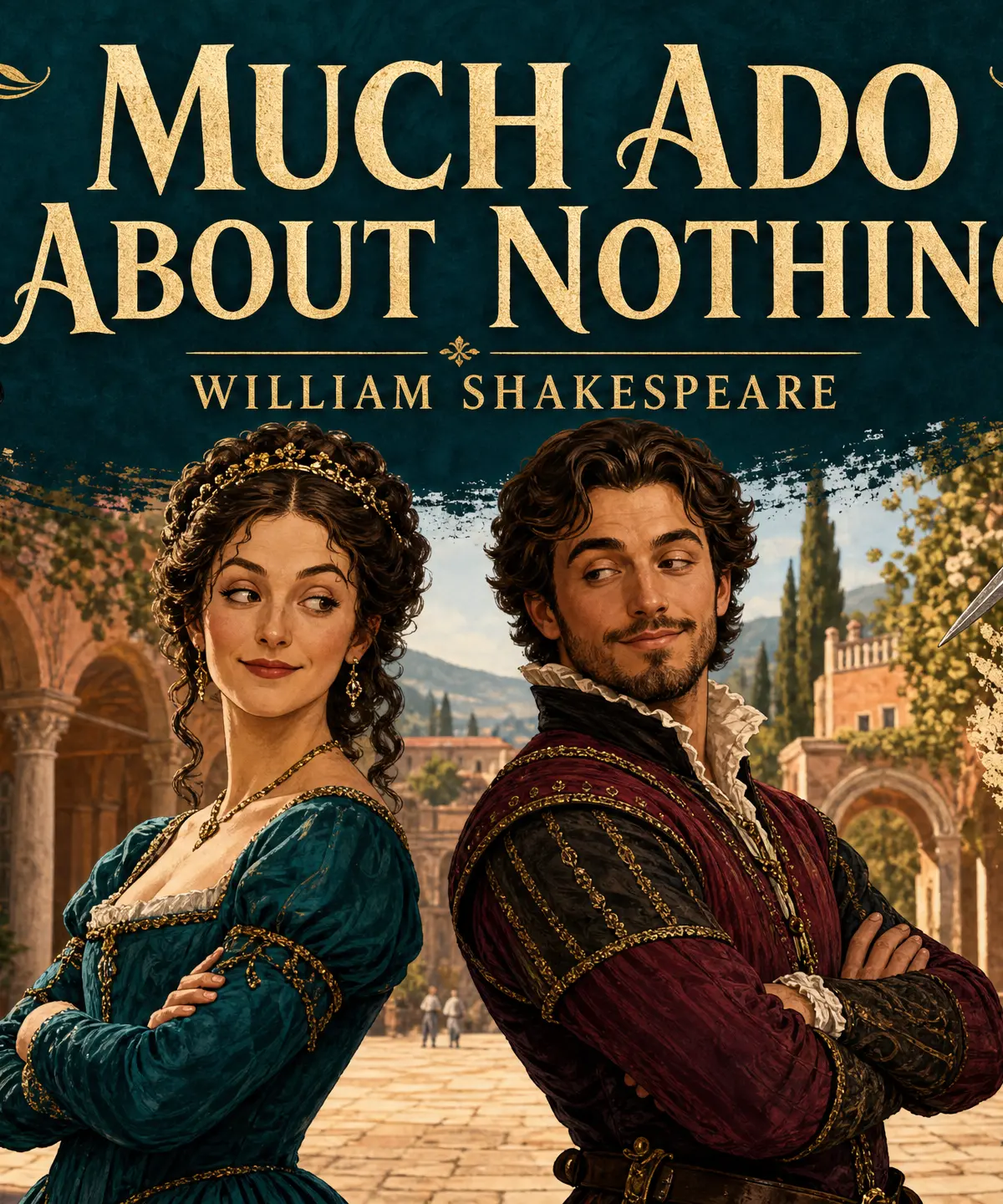
Much Ado About Nothing is one of Shakespeare's most celebrated comedies, written around 1598-1599. Set in Messina, Sicily, it revolves around two contrasting pairs of lovers: the conventional, transaction-driven Hero and Claudio, and the witty, reluctant Beatrice and Benedick. Examiners highly reward candidates who can look beyond the comedy to analyse the play's darker elements—particularly the vulnerability of female reputation and the destructive power of male honour in a patriarchal society. To achieve the highest marks (Level 5/6), you must consistently analyse how Shakespeare uses language (especially prose vs. verse), dramatic irony, and parallel plots to shape audience response.
Plot/Content Overview
- Act 1: Soldiers return from war to Messina. Claudio falls for Hero, while Beatrice and Benedick resume their "merry war" of words. Don Pedro offers to woo Hero for Claudio.
- Act 2: At a masked ball, Don John attempts to cause trouble by claiming Don Pedro is wooing Hero for himself. The misunderstanding is quickly resolved, and Hero and Claudio are betrothed. Don Pedro then devises a plan to trick Beatrice and Benedick into falling in love.
- Act 3: The "gulling" scenes take place. Benedick overhears that Beatrice loves him; Beatrice overhears that Benedick loves her. Both are transformed. Meanwhile, Don John hatches a malicious plot to ruin Hero's reputation, showing Claudio what appears to be Hero with another man.
- Act 4: Dogberry and the Watch unwittingly uncover Don John's plot by arresting his henchman, Borachio. At the wedding, Claudio brutally shames Hero, who faints. The Friar advises Leonato to pretend Hero is dead to induce remorse. Beatrice asks Benedick to "Kill Claudio."
- Act 5: The truth is revealed. Claudio repents and agrees to marry Leonato's "niece" as penance. At the wedding, the "niece" is revealed to be Hero. Beatrice and Benedick's love is made public, and the play ends with a double wedding and a dance.
Themes
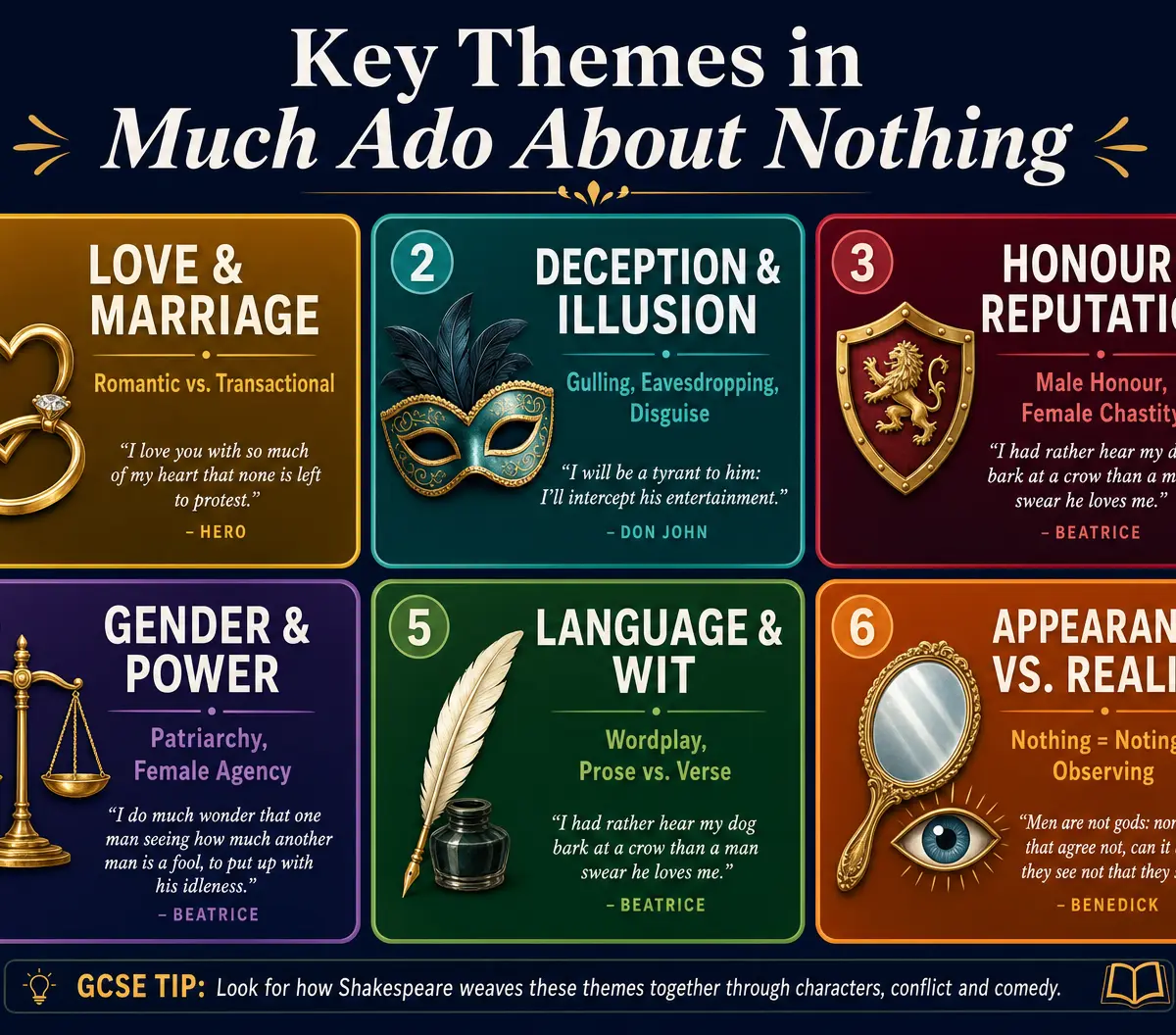
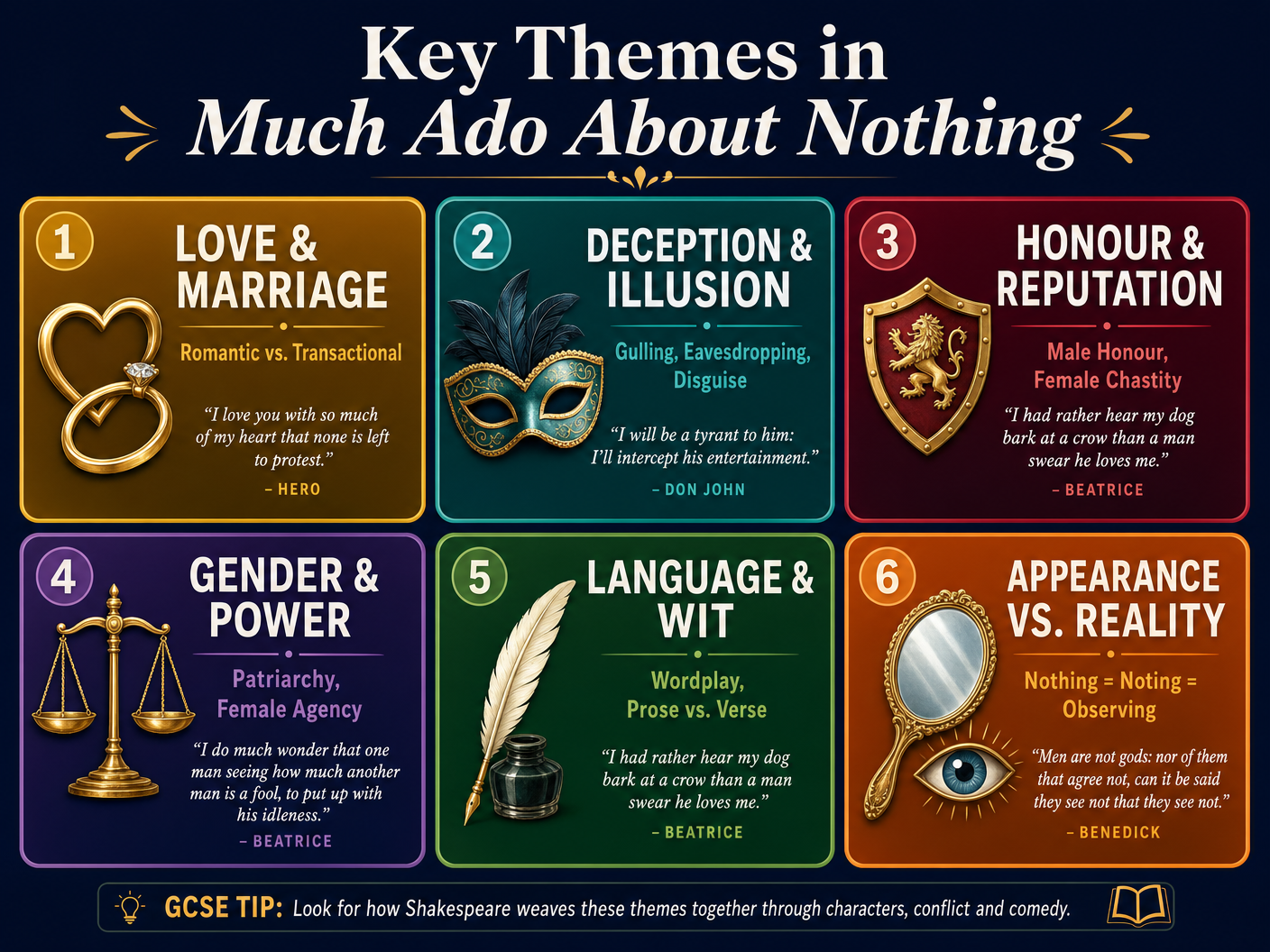
Theme 1: Deception and Illusion
Deception drives the entire plot, but Shakespeare presents it as both destructive and constructive. Don John's malicious deception nearly destroys Hero, while the well-intentioned "gulling" of Beatrice and Benedick allows genuine love to flourish. Examiners reward candidates who link this theme to the title's pun on "noting" (observing/eavesdropping).
Key Quotes:
- "I will be a tyrant to him: I'll intercept his entertainment." (Don John, Act 1, Scene 3) - Don John's deception is rooted in malice and a desire to disrupt social harmony.
- "Some Cupid kills with arrows, some with traps." (Hero, Act 3, Scene 1) - Highlights how the deception of Beatrice and Benedick is a "trap" set by Cupid, contrasting with Don John's destructive traps.
Theme 2: Honour and Reputation
In the patriarchal society of Messina, honour is everything, but it is gendered. Male honour is tied to military valour and camaraderie, while female honour is entirely dependent on chastity and public perception. The fragility of female reputation is the play's darkest element.
Key Quotes:
- "Give not this rotten orange to your friend." (Claudio, Act 4, Scene 1) - The metaphor "rotten orange" brutally commodifies Hero, reducing her worth to her perceived purity.
- "O that I were a man for his sake!" (Beatrice, Act 4, Scene 1) - An exclamation of profound frustration at the limitations placed on female agency and honour.
Theme 3: Gender and Power
Shakespeare explores the constraints placed on women in a patriarchal society. While Beatrice challenges these norms through her wit and independence, even she is ultimately limited by her gender and requires Benedick to enact revenge on Claudio.
Key Quotes:
- "I had rather hear my dog bark at a crow than a man swear he loves me." (Beatrice, Act 1, Scene 1) - Beatrice's hyperbolic rejection of romance highlights her desire for independence.
- "Hath no man's dagger here a point for me?" (Leonato, Act 4, Scene 1) - Leonato's reaction to Hero's shaming shows how female "dishonour" reflects directly on male relatives.
Character Analysis
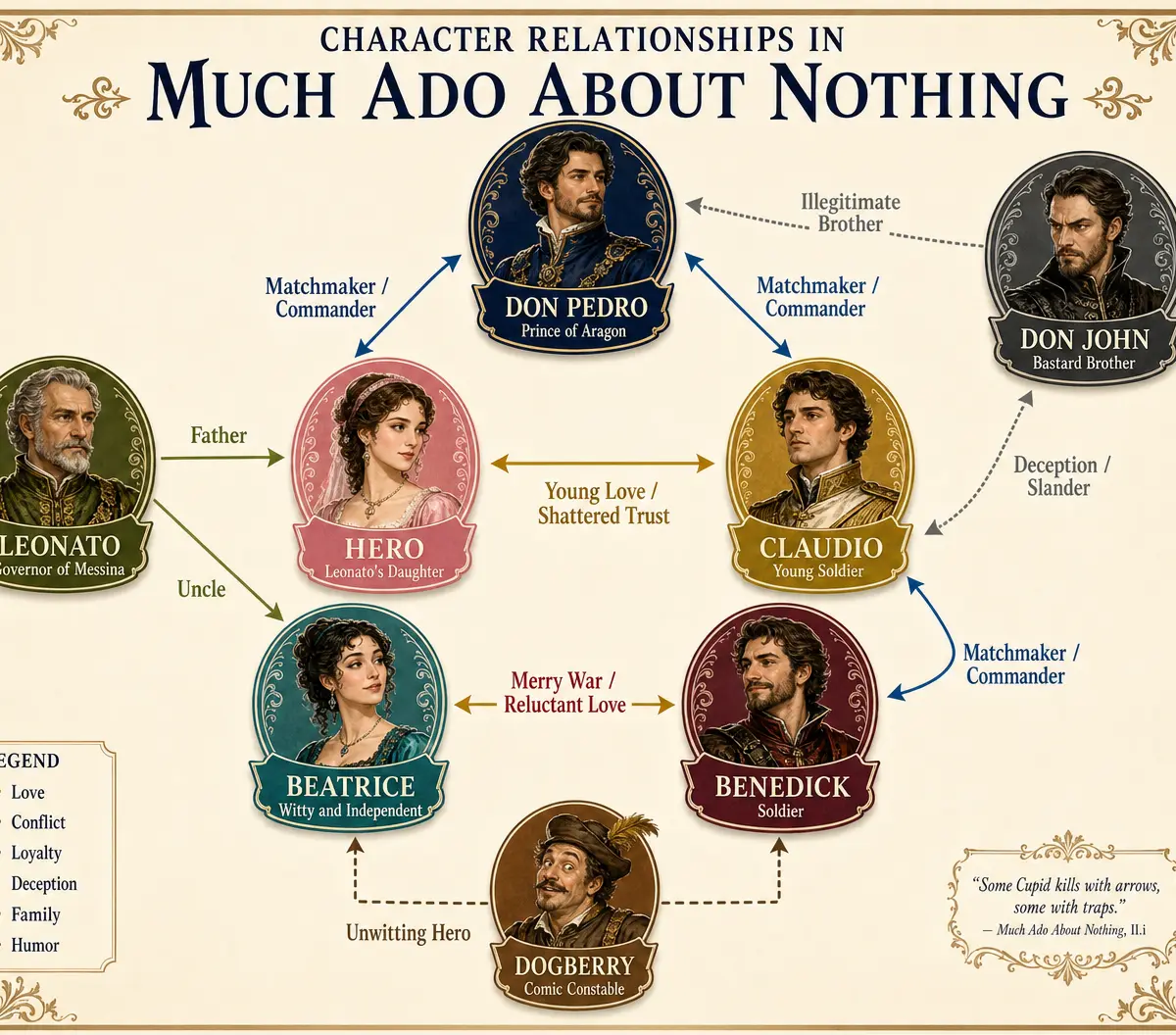
Beatrice
Role: The witty, unconventional female protagonist who challenges patriarchal norms.
Key Traits: Intelligent, sharp-tongued, fiercely loyal, yet vulnerable.
Character Arc: Moves from a defensive rejection of love and marriage to accepting vulnerability and emotional connection with Benedick.
Essential Quotes:
- "A bird of my tongue is better than a beast of yours."
- "Kill Claudio."
Benedick
Role: The arrogant soldier who claims to despise marriage but is ultimately transformed by love.
Key Traits: Witty, proud, loyal, capable of deep emotion.
Character Arc: Shifts his loyalty from male camaraderie (Claudio and Don Pedro) to his relationship with Beatrice, marking a significant maturation.
Essential Quotes:
- "I will live a bachelor."
- "I do love nothing in the world so well as you: is not that strange?"
Claudio
Role: The young, conventional romantic lead whose susceptibility to deception drives the tragicomic plot.
Key Traits: Impressionable, concerned with honour, superficial in his affections.
Character Arc: Moves from superficial infatuation to brutal cruelty, and finally to repentance (though many critics argue his repentance is inadequate).
Essential Quotes:
- "Can the world buy such a jewel?"
- "Farewell, thou pure impiety and impious purity."
Writer's Methods
Prose vs. Verse: Shakespeare uses prose for the witty, informal exchanges between Beatrice and Benedick, signaling their rejection of conventional romance. Aristocratic characters like Claudio and Don Pedro often use verse for formal declarations. When Benedick shifts to verse in Act 5, it signifies his emotional transformation.
Dramatic Irony: The "noting" scenes rely heavily on dramatic irony. The audience knows that Benedick and Beatrice are being tricked, which creates comedy, but we also know that Don John's plot is a lie, which creates tension.
Malapropism: Dogberry's constant misuse of language (e.g., "Our watch, sir, have indeed comprehended two auspicious persons") provides comic relief but also satirises the incompetence of authority figures.
Context
Elizabethan Patriarchy: Women were legally and socially subordinate to men. A woman's value was intrinsically linked to her chastity; losing her reputation meant social and economic ruin. This context is vital for understanding Leonato's extreme reaction in Act 4.
Cuckoldry: The Elizabethan fear of being a "cuckold" (a man whose wife is unfaithful, traditionally depicted with horns) permeates the play. Benedick's early jokes about horns reflect male anxiety about female fidelity.
Listen to our podcast episode for a deeper dive into these themes:

Visual Resources
2 diagrams and illustrations
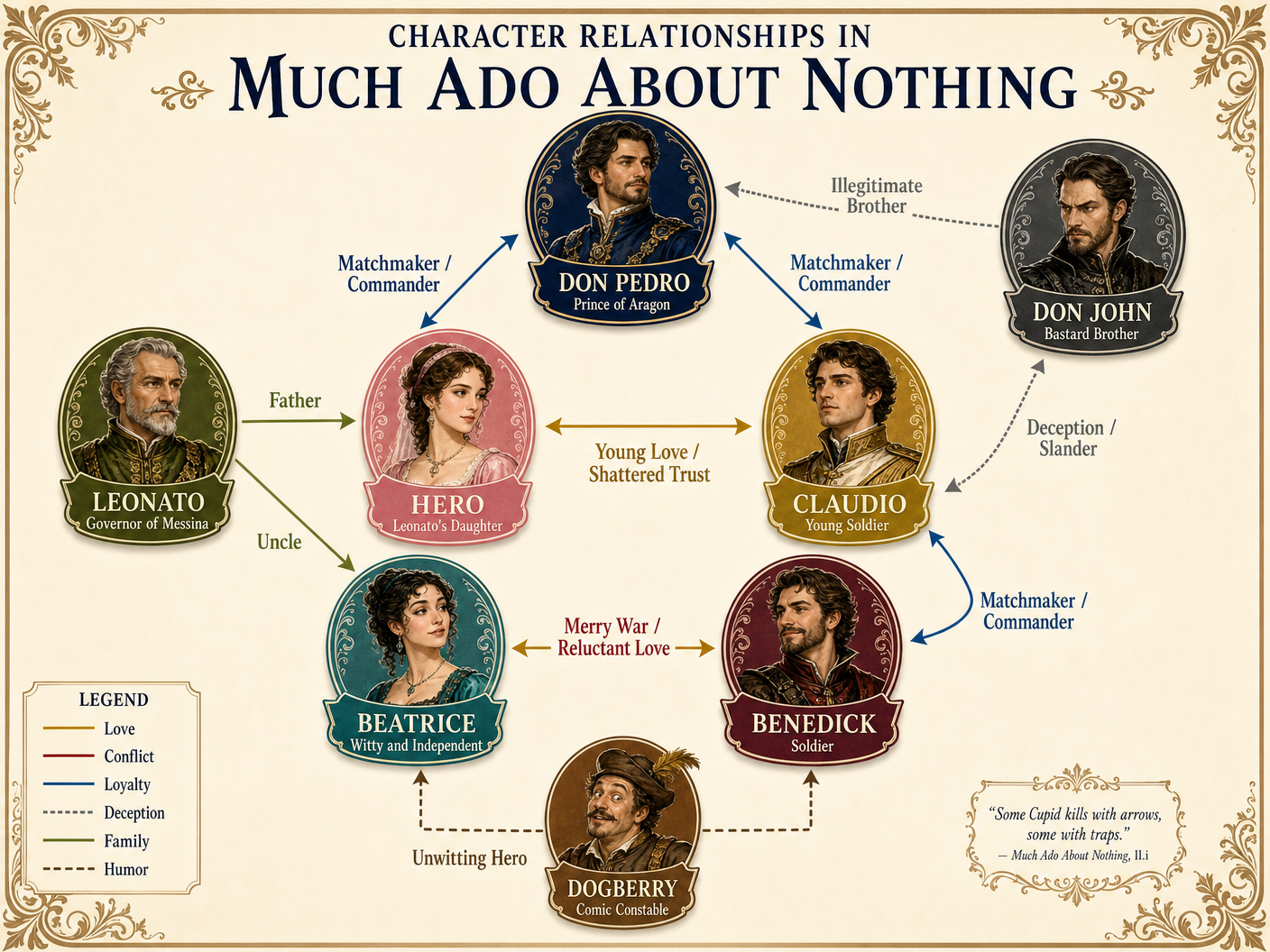
Interactive Diagrams
1 interactive diagram to visualise key concepts
Conceptual Flow Outline
Parallel Plots of Deception
Worked Examples
1 worked example — open one to explore the question and available guidance.
Practice Questions
Test your understanding — click to reveal model answers
How does Shakespeare present the relationship between Beatrice and Benedick? Write about:
- how their relationship is presented in the extract (Act 1, Scene 1)
- how their relationship develops in the play as a whole.
Hint: Consider how their use of prose and wordplay acts as a defence mechanism, and how this changes after they are 'gulled'.
Explore how Shakespeare presents the character of Don John as a villain in Much Ado About Nothing.
Hint: Look at his motivations (illegitimacy) and his use of language compared to the other characters.
How does Shakespeare explore the theme of deception in the play?
Hint: Remember to discuss both the comic deception (the gulling) and the tragic deception (the slander of Hero).
Starting with this extract (Act 4, Scene 1), how does Shakespeare present attitudes towards women?
Hint: Contrast the passive suffering of Hero with the active frustration of Beatrice.