Eduqas · GCSE · English Literature
Reading comprehension and reading critically
Master the core skills of GCSE English Literature: reading comprehension and critical analysis. This guide breaks down exactly how to move from basic understanding to perceptive analysis that examiners reward, complete with model answers and a 10-minute audio podcast.
- 4 min read
- 2 worked examples
- 4 practice questions
- 8 key terms
Study Notes
Overview
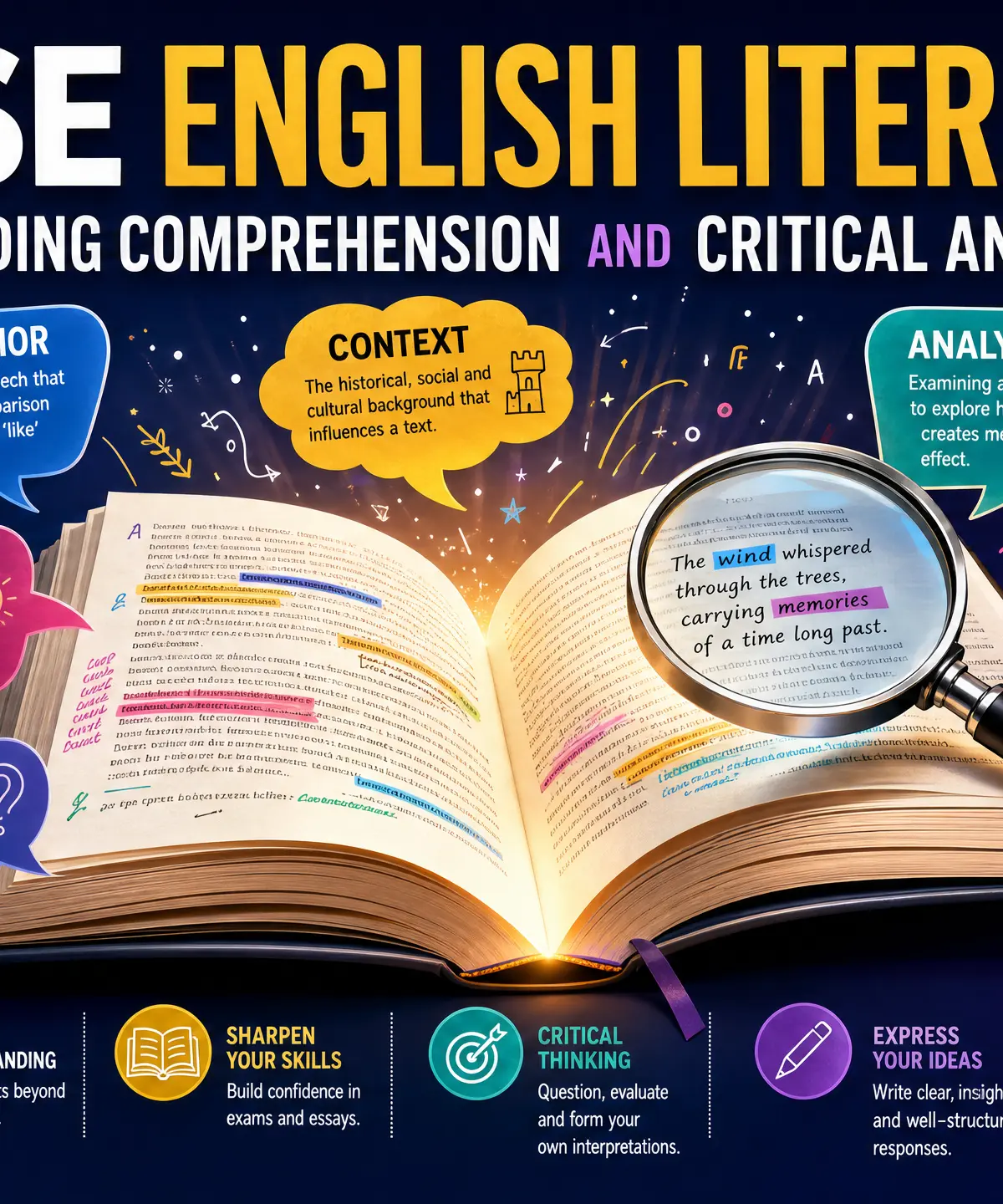
GCSE English Literature is fundamentally a test of two distinct but connected skills: Reading Comprehension (understanding what a text says) and Critical Analysis (understanding how and why a text says it). Examiners are looking for candidates who can move beyond a literal retelling of the plot to offer a perceptive, informed personal response. You must demonstrate that you understand the writer as a conscious craftsperson who makes deliberate choices regarding language, form, and structure to create specific effects and convey particular themes.
This guide focuses on the universal skills required across all texts in your specification, whether you are studying Shakespeare, a 19th-century novel, modern prose, or poetry. The core Assessment Objectives (AOs) remain the same. By mastering the PEAL structure and learning to integrate context naturally, you can significantly elevate your grade.
Listen to the companion podcast for an in-depth discussion on how to tackle these questions:

The Assessment Objectives (AOs)
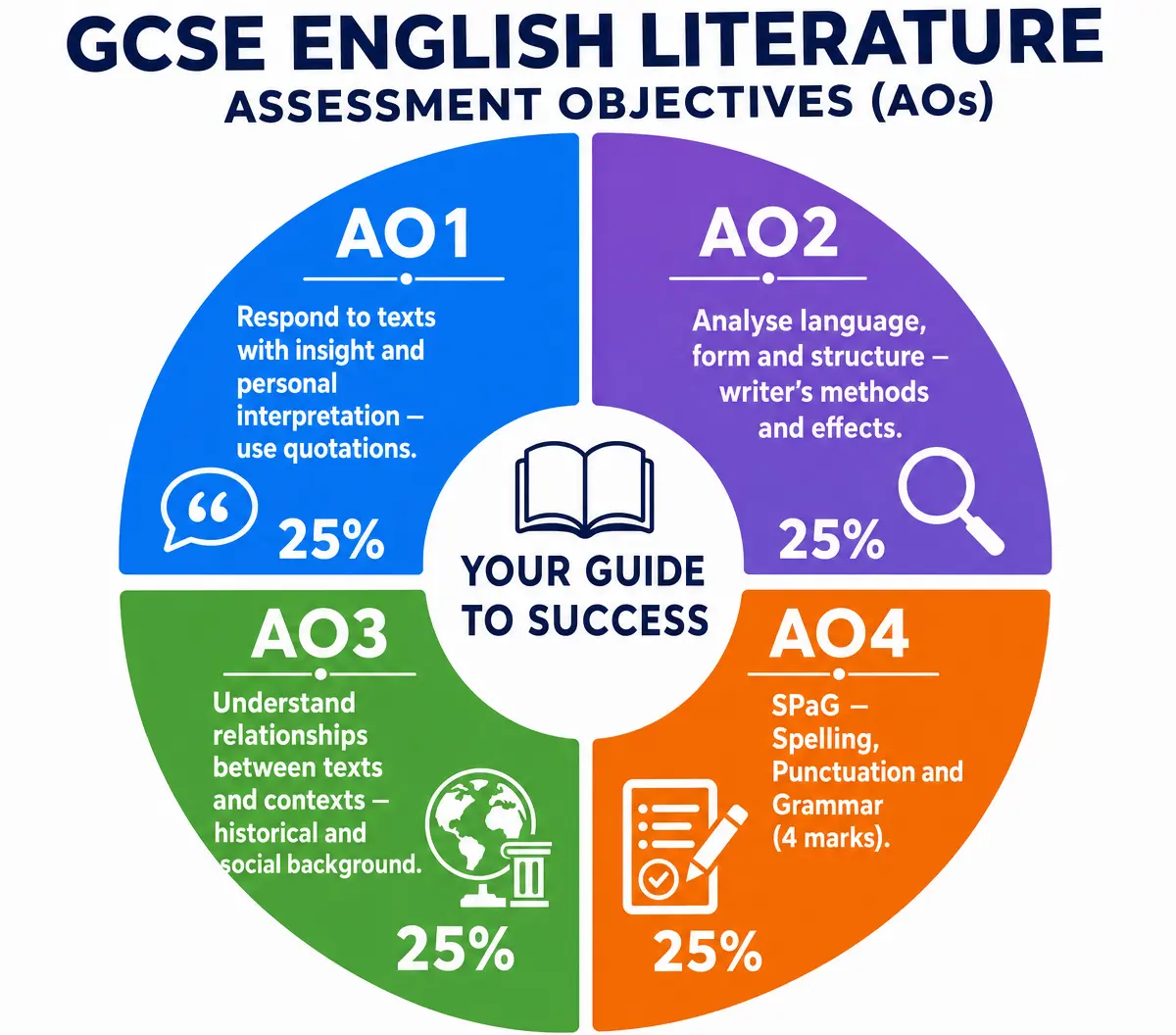
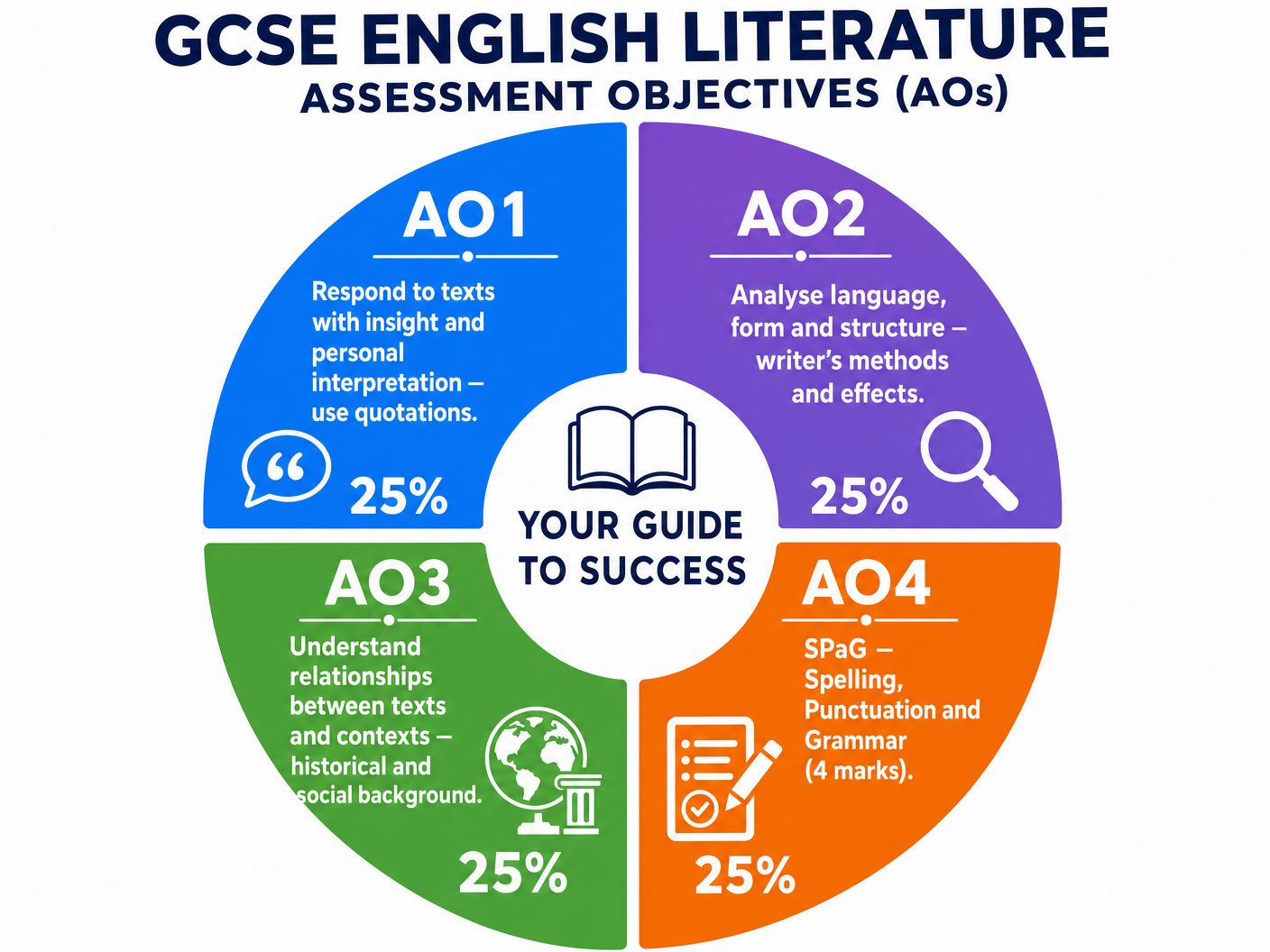
To succeed, you must understand exactly what the examiner is marking you on:
- AO1 (Textual Response): Read, understand and respond to texts. Maintain a critical style and develop an informed personal response. Use textual references, including embedded quotations, to support and illustrate interpretations.
- AO2 (Writer's Methods): Analyse the language, form and structure used by a writer to create meanings and effects, using relevant subject terminology where appropriate.
- AO3 (Context): Show understanding of the relationships between texts and the contexts in which they were written.
- AO4 (SPaG): Use a range of vocabulary and sentence structures for clarity, purpose and effect, with accurate spelling and punctuation.
Moving from Comprehension to Analysis
Literal vs. Inferential Comprehension
Literal comprehension is understanding the surface meaning. For example, knowing that Macbeth kills King Duncan. Inferential comprehension is reading between the lines. It is understanding why he does it, what his hesitation implies about his character, and what the act signifies about the disruption of the natural order (The Great Chain of Being).
Feature-Spotting vs. Critical Analysis
Examiners frequently complain about "feature-spotting." This is when a candidate identifies a technique (e.g., "The writer uses a simile") but fails to explain its effect.
- Feature-spotting (Level 2): "The writer uses the metaphor 'brief candle' to describe life."
- Critical Analysis (Level 4/5): "Shakespeare uses the metaphor of a 'brief candle' to reduce life to something fragile and temporary. This creates a sense of profound existential despair, reflecting Macbeth's realization that his bloody ambition has ultimately yielded nothing of lasting value."
Structuring Your Response
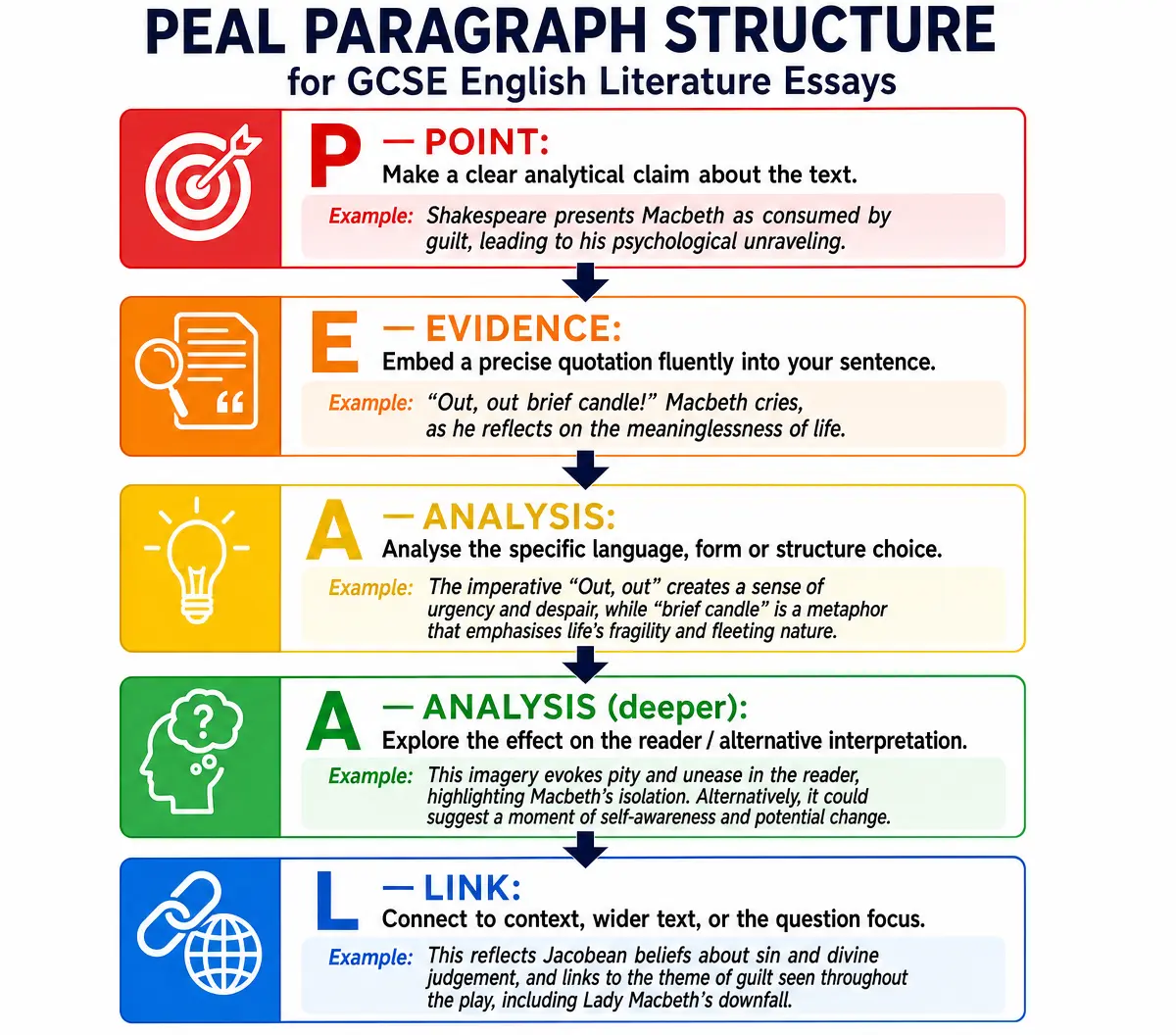
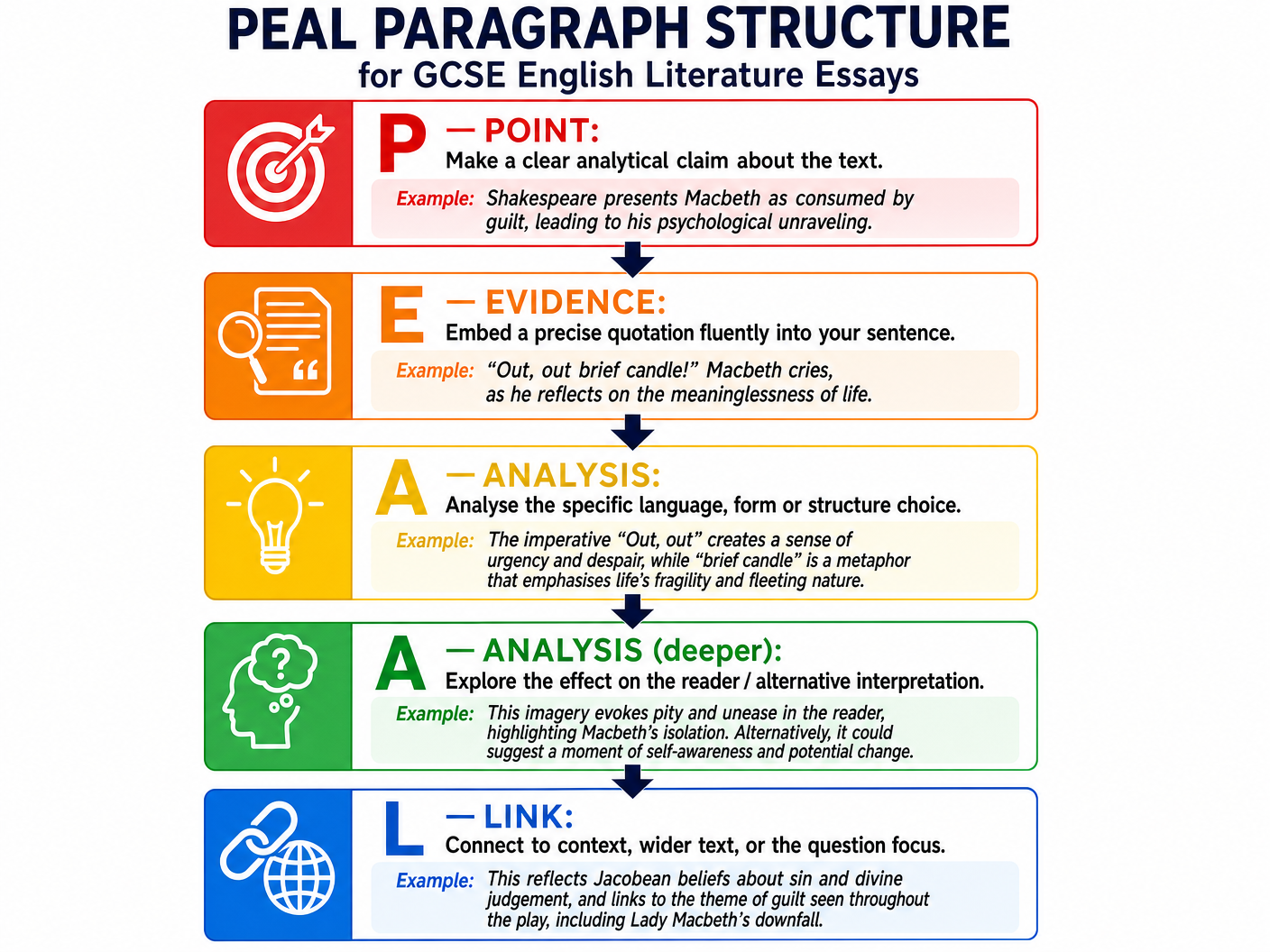
The most effective way to ensure you hit all AOs in your body paragraphs is to use a structured approach like PEAL:
- Point (AO1): Make a clear, analytical claim that directly answers the question.
- Evidence (AO1): Embed a precise, relevant quotation fluently into your sentence.
- Analysis (AO2): Zoom in on specific words or structural choices. Use subject terminology and explain the effect on the reader.
- Link (AO1/AO3): Connect your analysis back to the writer's overall purpose, the wider themes of the text, or the relevant historical/social context.
Integrating Context (AO3)
A major pitfall is "bolting on" context as a separate paragraph (e.g., "In Victorian times..."). Context must be woven into your analysis of the text. It should explain why a character behaves a certain way or why a writer chose a specific theme based on the society they were writing for.
Visual Resources
2 diagrams and illustrations
Interactive Diagrams
1 interactive diagram to visualise key concepts
Conceptual Flow Outline
The Progression of Critical Analysis Skills
Worked Examples
2 worked examples — open one to explore the question and available guidance.
Practice Questions
Test your understanding — click to reveal model answers
Read the following unseen prose extract. How does the writer use language and structure to create a sense of panic? (20 marks)
Hint: Look for short sentences, verbs indicating fast movement, and sensory language that focuses on confusion or lack of breath.
Starting with this extract, explore how the writer presents the conflict between the individual and society. (30 marks)
Hint: Remember to split your time evenly. Find where the individual clashes with societal rules in the extract, then track that conflict to the ending of the whole text.
Compare how poets present the power of nature in Poem A and one other poem from your anthology. (30 marks)
Hint: You must write about both poems in every paragraph. Do not write an essay on Poem A, followed by an essay on Poem B.
Evaluate the view that Character X is entirely responsible for their own downfall. (30 marks)
Hint: An 'evaluate' question requires a balanced argument. Show how they are responsible, but also explore external factors (other characters, society, fate) that contributed.