Eduqas · GCSE · English Literature
Section A (20%) Post 1914 Prose/Drama
Master Section A (Post-1914 Prose/Drama) with this definitive guide. Unlock the secrets to high-level analysis, weave context seamlessly into your answers, and discover the exact techniques examiners reward with top marks.
- 5 min read
- 2 worked examples
- 4 practice questions
- 8 key terms
Study Notes
Overview
Component 2, Section A focuses on Post-1914 Prose and Drama, a crucial 20% of your GCSE English Literature qualification. Examiners are looking for candidates who can move beyond simple plot retelling to offer a conceptualised, critical analysis of the text. You must demonstrate a clear understanding of the writer's methods (AO2) and how the text's meaning is shaped by its context (AO3). High-scoring responses seamlessly integrate quotations and subject terminology while maintaining a focused argument throughout.
Listen to our 10-minute podcast guide for an examiner's perspective on tackling this section.

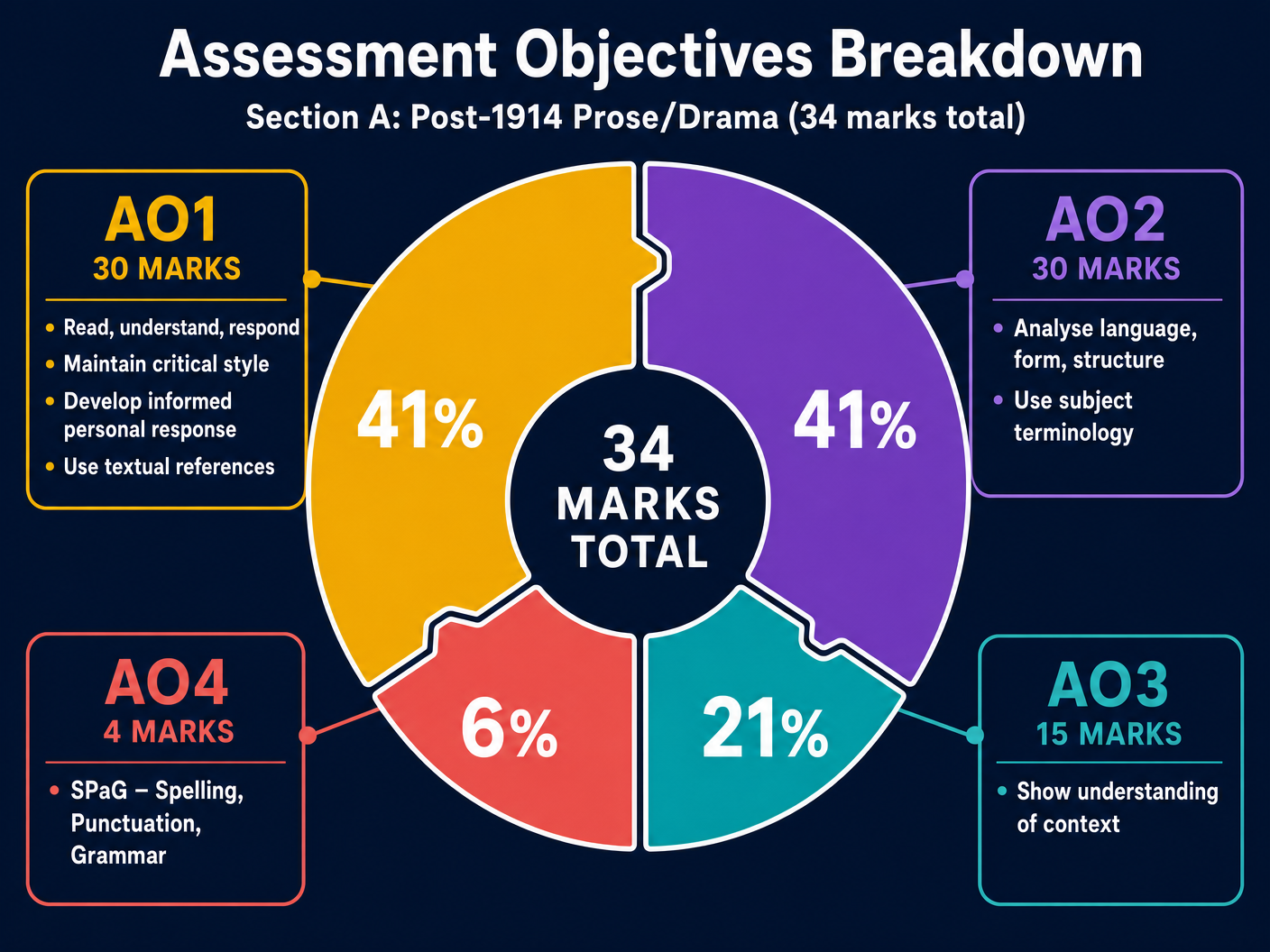
Core Assessment Objectives
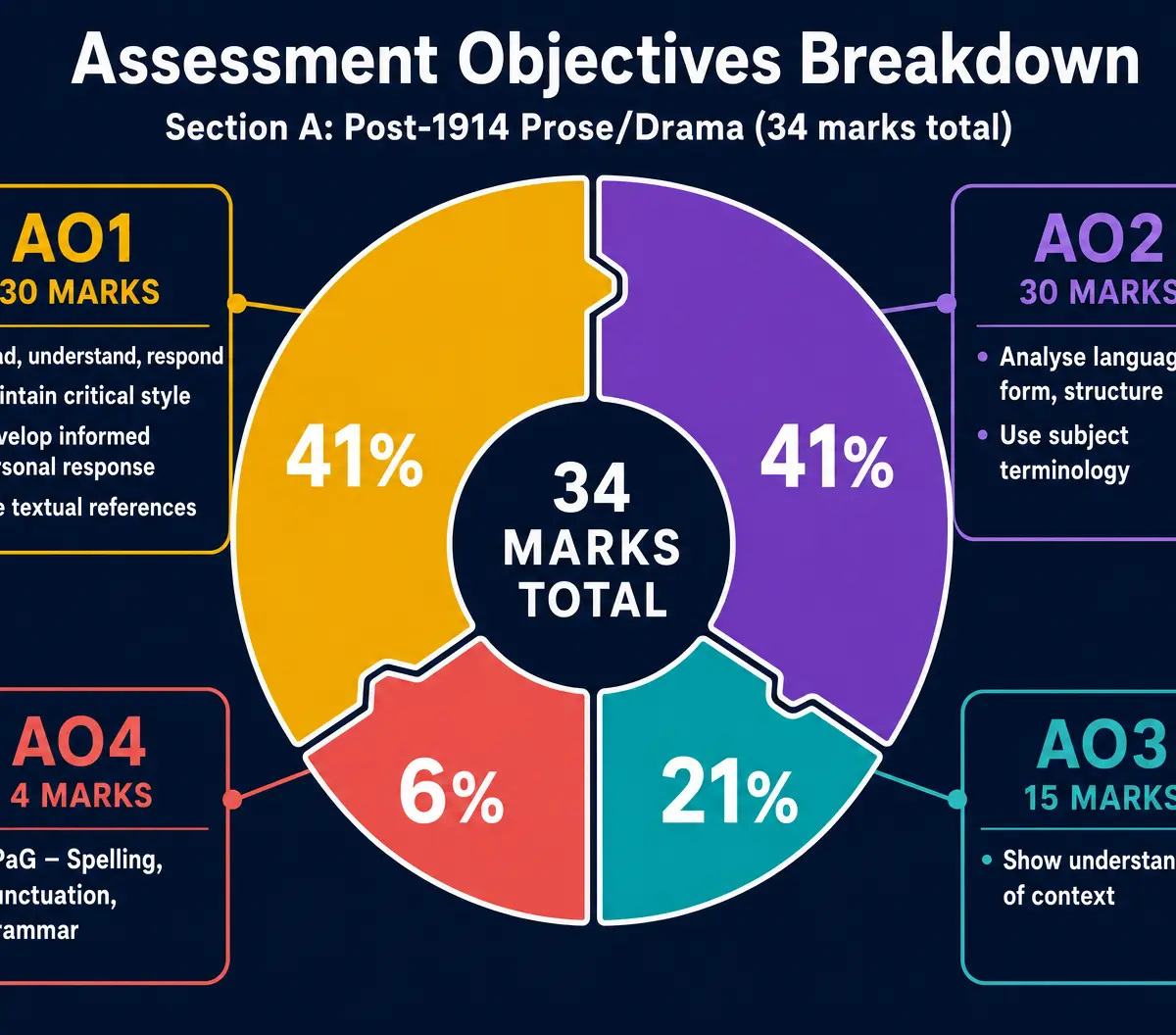
To succeed, you must understand exactly where the marks are awarded:
- AO1 (30 marks total): Read, understand and respond to texts. Maintain a critical style and develop an informed personal response. Use textual references, including quotations, to support and illustrate interpretations.
- AO2 (30 marks total): Analyse the language, form and structure used by a writer to create meanings and effects, using relevant subject terminology where appropriate.
- AO3 (15 marks total): Show understanding of the relationships between texts and the contexts in which they were written.
- AO4 (4 marks): Use a range of vocabulary and sentence structures for clarity, purpose and effect, with accurate spelling and punctuation.
Approaching Post-1914 Texts
Whether you are studying An Inspector Calls, Lord of the Flies, Animal Farm, or Blood Brothers, the fundamental skills remain the same. These texts were written in a century defined by rapid social change, global conflict, and shifting political ideologies. Examiners expect you to understand the text as a construct — a deliberate creation by the writer to communicate a specific message to their audience.
Themes and Context
When discussing themes, always link them to the writer's broader purpose.
- Social Responsibility: How does the text critique individualism or advocate for collective welfare?
- Class and Inequality: How are social hierarchies presented, and what is the writer's attitude towards them?
- Power and Control: Who holds power, how is it maintained, and how is it challenged?
Key Approach: Context (AO3) should never be a standalone history paragraph. It must be woven into your analysis of the text. Instead of writing, "In 1912 the Titanic sank," write, "The dramatic irony of Birling's confidence in the 'unsinkable' Titanic exposes the arrogant complacency of the Edwardian ruling class."
Writer's Methods (AO2)
Examiners heavily reward the precise analysis of language, form, and structure.
Language
- Word Choice: Zoom in on specific nouns, verbs, and adjectives. What connotations do they carry?
- Imagery and Metaphor: How do comparisons shape our understanding of a character or situation?
- Dialogue/Speech: In drama, how does the way a character speaks (fluency, hesitations, interruptions) reveal their status or state of mind?
Form and Structure
- Dramatic Irony: In plays, how does the audience's knowledge affect their perception of the characters?
- Stage Directions: How do lighting, movement, and setting contribute to the mood and meaning?
- Narrative Perspective: In prose, whose viewpoint are we given, and how does this bias our understanding?
- Pacing and Tension: How does the writer build to a climax or create moments of revelation?
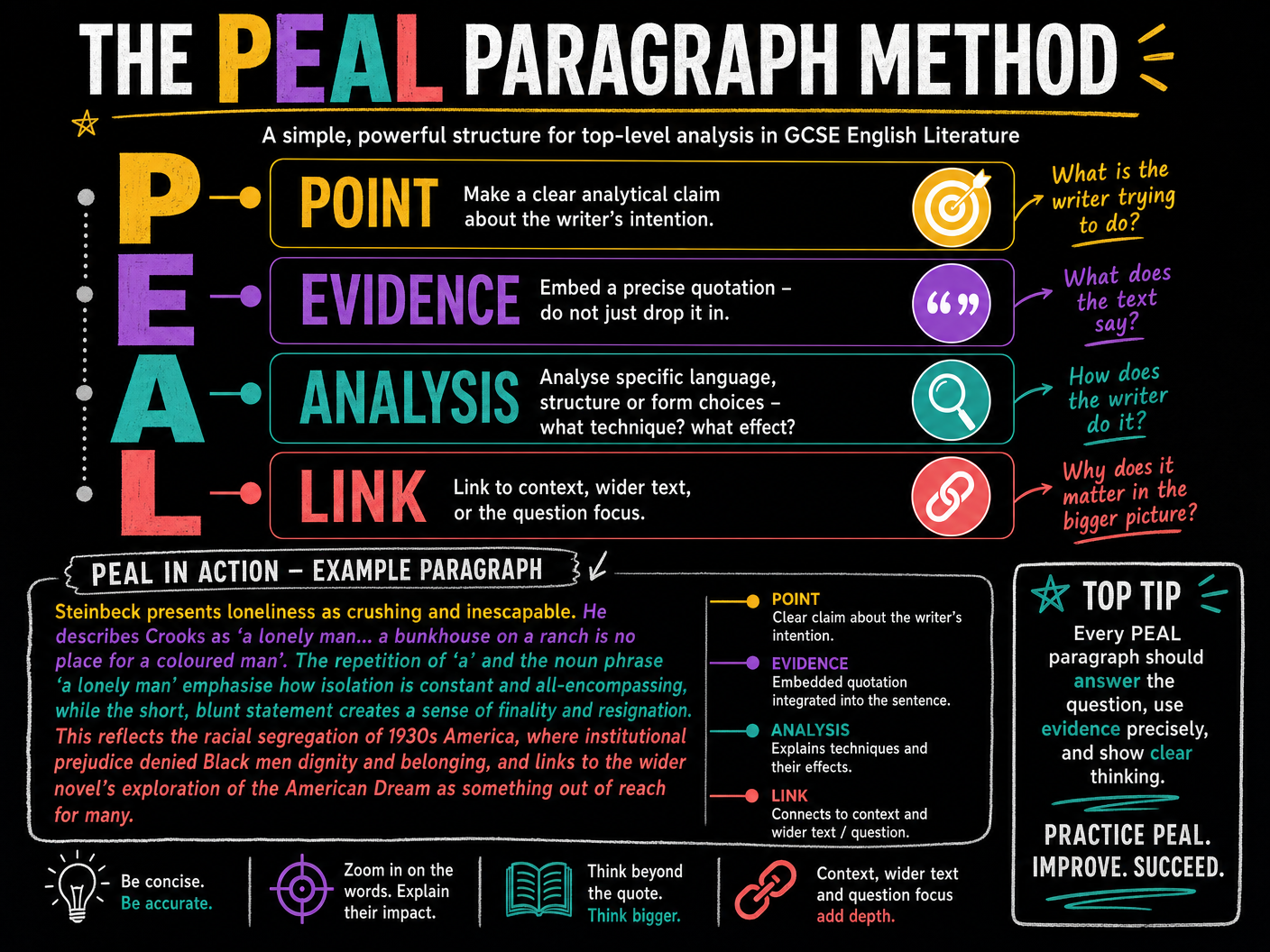
The PEAL Method
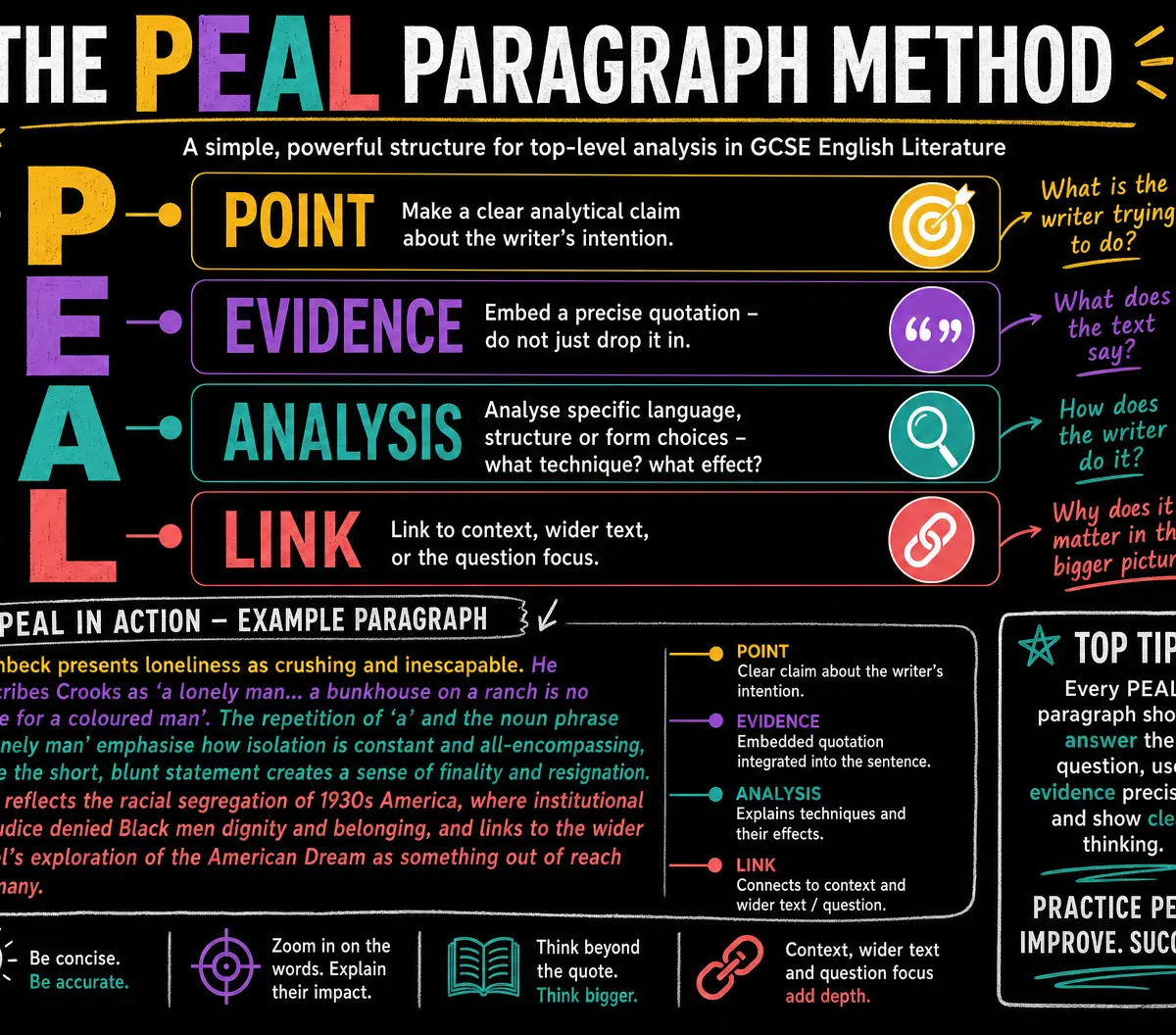
To ensure you hit all Assessment Objectives, use the PEAL paragraph structure:
- Point (AO1): Make a clear, conceptualised claim about the writer's intention.
- Evidence (AO1): Embed a precise quotation.
- Analysis (AO2): Zoom in on specific methods (language/structure) and explain their effects.
- Link (AO3/AO1): Connect your analysis back to the question focus and the relevant context.
Visual Resources
3 diagrams and illustrations
Interactive Diagrams
1 interactive diagram to visualise key concepts
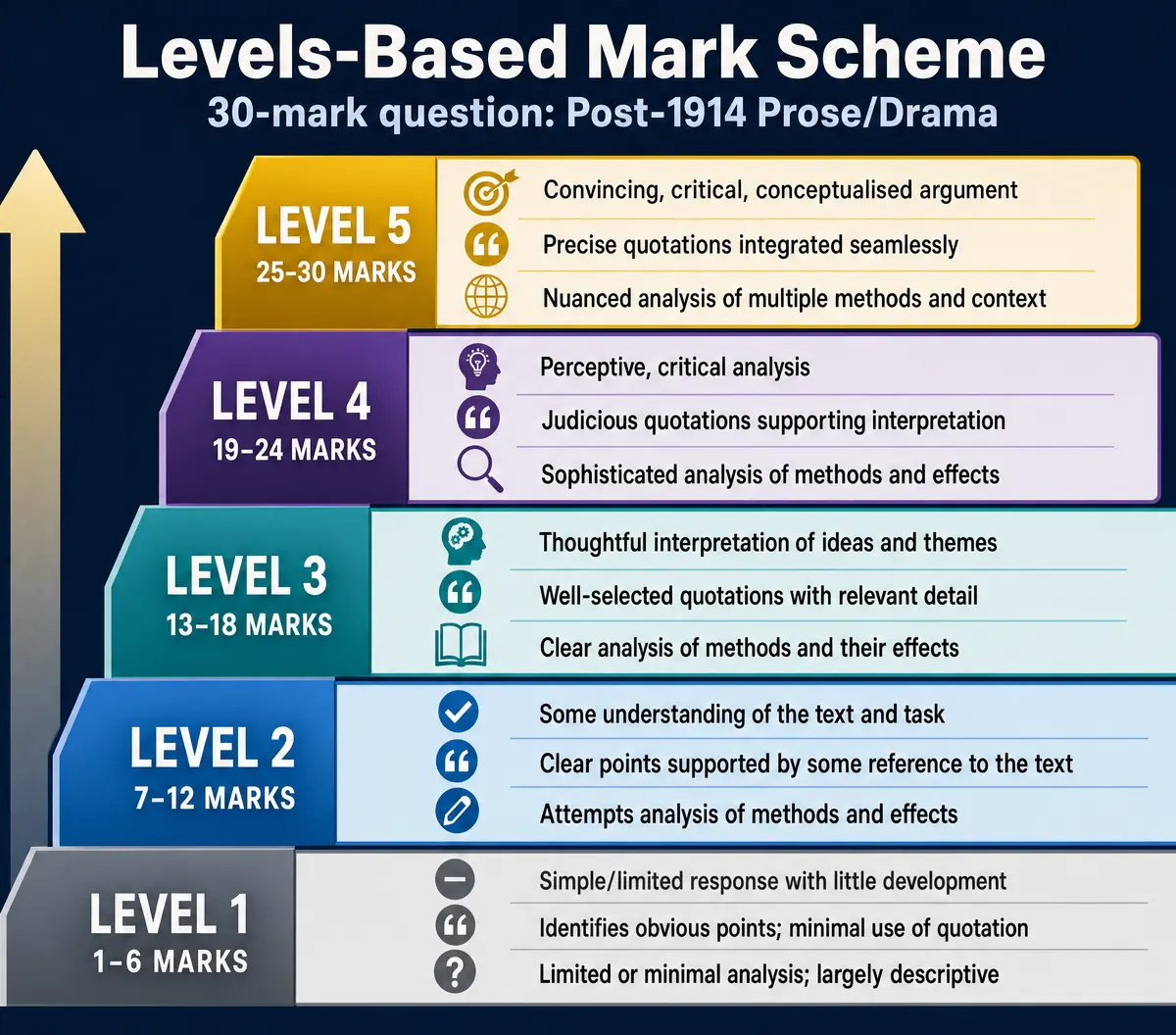
Conceptual Flow Outline
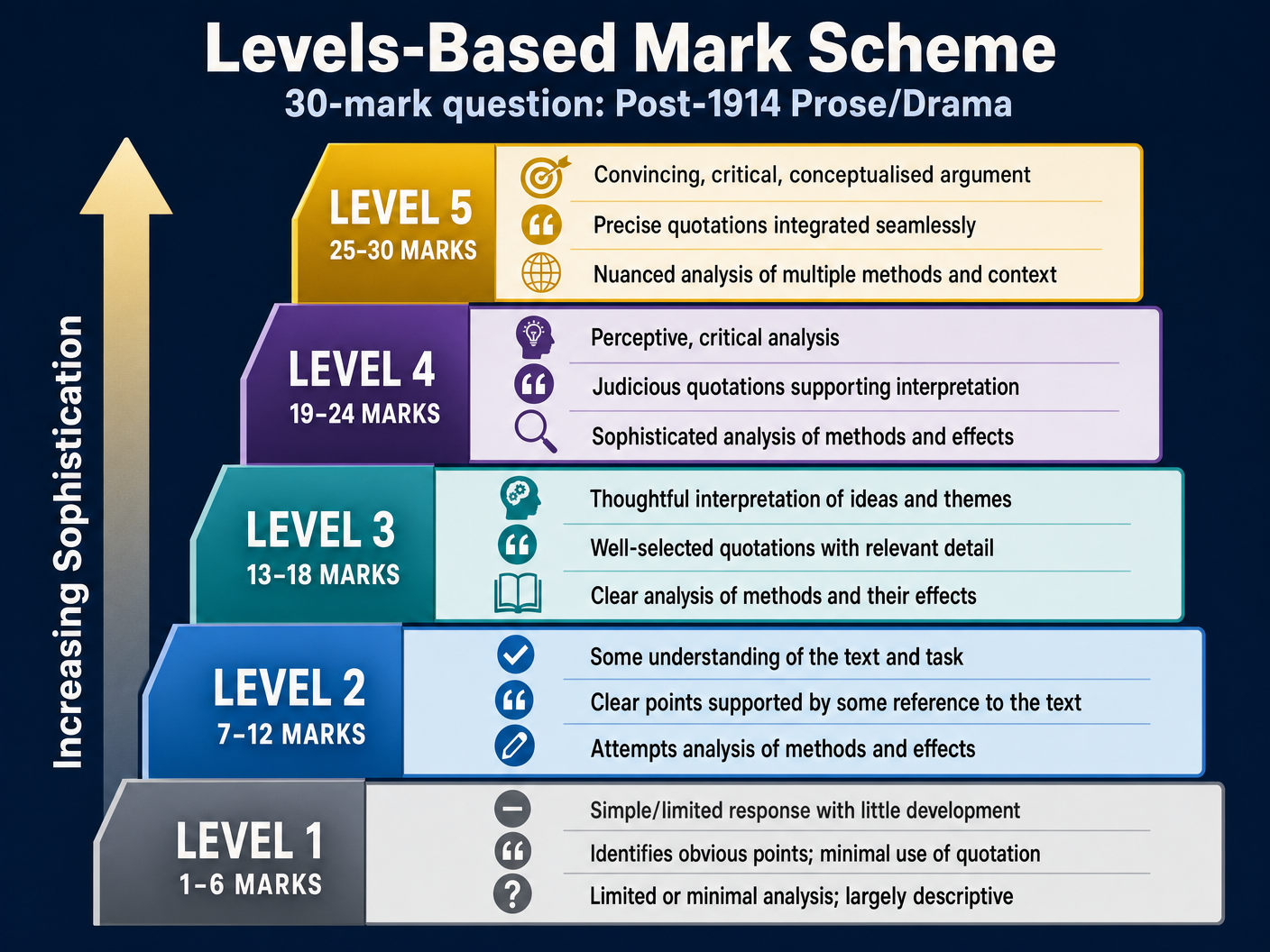
Moving up the Mark Scheme Levels
Worked Examples
2 worked examples — open one to explore the question and available guidance.
Practice Questions
Test your understanding — click to reveal model answers
How does the writer present the theme of power and control in the text? (30 marks + 4 AO4)
Hint: Consider who has power at the start, how they use it, and whether the balance of power shifts by the end.
Starting with this extract, explore how the writer presents the consequences of actions. (30 marks + 4 AO4)
Hint: Focus on the chain of events. How does the writer use structure (like foreshadowing or cyclical narratives) to show that actions cannot be undone?
How does the writer use setting to contribute to the mood and meaning of the text? (30 marks + 4 AO4)
Hint: Setting is more than just a backdrop. How does it reflect the characters' psychological states or the societal context?
Explore how the writer presents female characters in a patriarchal society. (30 marks + 4 AO4)
Hint: Look at the differences in how male and female characters are treated, and how female characters respond to their restrictions.