Eduqas · GCSE · English Literature
Section B (20%) 19th Century Prose
Master the complexities of 19th Century Prose with this comprehensive guide covering A Christmas Carol, Jekyll and Hyde, and Frankenstein. Discover how to analyse writer's methods, integrate historical context, and structure high-scoring essays to secure top marks in your GCSE English Literature exam.
- 9 min read
- 2 worked examples
- 4 practice questions
- 8 key terms
Study Notes
Overview
Section B of Paper 2.2 requires candidates to demonstrate a deep understanding of a 19th-century prose text. Examiners are looking for a conceptualised response that weaves together textual analysis (AO1), the writer's methods (AO2), and the historical context (AO3). The most successful responses avoid simply retelling the plot; instead, they focus on how the writer uses language, structure, and form to convey their message and critique Victorian society. Whether you are studying Dickens' social commentary, Stevenson's exploration of duality, or Shelley's warning against unchecked ambition, your goal is to present a clear, critical argument supported by judiciously selected, embedded quotations.
Listen to the Podcast

Plot/Content Overview
While you must not retell the plot in your exam, a solid grasp of the narrative structure is essential for placing extracts in context and tracking character development.
A Christmas Carol (Dickens)
- Stave 1: Scrooge is established as a miserly misanthrope. He rejects Fred's invitation, dismisses the charity collectors, and is visited by Marley's ghost, who warns of the chains forged in life.
- Stave 2: The Ghost of Christmas Past shows Scrooge his lonely childhood, his beloved sister Fan, his joyous apprenticeship under Fezziwig, and his lost love, Belle.
- Stave 3: The Ghost of Christmas Present reveals the warmth of the Cratchit family despite their poverty, the suffering of Tiny Tim, and the allegorical children Ignorance and Want.
- Stave 4: The Ghost of Christmas Yet to Come shows Scrooge a bleak future: his own unmourned death, the plundering of his belongings, and the grief of the Cratchits over Tiny Tim.
- Stave 5: Scrooge awakens on Christmas morning transformed. He sends a turkey to the Cratchits, donates to charity, visits Fred, and becomes a second father to Tiny Tim.
The Strange Case of Dr Jekyll and Mr Hyde (Stevenson)
- Chapters 1-3: Utterson hears the story of the door and Hyde's trampling of a girl. He discovers Jekyll has left everything to Hyde in his will. Jekyll dismisses Utterson's concerns.
- Chapters 4-6: Hyde murders Sir Danvers Carew. Jekyll appears increasingly ill and isolated. Dr Lanyon dies of shock after discovering Jekyll's secret.
- Chapters 7-8: Utterson and Enfield see Jekyll transform at his window. Poole seeks Utterson's help; they break into the laboratory and find Hyde dead by suicide.
- Chapters 9-10: Lanyon's letter reveals the transformation he witnessed. Jekyll's full statement of the case explains his creation of the potion and his ultimate loss of control over Hyde.
Frankenstein (Shelley)
- Walton's Letters: Explorer Robert Walton rescues Victor Frankenstein in the Arctic and records his story.
- Volume 1: Victor details his privileged childhood, his obsession with science, and his creation of the monster. Horrified, he abandons it. His brother William is murdered, and Justine is wrongly executed.
- Volume 2: Victor meets the creature, who recounts his tale of learning language, facing rejection from the De Lacey family, and turning to vengeance. The creature demands a female companion.
- Volume 3: Victor begins creating the female but destroys it in fear. The creature murders Victor's friend Clerval and his bride Elizabeth. Victor pursues the creature to the Arctic, where he dies. The creature mourns Victor and departs to die.
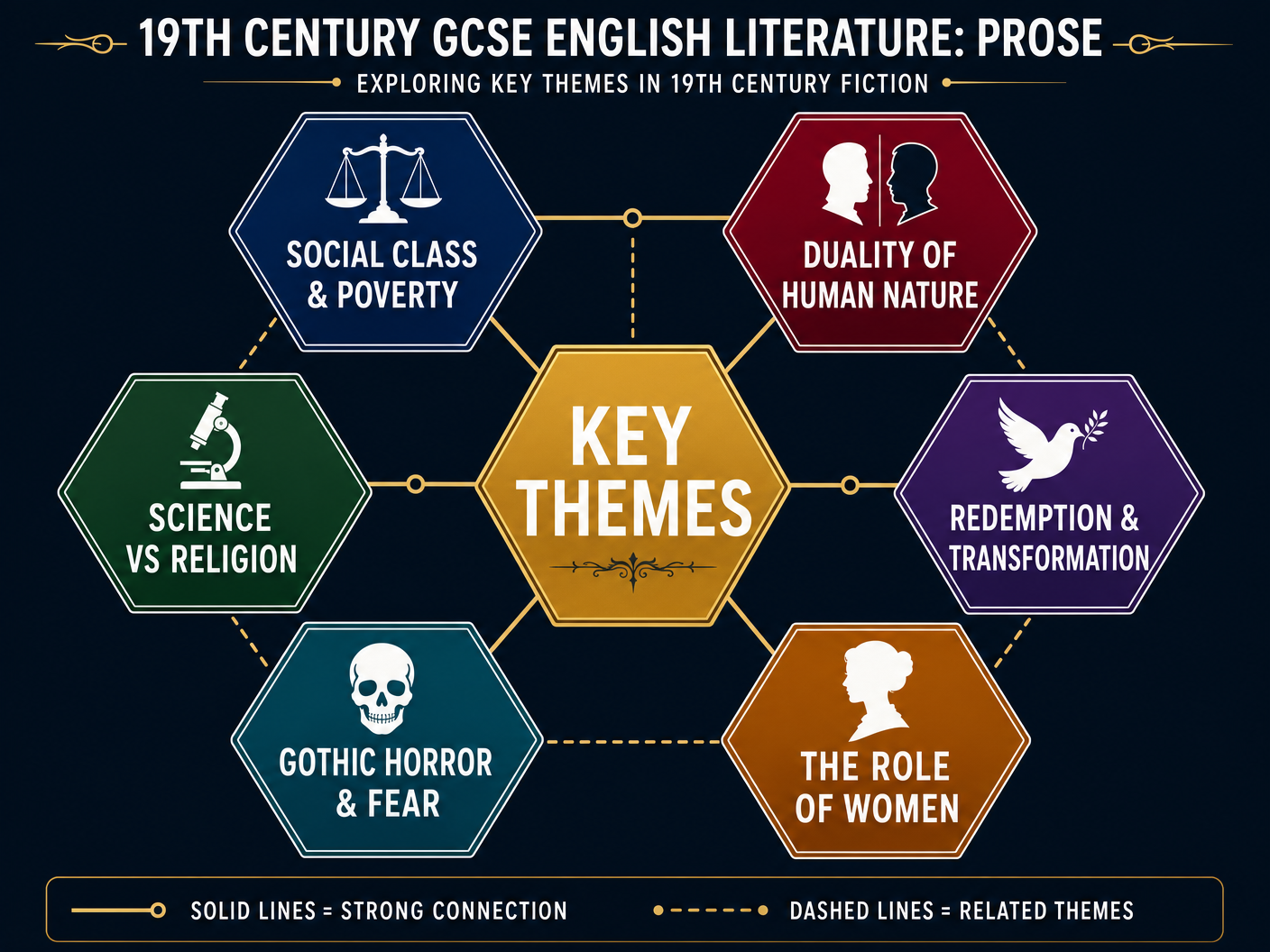
Themes
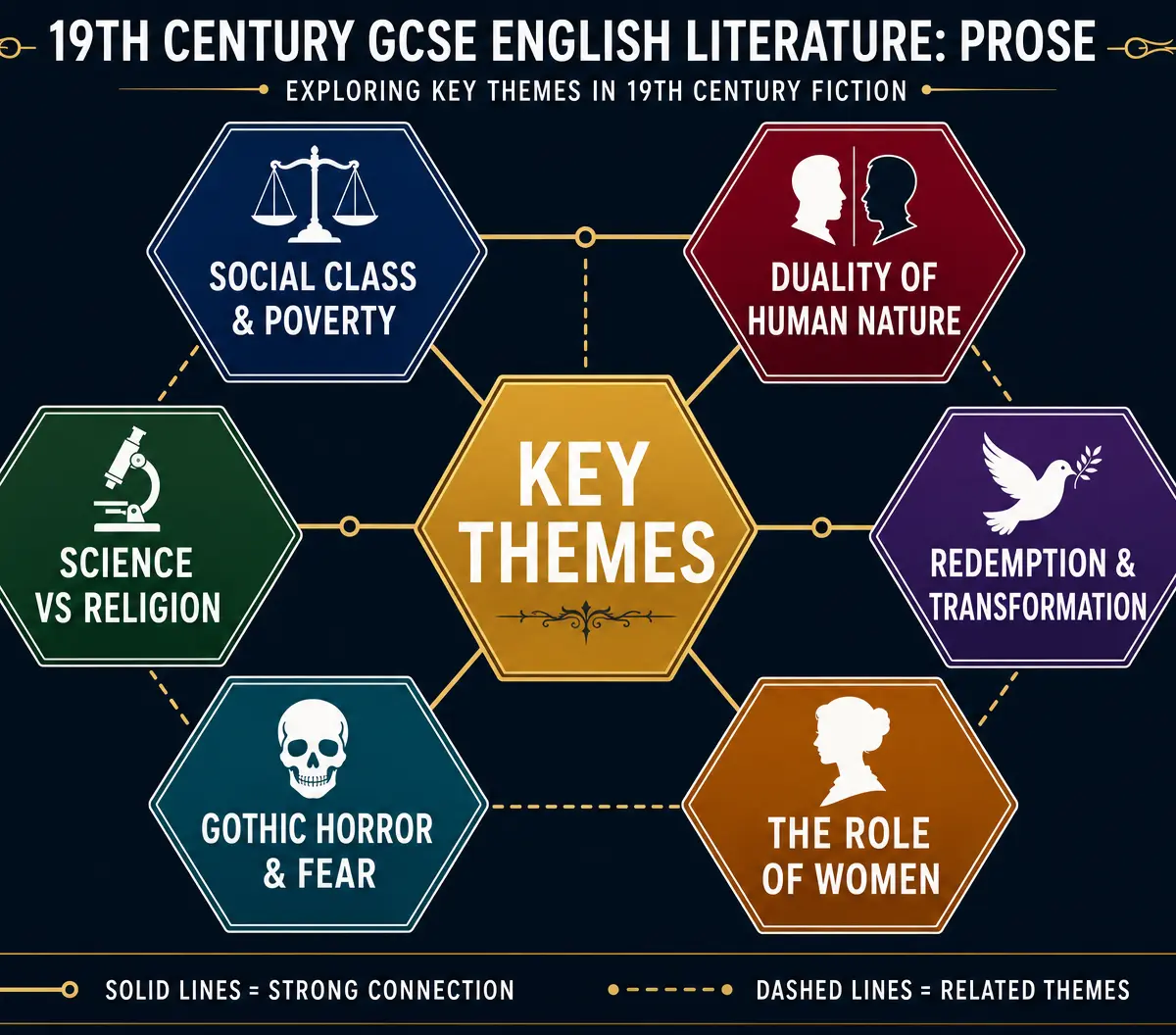
Theme 1: Social Responsibility and Class
In the 19th century, writers frequently used literature to critique the stark divide between the wealthy and the destitute. Dickens directly challenges the Malthusian economic view that the poor are a "surplus population" to be managed through workhouses. Stevenson highlights the hypocrisy of the upper classes who maintain a respectable facade while indulging in secret vices.
Key Quotes:
- "Are there no prisons? Are there no workhouses?" (Scrooge, Stave 1) - Dickens uses rhetorical questions to expose the callousness of the ruling class. Scrooge views the poor as a problem for institutions, not individuals.
- "This boy is Ignorance. This girl is Want. Beware them both..." (Ghost of Christmas Present, Stave 3) - Dickens uses personification to warn that neglecting the education and welfare of the poor will lead to societal ruin.
Theme 2: Duality and the Divided Self
Stevenson's novella is the quintessential exploration of duality, suggesting that human nature is inherently conflicted. This reflects Victorian anxieties about evolution, psychology, and the fragility of civilisation.
Key Quotes:
- "Man is not truly one, but truly two." (Jekyll, Chapter 10) - The thesis of the novella. The syntactic parallelism emphasises the inescapable division within the human soul.
- "My devil had been long caged, he came out roaring." (Jekyll, Chapter 10) - The metaphor of the cage highlights the danger of repression; denying our darker impulses only makes them more explosive.
Theme 3: Ambition and the Limits of Science
Shelley's novel serves as a Romantic critique of Enlightenment science. Victor's hubris—his desire to conquer death and play God—leads to destruction, reflecting contemporary fears about scientific overreach (such as Galvanism).
Key Quotes:
- "A new species would bless me as its creator and source." (Victor, Vol 1) - Victor's ambition is rooted in ego and a desire for worship, highlighting the dangers of unchecked scientific pursuit.
- "I ought to be thy Adam, but I am rather the fallen angel." (The Creature, Vol 2) - A direct allusion to Milton's Paradise Lost. The creature recognises his rejection and the inversion of the natural order.
Character Analysis
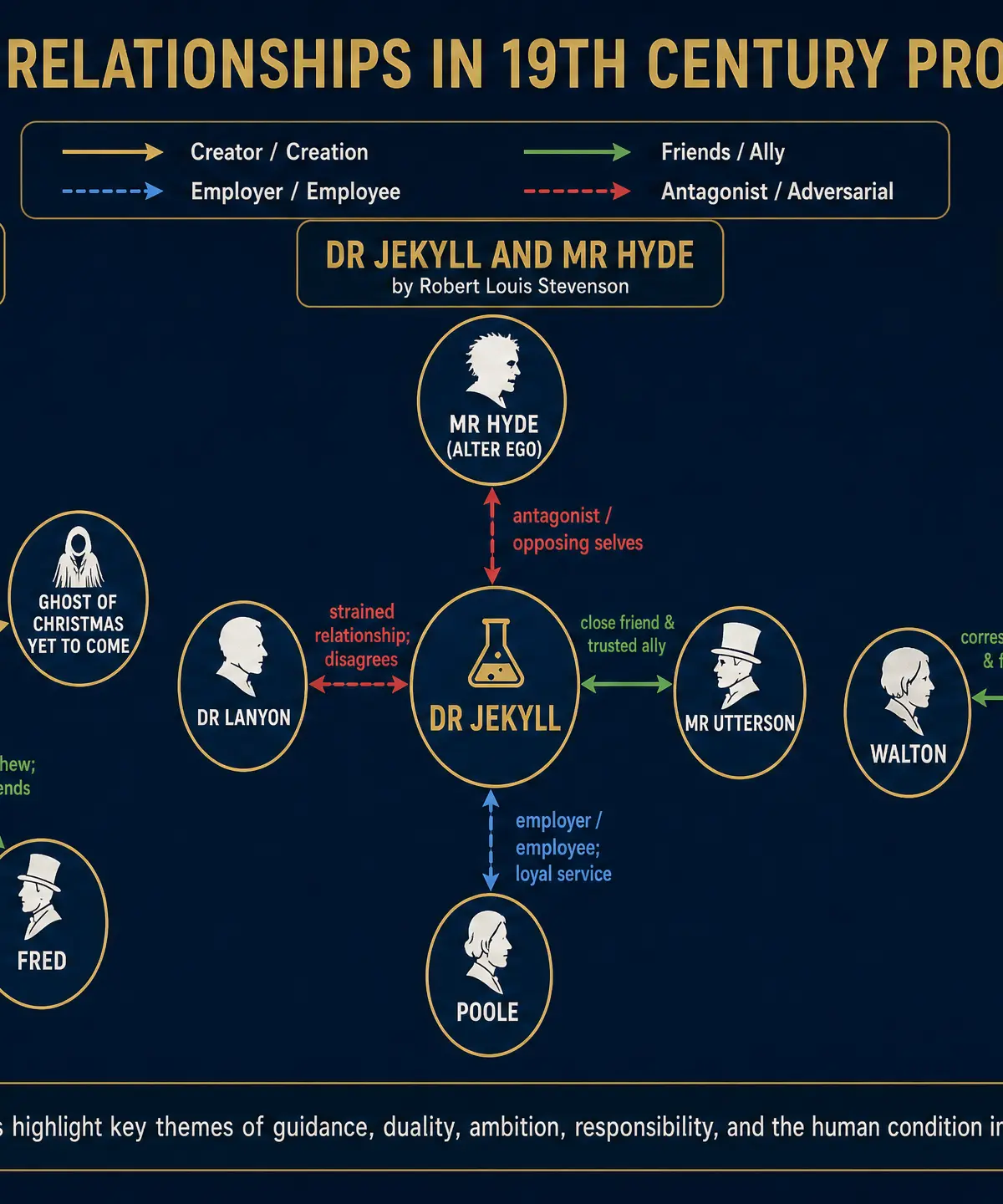
Ebenezer Scrooge
Role: The protagonist whose journey from misanthropy to redemption forms the moral core of the narrative.
Key Traits: Miserly, isolated, cynical, ultimately capable of change.
Character Arc: Scrooge begins as a symbol of capitalist greed. Through supernatural intervention, he reconnects with his past humanity, develops empathy for the present suffering of others, and fears the consequences of his actions, leading to a total rebirth.
Essential Quotes:
- "Hard and sharp as flint, from which no steel had ever struck out generous fire."
- "Solitary as an oyster."
- "I am as light as a feather, I am as happy as an angel."
Dr Henry Jekyll
Role: The tragic figure whose desire to separate his good and evil impulses leads to his destruction.
Key Traits: Ambitious, hypocritical, repressed, desperate.
Character Arc: Jekyll starts as a respected, wealthy doctor constrained by societal expectations. He seeks freedom through his alter ego, Hyde, but gradually loses control as the evil side becomes dominant, ending in his suicide.
Essential Quotes:
- "A large, well-made, smooth-faced man of fifty, with something of a slyish cast perhaps."
- "I was slowly losing hold of my original and better self, and becoming slowly incorporated with my second and worse."
The Creature (Frankenstein)
Role: The abandoned creation who reflects the consequences of Victor's ambition and society's prejudice.
Key Traits: Articulate, emotional, vengeful, profoundly lonely.
Character Arc: Created innocent, the creature seeks love and connection. Repeated violent rejection by humanity turns his innate goodness into bitter vengeance against his creator.
Essential Quotes:
- "I was benevolent and good; misery made me a fiend."
- "Am I not shunned and hated by all mankind?"
Writer's Methods
Examiners award the highest marks for AO2 when candidates analyse how meaning is constructed.
- Narrative Structure: Consider the effect of the frame narrative in Frankenstein (creating distance and questioning reliability) or the five-stave structure of A Christmas Carol (mirroring a musical composition or a five-act play).
- Setting and Pathetic Fallacy: Writers use setting to reflect character and theme. The "fog and darkness" of Dickens' London mirrors Scrooge's moral blindness, while the "labyrinths of lamp-lighted city" in Jekyll and Hyde represent the twisted, secretive nature of Victorian society.
- Motifs and Symbolism: Look for recurring images. Fire and light in A Christmas Carol symbolise warmth and generosity. The locked doors in Jekyll and Hyde represent secrecy and the division between public and private spheres.
Context
To achieve top marks in AO3, context must be integrated into your analysis, not bolted on.
- Dickens was a social reformer critiquing the 1834 Poor Law and the Malthusian belief that poverty was the fault of the poor. His text is a Christian allegory urging the wealthy to embrace social responsibility.
- Stevenson wrote during the fin de siècle (end of the century), a time of anxiety about degeneration, evolution (Darwin's theories), and the strict moral codes of Victorian society that forced men to live double lives.
- Shelley was influenced by the Romantic movement, which valued nature and emotion over cold, rational science. She was aware of scientific experiments like Galvanism (animating dead tissue with electricity) and used them to warn against man playing God.
Visual Resources
2 diagrams and illustrations
Interactive Diagrams
1 interactive diagram to visualise key concepts
Conceptual Flow Outline
The structural narrative arc common to 19th Century Prose texts
Worked Examples
2 worked examples — open one to explore the question and available guidance.
Practice Questions
Test your understanding — click to reveal model answers
Starting with this extract (Chapter 4, the Carew Murder Case), explore how Stevenson presents the character of Mr Hyde as frightening. (30 marks + 4 AO4)
Hint: Look closely at the verbs used to describe Hyde's actions in the extract. Then, connect this to how other characters react to him elsewhere in the novella.
Explore how Dickens presents the importance of family in A Christmas Carol. (30 marks + 4 AO4)
Hint: Contrast Scrooge's isolation with the warmth of the Cratchits and Fred's household.
Explore how Shelley presents the theme of responsibility in Frankenstein. (30 marks + 4 AO4)
Hint: Consider both Victor's failure to take responsibility for his creation and the creature's own moral responsibility for his violent actions.
Starting with this extract (Stave 3, the introduction of Ignorance and Want), explore how Dickens uses ghosts to teach Scrooge lessons. (30 marks + 4 AO4)
Hint: Focus on the allegorical function of the ghosts. What specific societal flaw does each ghost address?