AQA · GCSE · Food Preparation and Nutrition
Food safety
Mastering food safety is not just about avoiding food poisoning; it's a critical, high-scoring area in both your written exams and practical assessments. This guide breaks down the essential temperatures, cross-contamination prevention strategies, and FSA guidelines you need to know to secure top marks.
- 5 min read
- 3 worked examples
- 5 practice questions
- 6 key terms
Study Notes
Overview
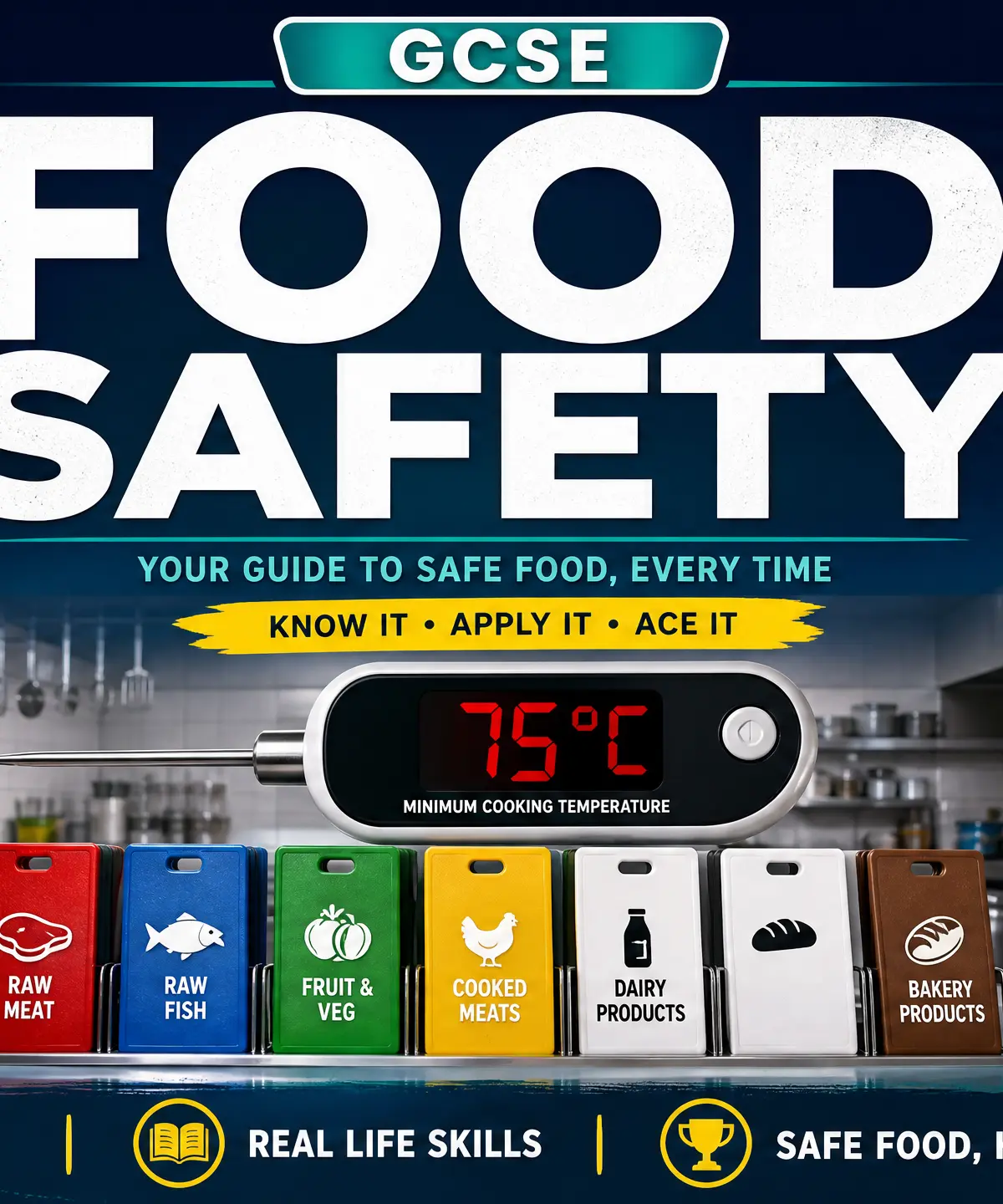
Food safety is the cornerstone of the GCSE Food Preparation and Nutrition course. It covers the essential principles required when buying, storing, preparing, cooking, and serving food, strictly following current Food Standards Agency (FSA) guidelines. Examiners place heavy emphasis on this topic because it is a fundamental life skill. Whether you are answering multiple-choice questions on temperature ranges, evaluating a food preparation plan, or demonstrating your skills during the practical assessment (NEA 2), a solid grasp of food safety principles will consistently earn you marks. You must be able to accurately state critical temperatures, explain the conditions bacteria need to multiply, and detail strategies to prevent cross-contamination.
Temperature Control
Temperature control is the most critical factor in preventing bacterial growth and food poisoning. Examiners expect you to know specific temperature ranges and explain their effect on bacteria.
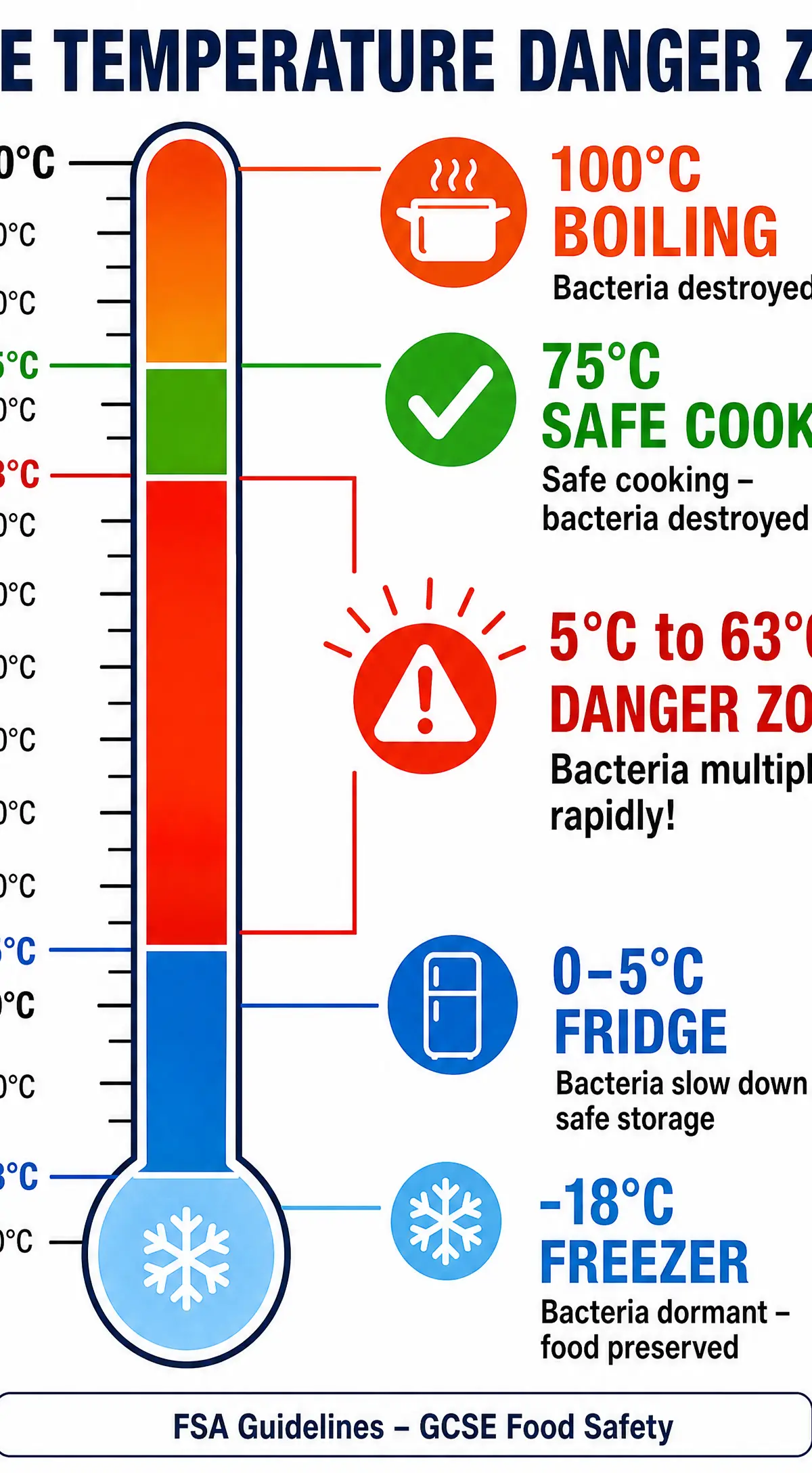
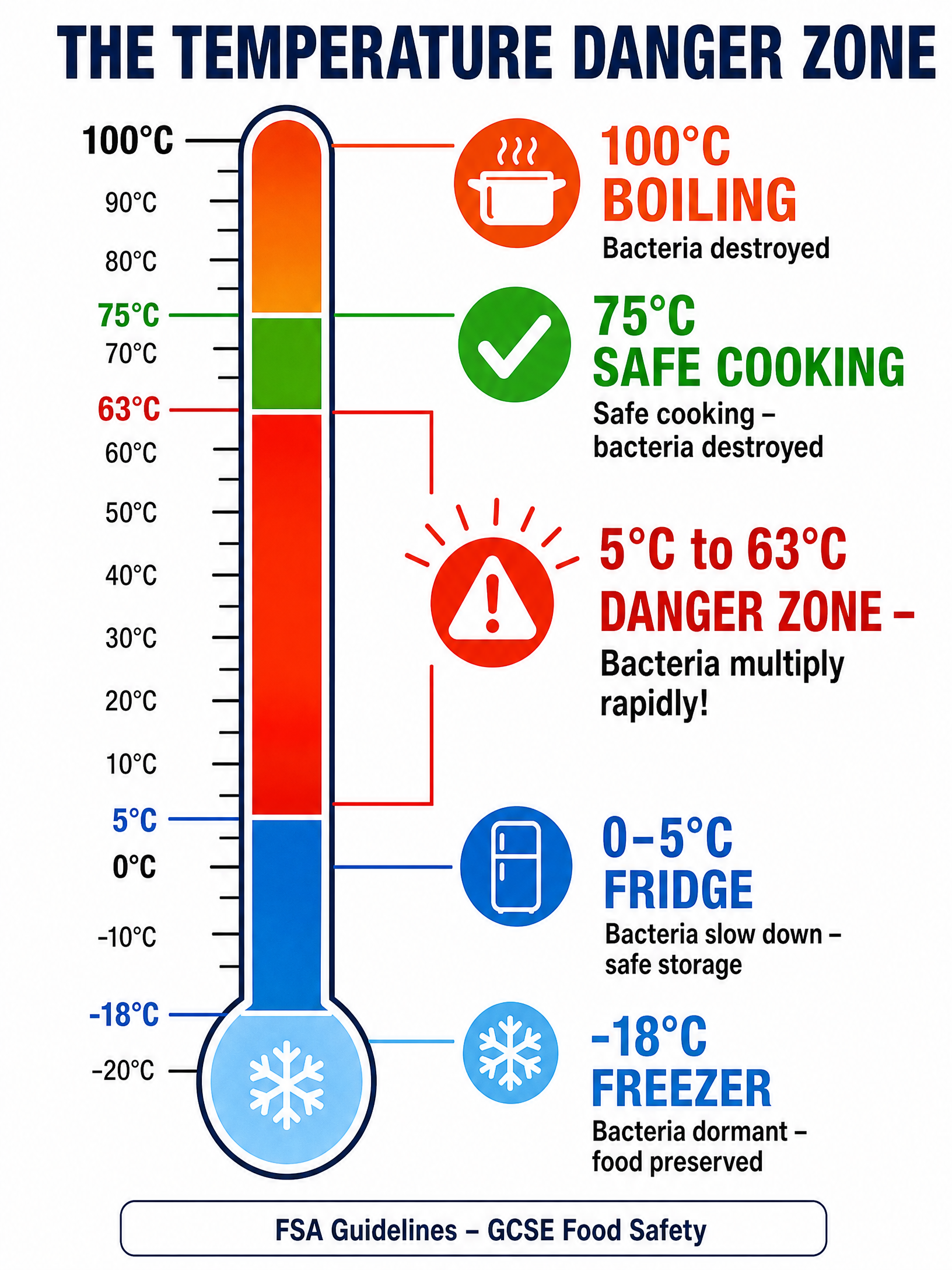
The Danger Zone (5°C to 63°C)
Temperature: 5°C to 63°C
What happens: In this range, bacteria multiply rapidly. Under ideal conditions, bacteria can double every 20 minutes.
Why it matters: Leaving high-risk food in the danger zone is the primary cause of food poisoning. You must minimize the time food spends in this zone during preparation and cooling.
Specific Knowledge: You must explicitly state 63°C as the upper limit. Many candidates lose marks by writing 65°C.
Chilling (0°C to 5°C)
Temperature: 0°C to 5°C (Fridge temperature)
What happens: Bacterial growth slows down significantly. Bacteria are not killed, but their reproduction is severely restricted.
Why it matters: This extends the shelf life of perishable, high-risk foods.
Freezing (-18°C)
Temperature: -18°C
What happens: Bacteria become dormant. They stop multiplying entirely, but they are not killed.
Why it matters: Freezing preserves food for long periods. However, once thawed, bacteria will become active again and begin to multiply.
Cooking and Reheating (75°C)
Temperature: 75°C
What happens: At this core temperature, harmful bacteria are destroyed.
Why it matters: This is the FSA recommended temperature for safe cooking and reheating. Food should only be reheated once.
High-Risk Foods & Bacterial Growth
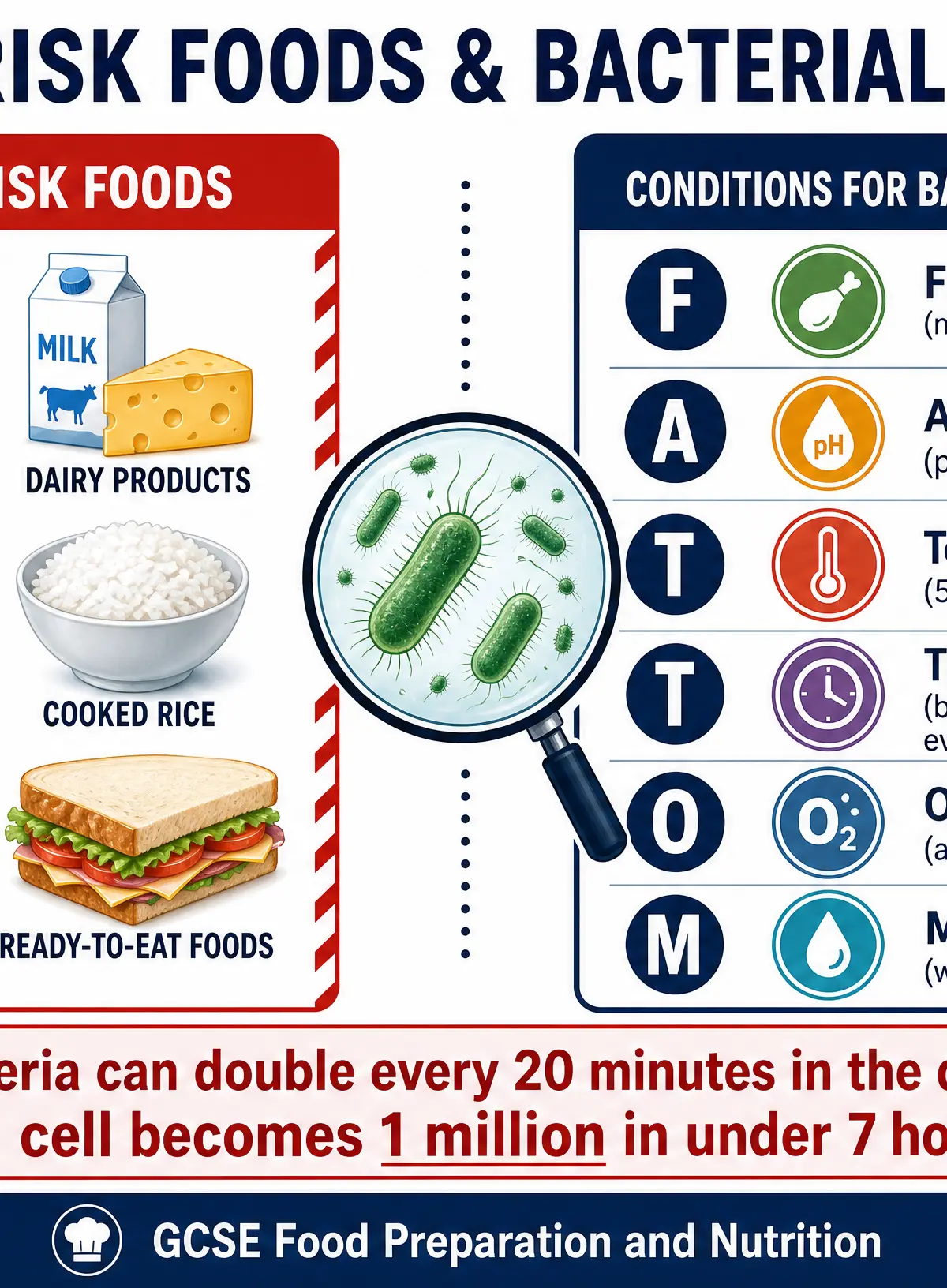
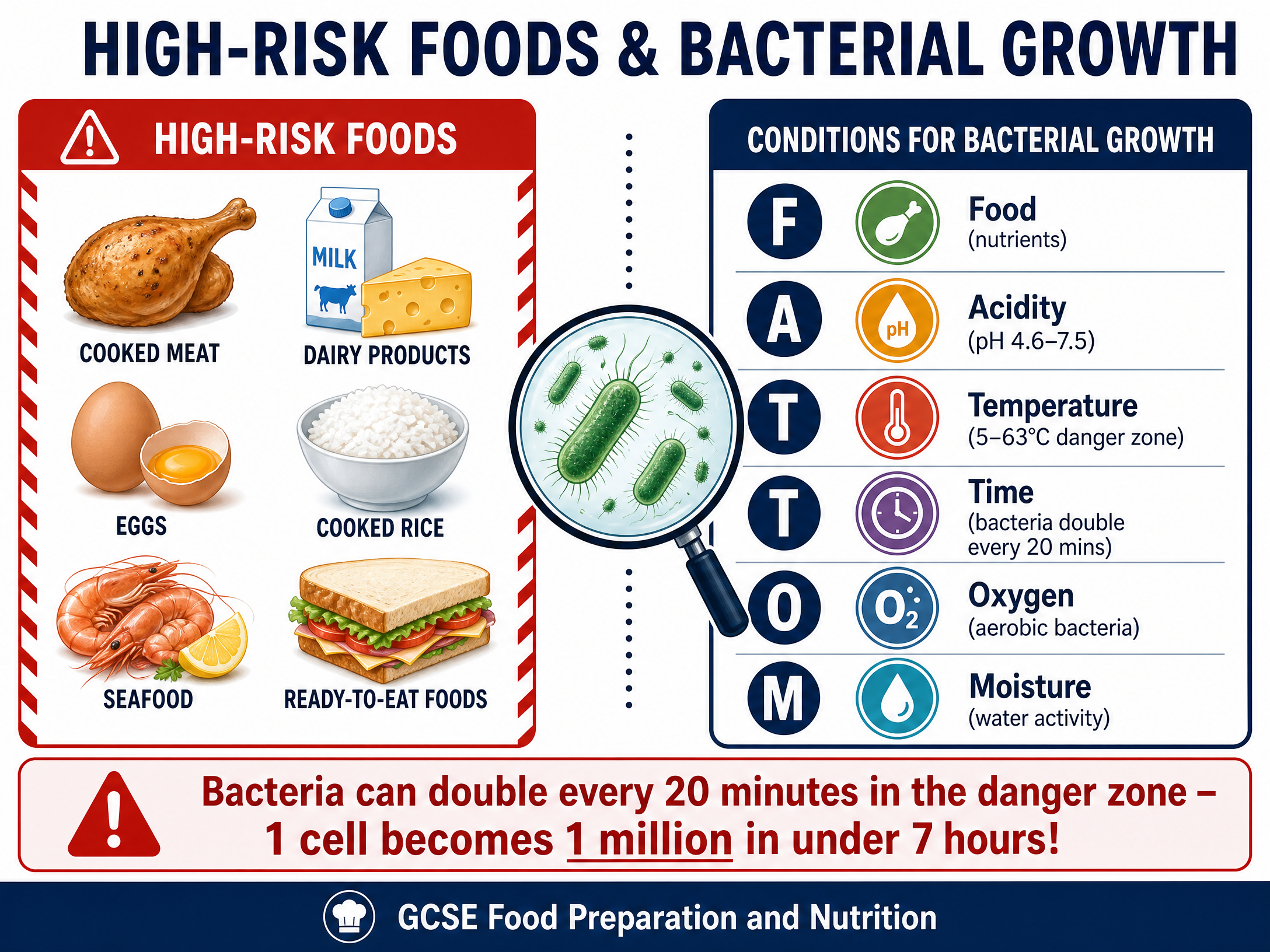
High-risk foods are those that provide the ideal conditions for bacteria to multiply. They are typically high in protein and moisture.
Key Examples: Cooked meat and poultry, dairy products, eggs, cooked rice, seafood, and ready-to-eat foods (like sandwiches).
Conditions for Growth (FATTOM)
Bacteria require six specific conditions to multiply, easily remembered by the acronym FATTOM:
- Food: Nutrients, especially protein.
- Acidity: A neutral pH (around 4.6 to 7.5).
- Temperature: The Danger Zone (5°C to 63°C).
- Time: Bacteria double every 20 minutes.
- Oxygen: Most harmful bacteria are aerobic (need oxygen).
- Moisture: Water activity is essential for survival.
Preventing Cross-Contamination
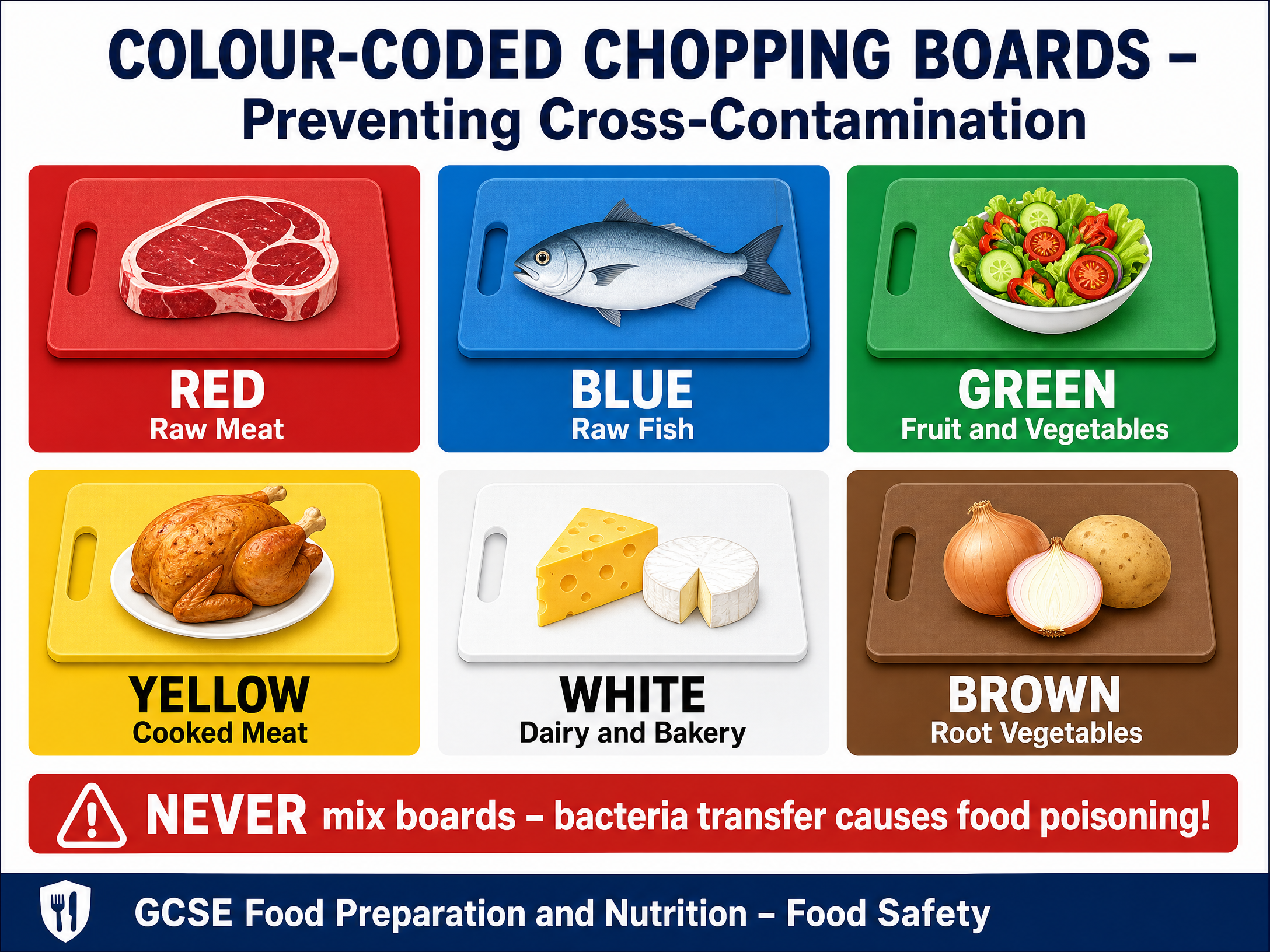
Cross-contamination occurs when harmful bacteria are transferred from one food (usually raw) to another (usually cooked or ready-to-eat), or from equipment/surfaces to food.
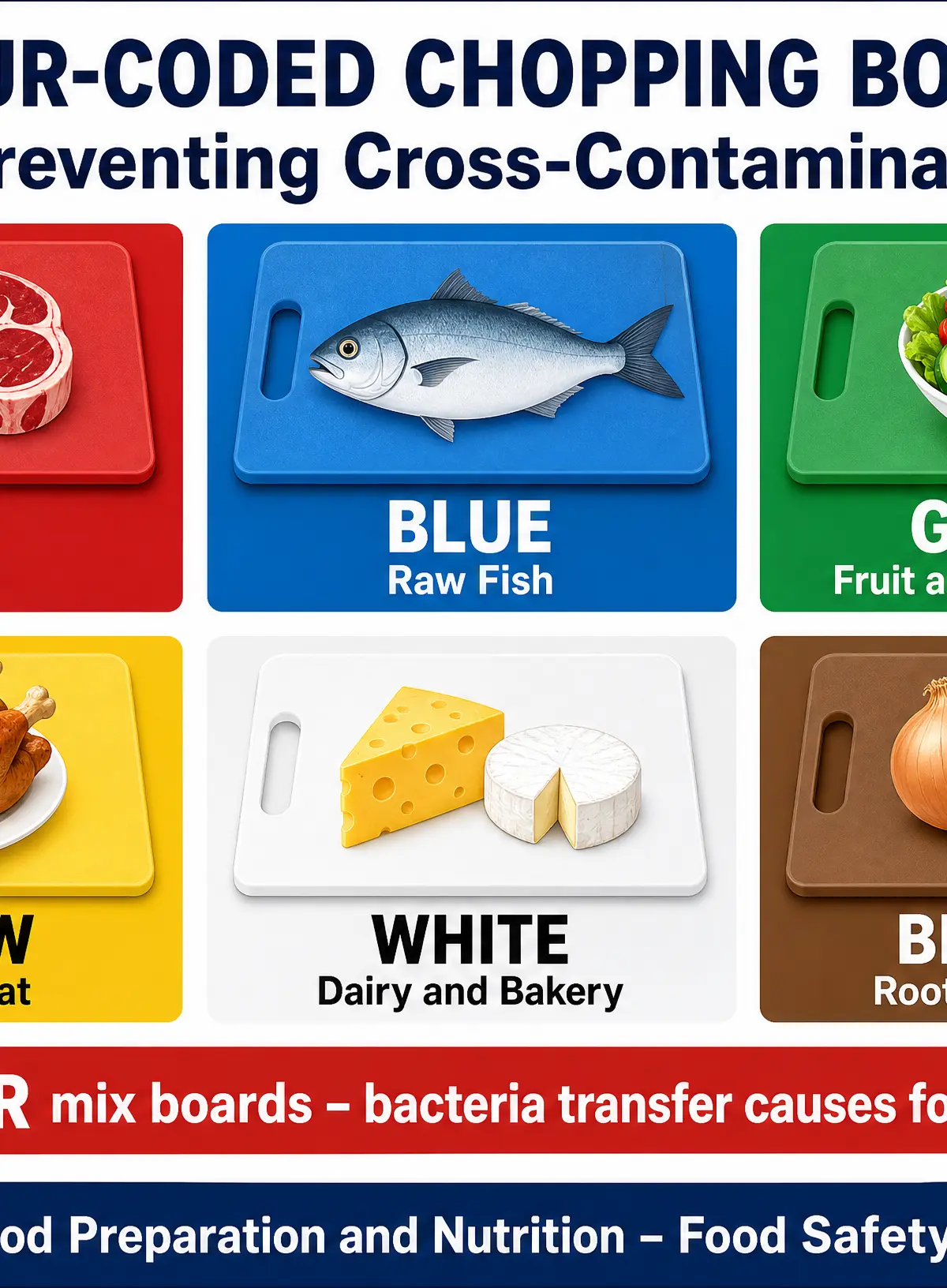
Colour-Coded Chopping Boards
Using specific boards prevents bacteria from raw foods contaminating ready-to-eat foods.
- Red: Raw Meat
- Blue: Raw Fish
- Green: Fruit and Vegetables
- Yellow: Cooked Meat
- White: Dairy and Bakery
- Brown: Root Vegetables
Fridge Storage
Raw meat must always be stored on the bottom shelf of the fridge. This prevents raw meat juices from dripping onto and contaminating cooked or ready-to-eat foods stored below.
Date Marks: Use By vs. Best Before
Examiners frequently test the distinction between these two date marks.
Use By
Focus: Safety.
Application: Found on high-risk, perishable foods (e.g., raw meat, milk).
Rule: Never consume food after this date, even if it looks and smells fine, as harmful bacteria may be present.
Best Before
Focus: Quality.
Application: Found on lower-risk foods (e.g., tinned goods, biscuits).
Rule: Food is safe to eat after this date, but the quality, taste, or texture may have deteriorated.
Listen to the Podcast
Reinforce your learning by listening to our comprehensive 10-minute audio guide covering all these concepts, exam tips, and a quick-fire quiz.
Visual Resources
3 diagrams and illustrations
Interactive Diagrams
1 interactive diagram to visualise key concepts
Conceptual Flow Outline
The Food Safety Pathway from Purchase to Consumption
Worked Examples
3 worked examples — open one to explore the question and available guidance.
Practice Questions
Test your understanding — click to reveal model answers
State the temperature range of the danger zone and explain why it is important to keep food out of this zone. (3 marks)
Hint: Remember the exact upper limit, and explain what bacteria do in this range.
A restaurant is serving a buffet. Explain three food safety rules the staff must follow when displaying and serving the food. (6 marks)
Hint: Think about temperature control for hot and cold food, and preventing cross-contamination from customers.
Evaluate the use of a temperature probe when cooking a whole roast chicken. (4 marks)
Hint: Why is a probe better than just looking at the chicken?
Name the colour of chopping board that should be used for raw fish. (1 mark)
Hint: Think of the colour of the sea.
Explain the difference between a 'Use By' date and a 'Best Before' date. (4 marks)
Hint: Link one to safety and high-risk foods, and the other to quality and low-risk foods.
Test your understanding of Food safety
Active recall beats re-reading. Take an instant quiz now to test what you’ve learned and lock it into long-term memory.
7 days Premium · Then free forever · No card, no charge