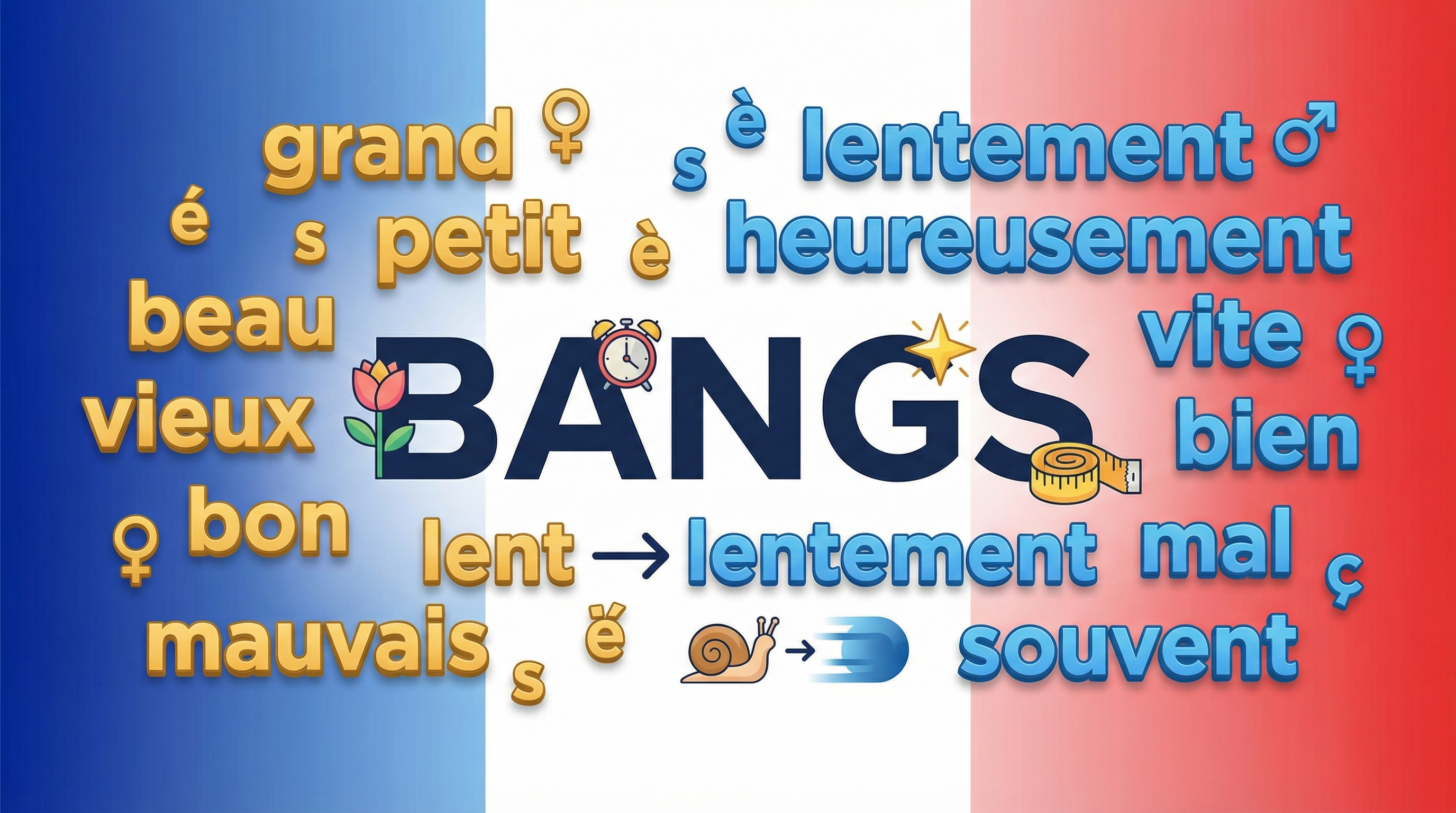
Adjectives and adverbs — AQA GCSE study guide illustration

    Adjectives and adverbs

    AQA
    GCSE
    French

    Mastering French adjectives and adverbs is a game-changer for your AQA GCSE. This guide breaks down the essential rules of agreement, positioning (BANGS), and adverb formation that examiners are looking for to award top marks in writing and speaking.

    4
    Min Read
    3
    Examples
    5
    Questions
    6
    Key Terms
    🎙 Podcast Episode
    Adjectives and adverbs
    0:00-0:00

    Study Notes

    Header image for Adjectives and Adverbs

    Overview

    Welcome to your deep dive into French adjectives and adverbs for the AQA GCSE exam. This topic is a cornerstone of grammatical accuracy and a key differentiator between Foundation and Higher tier performance. AQA examiners award significant credit under Assessment Objective 4 (Writing) and Assessment Objective 2 (Speaking) for the correct manipulation of these structures. This guide will equip you with the rules, patterns, and exam techniques needed to demonstrate a sophisticated command of French, focusing on the three core areas: adjectival agreement (gender and number), adjectival positioning (the BANGS rule), and adverb formation (the -ment rule). By mastering these, candidates can confidently add complexity and precision to their language, securing the marks needed for the highest grades.

    GCSE French Podcast: Adjectives and Adverbs

    Key Concepts: Adjectives

    1. Adjectival Agreement: The Chameleon Rule

    In French, an adjective must always agree in gender (masculine/feminine) and number (singular/plural) with the noun it describes. Think of it as a chameleon changing to match its surroundings. Failure to do this is one of the most common errors seen by examiners.

    The Four Forms: Most adjectives have four forms. Let's take grand (big/tall) as a typical example:

    • Masculine Singular: grand (e.g., un garçon grand - a tall boy)
    • Feminine Singular: grande (add -e) (e.g., une fille grande - a tall girl)
    • Masculine Plural: grands (add -s) (e.g., des garçons grands - tall boys)
    • Feminine Plural: grandes (add -es) (e.g., des filles grandes - tall girls)
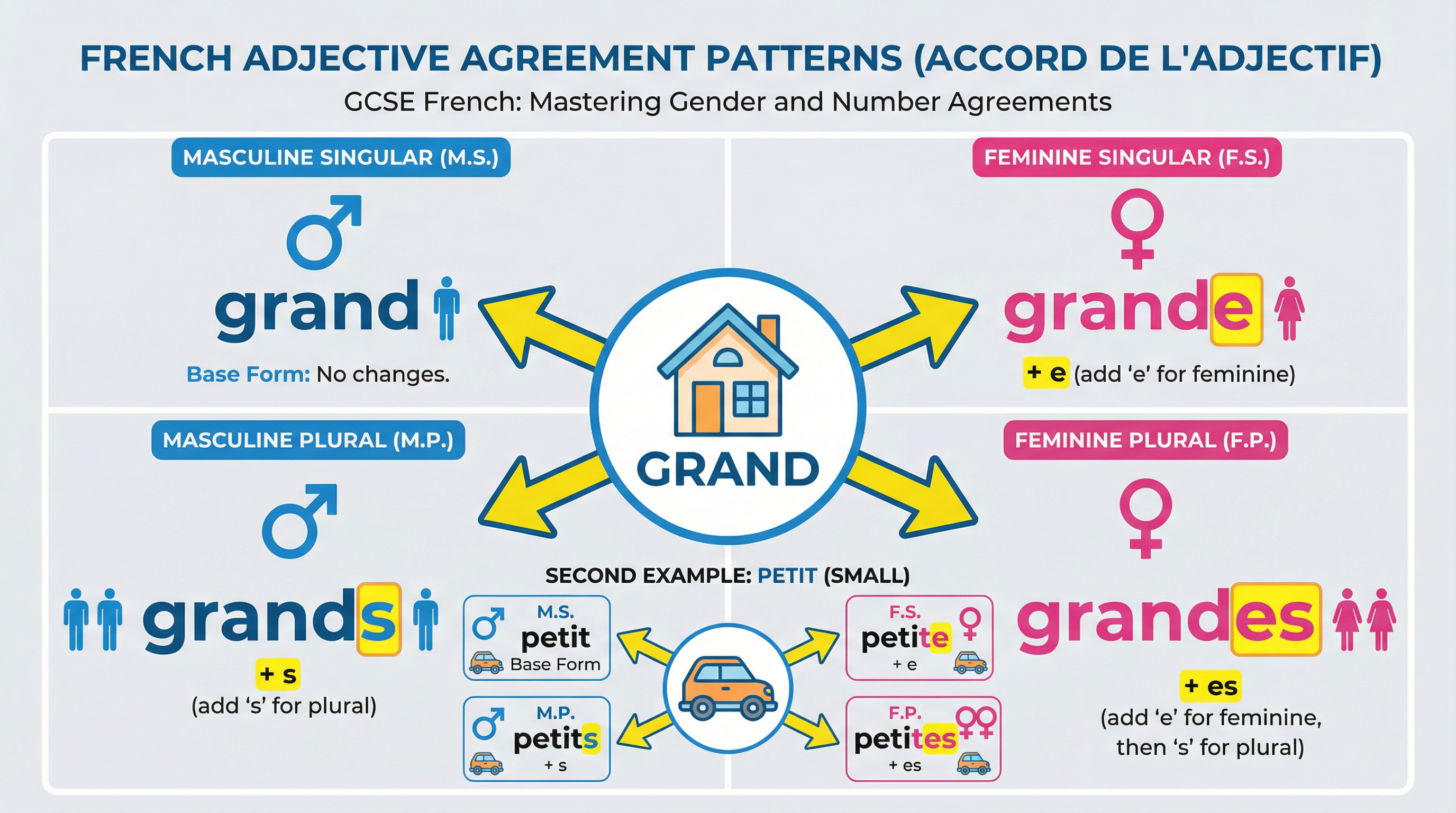
    French Adjective Agreement Patterns

    2. Adjectival Positioning: After or Before?

    Most adjectives in French are placed after the noun. This is the default position, especially for adjectives of colour, shape, and nationality.

    • Correct: une voiture rouge (a red car)
    • Incorrect: une rouge voiture

    However, a small but very common group of adjectives come before the noun. These can be remembered with the acronym BANGS.
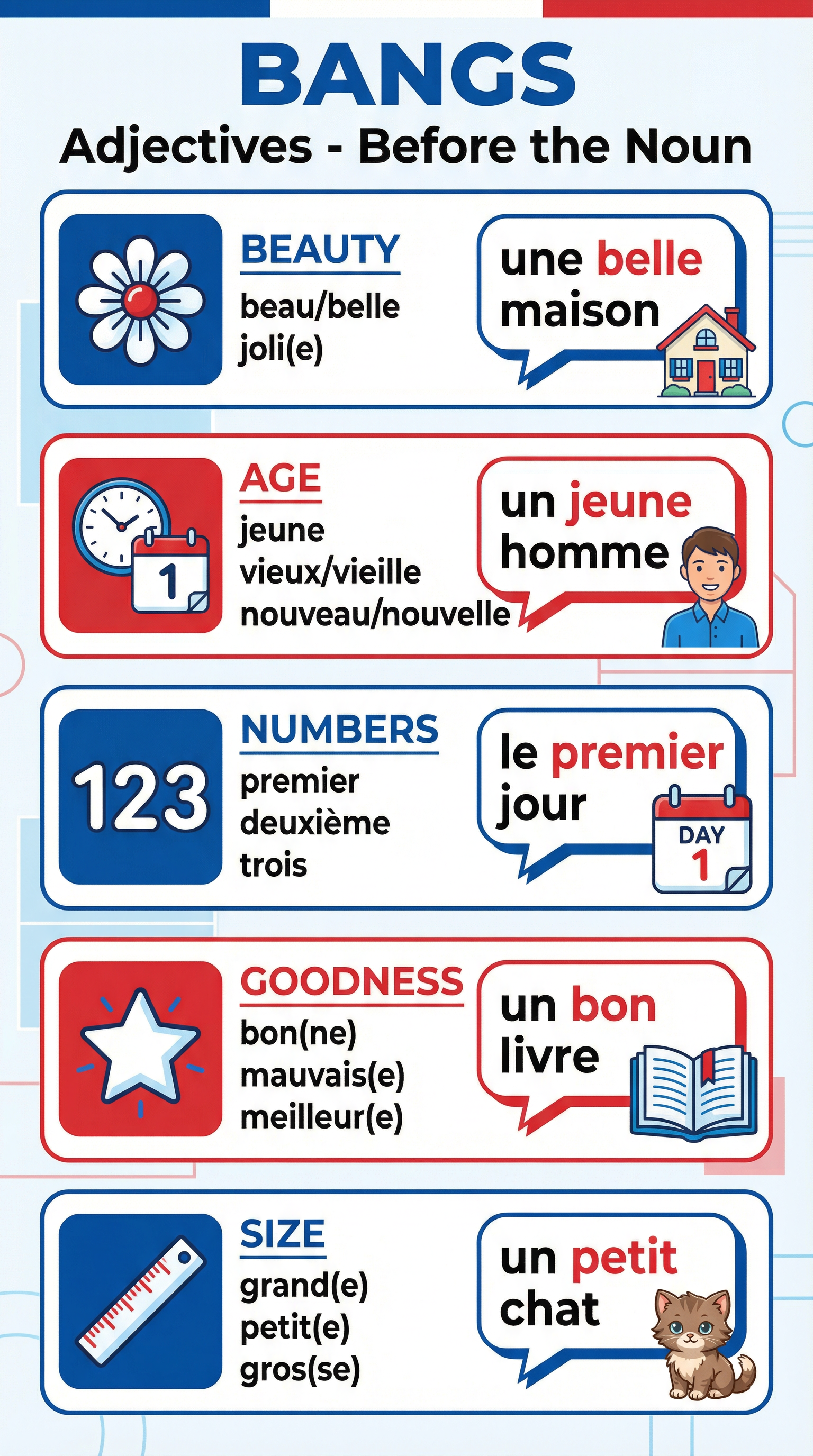
    The BANGS Rule for Adjective Placement

    Key Concepts: Adverbs

    1. Adverb Formation: The -ment Rule

    Adverbs modify verbs, adjectives, or other adverbs to describe how an action is performed. In English, this is often done by adding '-ly' (e.g., slow -> slowly). In French, the equivalent is typically adding -ment.

    The Standard Method: The most common rule is to find the feminine singular form of the adjective and add -ment.

    1. Start with the masculine adjective: lent (slow)
    2. Convert to its feminine form: lente
    3. Add -ment: lentement (slowly)

    Example: Il marche lentement. (He walks slowly.)
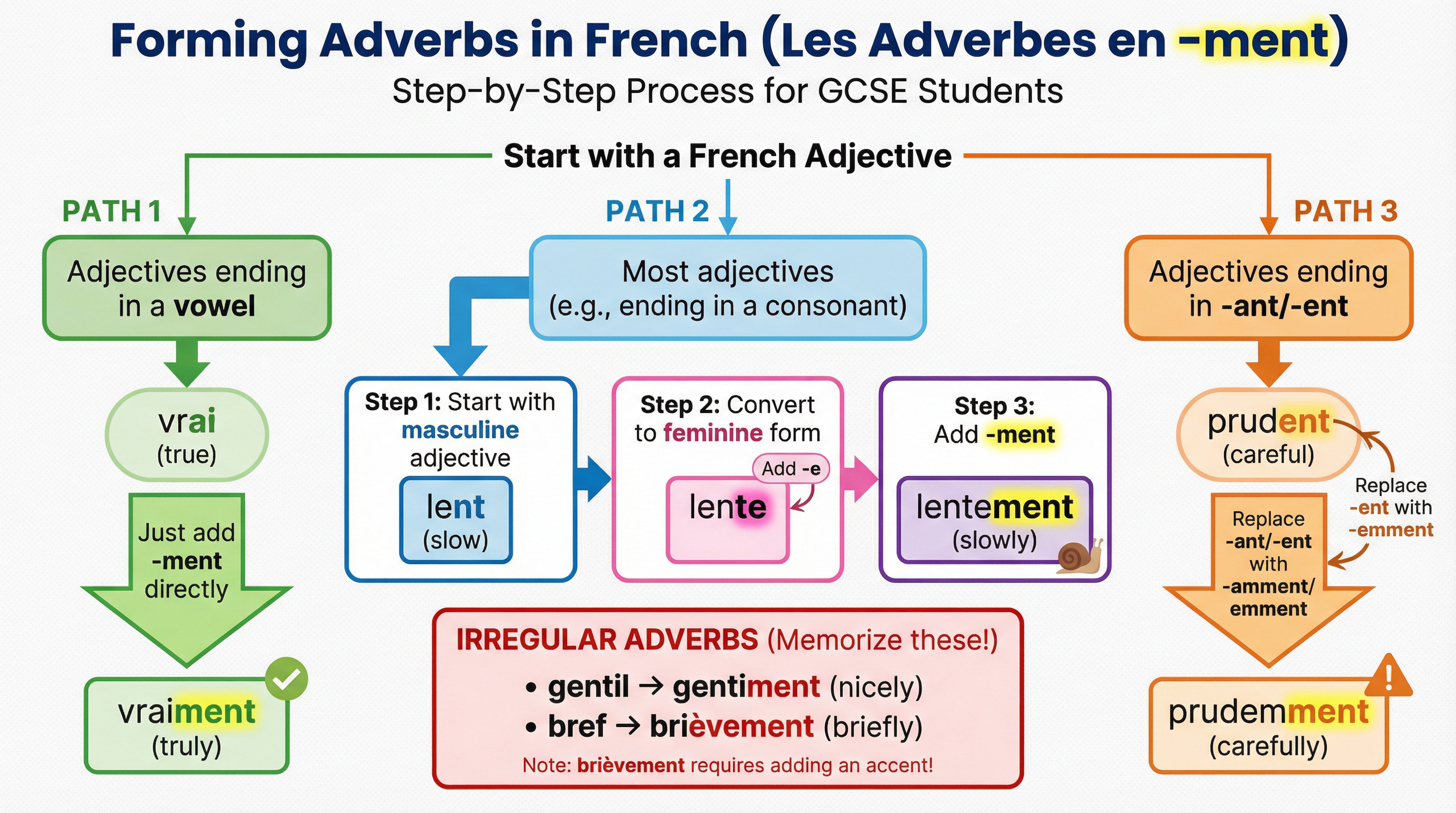
    Forming Adverbs in French

    2. Irregular Adverbs & Exceptions

    As with all rules, there are exceptions that must be memorized. These are frequently tested.

    • Adjectives ending in a vowel: Just add -ment to the masculine form. (e.g., vrai -> vraiment - truly, really)
    • Adjectives ending in -ant or -ent: Replace the ending with -amment or -emment. (e.g., constant -> constamment; prudent -> prudemment). Note that both endings are pronounced the same.
    • Key Irregulars: Some of the most important adverbs are irregular.
      • bon (good) -> bien (well)
      • mauvais (bad) -> mal (badly)
      • gentil (kind) -> gentiment (kindly)

    Worked Examples

    3 detailed examples with solutions and examiner commentary

    Practice Questions

    Test your understanding — click to reveal model answers

    Q1

    Translate into French: 'The old castle has big, dark rooms.'

    4 marks
    standard

    Hint: Remember BANGS for 'old' and 'big'. What is the gender of 'château' and 'pièces'?

    Q2

    Rewrite the following sentence using an adverb: 'Leur réponse était immédiate.' (Their response was immediate.)

    2 marks
    standard

    Hint: Change the verb from 'to be' to 'to respond'. How do you form an adverb from an adjective ending in a vowel?

    Q3

    Choose the correct form of the adjective (bon/bien): 'C'est un ___ élève, il travaille ___.'

    2 marks
    standard

    Hint: Which word describes a noun ('élève') and which describes a verb ('travaille')?

    Q4

    Write a short paragraph in French (approx. 30-40 words) describing your ideal holiday. Use at least three different adjectives and one adverb.

    5 marks
    higher

    Hint: Try to use a BANGS adjective and a colour adjective. Use an intensifier like 'très' or 'vraiment'.

    Q5

    Translate into French: 'She speaks French fluently because she is intelligent.'

    3 marks
    higher

    Hint: The adverb for 'fluent' is formed from an '-ent' adjective.

    Key Terms

    Essential vocabulary to know

    More French Study Guides

    View all

    Describing events and experiences

    WJEC
    GCSE

    Master the art of describing events and experiences in WJEC GCSE French. This guide will equip you with the essential grammar, vocabulary, and exam techniques to confidently narrate past events and achieve top marks.

    Prepositions

    AQA
    GCSE

    Mastering French prepositions is a game-changer for your AQA GCSE exam. This guide breaks down the essential rules for using words like 'à', 'de', and 'en' correctly, giving you the tools to boost your grade by demonstrating precision and a wider range of language, which is critical for hitting the top marks in both speaking and writing.

    Global issues

    AQA
    GCSE

    This study guide for AQA GCSE French (Theme 2, Topic 3: Global Issues) provides a comprehensive, exam-focused resource to help students master the vocabulary and grammar needed to discuss environmental and social problems. It is designed to build confidence and secure top marks by focusing on examiner expectations, complex structures, and common pitfalls.

    Conjunctions

    AQA
    GCSE

    Unlock top marks in your AQA GCSE French exams by mastering conjunctions. This guide will transform your writing and speaking from simple to sophisticated, showing you how to use linking words to demonstrate the complexity and range of language that examiners reward.

    Identifying key information

    AQA
    GCSE

    Identifying key information in AQA GCSE French is the foundation skill that determines whether candidates earn marks for precision or lose them through vague responses. This study focuses on extracting specific details from authentic French sources, distinguishing timeframes, recognising negation, and navigating examiner-designed distractors. Mastering this skill unlocks success across 80% of the assessment objectives in Papers 1 and 3.

    Travel and tourism

    AQA
    GCSE

    This study guide for AQA GCSE French focuses on the 'Travel and Tourism' topic, a core component of Theme 2. It is designed to equip candidates with the vocabulary, grammar, and exam techniques required to narrate holidays across three time frames, justify opinions, and secure top marks in writing and speaking assessments.