
Free-time activities — AQA GCSE study guide illustration

    Free-time activities

    AQA
    GCSE
    French

    Master AQA GCSE French Theme 1, Topic 3: Free-time activities. This guide provides a comprehensive breakdown of essential vocabulary, verb conjugations, and exam techniques to help you secure top marks. Move beyond simple statements to constructing complex, justified opinions that will impress examiners.

    5
    Min Read
    3
    Examples
    5
    Questions
    6
    Key Terms
    🎙 Podcast Episode
    Free-time activities
    0:00-0:00

    Study Notes

    Header image for AQA GCSE French: Free-time activities

    Overview

    This study guide focuses on AQA GCSE French Theme 1, Topic 3: Free-time activities (les activités de temps libre). This is a cornerstone of the GCSE course, frequently appearing in all four assessment papers: Listening, Speaking, Reading, and Writing. Mastery of this topic is not merely about vocabulary recall; examiners are looking for candidates who can confidently manipulate verb tenses, use a range of opinion structures, and apply grammatical rules with precision. This guide will equip you with the specific knowledge and skills required to excel, moving from foundational understanding to higher-tier proficiency. We will deconstruct the key vocabulary themes, tackle irregular verb conjugations across three timeframes, and master the often-confusing prepositions associated with sports and hobbies. By the end of this guide, you will be able to discuss your free-time activities in the past, present, and future, justifying your opinions with the sophisticated language that examiners reward.

    Key Concepts & Grammar

    Vocabulary Themes

    To earn full marks, candidates must demonstrate a breadth of vocabulary across several sub-topics. You should aim to learn at least five specific activities for each category.

    1. Music & Cinema (La Musique et le Cinéma)

    • écouter de la musique: to listen to music
    • jouer de la guitare/du piano: to play the guitar/piano
    • aller à un concert: to go to a concert
    • télécharger des chansons: to download songs
    • regarder un film/une série: to watch a film/a series

    2. Sport (Le Sport)

    • jouer au football/au tennis: to play football/tennis
    • faire de la natation: to go swimming
    • faire du vélo: to go cycling
    • faire de l'équitation: to go horse riding
    • aller à la pêche: to go fishing

    3. Food & Socialising (La Nourriture et la Socialisation)

    • manger au restaurant: to eat at a restaurant
    • sortir avec mes amis: to go out with my friends
    • faire les magasins: to go shopping
    • cuisiner: to cook
    • visiter ma famille: to visit my family

    Irregular Verbs: Past, Present & Future

    Manipulating timeframes is a key skill for higher marks. You must master the conjugation of these three irregular verbs.
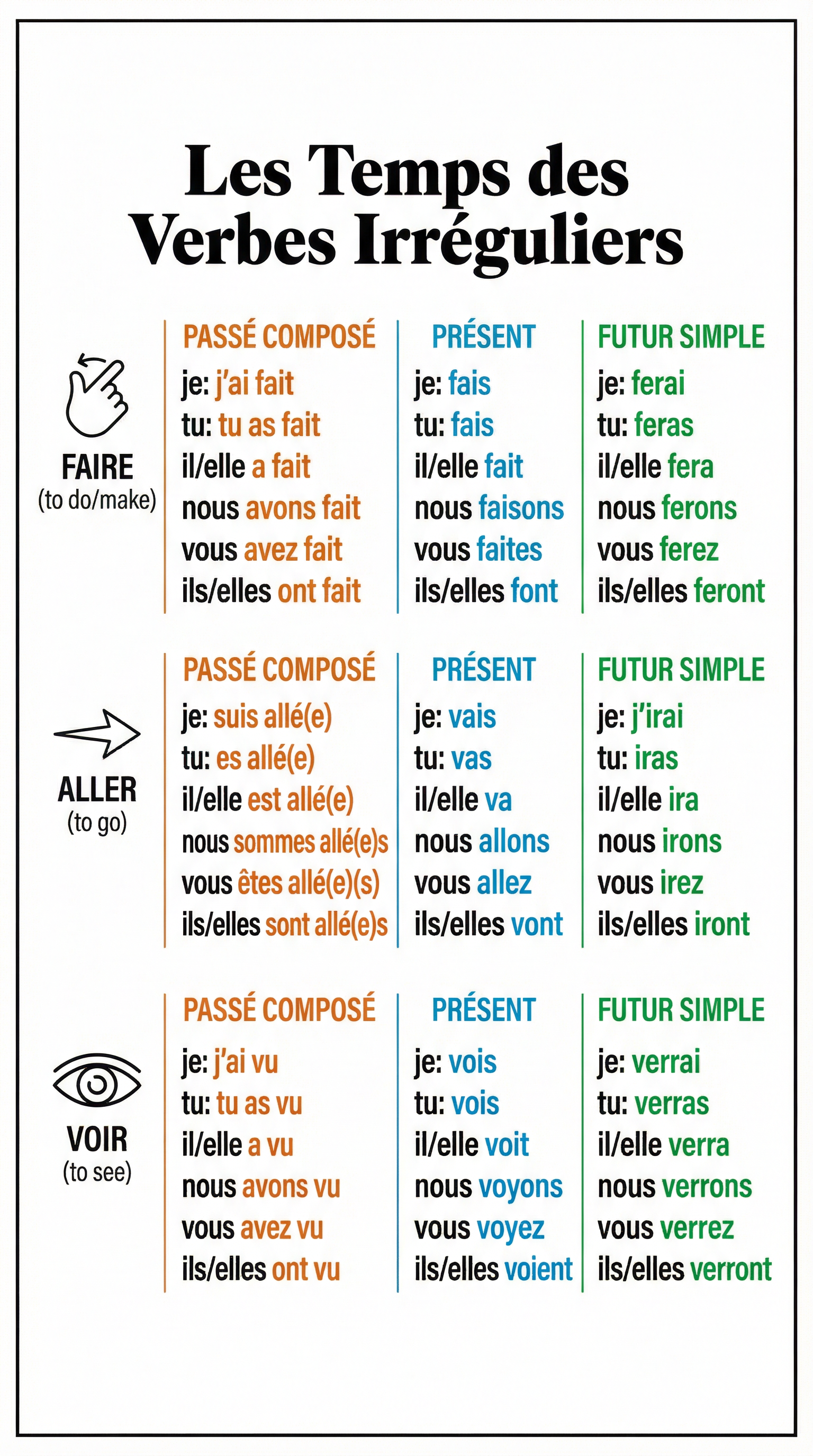
    Irregular Verb Conjugations for Free-Time Activities

    1. FAIRE (to do/make)

    • Présent: je fais, tu fais, il/elle fait, nous faisons, vous faites, ils/elles font
    • Passé Composé: j'ai fait, tu as fait, il/elle a fait, nous avons fait, vous avez fait, ils/elles ont fait
    • Futur Simple: je ferai, tu feras, il/elle fera, nous ferons, vous ferez, ils/elles feront

    2. ALLER (to go)

    • Présent: je vais, tu vas, il/elle va, nous allons, vous allez, ils/elles vont
    • Passé Composé: je suis allé(e), tu es allé(e), il/elle est allé(e), nous sommes allé(e)s, vous êtes allé(e)s, ils/elles sont allé(e)s
    • Futur Simple: j'irai, tu iras, il/elle ira, nous irons, vous irez, ils/elles iront

    3. VOIR (to see)

    • Présent: je vois, tu vois, il/elle voit, nous voyons, vous voyez, ils/elles voient
    • Passé Composé: j'ai vu, tu as vu, il/elle a vu, nous avons vu, vous avez vu, ils/elles ont vu
    • Futur Simple: je verrai, tu verras, il/elle verra, nous verrons, vous verrez, ils/elles verront

    Prepositional Phrases: Jouer à vs. Jouer de vs. Faire de

    A common area for mistakes. Credit is given for correct application.
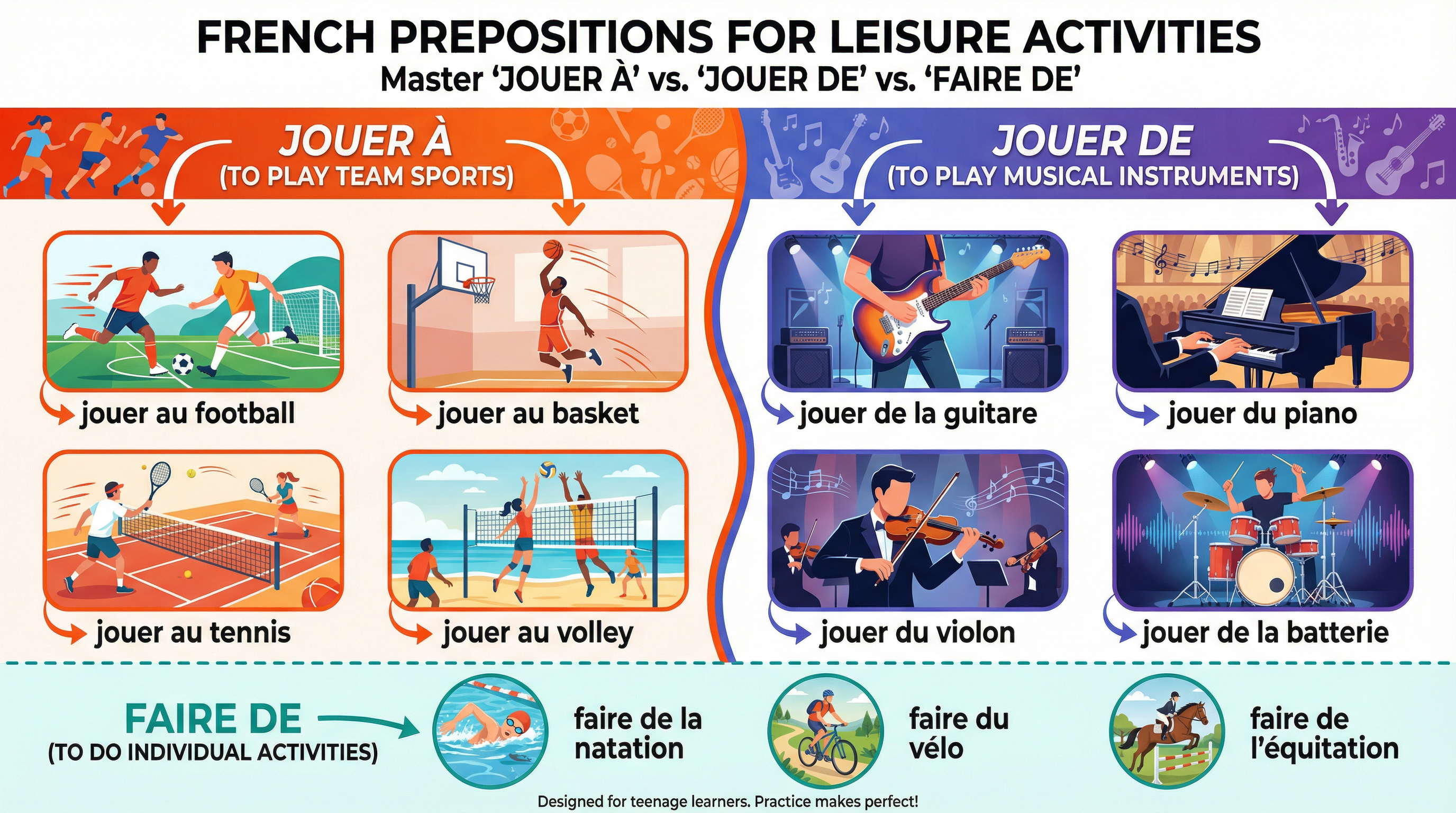
    Mastering Prepositions for Leisure Activities

    • JOUER + À + [team sport]: Used for team sports and games.
      • Je joue au football. (à + le = au)
      • Je joue à la pétanque.
    • JOUER + DE + [instrument]: Used for musical instruments.
      • Je joue de la guitare.
      • Je joue du piano. (de + le = du)
    • FAIRE + DE + [activity]: Used for many other individual activities and hobbies.
      • Je fais de la natation.
      • Je fais du vélo. (de + le = du)

    Building Complex Opinions

    To access the highest marks, you must justify your opinions with sophisticated connectives.
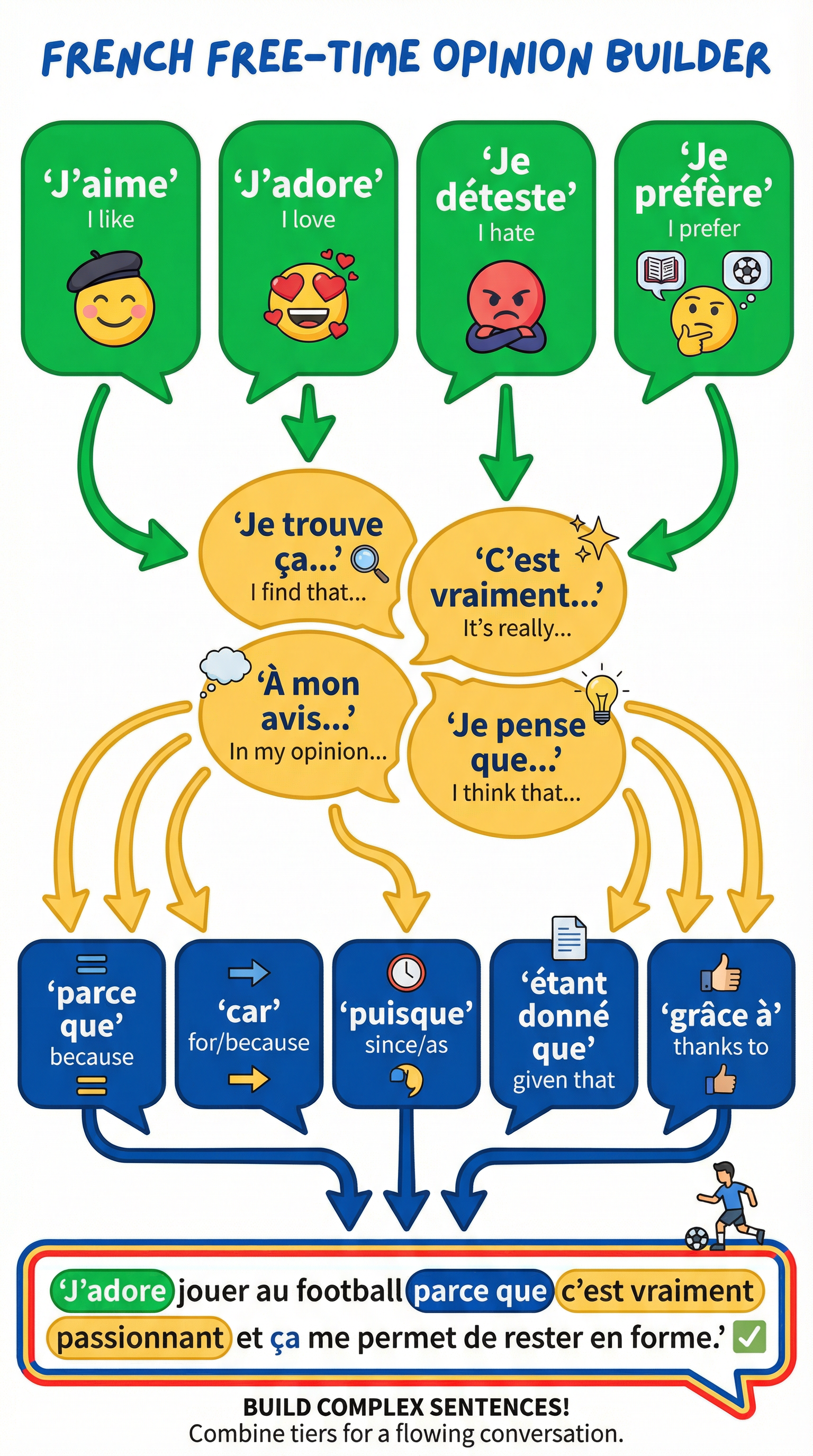
    Building High-Level Opinion Phrases

    Step 1: State your opinion

    • J'aime... / J'adore... / Je déteste... / Je préfère...

    Step 2: Add an intensifier/nuance

    • Je trouve ça... (I find it...)
    • À mon avis... (In my opinion...)
    • C'est vraiment... (It's really...)

    Step 3: Justify with a complex connective

    • parce que/car: because
    • puisque: since/as
    • étant donné que: given that
    • grâce à: thanks to

    Example High-Level Sentence:
    À mon avis, j'adore faire de l'équitation puisque c'est une activité passionnante qui me permet d'être en plein air. (In my opinion, I love horse riding since it's an exciting activity that allows me to be outdoors.)

    Worked Examples

    3 detailed examples with solutions and examiner commentary

    Practice Questions

    Test your understanding — click to reveal model answers

    Q1

    Tu préfères le cinéma ou la télévision? Pourquoi?

    9 marks
    standard

    Hint: Give your preference, justify it, and try to use both past and future tenses in your answer.

    Q2

    Quels sont les avantages de faire du sport?

    9 marks
    standard

    Hint: Think about physical and mental health benefits. Use a range of vocabulary and connectives.

    Q3

    Parle-moi d'un film que tu as vu récemment.

    9 marks
    standard

    Hint: Describe the film, say when you saw it, who you saw it with, and what you thought of it.

    Q4

    Que feras-tu le week-end prochain?

    9 marks
    standard

    Hint: Use the futur simple tense. Try to include more than one activity and give details.

    Q5

    Quand tu étais petit(e), quels étaient tes passe-temps?

    9 marks
    higher

    Hint: Use the imperfect tense (l'imparfait) to describe what you used to do.

    Key Terms

    Essential vocabulary to know

    More French Study Guides

    View all

    Describing events and experiences

    WJEC
    GCSE

    Master the art of describing events and experiences in WJEC GCSE French. This guide will equip you with the essential grammar, vocabulary, and exam techniques to confidently narrate past events and achieve top marks.

    Prepositions

    AQA
    GCSE

    Mastering French prepositions is a game-changer for your AQA GCSE exam. This guide breaks down the essential rules for using words like 'à', 'de', and 'en' correctly, giving you the tools to boost your grade by demonstrating precision and a wider range of language, which is critical for hitting the top marks in both speaking and writing.

    Global issues

    AQA
    GCSE

    This study guide for AQA GCSE French (Theme 2, Topic 3: Global Issues) provides a comprehensive, exam-focused resource to help students master the vocabulary and grammar needed to discuss environmental and social problems. It is designed to build confidence and secure top marks by focusing on examiner expectations, complex structures, and common pitfalls.

    Conjunctions

    AQA
    GCSE

    Unlock top marks in your AQA GCSE French exams by mastering conjunctions. This guide will transform your writing and speaking from simple to sophisticated, showing you how to use linking words to demonstrate the complexity and range of language that examiners reward.

    Identifying key information

    AQA
    GCSE

    Identifying key information in AQA GCSE French is the foundation skill that determines whether candidates earn marks for precision or lose them through vague responses. This study focuses on extracting specific details from authentic French sources, distinguishing timeframes, recognising negation, and navigating examiner-designed distractors. Mastering this skill unlocks success across 80% of the assessment objectives in Papers 1 and 3.

    Travel and tourism

    AQA
    GCSE

    This study guide for AQA GCSE French focuses on the 'Travel and Tourism' topic, a core component of Theme 2. It is designed to equip candidates with the vocabulary, grammar, and exam techniques required to narrate holidays across three time frames, justify opinions, and secure top marks in writing and speaking assessments.