Using a range of vocabulary — AQA GCSE study guide illustration

    Using a range of vocabulary

    AQA
    GCSE
    French

    This study guide focuses on a crucial skill for AQA GCSE French: using a wide range of vocabulary. Mastering this is essential for accessing the top marks in both the writing and speaking exams, as it accounts for 35% of the assessment objective for language. This guide will equip you with the tools to move beyond basic words and impress the examiners.

    5
    Min Read
    3
    Examples
    5
    Questions
    6
    Key Terms
    🎙 Podcast Episode
    Using a range of vocabulary
    0:00-0:00

    Study Notes

    Boost your vocabulary for exam success.

    Overview

    This guide provides a deep dive into the AQA GCSE French assessment objective focused on vocabulary range. Examiners are trained to reward candidates who can demonstrate a broad and sophisticated lexicon, moving beyond high-frequency words to employ more nuanced and topic-specific language. This is not simply about knowing more words; it is about using them accurately and appropriately to convey meaning with precision. A significant portion of marks in both Paper 4 (Writing) and Paper 2 (Speaking) are awarded for this skill. This guide will break down what constitutes a 'range of vocabulary' in the eyes of an examiner, from using synonyms and intensifiers to deploying complex grammatical structures and manipulating time frames effectively. By the end of this guide, you will have a clear roadmap for elevating your language and securing higher marks.

    Listen to our expert guide on mastering vocabulary.

    Key Concepts for Vocabulary Range

    The Vocabulary Pyramid

    Think of your vocabulary as a pyramid. To achieve top marks, you need to build from a solid base to a sophisticated peak.
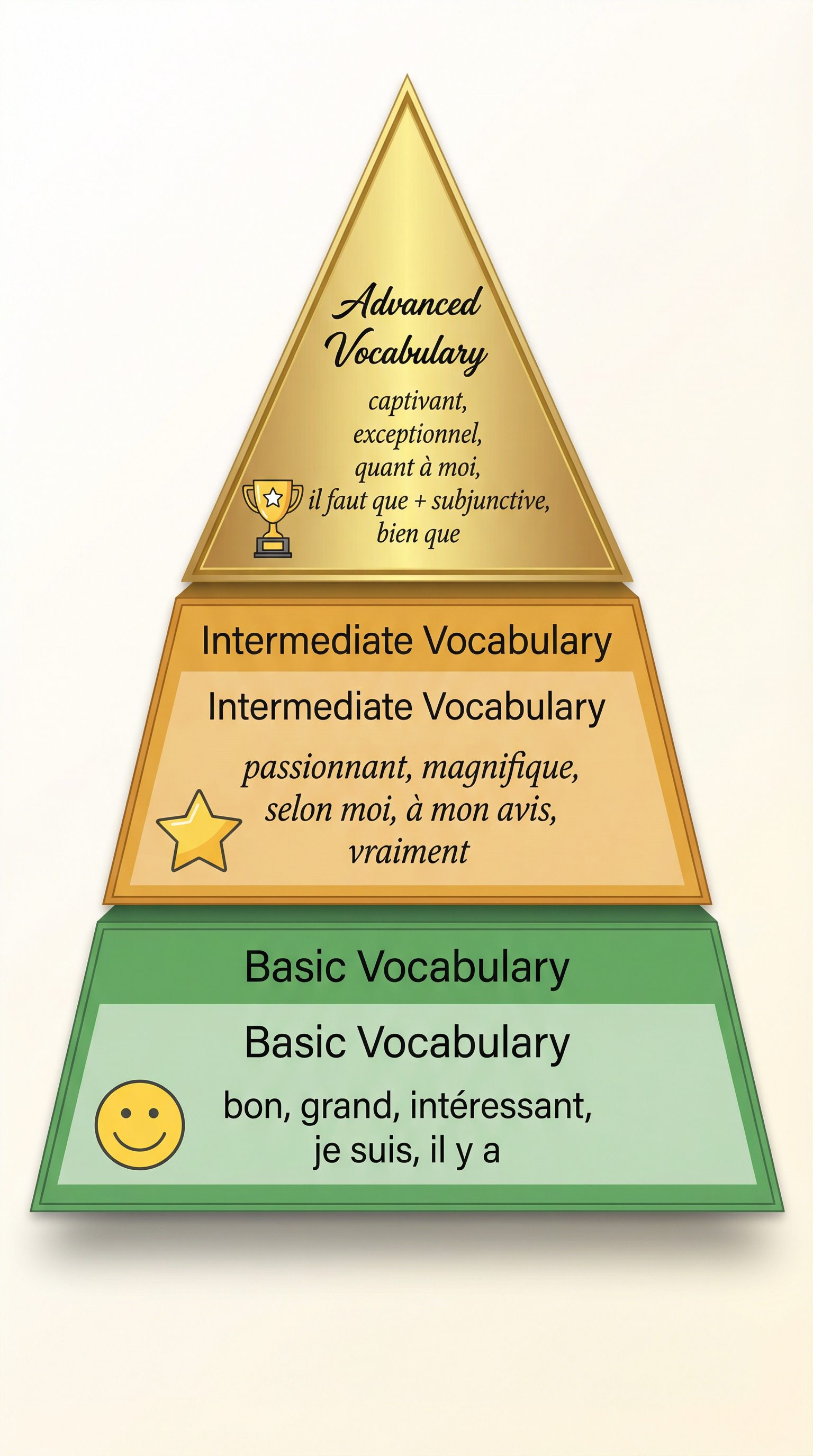
    The Vocabulary Pyramid: Aim for the top!

    • Base Tier (Basic Vocabulary): These are the high-frequency words you learn first (e.g., bon, grand, intéressant, je suis, il y a). While essential, relying solely on these will limit your marks.
    • Middle Tier (Intermediate Vocabulary): This is where you start to show more variety. It includes better adjectives, opinion phrases, and intensifiers (e.g., passionnant, magnifique, selon moi, vraiment).
    • Top Tier (Advanced Vocabulary): This is the goal. It involves using sophisticated synonyms, idiomatic expressions, and complex grammatical structures that demonstrate a high level of linguistic competence (e.g., captivant, exceptionnel, quant à moi, il faut que + subjunctive).

    Manipulating Time Frames

    Examiners explicitly reward candidates who can successfully and accurately use a variety of tenses. In a single response, you should aim to seamlessly integrate the past, present, and future.
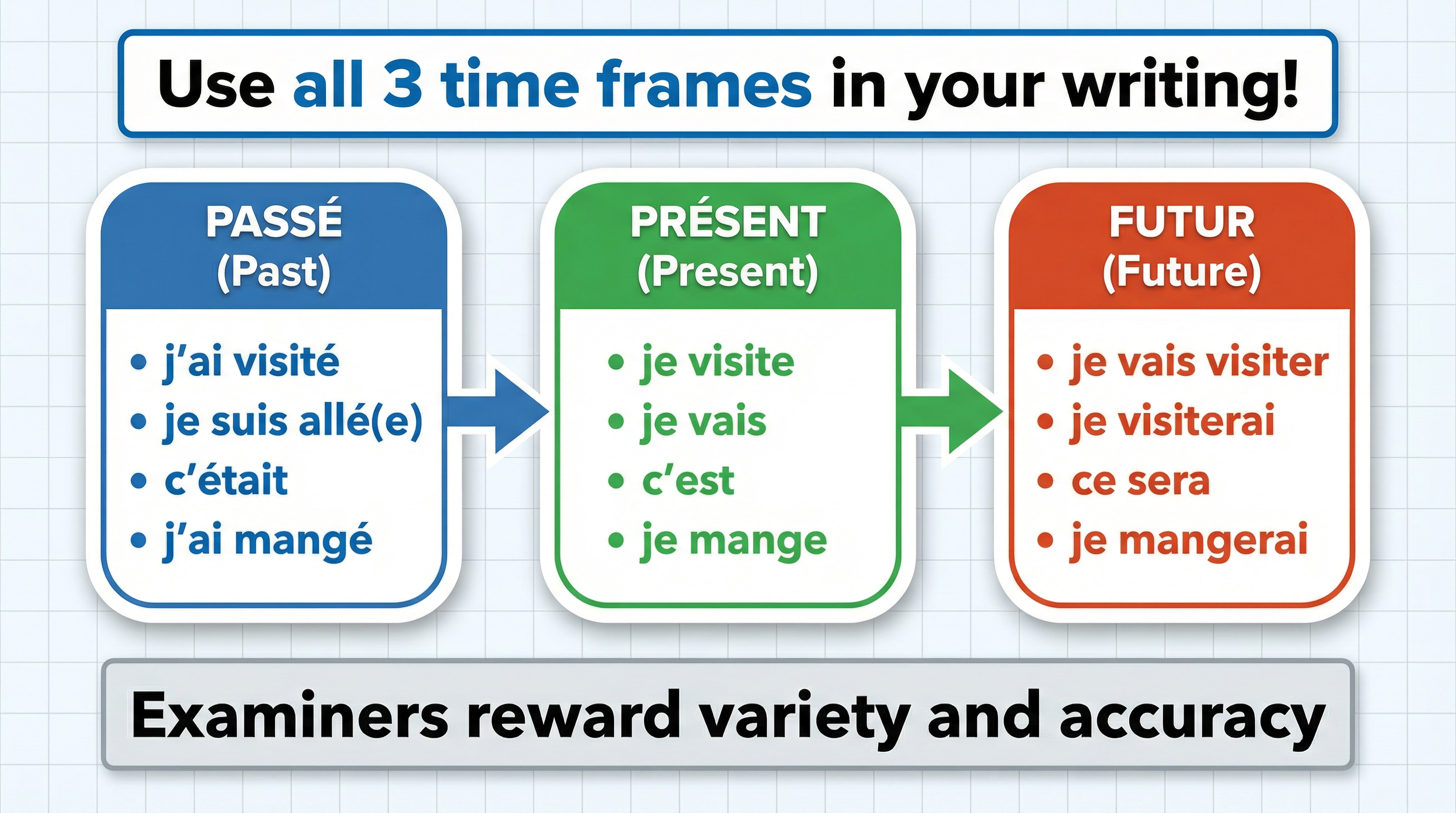
    Use all three time frames to demonstrate linguistic control.

    • Past: Use the perfect tense (passé composé) for specific past actions (e.g., j'ai visité, je suis allé(e)) and the imperfect tense (imparfait) for descriptions and habitual actions in the past (e.g., c'était, je jouais).
    • Present: Use the present tense for facts, current actions, and regular habits (e.g., je visite, c'est).
    • Future: Use the near future (futur proche) for immediate plans (e.g., je vais visiter) and the simple future (futur simple) for more distant or certain future events (e.g., je visiterai).

    Complex Structures

    Integrating complex structures is a direct way to signal to the examiner that you are a higher-tier candidate. These constructions show that you can manipulate language beyond simple sentences.
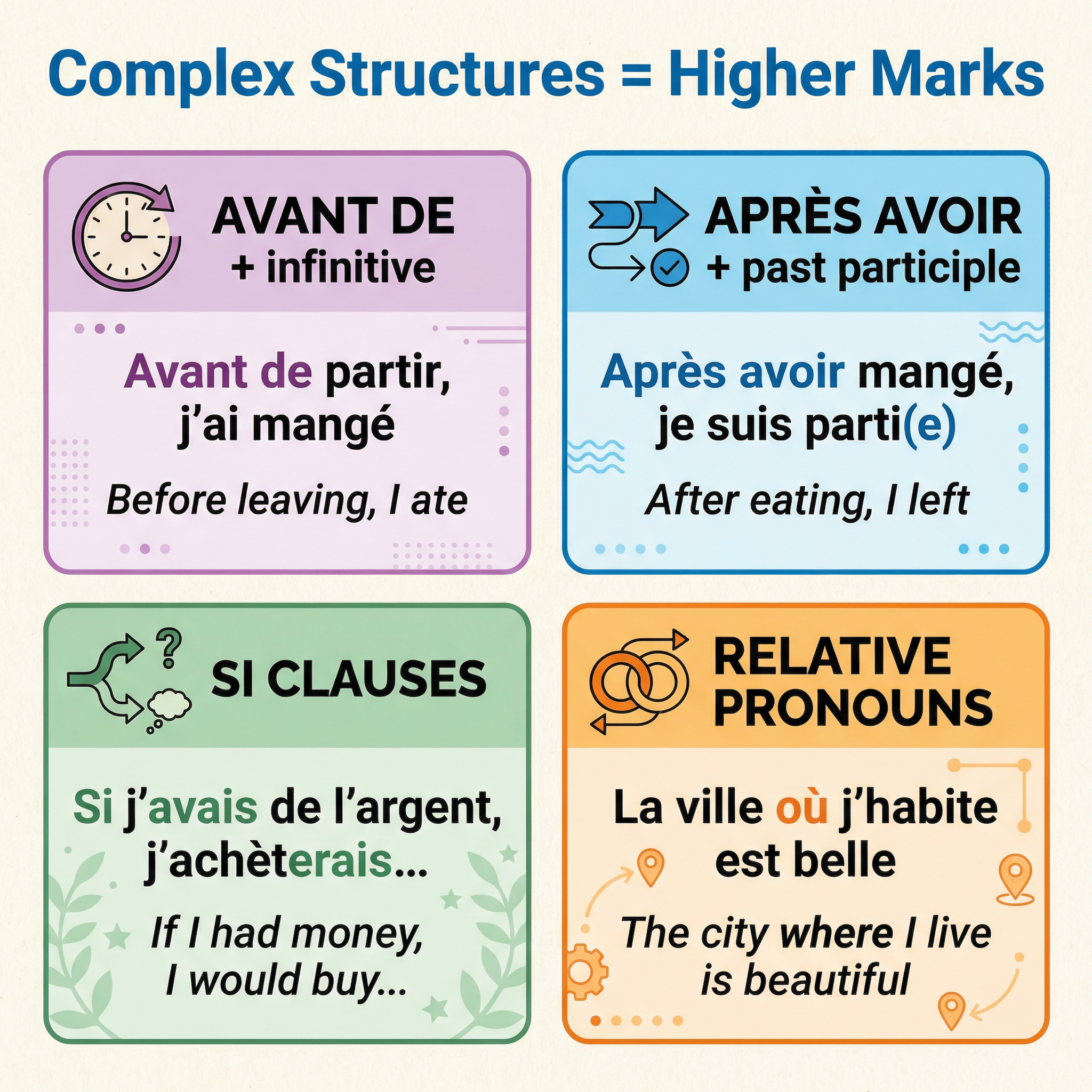
    Incorporate these complex structures to impress examiners.

    • 'Avant de' + Infinitive: Used to say 'before doing something'. Example: Avant de sortir, je dois finir mes devoirs. (Before going out, I have to finish my homework.)
    • 'Après avoir/être' + Past Participle: Used to say 'after having done something'. Example: Après avoir mangé, nous sommes allés au cinéma. (After having eaten, we went to the cinema.)
    • Si Clauses (Conditionals): Show your ability to discuss hypothetical situations. Example: Si j'avais plus d'argent, j'achèterais une nouvelle voiture. (If I had more money, I would buy a new car.)
    • Relative Pronouns (qui, que, où, dont): Used to connect clauses and create more fluid, complex sentences. Example: J'adore la ville où j'habite. (I love the town where I live.)
    • The Subjunctive: (Higher Tier) Essential for expressing opinions, doubts, and necessities. Triggered by phrases like il faut que, bien que, pour que. Example: Il faut que je fasse mes devoirs. (I must do my homework.)

    Worked Examples

    3 detailed examples with solutions and examiner commentary

    Practice Questions

    Test your understanding — click to reveal model answers

    Q1

    Décris tes dernières vacances. Qu'est-ce que tu as fait? (90 mots)

    16 marks
    standard

    Hint: Remember to use past tenses (perfect and imperfect) and give at least two opinions with justifications.

    Q2

    Tu organises une fête pour ton ami(e). Écris un email à un(e) autre ami(e) pour l'inviter. (90 mots)

    16 marks
    standard

    Hint: Make sure you cover all four bullet points in the prompt (who the party is for, date/time, what to bring, why they should come). Use the future tense for plans.

    Q3

    Penses-tu qu'il est important de protéger l'environnement? Pourquoi/pourquoi pas? (150 mots)

    20 marks
    higher

    Hint: Structure your answer with an introduction, a paragraph with your main arguments, and a conclusion. Use subjunctive phrases like 'il est essentiel que' or 'il faut que'.

    Q4

    Comment était ta ville dans le passé?

    10 marks
    standard

    Hint: Use the imperfect tense to describe how things used to be.

    Q5

    Que feras-tu après tes examens GCSE?

    10 marks
    standard

    Hint: Use the simple future or near future tense to talk about your plans. Try to include a 'si' clause.

    Key Terms

    Essential vocabulary to know

    More French Study Guides

    View all

    Describing events and experiences

    WJEC
    GCSE

    Master the art of describing events and experiences in WJEC GCSE French. This guide will equip you with the essential grammar, vocabulary, and exam techniques to confidently narrate past events and achieve top marks.

    Prepositions

    AQA
    GCSE

    Mastering French prepositions is a game-changer for your AQA GCSE exam. This guide breaks down the essential rules for using words like 'à', 'de', and 'en' correctly, giving you the tools to boost your grade by demonstrating precision and a wider range of language, which is critical for hitting the top marks in both speaking and writing.

    Global issues

    AQA
    GCSE

    This study guide for AQA GCSE French (Theme 2, Topic 3: Global Issues) provides a comprehensive, exam-focused resource to help students master the vocabulary and grammar needed to discuss environmental and social problems. It is designed to build confidence and secure top marks by focusing on examiner expectations, complex structures, and common pitfalls.

    Conjunctions

    AQA
    GCSE

    Unlock top marks in your AQA GCSE French exams by mastering conjunctions. This guide will transform your writing and speaking from simple to sophisticated, showing you how to use linking words to demonstrate the complexity and range of language that examiners reward.

    Identifying key information

    AQA
    GCSE

    Identifying key information in AQA GCSE French is the foundation skill that determines whether candidates earn marks for precision or lose them through vague responses. This study focuses on extracting specific details from authentic French sources, distinguishing timeframes, recognising negation, and navigating examiner-designed distractors. Mastering this skill unlocks success across 80% of the assessment objectives in Papers 1 and 3.

    Travel and tourism

    AQA
    GCSE

    This study guide for AQA GCSE French focuses on the 'Travel and Tourism' topic, a core component of Theme 2. It is designed to equip candidates with the vocabulary, grammar, and exam techniques required to narrate holidays across three time frames, justify opinions, and secure top marks in writing and speaking assessments.