Pearson Edexcel · GCSE · French
Bringing the world together
Master the 'Bringing the World Together' topic for your GCSE French exam. This guide covers essential vocabulary, grammar, and exam techniques to help you discuss global issues, travel, and international cooperation while picking up top marks.
- 4 min read
- 3 worked examples
- 5 practice questions
- 6 key terms
Study Notes
Overview
The theme 'Bringing the world together' (Rassembler le monde) is a core part of the 'My personal world' thematic context in the GCSE French specification. It requires candidates to demonstrate their ability to communicate about international travel, global issues, the environment, and cultural exchange. Examiners expect you to move beyond simple descriptions and show linguistic range by using varied vocabulary, complex structures, and multiple tenses.
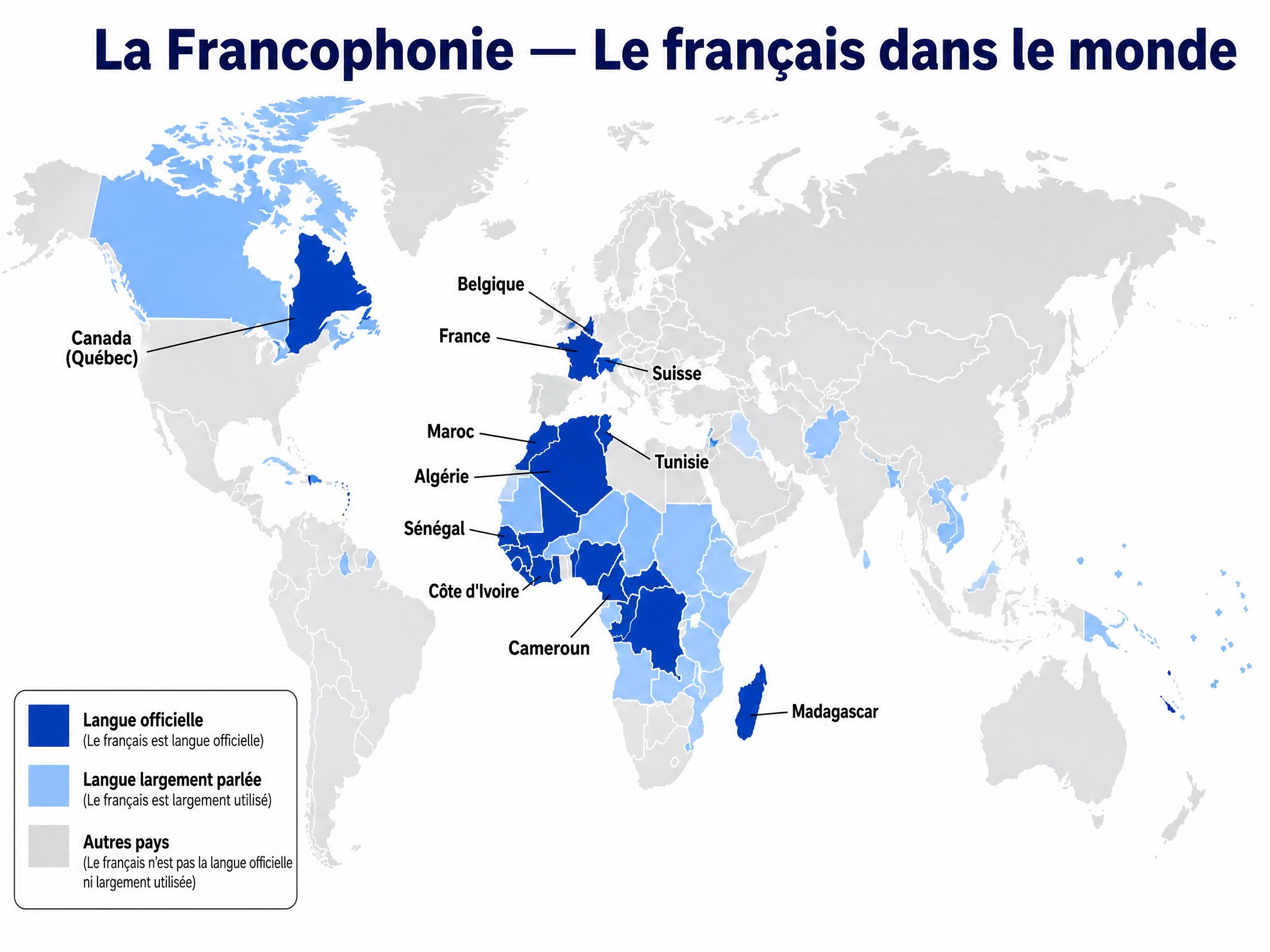
This topic is heavily assessed across all four skills: Listening, Speaking, Reading, and Writing. To achieve the highest grades, candidates must show they can give and justify opinions on global topics, refer to past experiences (like travel), and discuss future plans or hypothetical situations (like volunteering abroad). Understanding the cultural context of La Francophonie (the French-speaking world) is also highly rewarded.
Key Vocabulary Themes
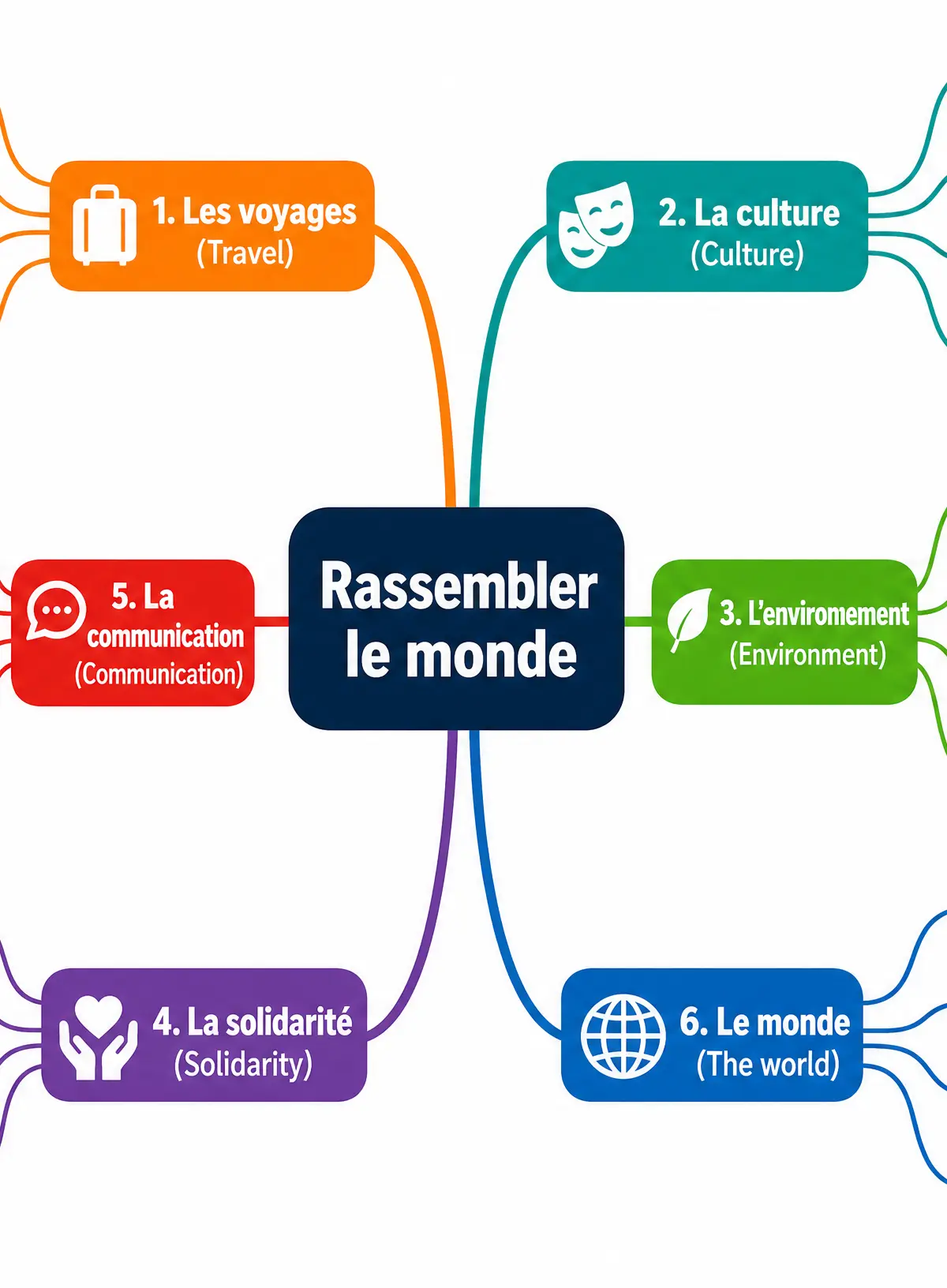
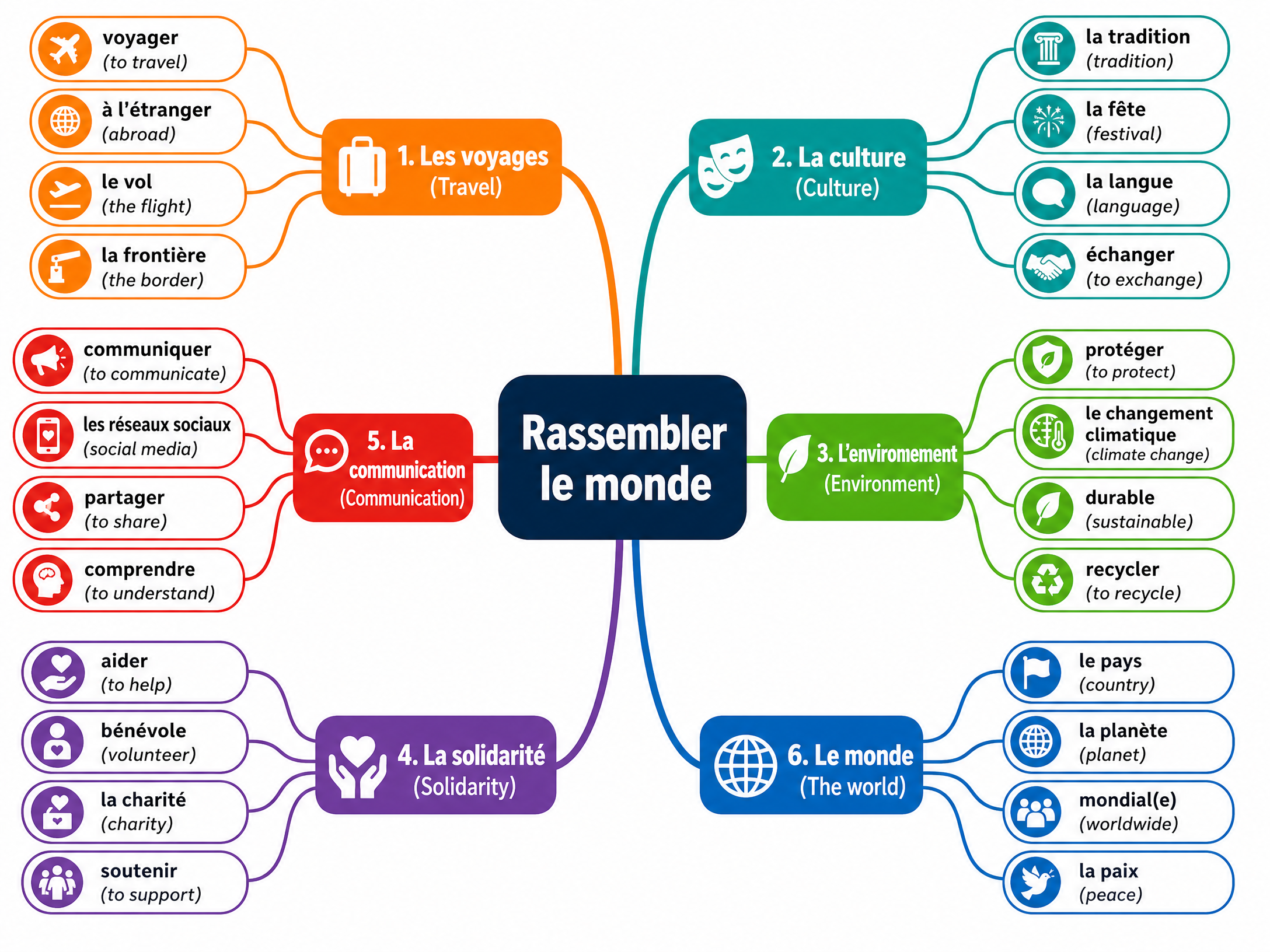
To succeed in this topic, candidates must confidently use vocabulary from the prescribed list across several sub-themes:
1. Les voyages (Travel)
Examiners look for accurate descriptions of journeys, holidays, and experiences abroad. Key terms include:
- voyager (to travel)
- à l'étranger (abroad)
- le vol (the flight)
- la frontière (the border)
- le passeport (the passport)
2. La culture et La Francophonie (Culture and the French-speaking world)
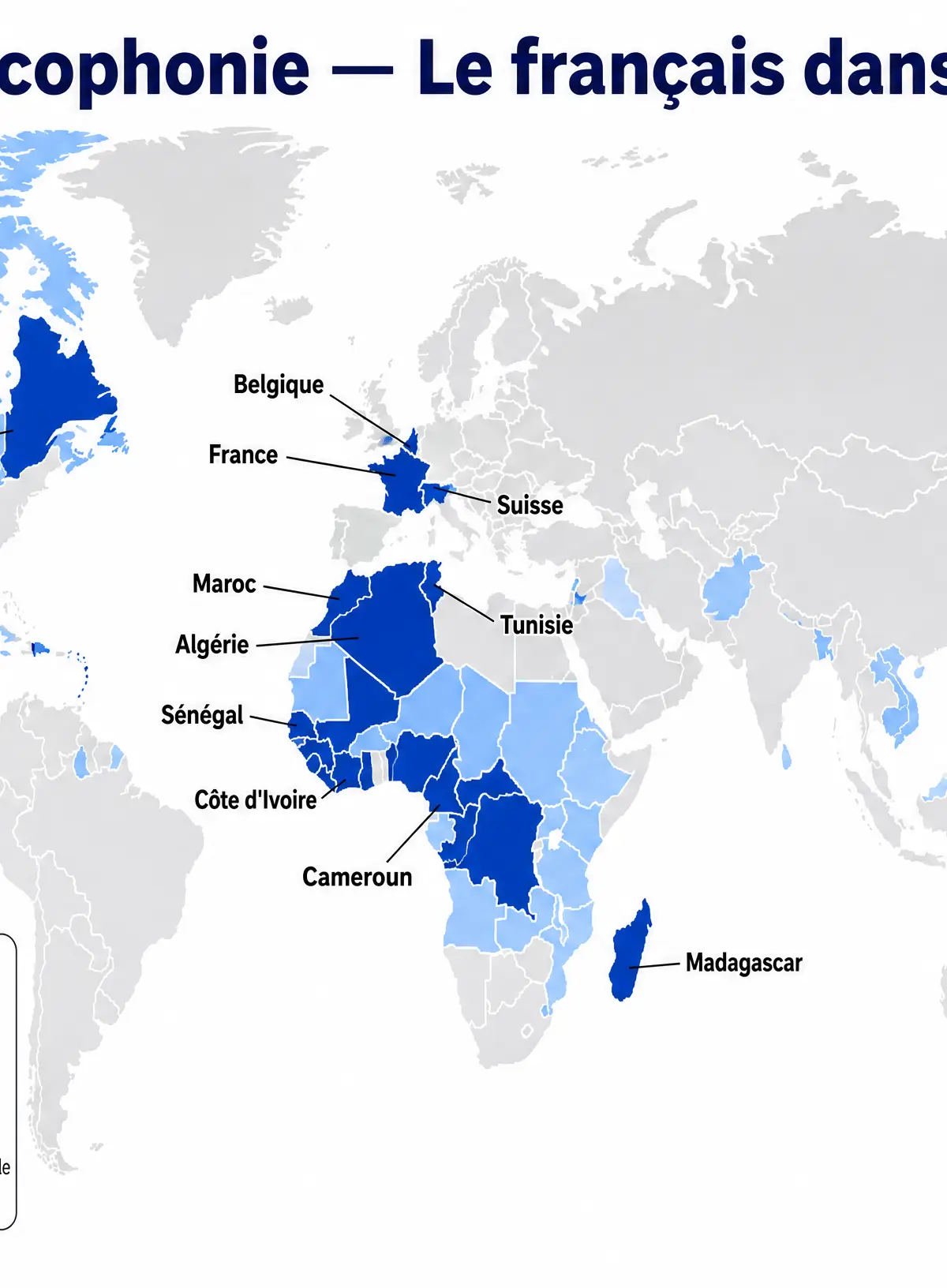
Candidates should demonstrate awareness that French is a global language. Key terms:
- la tradition (tradition)
- la fête (festival/celebration)
- la langue (language)
- échanger (to exchange)
3. L'environnement (The Environment)
Discussing global challenges is a common exam requirement. Key terms:
- protéger (to protect)
- le changement climatique (climate change)
- durable (sustainable)
- recycler (to recycle)
4. La solidarité (Solidarity & Volunteering)
Expressing a desire to help others allows for excellent use of the conditional tense. Key terms:
- aider (to help)
- bénévole (volunteer)
- la charité (charity)
- soutenir (to support)
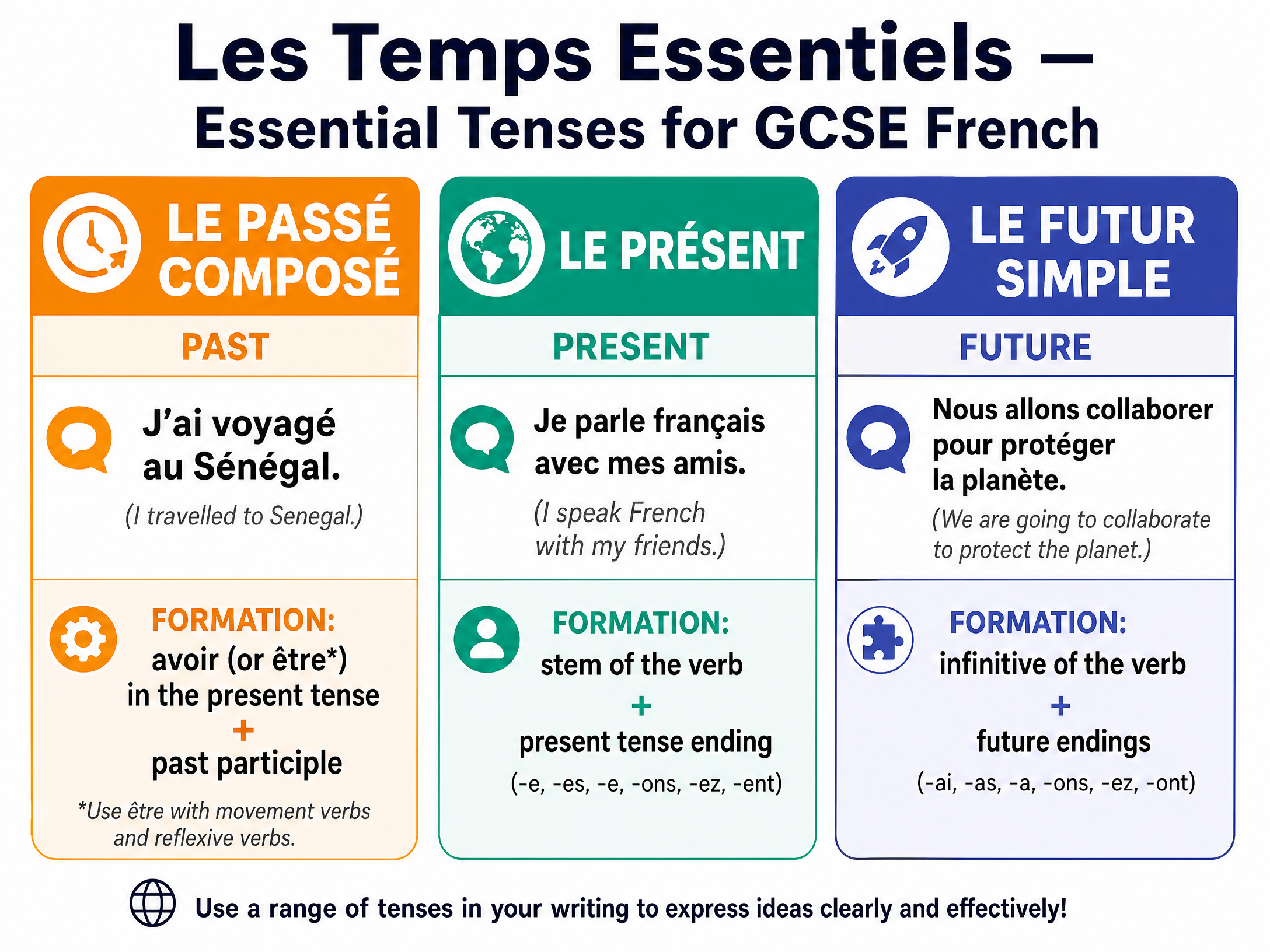
Essential Grammar: The Three Time Frames
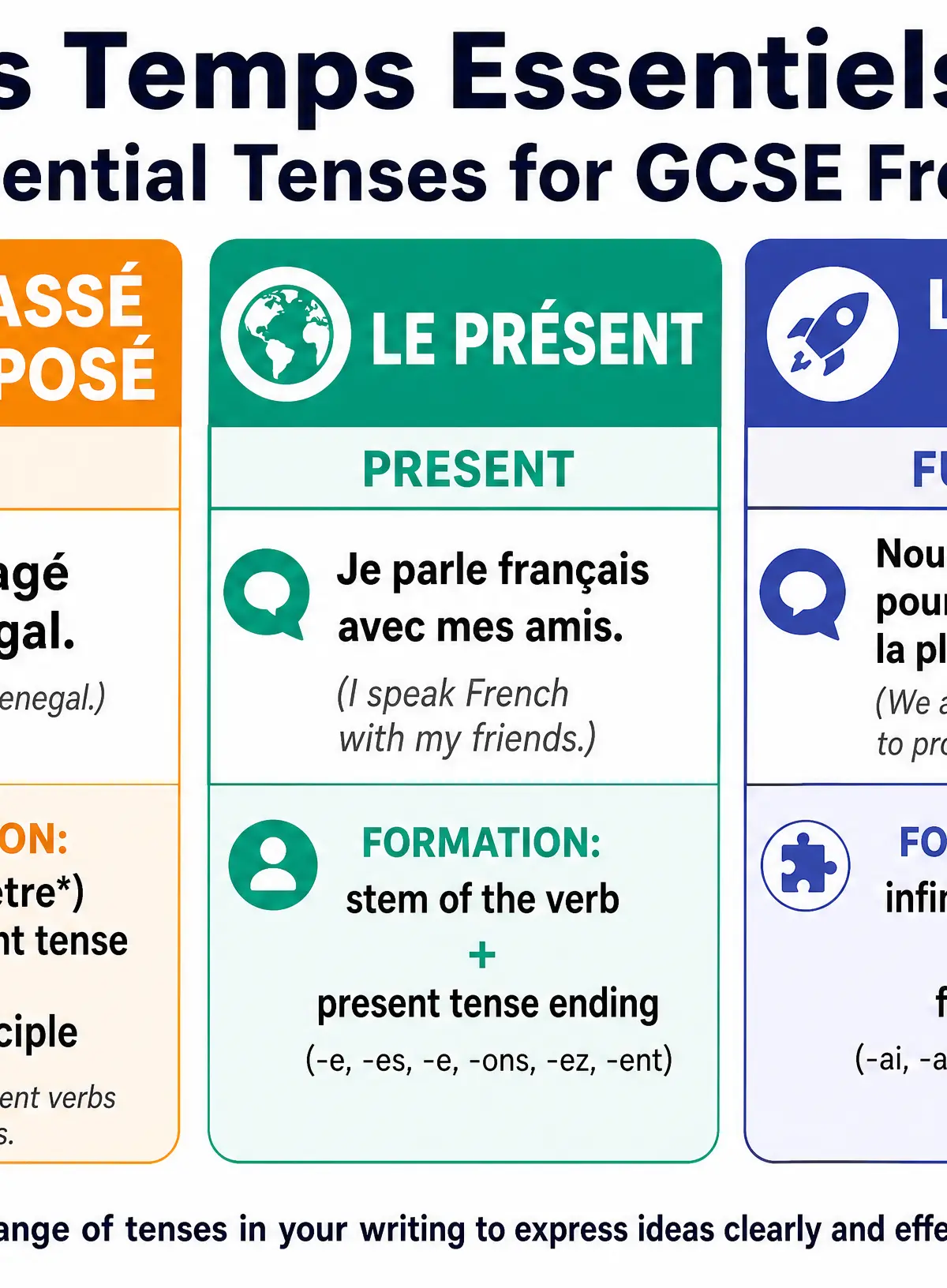
To access the higher mark bands in Writing and Speaking, candidates must refer to past, present, and future events successfully.
Le Passé Composé (Past)
Used for completed actions, such as describing a past trip or event.
- Formation: Present tense of avoir (or être for movement/reflexive verbs) + past participle.
- Example: L'année dernière, j'ai voyagé au Sénégal avec mon école. (Last year, I travelled to Senegal with my school.)
Le Présent (Present)
Used for current facts, routines, and general opinions.
- Formation: Verb stem + present tense endings.
- Example: Je pense qu'il est important de parler d'autres langues. (I think it is important to speak other languages.)
Le Futur Simple (Future)
Used for future plans and intentions.
- Formation: Infinitive (or irregular stem) + future endings (-ai, -as, -a, -ons, -ez, -ont).
- Example: À l'avenir, je travaillerai comme bénévole en Afrique. (In the future, I will work as a volunteer in Africa.)
Audio Revision: The Podcast
Listen to our comprehensive revision podcast for this topic. It covers pronunciation practice, exam tips, and a quick-fire recall quiz.
Giving and Justifying Opinions
A major assessment objective is the ability to give and justify opinions. Do not rely solely on j'aime or je n'aime pas. Use developed structures:
- À mon avis... (In my opinion...)
- Je crois que... (I believe that...)
- Il me semble que... (It seems to me that...)
Always justify using connectives:
- parce que / car (because)
- cependant / pourtant (however)
- d'un côté... de l'autre (on one hand... on the other)
Visual Resources
3 diagrams and illustrations
Interactive Diagrams
1 interactive diagram to visualise key concepts
Conceptual Flow Outline
Vocabulary Concept Map: Bringing the world together
Worked Examples
3 worked examples — open one to explore the question and available guidance.
Practice Questions
Test your understanding — click to reveal model answers
Writing Task (90 words): Vous écrivez un article sur l'importance d'aider les autres. Mentionnez: 1. Un problème global important. 2. Ce que vous avez fait récemment pour aider. 3. Vos projets de bénévolat à l'avenir.
Hint: Ensure you use the present tense for point 1, the passé composé for point 2, and the futur simple for point 3.
Speaking (Role Play): L'examinateur vous demande: 'Qu'est-ce que tu vas faire l'année prochaine pour aider l'environnement?'
Hint: The question uses 'vas faire' (near future). Your answer must be in the future tense.
Reading Comprehension: Lisez le texte. 'L'été dernier, je suis allée au Québec pour un échange scolaire. C'était génial de découvrir une nouvelle culture. L'année prochaine, ma correspondante canadienne viendra chez moi en Angleterre.' Question: Where did the writer go last year, and what is happening next year?
Hint: Look for the time markers 'L'été dernier' and 'L'année prochaine'.
Writing (Translation into French): 1. I like travelling abroad. 2. Last year I visited Senegal. 3. It is important to protect the planet.
Hint: Watch out for the preposition used with 'Sénégal' (it's masculine).
Speaking (General Conversation): L'examinateur demande: 'Penses-tu qu'il est important d'apprendre des langues étrangères ?'
Hint: Give a developed opinion, justify it, and try to use a complex structure.
Test your understanding of Bringing the world together
Active recall beats re-reading. Take an instant quiz now to test what you’ve learned and lock it into long-term memory.
7 days Premium · Then free forever · No card, no charge