Pearson Edexcel · GCSE · French
Holidays
Master the essential vocabulary, grammar, and exam techniques for the 'Les Vacances' (Holidays) topic in GCSE French. This guide provides high-scoring structures, tense usage, and justified opinions to ensure you achieve top marks across reading, writing, listening, and speaking assessments.
- 5 min read
- 3 worked examples
- 5 practice questions
- 6 key terms
Study Notes
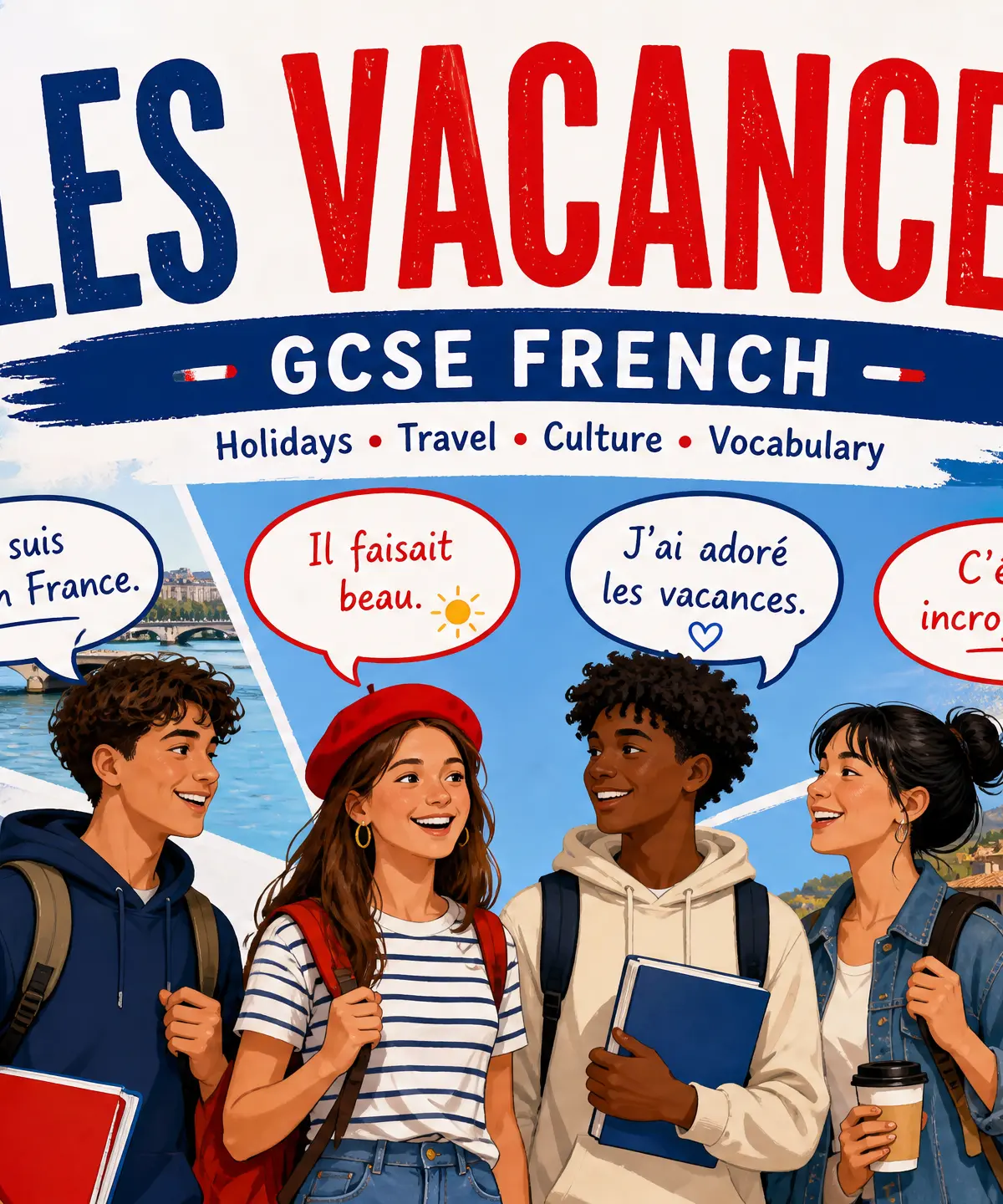
Overview
The topic of 'Les Vacances' (Holidays) is a cornerstone of the GCSE French specification, falling under the broader theme of 'Local, national, international and global areas of interest'. It is universally assessed across all four skills: listening, speaking, reading, and writing. Examiners expect candidates to communicate effectively about past holiday experiences, describe current holiday activities, and outline future travel plans. To access the higher mark bands, you must demonstrate a secure command of three time frames, use a wide range of topic-specific vocabulary, and, crucially, provide and justify your opinions. This guide breaks down the essential knowledge and strategies required to excel in this topic.
Core Vocabulary: Les Mots Essentiels
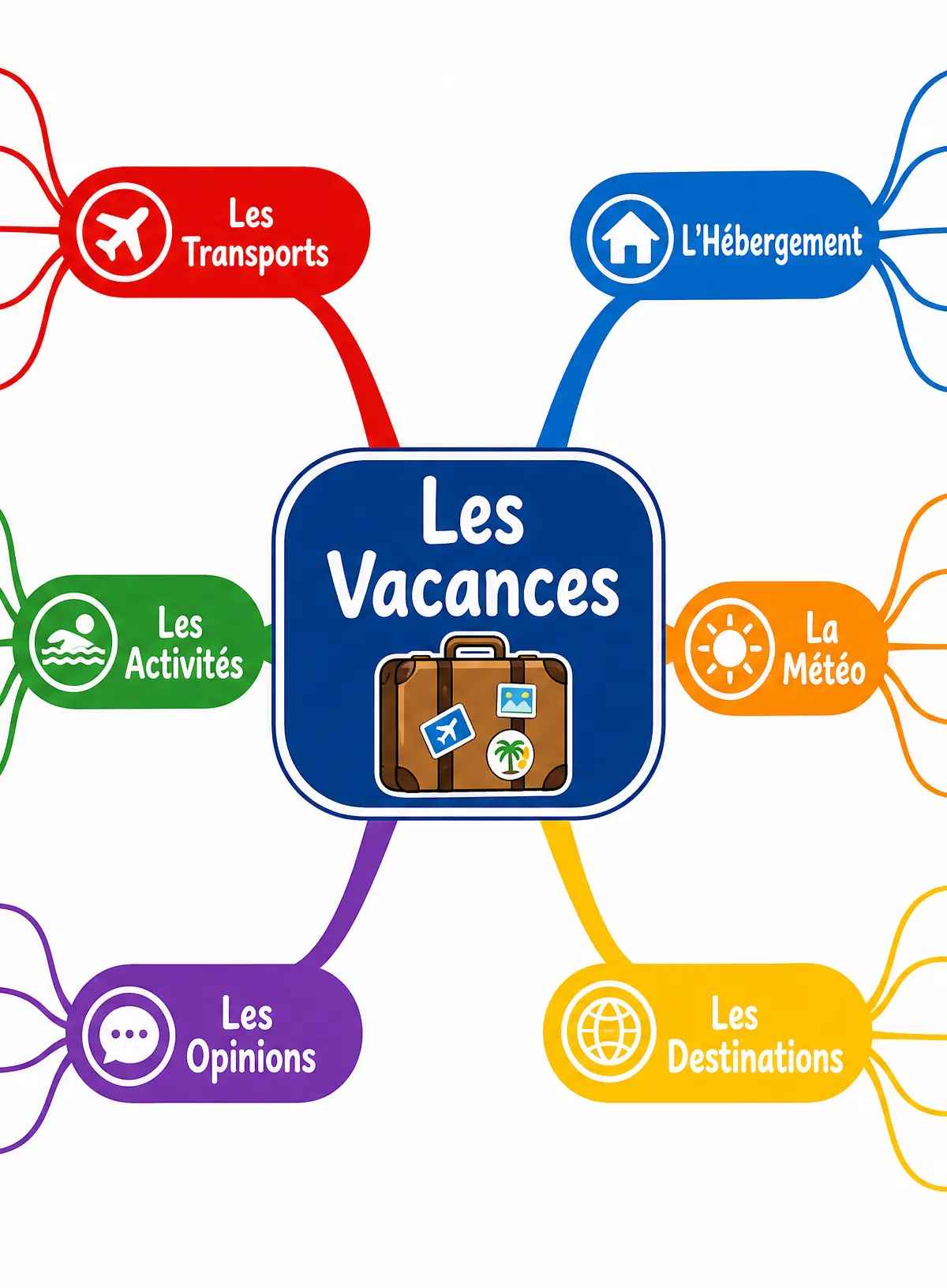
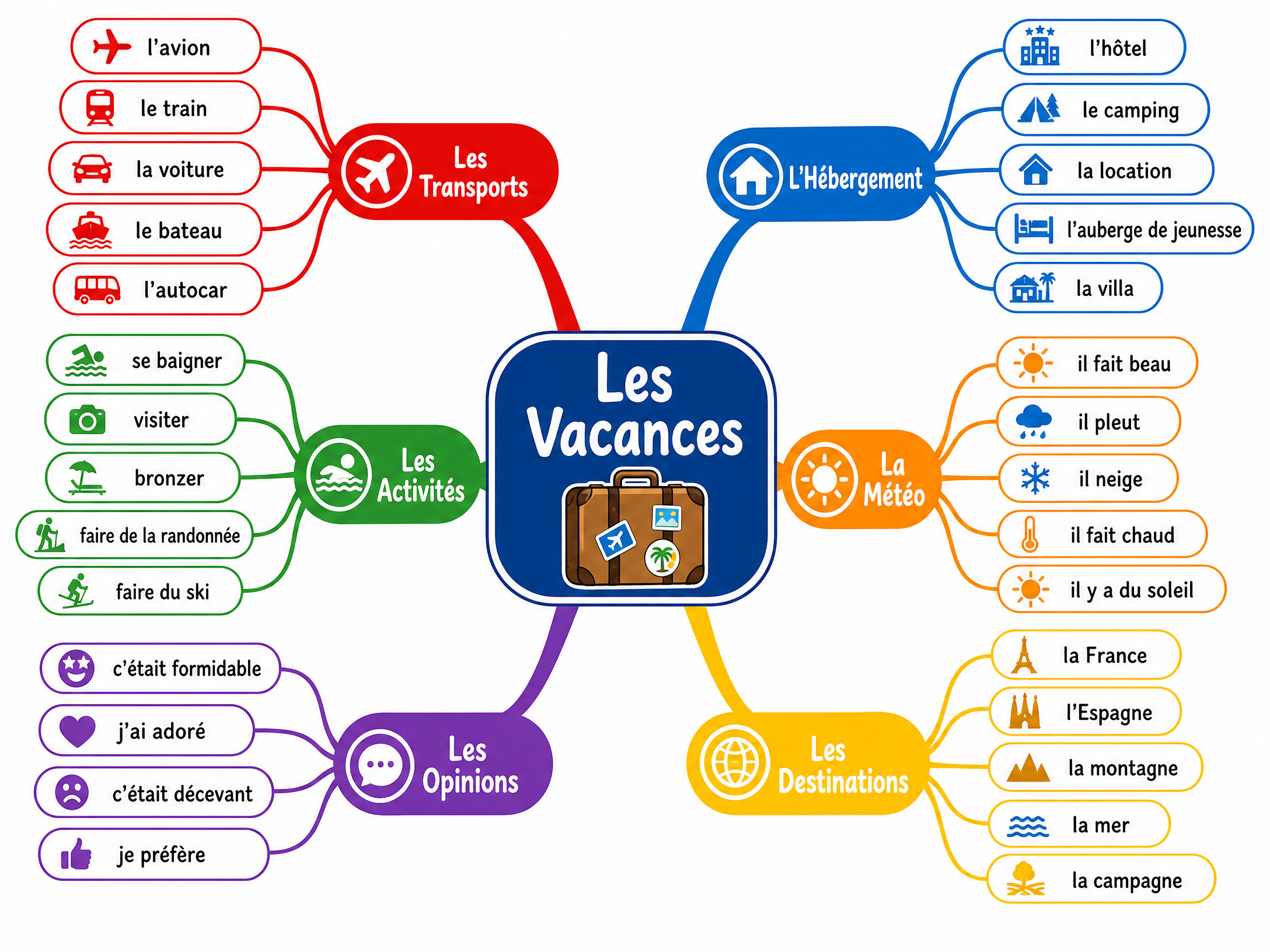
To communicate effectively, you need a robust vocabulary covering several key areas of the holiday experience. Examiners reward variety; using 'l'auberge de jeunesse' instead of just 'l'hôtel' demonstrates a wider lexical resource.
Les Transports (Transport)
Key terms: l'avion (plane), le train (train), la voiture (car), le bateau (boat), l'autocar (coach).
Examiner Tip: Pay attention to prepositions. We use en for transport you go inside (en avion, en train, en voiture) and à for transport you go on (à vélo, à pied).
L'Hébergement (Accommodation)
Key terms: l'hôtel (hotel), le camping (campsite), la location (rental), l'auberge de jeunesse (youth hostel), la chambre d'hôtes (B&B).
Specific Knowledge: Remember that le camping refers to the campsite itself, while the activity of camping is faire du camping.
Les Activités (Activities)
Key terms: se baigner (to swim/bathe), bronzer (to sunbathe), visiter les monuments (to visit sights), faire de la randonnée (to hike), faire du ski (to ski).
Examiner Tip: The verb faire (to do/make) is highly versatile in holiday contexts. Ensure you know its irregular present tense conjugation (je fais, tu fais, il/elle fait, nous faisons, vous faites, ils/elles font).
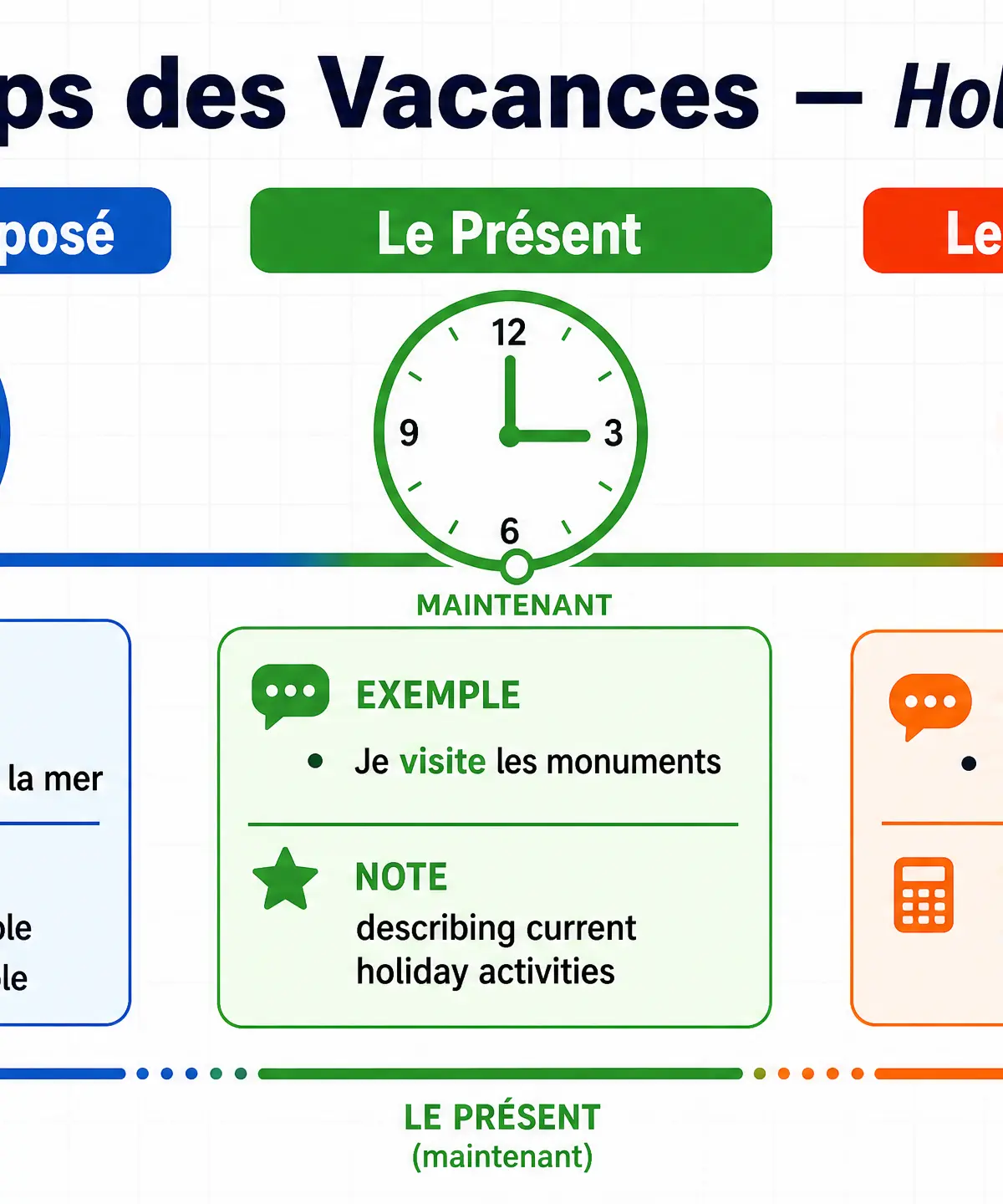
Grammar: Mastering the Tenses
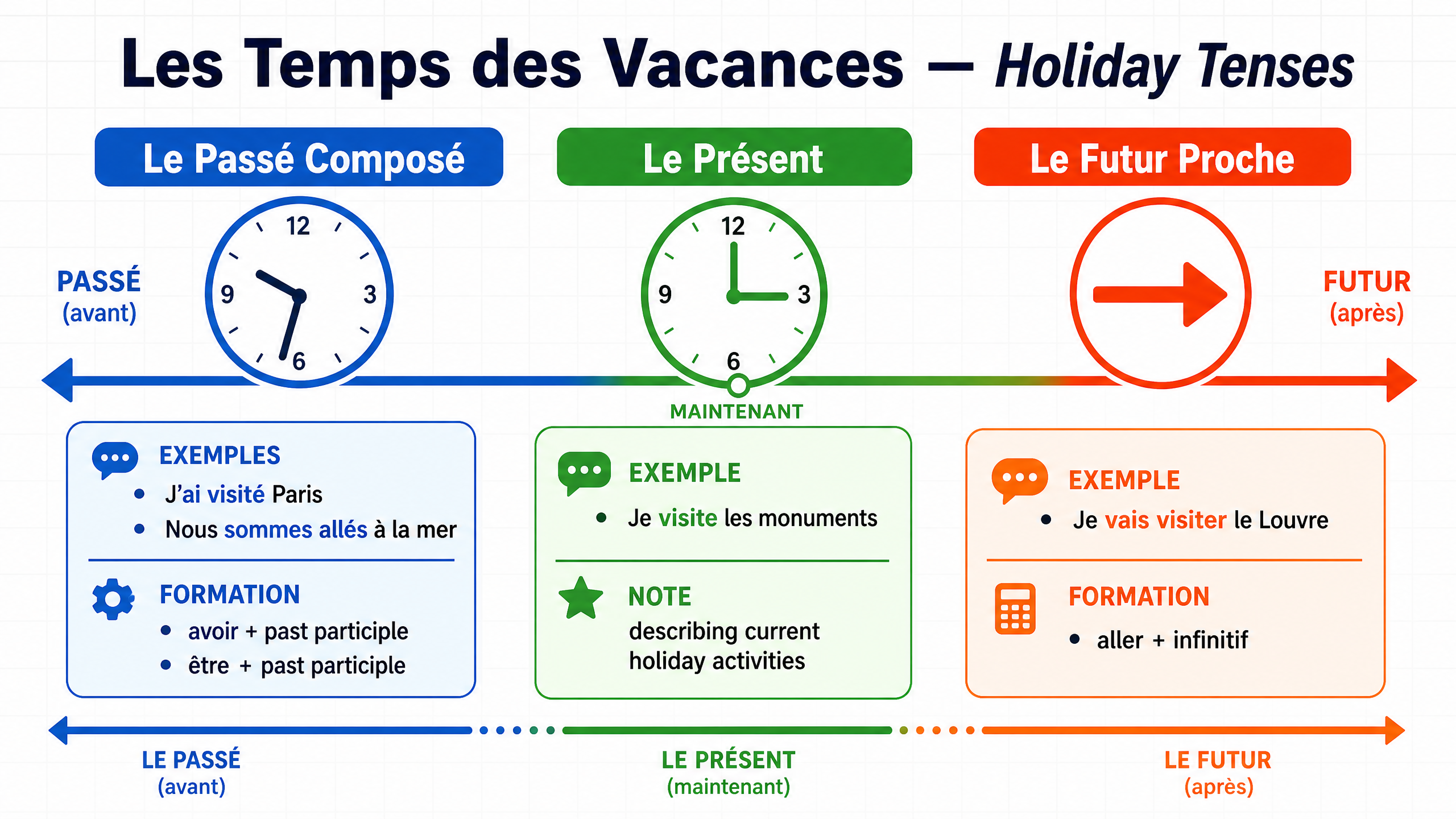
The ability to refer accurately to past, present, and future events is a key differentiator between average and top-tier candidates. The 'Holidays' topic is the perfect vehicle for showcasing your grammatical range.
Le Passé Composé (The Past)
Used to describe completed actions on holiday (e.g., what you did last summer).
Formation: Auxiliary verb (avoir or être) + past participle.
With avoir: J'ai visité le musée (I visited the museum); Nous avons mangé au restaurant (We ate at the restaurant).
With être: Used for verbs of movement (the 'MR MRS VANDERTRAMP' verbs) and reflexive verbs. Crucially, the past participle must agree with the subject.
Je suis allé(e) en France (I went to France).
Nous sommes parti(e)s tôt (We left early).
L'Imparfait (The Imperfect)
Used for descriptions in the past, setting the scene, and expressing ongoing states (e.g., what the weather was like).
Key phrases: Il faisait beau (The weather was nice); C'était fantastique (It was fantastic); Il y avait beaucoup de monde (There were lots of people).
Examiner Tip: Combining the passé composé (action) with the imperfect (description) in the same sentence is a sophisticated structure that examiners actively look for: Je suis allé à la plage (passé composé) où il faisait très chaud (imparfait).
Le Futur Proche (The Near Future)
Used to describe intended future actions (e.g., what you are going to do next year).
Formation: Present tense of aller + infinitive.
Examples: Je vais visiter l'Espagne (I am going to visit Spain); Nous allons faire du camping (We are going to go camping).
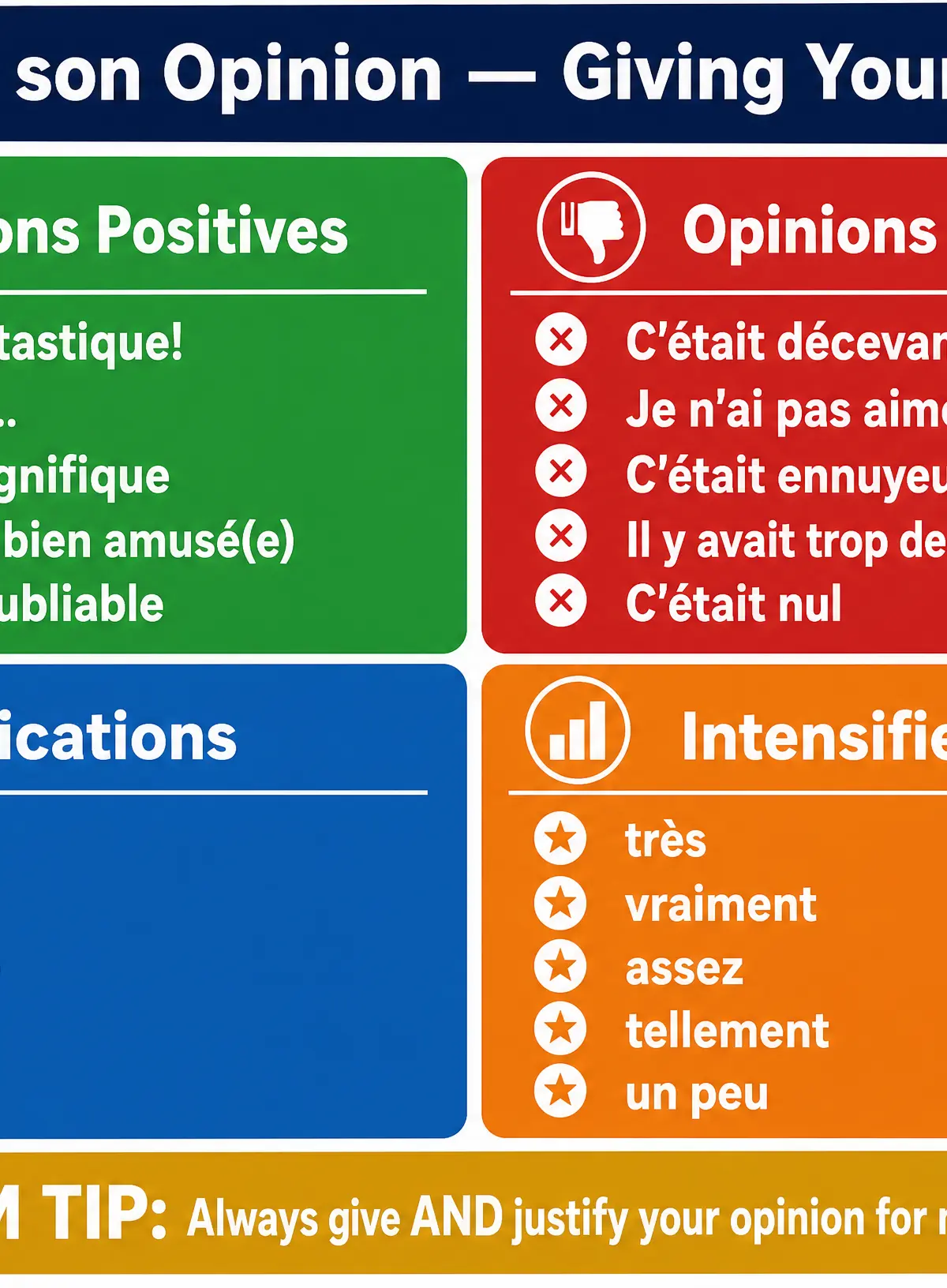
Giving and Justifying Opinions
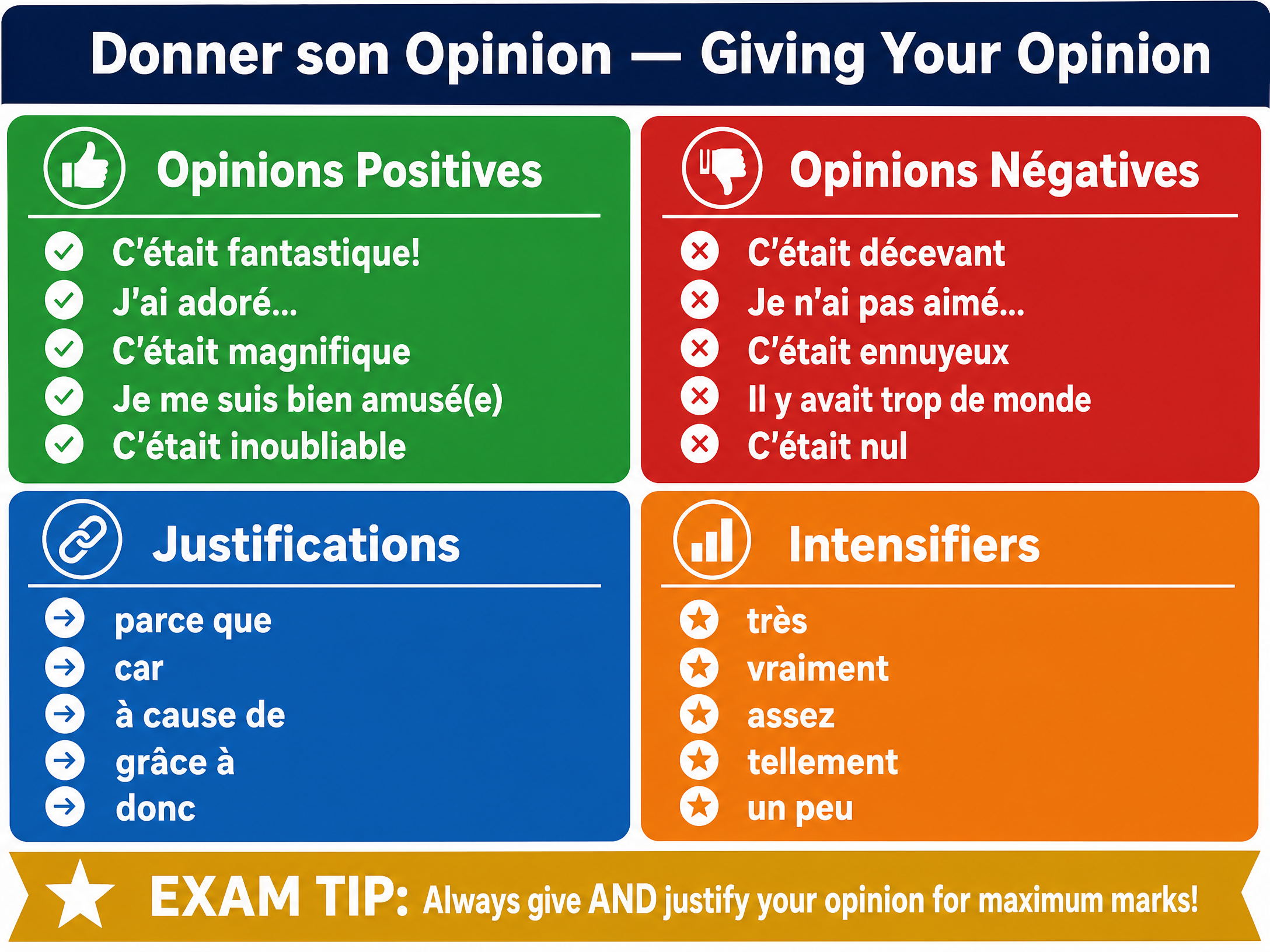
Stating an opinion is a basic requirement; justifying that opinion is what secures higher marks. You must explain why you hold a particular view.
Opinion Phrases
Positive: C'était fantastique (It was fantastic); J'ai adoré (I loved it); Je me suis bien amusé(e) (I had a good time).
Negative: C'était décevant (It was disappointing); Je n'ai pas aimé (I didn't like it); C'était nul (It was rubbish).
Justification Connectives
Use these to link your opinion to your reason: parce que (because), car (because), à cause de (because of - usually negative), grâce à (thanks to - positive).
Model Sentence: J'ai adoré mes vacances en Italie parce qu'il faisait toujours beau et la nourriture était délicieuse.
Visual Resources
3 diagrams and illustrations
Interactive Diagrams
1 interactive diagram to visualise key concepts
Conceptual Flow Outline
The Three Time Frames of Holidays
Worked Examples
3 worked examples — open one to explore the question and available guidance.
Practice Questions
Test your understanding — click to reveal model answers
Writing (Higher Tier): Écris un article pour ton blog scolaire sur le thème des vacances. Mentionne: une visite récente à l'étranger, les avantages et les inconvénients du tourisme, et tes projets pour l'été prochain. (90-150 words) (16 marks)
Hint: Ensure you cover all three bullet points clearly, using the passé composé/imparfait for the first, present for the second, and futur proche/simple for the third. Include justified opinions.
Speaking (Role Play): L'examinateur te pose une question: 'Où préfères-tu passer tes vacances normalement?'
Hint: Use the present tense, name a destination type (e.g., la mer, la montagne), and give a reason.
Reading (Foundation Tier): Read the text: 'Pendant les grandes vacances, je déteste rester en ville. Je préfère la tranquillité de la campagne. L'année dernière, j'ai fait du camping avec mes cousins. Malheureusement, il a plu tous les jours.' Question: Why did the writer not enjoy their holiday last year?
Hint: Look at the final sentence and identify the weather vocabulary.
Writing (Foundation Tier): Traduis en français: 'I like holidays in Spain. The weather is hot.'
Hint: Remember the preposition for countries and the verb used for weather.
Listening (Higher Tier): Listen to the recording: 'Pour moi, les vacances idéales seraient au bord de la mer dans un pays tropical. Je logerais dans une villa de luxe avec une piscine privée.' Question: Detail two aspects of the speaker's ideal holiday.
Hint: Listen for location and accommodation details.
Test your understanding of Holidays
Active recall beats re-reading. Take an instant quiz now to test what you’ve learned and lock it into long-term memory.
7 days Premium · Then free forever · No card, no charge