Pearson Edexcel · GCSE · French
Theme 2: Local area, holiday and travel
Theme 2: 'Local area, holiday and travel' is one of the highest-value themes in GCSE French. Mastering this theme allows you to describe your surroundings, narrate past holidays, and express future travel plans—essential skills that examiners look for across listening, reading, speaking, and writing papers.
- 5 min read
- 3 worked examples
- 5 practice questions
- 6 key terms
Study Notes

Overview
Theme 2 focuses on enabling you to communicate about where you live, places in your town or region, and your holiday experiences. Examiners highly value this theme because it naturally invites the use of three distinct timeframes (past, present, and future) and provides ample opportunity for you to state and justify your opinions. To achieve the highest mark bands, candidates must demonstrate accuracy in vocabulary (such as places in town and modes of transport), precision in grammar (especially verb conjugations and gender agreements), and the ability to develop responses with complex structures like the conditional tense.
Core Vocabulary: The Local Area
To describe your town or region effectively, you need a solid grasp of key places and facilities.
Key Places (Les Endroits)
- La mairie – the town hall
- La bibliothèque – the library
- La piscine – the swimming pool
- Le centre commercial – the shopping centre
- La gare – the train station
- L'église (f) – the church
- Le musée – the museum
- Le marché – the market
Examiner Tip: Always learn nouns with their article (le/la/un/une) so you know their gender. This is crucial for adjective agreements later on.
Transport and Travel
Knowing how to say how you travel is essential.
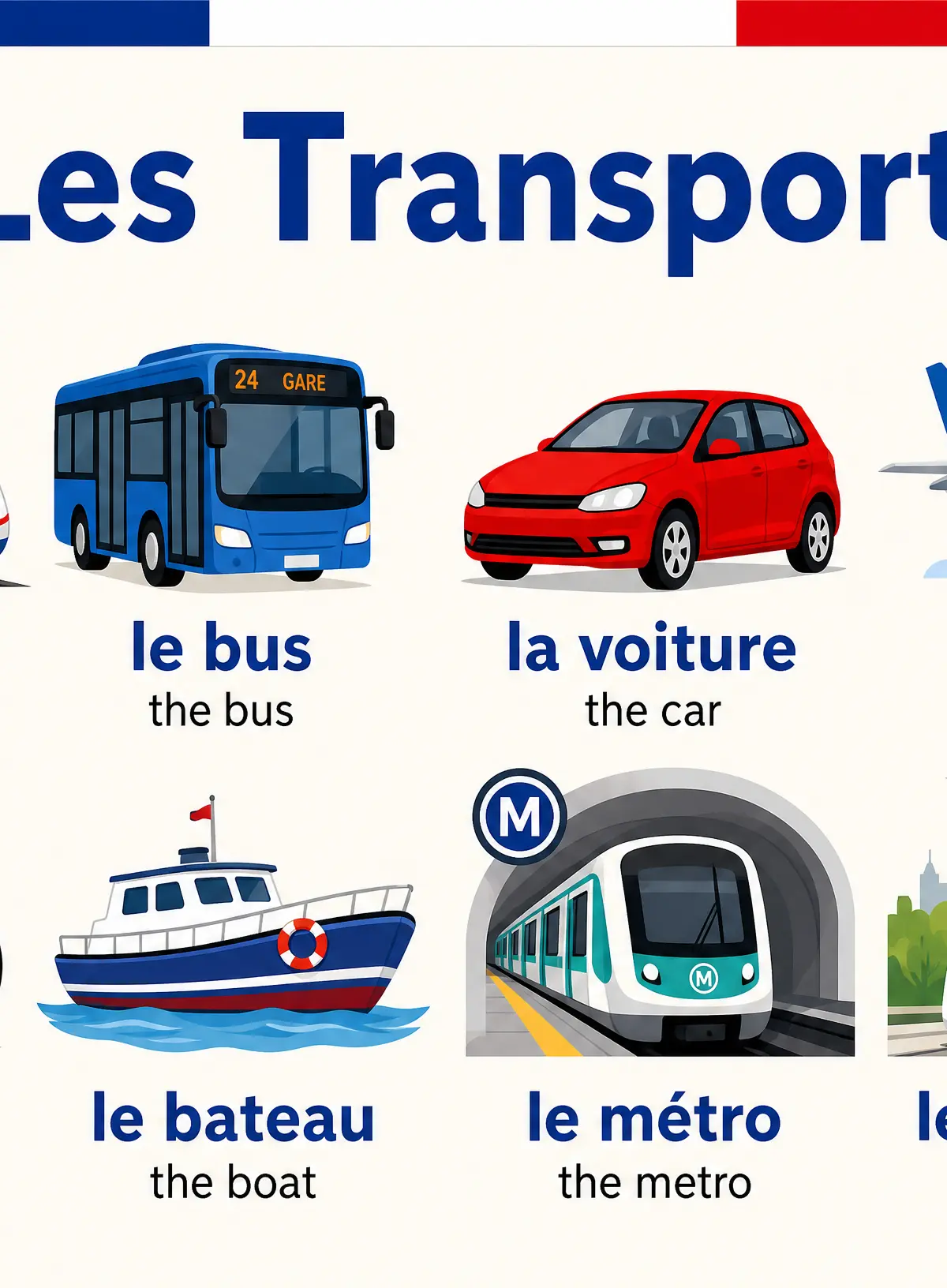
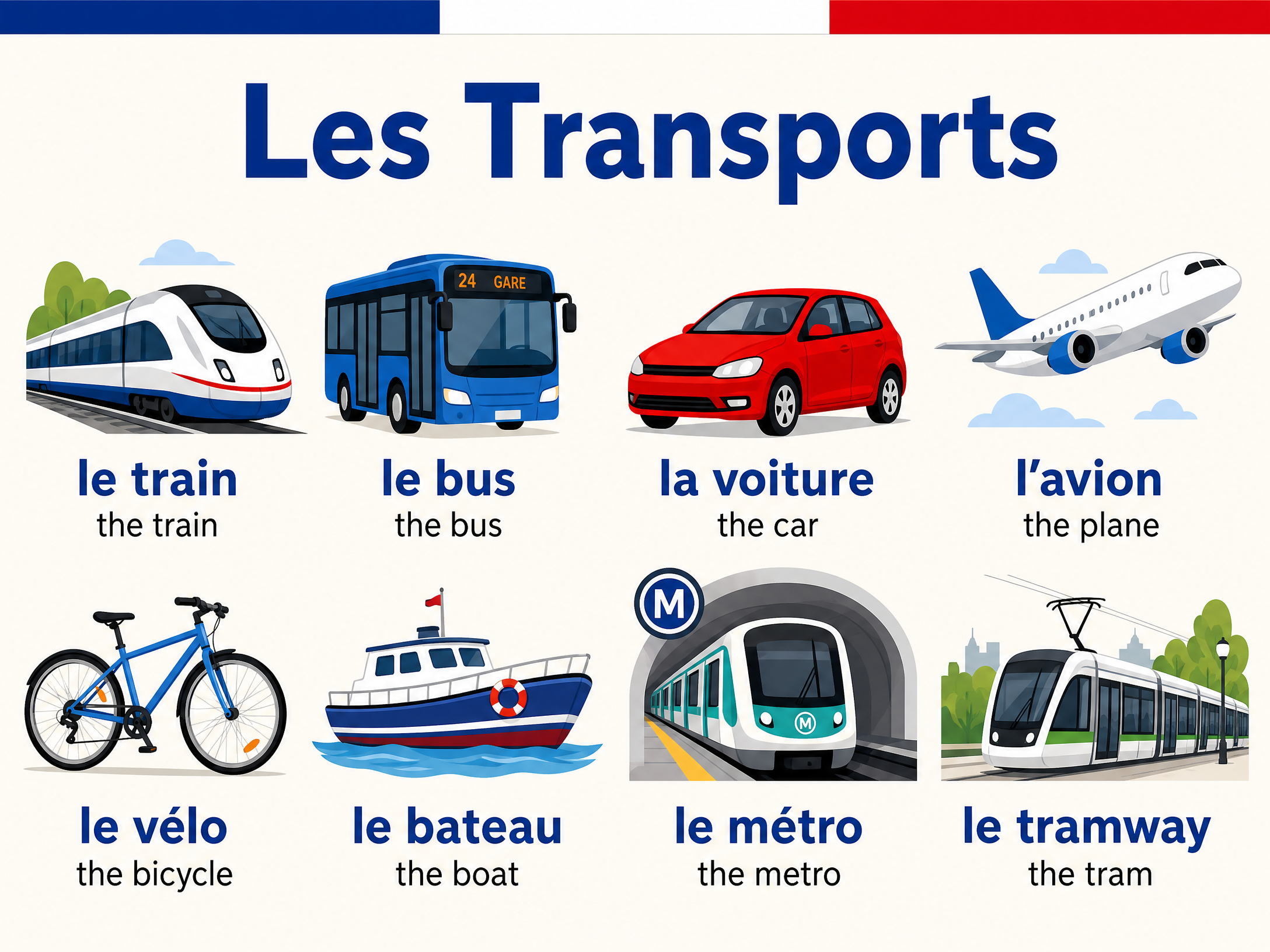
Modes of Transport (Les Moyens de Transport)
- Le train – the train
- Le bus – the bus
- La voiture – the car
- L'avion (m) – the plane
- Le vélo – the bicycle
- Le bateau – the boat
- Le métro – the underground
- Le tramway – the tram
Crucial Grammar Rule: Use the preposition en for vehicles you get into (en voiture, en train, en avion) but use à for open transport or walking (à vélo, à pied, à moto). Examiners actively look for this distinction.
Holidays and Activities
When discussing holidays, you must be able to describe the destination, accommodation, and activities.
Destinations and Accommodation
- À la plage – at the beach
- À la montagne – in the mountains
- À la campagne – in the countryside
- À l'étranger – abroad
- Un hôtel – a hotel
- Une auberge de jeunesse – a youth hostel
- Un camping – a campsite
Holiday Activities (Les Activités de Vacances)
- Se baigner – to swim (in the sea/lake)
- Se bronzer – to sunbathe
- Faire du tourisme – to go sightseeing
- Faire des randonnées – to go hiking
- Se détendre – to relax
Grammar Focus: The Three Timeframes
The single most important skill for this theme is the ability to use past, present, and future tenses confidently.
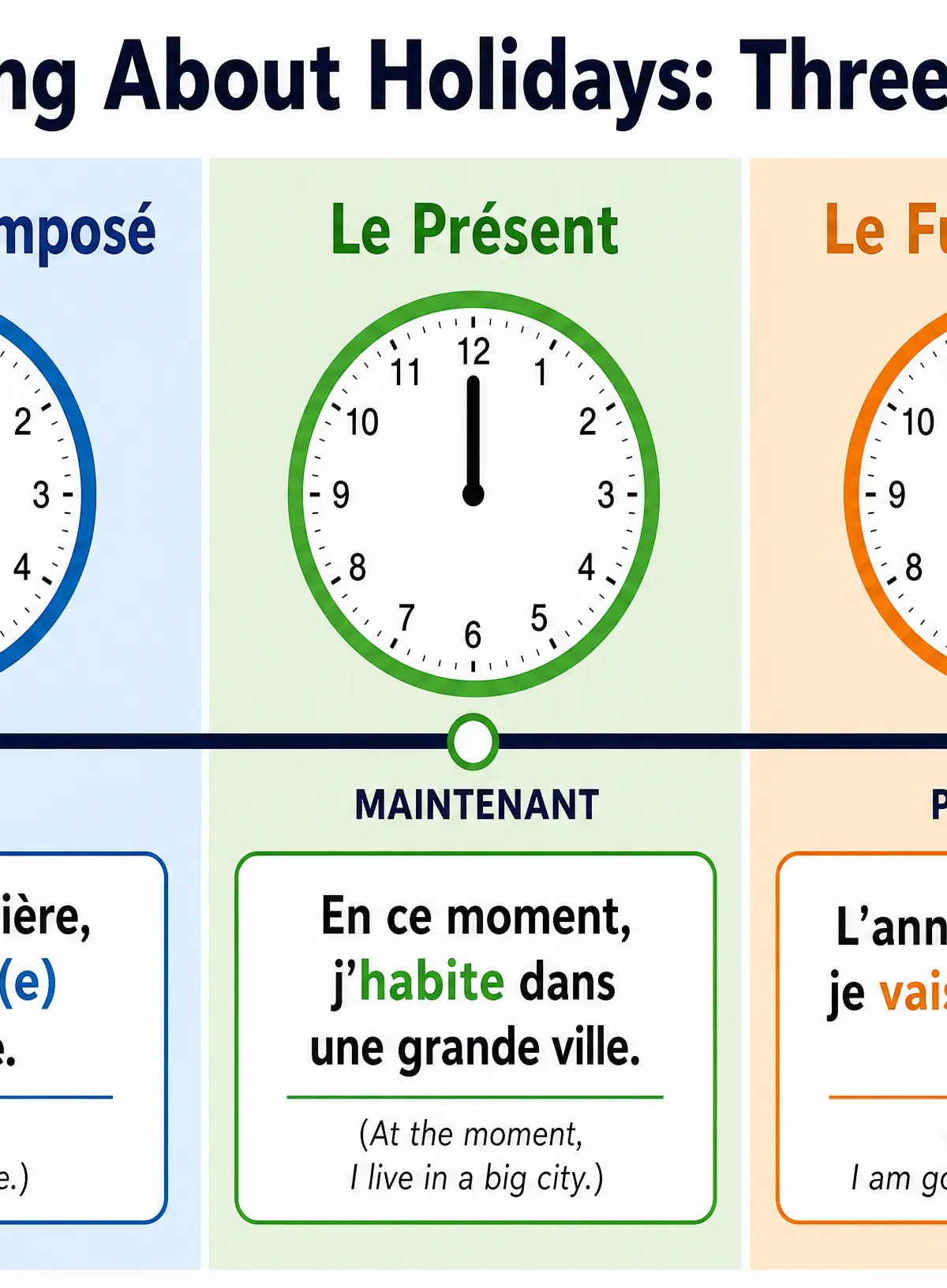
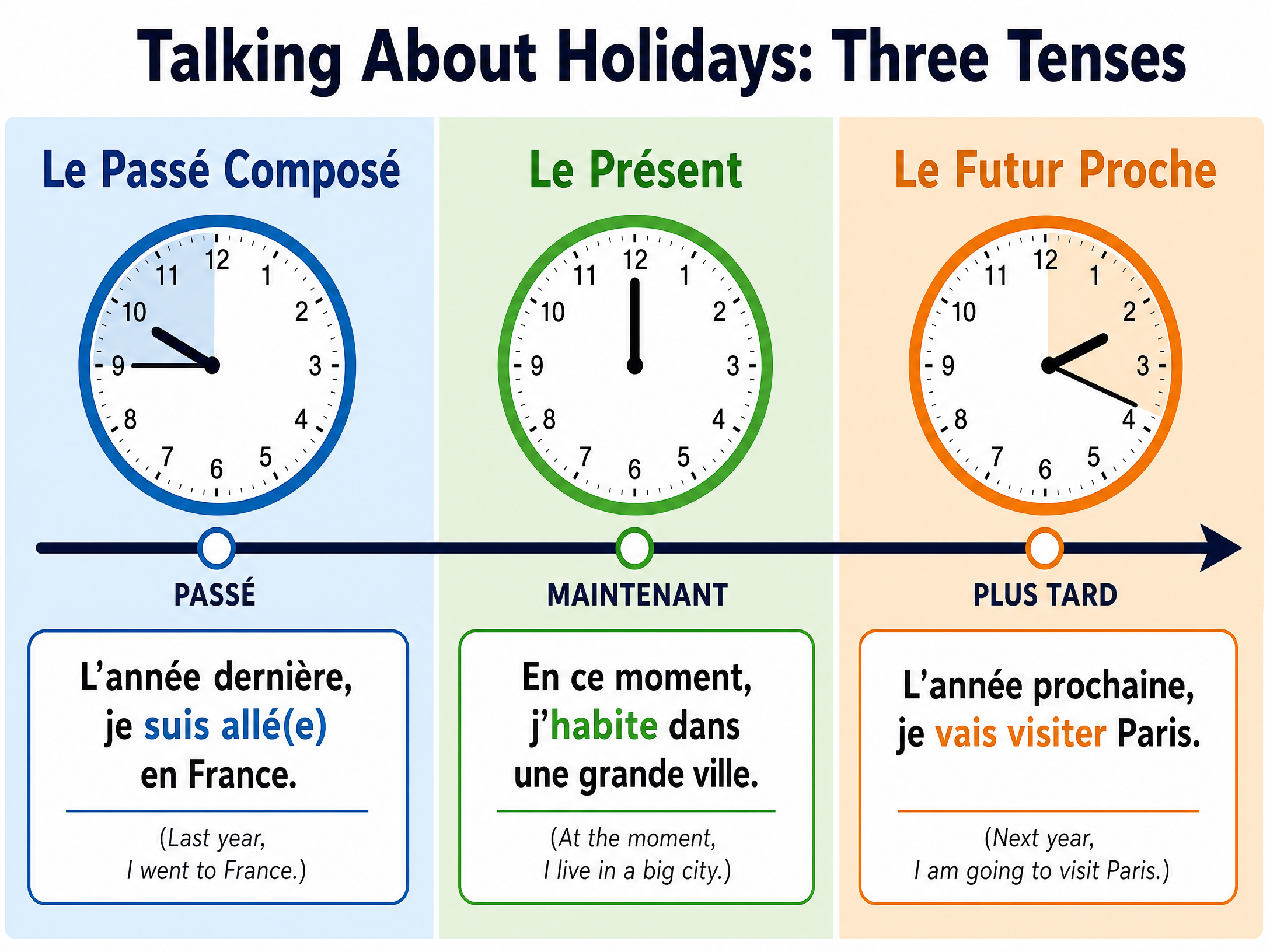
1. Le Passé Composé (The Past)
Used for completed actions in the past (e.g., what you did on holiday last year).
- Formation: Auxiliary verb (avoir or être) + past participle.
- Example with avoir: J'ai visité Paris. (I visited Paris.)
- Example with être: Je suis allé(e) en France. (I went to France.)
- Watch out: Verbs of movement (aller, venir, partir, arriver, etc.) use être, and the past participle must agree with the subject (add 'e' for feminine, 's' for plural).
2. Le Présent (The Present)
Used for current situations and habits (e.g., describing your town now).
- Example: J'habite dans une grande ville. (I live in a big city.)
- Example: Normalement, je vais en Espagne. (Normally, I go to Spain.)
3. Le Futur Proche (The Near Future)
Used for planned future actions (e.g., your plans for next summer).
- Formation: Present tense of aller + infinitive.
- Example: L'année prochaine, je vais visiter l'Italie. (Next year, I am going to visit Italy.)
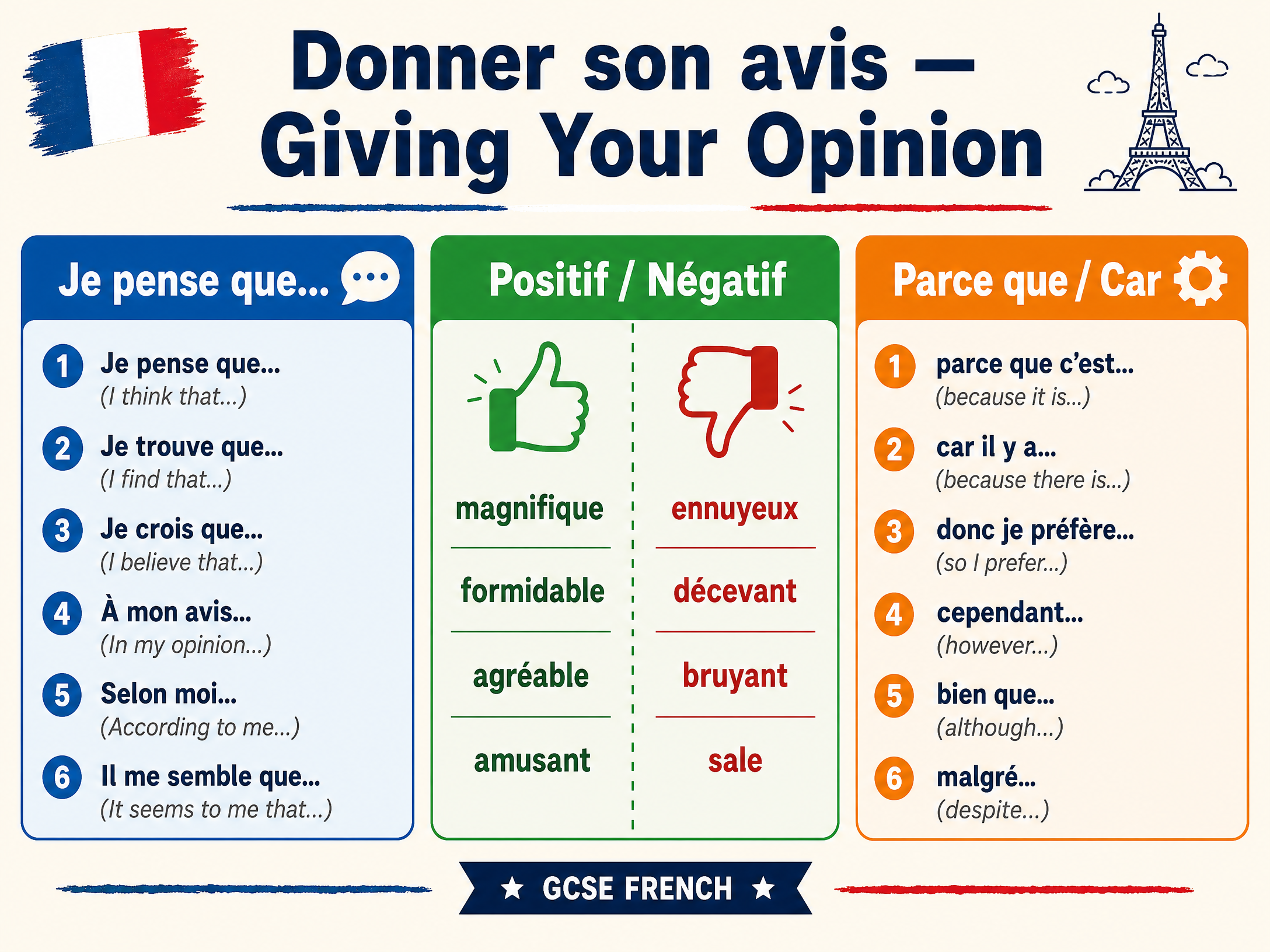
Giving and Justifying Opinions
To reach the highest mark bands, stating an opinion is not enough; you must justify it.
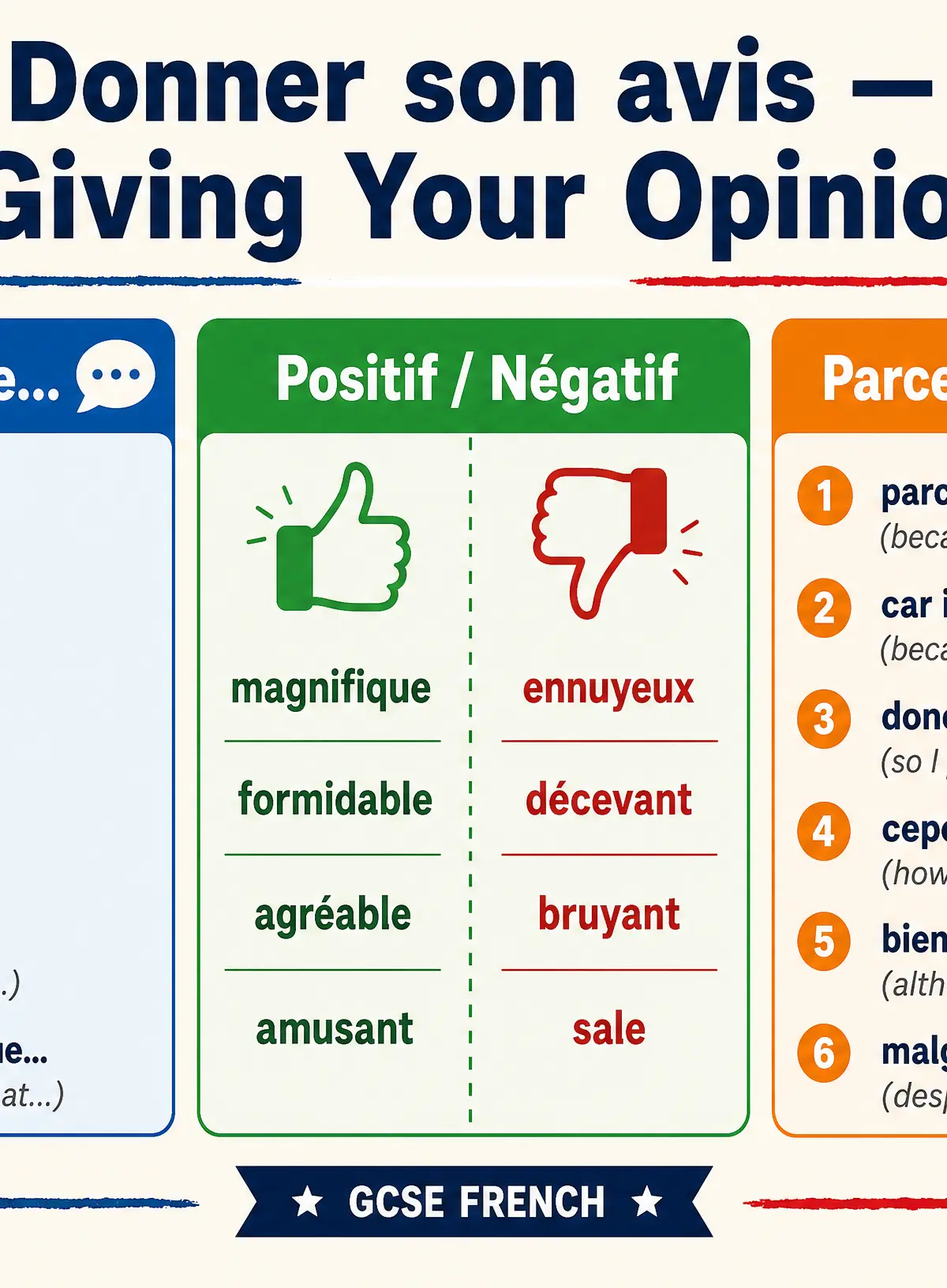
The Magic Formula: Opinion Phrase + Adjective + Connective (parce que/car) + Reason.
- Je pense que ma ville est ennuyeuse parce qu'il n'y a pas grand-chose à faire pour les jeunes.
(I think my town is boring because there isn't much to do for young people.) - À mon avis, les vacances à la mer sont merveilleuses car on peut se détendre.
(In my opinion, seaside holidays are wonderful because you can relax.)
Audio Revision
Listen to our exclusive podcast episode covering all these topics, pronunciation tips, and a quick-fire recall quiz!
Visual Resources
3 diagrams and illustrations
Interactive Diagrams
1 interactive diagram to visualise key concepts
Conceptual Flow Outline
Forming the Passé Composé
Worked Examples
3 worked examples — open one to explore the question and available guidance.
Practice Questions
Test your understanding — click to reveal model answers
Writing: Write a paragraph (approx. 90 words) about a recent holiday. Include: where you went, how you travelled, what you did, and your opinion of the holiday.
Hint: Make sure you use the passé composé throughout, remember the 'en'/'à' rule for transport, and justify your opinion at the end.
Speaking (Role Play): Your teacher will play the role of a tourist information officer. You must ask for directions to the train station.
Hint: Use 'Excusez-moi' to be polite, and remember the gender of 'gare'.
Translation: Translate into French: 'Next year, I would like to visit Spain because it is hot.'
Hint: You need a time phrase, the conditional tense of 'vouloir', the correct preposition for a feminine country, and a weather expression.
Reading Comprehension: Lisez le texte. (Read the text). 'J'habite dans une petite ville historique. Il y a un vieux château et une grande église, mais il n'y a pas de centre commercial. C'est dommage car j'adore faire les magasins.' Question: What does the writer like doing, and why is this a problem where they live?
Hint: Look for the verb 'adorer' and the phrase 'il n'y a pas de'.
Writing: Write a short text (approx. 40 words) describing your ideal holiday. Include where you would go and who with.
Hint: Use the conditional tense (je voudrais aller / j'irais) to describe an 'ideal' or hypothetical situation.
Test your understanding of Theme 2: Local area, holiday and travel
Active recall beats re-reading. Take an instant quiz now to test what you’ve learned and lock it into long-term memory.
7 days Premium · Then free forever · No card, no charge