Pearson Edexcel · GCSE · French
Theme 3: School
Master Theme 3: School (L'École) for your French GCSE. This comprehensive guide covers essential vocabulary, grammar structures, and exam techniques to help you confidently describe your school life, express justified opinions, and secure top marks across all four papers.
- 4 min read
- 3 worked examples
- 5 practice questions
- 6 key terms
Study Notes

Overview
Theme 3: School (L'École) is a cornerstone of the GCSE French specification across all major exam boards (AQA, Edexcel, OCR). It falls under the broader context of 'Current and future study and employment' or 'My personal world'. Examiners frequently use this topic to test your ability to describe routines, express and justify opinions, and narrate events across different timeframes.
Because school is a universal experience, candidates are expected to demonstrate a rich, varied vocabulary and an authentic, personal response. To achieve the highest marks (Grades 7-9), you must move beyond simple statements like 'J'aime les maths' and confidently use complex structures, including modal verbs, comparative language, and accurate tense changes.
Core Vocabulary: School Types & Subjects
Types of School (Les Établissements Scolaires)
- L'école primaire: Primary school (ages 6-11)
- Le collège: Middle/Secondary school (ages 11-15)
- Le lycée: High school / Sixth form equivalent (ages 15-18)
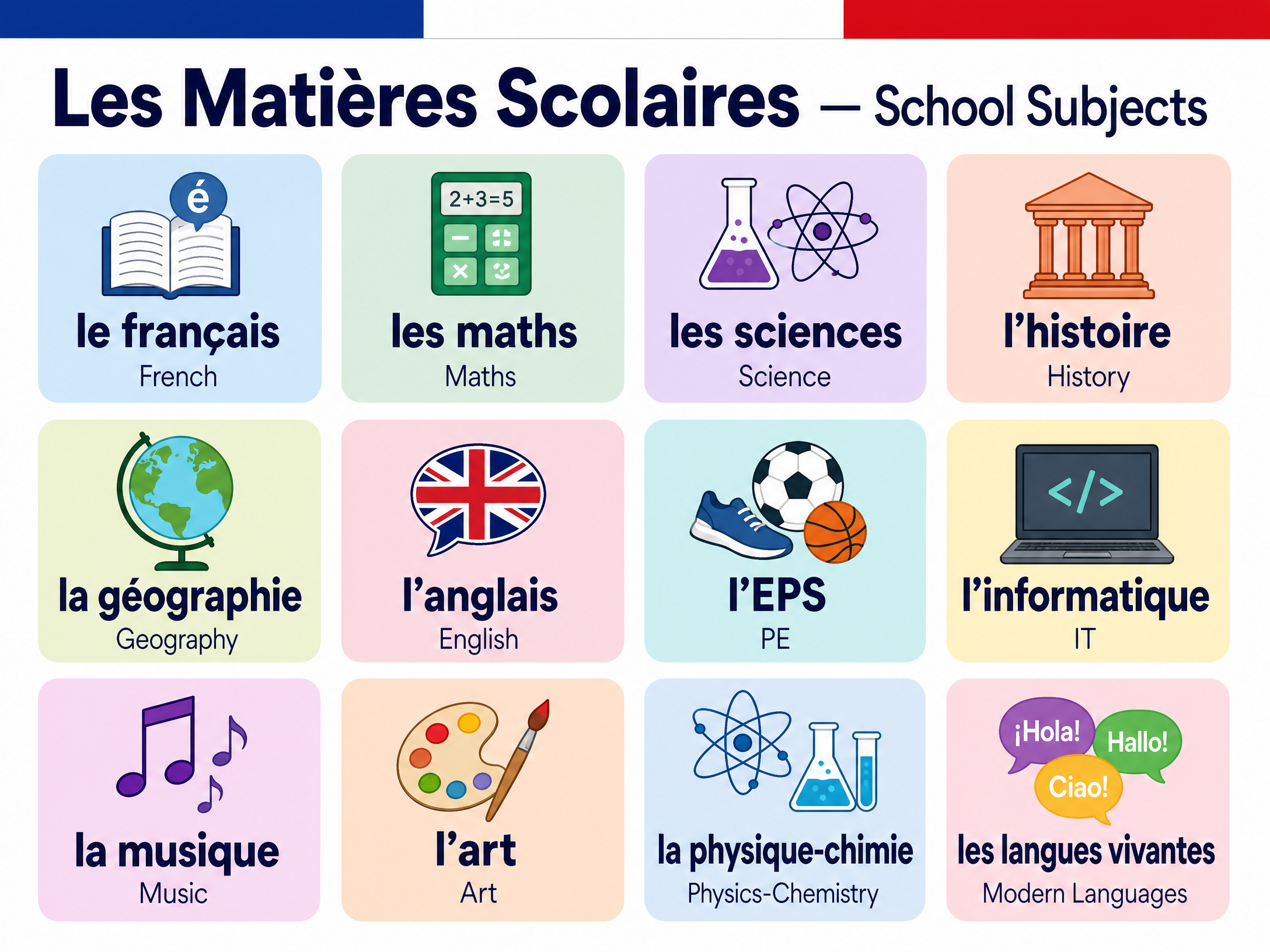
School Subjects (Les Matières)
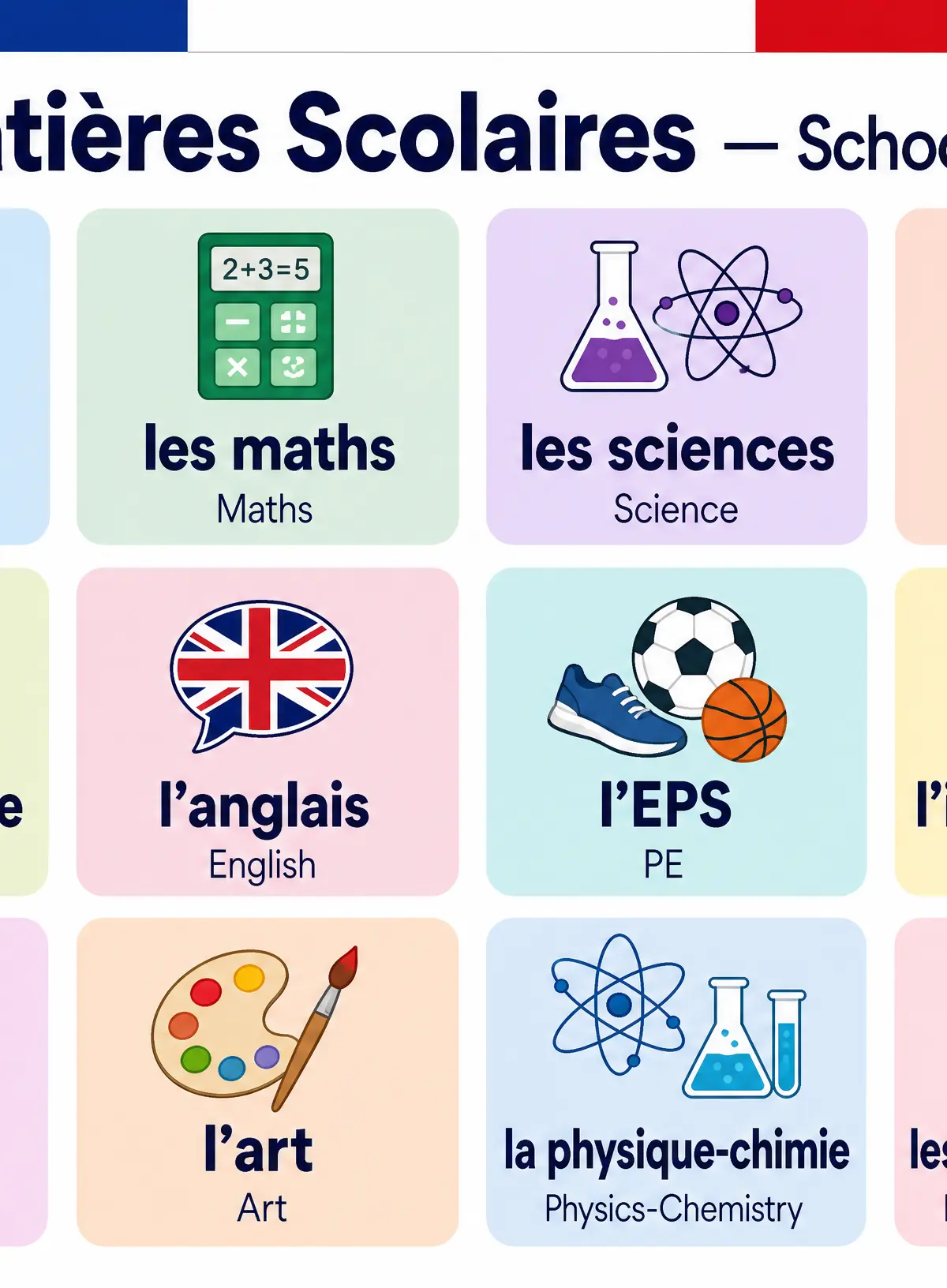
Examiner Tip: Always ensure you use the correct definite article (le/la/les/l') as gender accuracy is explicitly rewarded in the mark scheme.
- Le français (French)
- Les maths (Maths)
- Les sciences (Science)
- L'histoire (History)
- La géographie (Geography)
- L'anglais (English)
- L'EPS (Éducation Physique et Sportive - PE)
- L'informatique (IT / Computing)
- La musique (Music)
- L'art (Art)
- La physique-chimie (Physics-Chemistry)
- Les langues vivantes (Modern Languages)
Giving and Justifying Opinions
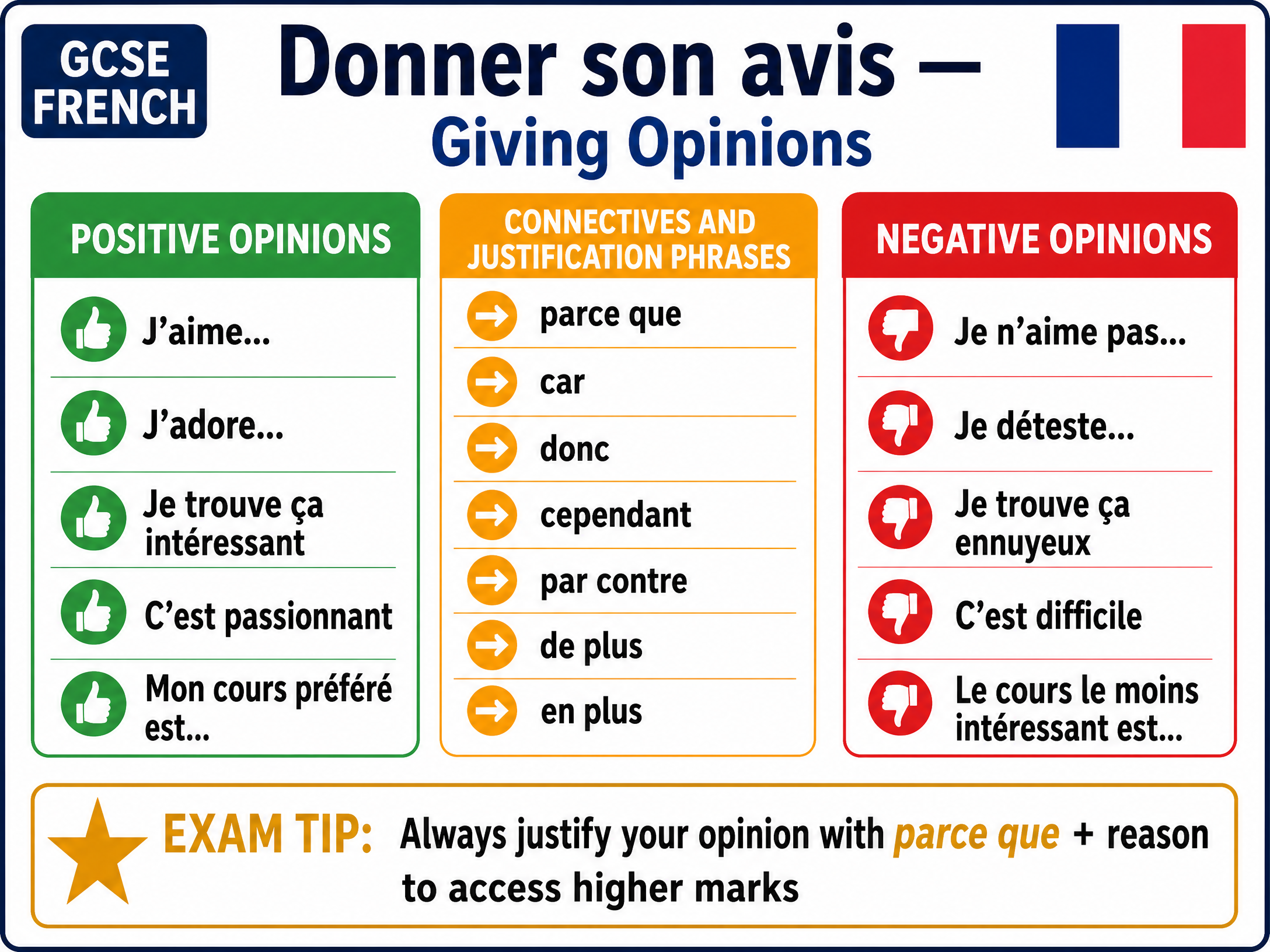
To access higher mark bands, you must develop your responses by expressing clear opinions and justifying them using a variety of connectives.
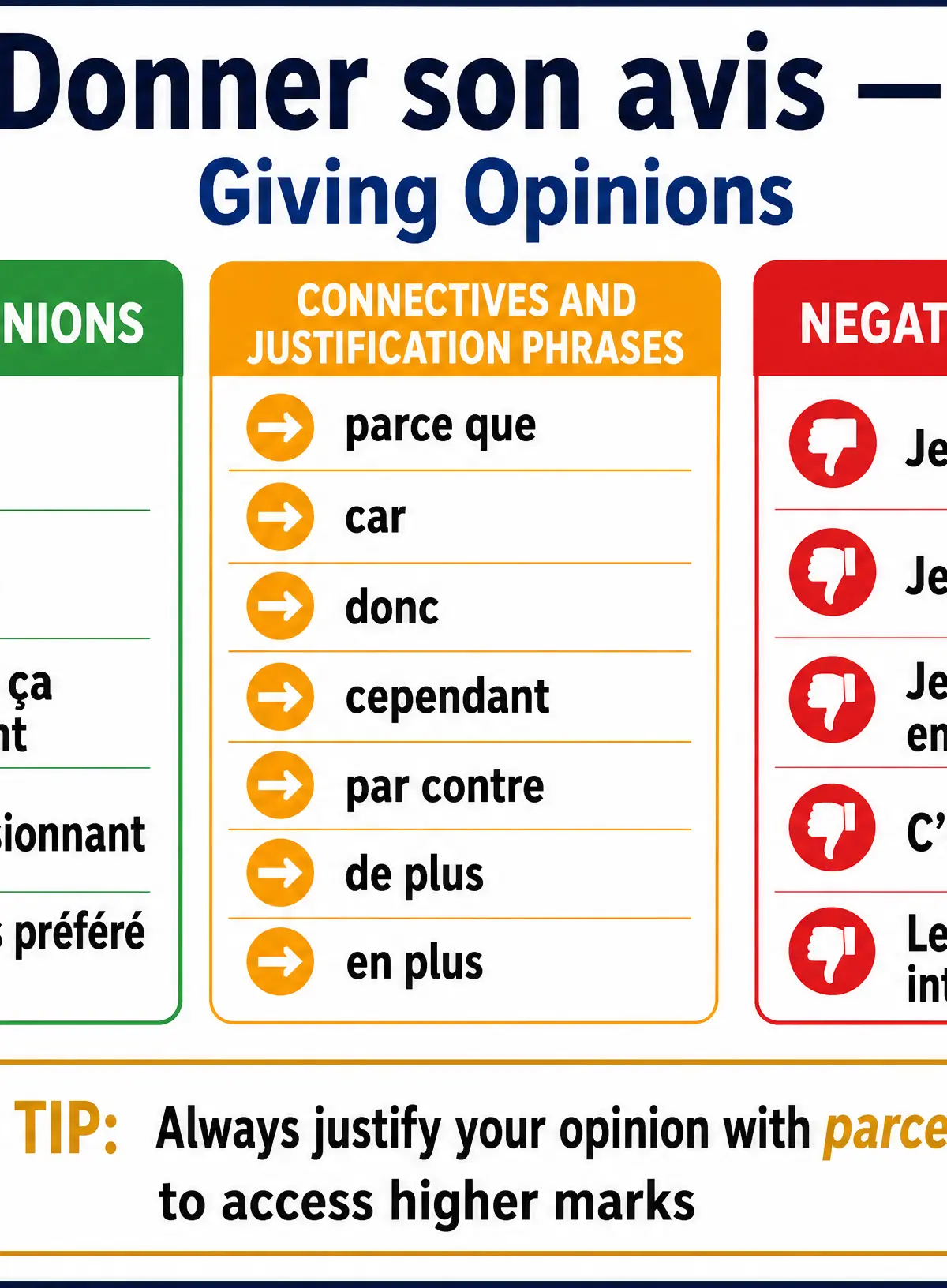
Opinion Starters
- Positive: J'aime (I like), J'adore (I love), Je trouve ça passionnant (I find it fascinating), Mon cours préféré est... (My favourite lesson is...)
- Negative: Je n'aime pas (I don't like), Je déteste (I hate), Je trouve ça ennuyeux (I find it boring), C'est difficile (It's difficult)
Justifications & Connectives
Always link your opinion to a reason using connectives:
- Parce que / Car (Because)
- Cependant / Pourtant (However)
- De plus / En plus (Furthermore / In addition)
- Donc (Therefore)
Example: "J'adore l'histoire parce que je trouve ça fascinant, cependant je déteste les maths car c'est trop difficile."
Grammar: Mastering the Timeframes
Examiners actively look for your ability to refer to past, present, and future events. A response restricted to the present tense cannot achieve top marks.
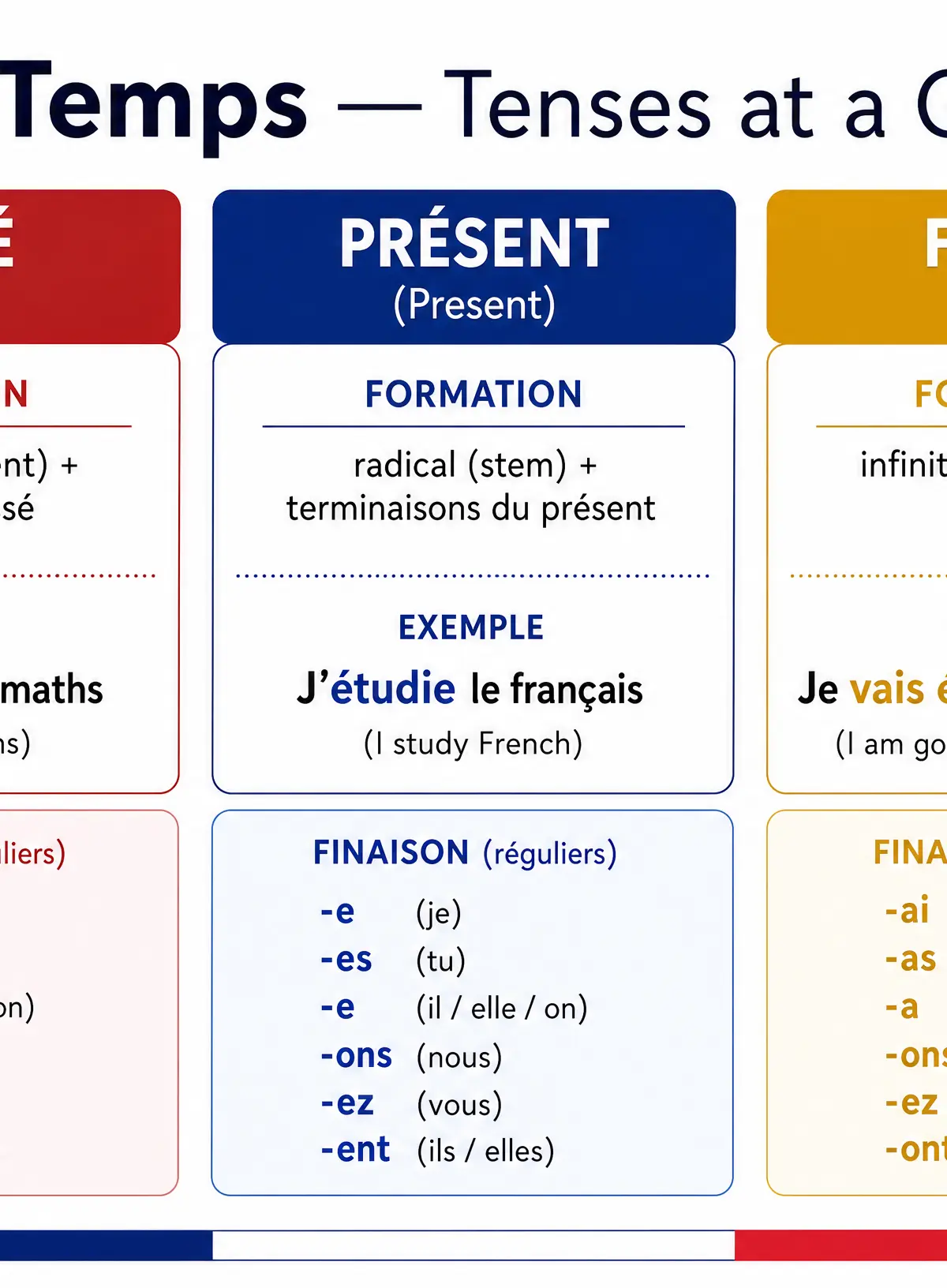
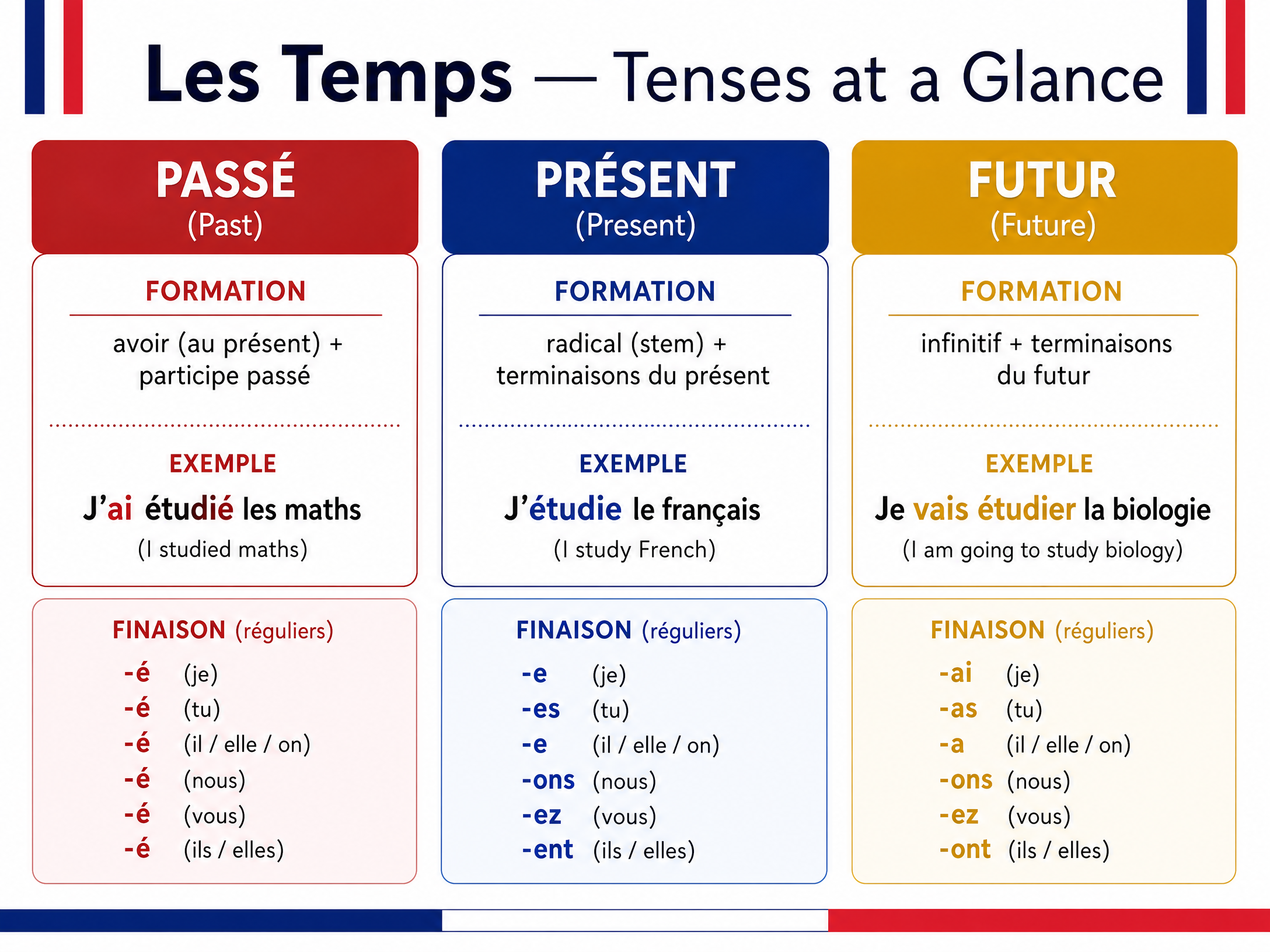
Le Présent (Present Tense)
Used for routines and current opinions.
- J'étudie le français tous les jours. (I study French every day.)
Le Passé Composé (Past Tense)
Used for completed actions (e.g., describing a recent school trip or yesterday's lessons).
- Formed with avoir or être + past participle.
- J'ai étudié les maths hier. (I studied maths yesterday.)
- Je suis allé(e) au collège en bus. (I went to school by bus.)
Le Futur Proche (Near Future Tense)
Used for intentions and upcoming events.
- Formed with present tense of aller + infinitive.
- Je vais étudier la biologie l'année prochaine. (I am going to study biology next year.)
School Rules and Uniform (Le Règlement et L'Uniforme)
This sub-topic is perfect for demonstrating complex structures, specifically modal verbs.
- Il faut (It is necessary to / You must)
- On doit (One must / We must)
- Il est interdit de (It is forbidden to)
- On ne doit pas (One must not)
Example: "Dans mon collège, **il est interdit d'**utiliser son portable en classe et on doit porter un uniforme strict."
Listen to the Revision Podcast
Reinforce your learning by listening to our 10-minute tutor-led podcast covering all these topics, complete with a quick-fire recall quiz.
Visual Resources
3 diagrams and illustrations
Interactive Diagrams
1 interactive diagram to visualise key concepts
Conceptual Flow Outline
Overview of the French School System
Worked Examples
3 worked examples — open one to explore the question and available guidance.
Practice Questions
Test your understanding — click to reveal model answers
Writing (Foundation Tier - 40 words): Écris un e-mail à ton correspondant français pour décrire ton collège. Mentionne: ton collège, ta matière préférée, ton opinion sur les profs, ce que tu vas faire demain au collège.
Hint: Ensure you address all four bullet points and include a future tense for the final point.
Writing (Higher Tier - 150 words): Tu écris un article pour le blog de ton collège sur le thème de l'éducation. Mentionne: une description de ton école primaire, ton opinion sur les règles dans ton collège actuel, l'importance d'apprendre les langues vivantes.
Hint: You must use the past tense for primary school, present/modal verbs for current rules, and complex justifications for the importance of languages.
Translation (into French): 1. I study maths. 2. I like my school because it is modern. 3. Yesterday, I ate in the canteen. 4. Next year, I am going to do my homework.
Hint: Watch out for the tenses: Present, Present, Past, Near Future.
Speaking (Role Play): L'examinateur joue le rôle d'un étudiant français. Vous parlez de l'école.
! (Unexpected question): Posez-moi une question sur mon école.
Hint: You must formulate an accurate question in French. Use 'Tu' as you are speaking to a student.
Reading (Multiple Choice): Lisez le texte. 'Je déteste la cantine parce que la nourriture est dégoûtante et c'est toujours bruyant.' Why does the student hate the canteen? A) It is expensive. B) The food is disgusting. C) It is too small.
Hint: Look for the translation of 'dégoûtante'.
Test your understanding of Theme 3: School
Active recall beats re-reading. Take an instant quiz now to test what you’ve learned and lock it into long-term memory.
7 days Premium · Then free forever · No card, no charge