Pearson Edexcel · GCSE · French
Theme 4: Future aspirations, study and work
Master Theme 4 of your GCSE French: Future aspirations, study and work. This comprehensive guide covers the essential vocabulary, grammar, and exam techniques needed to secure top marks when discussing your ambitions and future plans.
- 5 min read
- 3 worked examples
- 5 practice questions
- 6 key terms
Study Notes
Overview
Theme 4: Future aspirations, study and work (L'avenir) is a crucial component of your GCSE French assessment. It forms part of the broader 'My personal world' thematic context and requires you to communicate effectively about your educational journey, career ambitions, and life plans. Examiners particularly value this theme because it naturally invites the use of complex grammar, specifically the ability to refer to events in the past, present, and future.
To succeed in this theme, candidates must demonstrate clear pronunciation, accurate application of the prescribed vocabulary list, and the ability to justify opinions. Whether you are tackling a reading comprehension on apprenticeships, a listening task about university choices, or a speaking assessment detailing your dream job, this guide provides the structured knowledge and techniques you need to excel.
Key Vocabulary Clusters
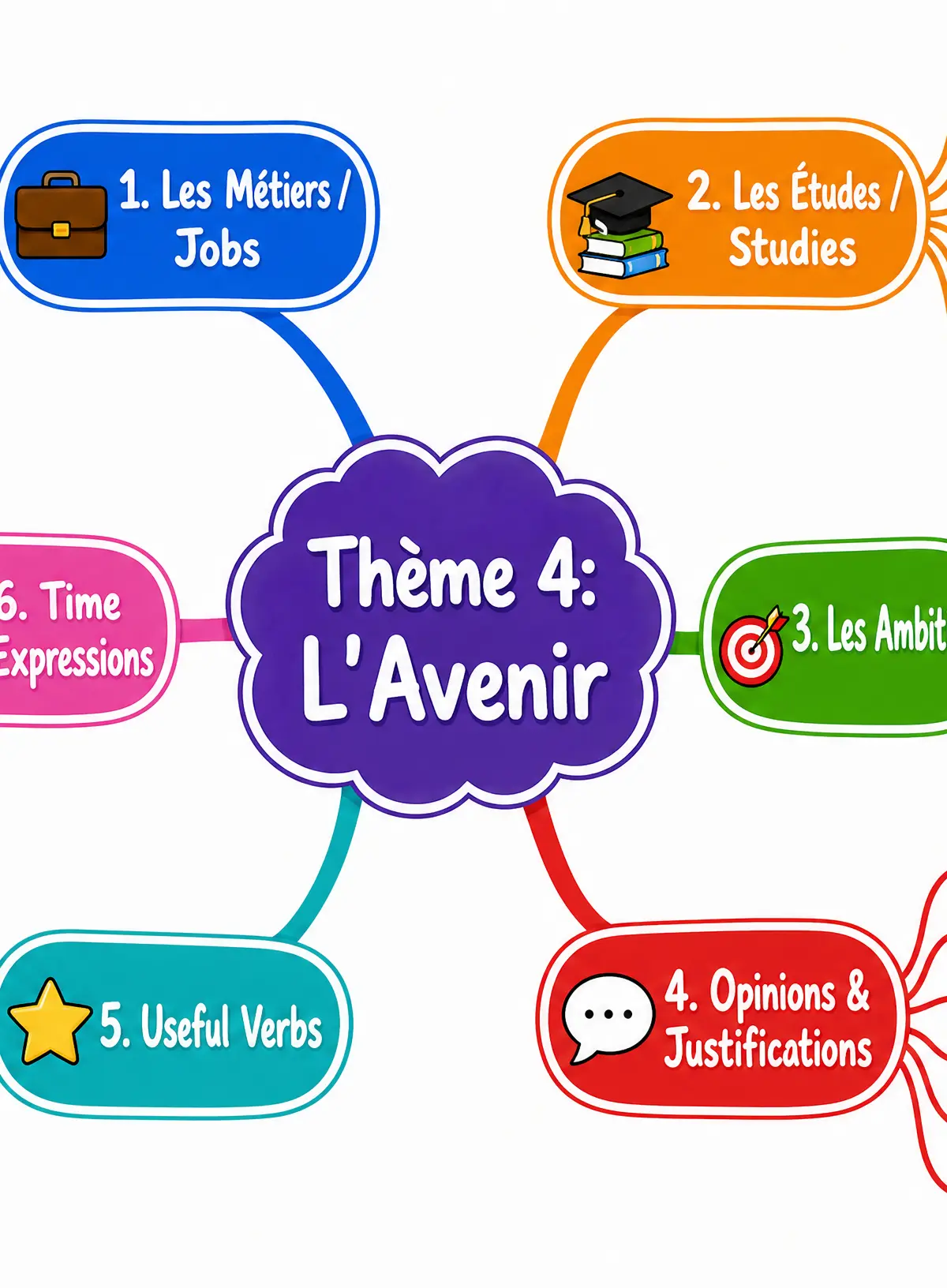
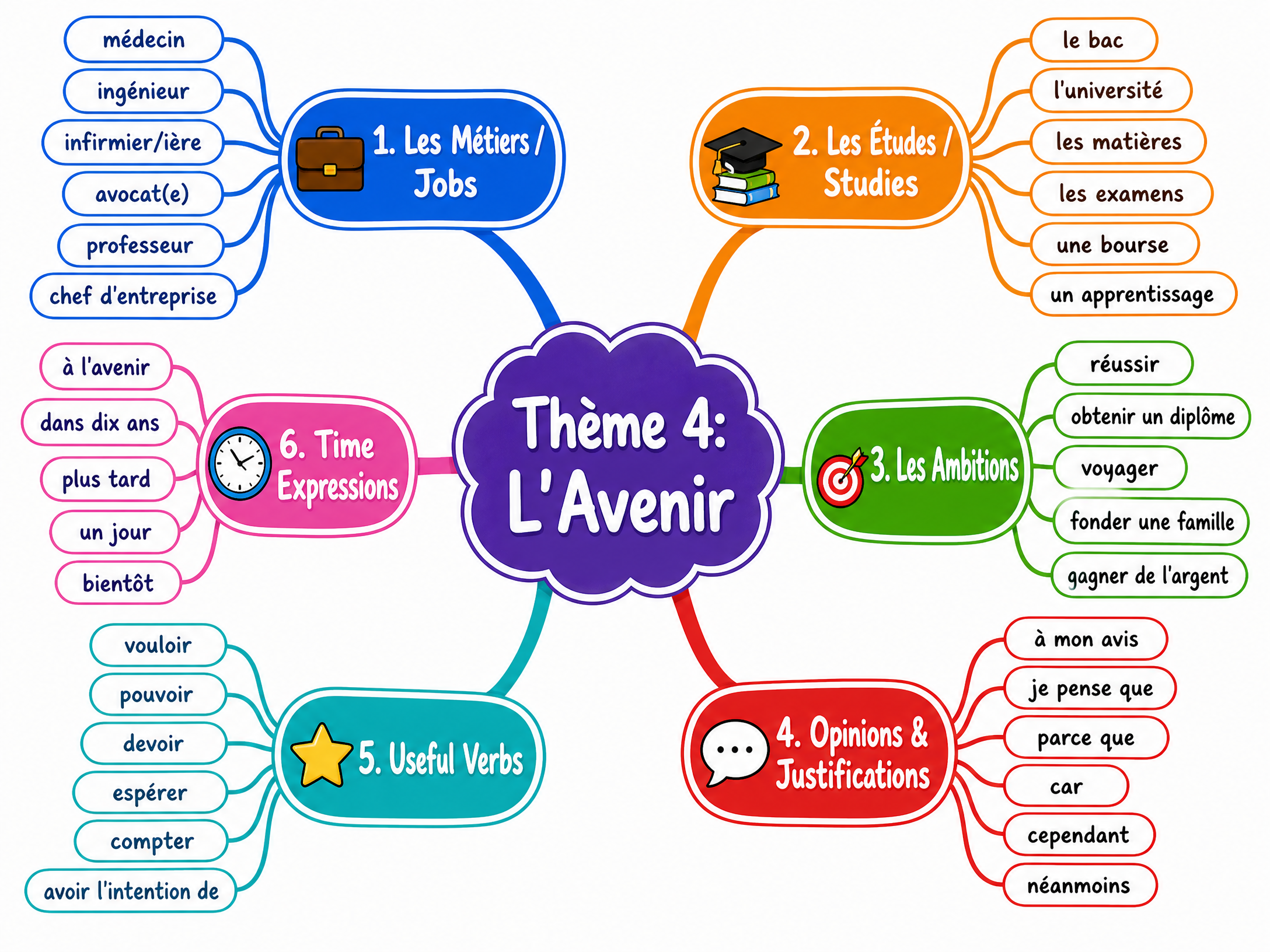
1. Les Métiers (Jobs and Professions)
Core Vocabulary:
- Un médecin (Doctor)
- Un(e) infirmier/ière (Nurse)
- Un(e) ingénieur(e) (Engineer)
- Un(e) avocat(e) (Lawyer)
- Un professeur (Teacher)
- Un chef d'entreprise (Business owner)
Examiner Tip: Pay close attention to gender agreements when discussing professions. For example, un acteur becomes une actrice, and un boulanger becomes une boulangère. If you are unsure of the feminine form in a speaking exam, you can use the gender-neutral phrase Je voudrais travailler comme... (I would like to work as...).
2. Les Études (Studies and Education)
Core Vocabulary:
- Le baccalauréat / le bac (A-Levels equivalent)
- L'université / la fac (University)
- Les matières (School subjects)
- Les examens (Exams)
- Une bourse (A scholarship)
- Un apprentissage (An apprenticeship)
Why it matters: These terms frequently appear in receptive tasks (Reading and Listening). Being able to distinguish between un apprentissage and l'université is vital for answering multiple-choice or short-answer questions accurately.
3. Les Ambitions (Ambitions and Aspirations)
Core Vocabulary:
- Réussir (To succeed)
- Obtenir un diplôme (To get a degree)
- Voyager (To travel)
- Fonder une famille (To start a family)
- Gagner de l'argent (To earn money)
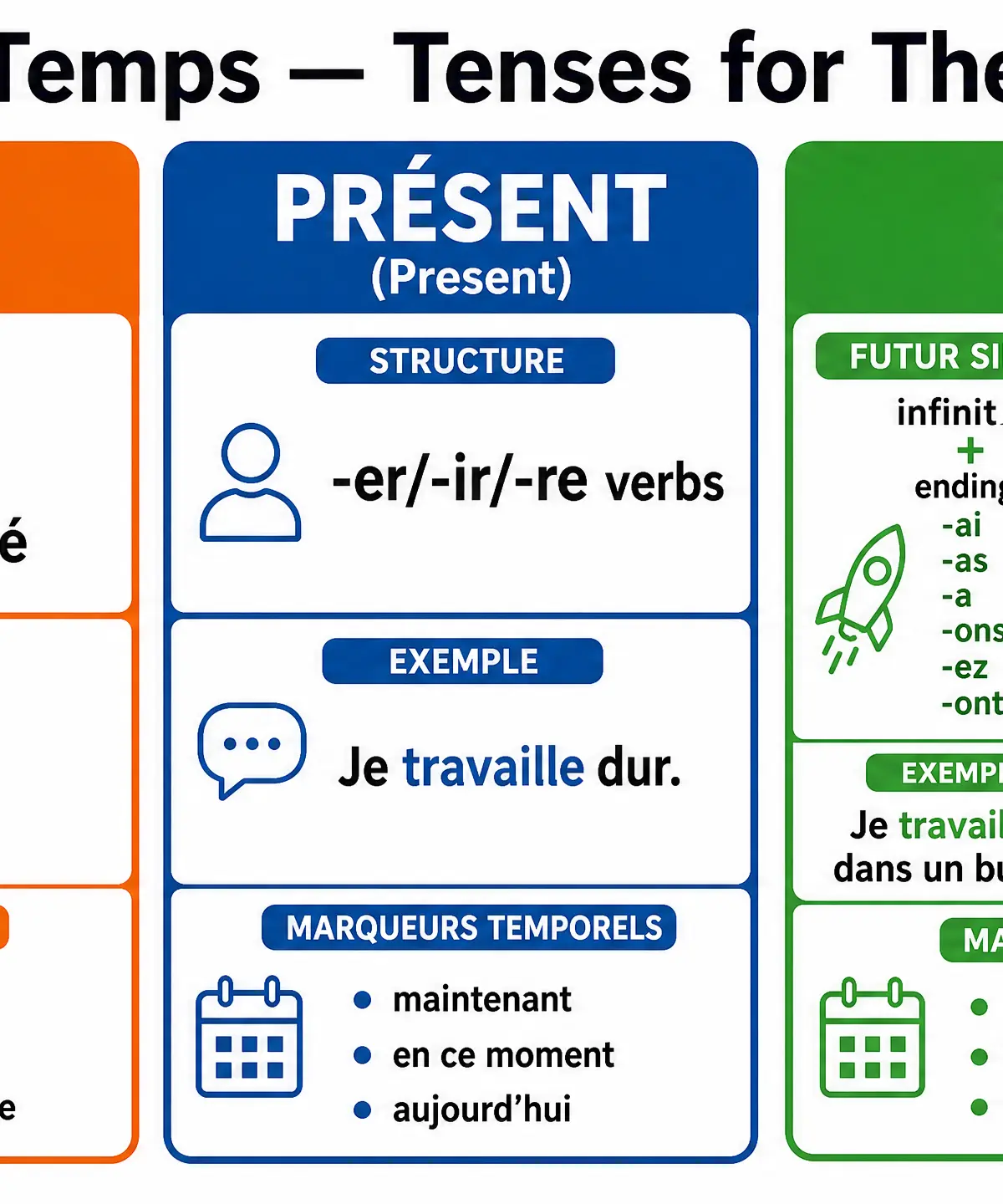
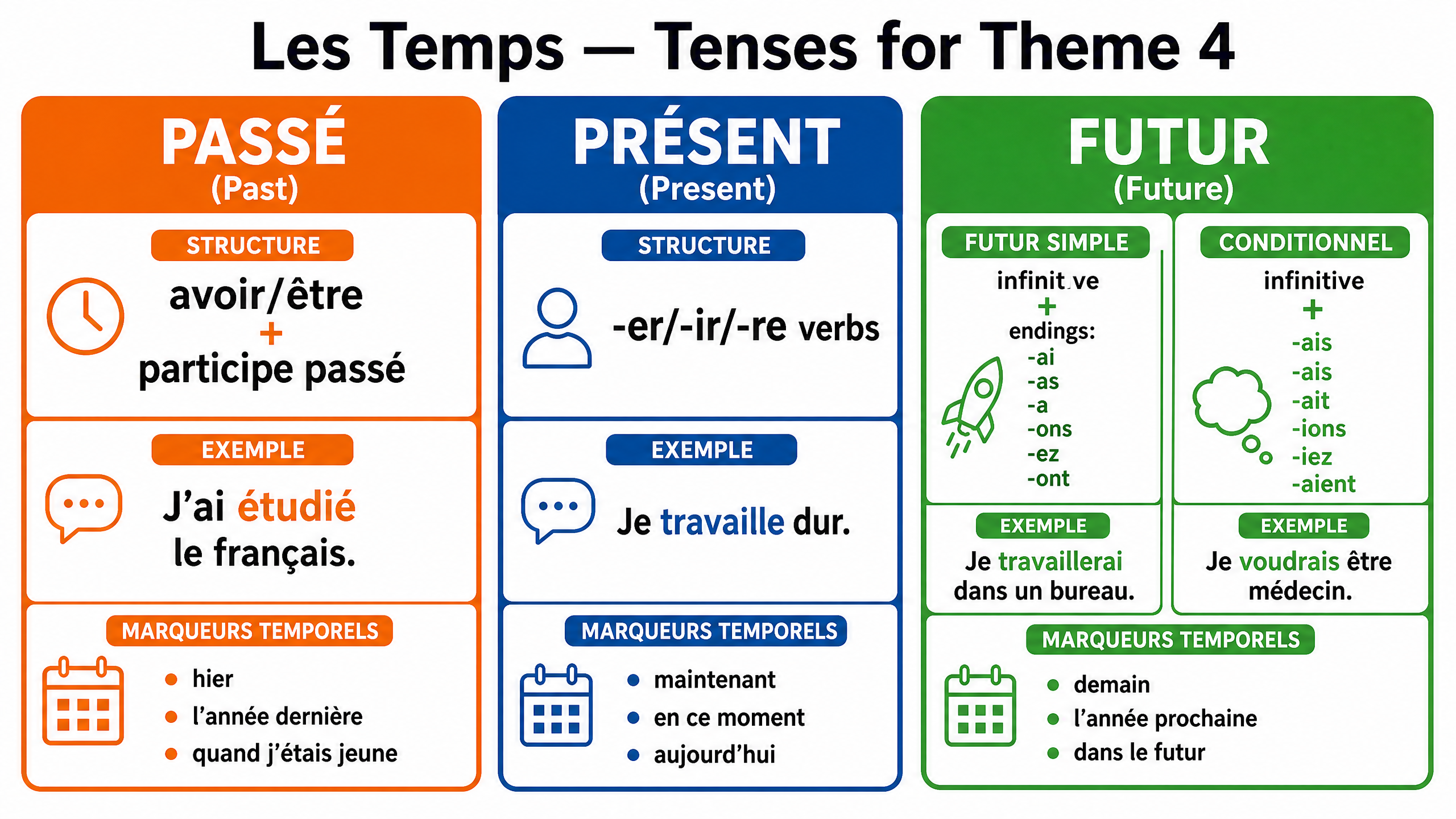
Essential Grammar: The Traffic Light Tenses
To achieve higher mark bands, candidates must refer to past, present, and future events seamlessly. Think of these as the 'Traffic Light Tenses'.
Red: The Past (Le Passé Composé)
Use this to discuss past work experience or early ambitions.
- Structure: Avoir or Être + past participle
- Example: J'ai étudié le français. (I studied French.)
- Time markers: hier (yesterday), l'année dernière (last year), quand j'étais jeune (when I was young).
Amber: The Present (Le Présent)
Use this to discuss current studies or part-time jobs.
- Structure: Regular -er, -ir, -re endings or irregular present tense verbs.
- Example: Je travaille dur. (I work hard.)
- Time markers: maintenant (now), en ce moment (at the moment), aujourd'hui (today).
Green: The Future (Le Futur Simple & Le Conditionnel)
This is where you secure the top grades by discussing future plans.
- Futur Simple Structure: Infinitive + -ai, -as, -a, -ons, -ez, -ont
- Example: Je travaillerai dans un bureau. (I will work in an office.)
- Conditionnel Structure: Infinitive + -ais, -ais, -ait, -ions, -iez, -aient
- Example: Je voudrais être médecin. (I would like to be a doctor.)
- Time markers: demain (tomorrow), l'année prochaine (next year), à l'avenir (in the future).
Expressing and Justifying Opinions
Examiners actively look for justified opinions. Stating Je pense que c'est bien (I think it's good) is insufficient for higher grades. You must develop your response using connectives.
The Magic Formula: Opinion phrase + statement + connective (parce que / car) + reason.
Example: À mon avis, il est important de travailler dur parce que je veux réussir dans la vie. (In my opinion, it is important to work hard because I want to succeed in life.)
Key Connectives for Contrast:
- Cependant (However)
- Néanmoins (Nevertheless)
- Par contre (On the other hand)
Worked Examples
3 worked examples — open one to explore the question and available guidance.
Practice Questions
Test your understanding — click to reveal model answers
Reading Task: Read the text about Luc's plans. 'L'année prochaine, je vais aller à l'université pour étudier le droit. Mon rêve est de devenir avocat parce que je veux défendre les gens. Cependant, mes parents pensent que c'est trop difficile.' What is Luc's dream job and why?
Hint: Look for the cognate 'avocat' and the reason following 'parce que'.
Writing Task (Foundation): Translate the following sentences into French: 1. I would like to be a teacher. 2. I work in a shop. 3. University is expensive.
Hint: Remember to use the conditional for 'would like', and watch out for the correct preposition for 'in a shop'.
Speaking Task (General Conversation): Que feras-tu après tes examens ? (What will you do after your exams?)
Hint: The question uses the futur simple ('feras-tu'). You must reply using a future timeframe and add a justified opinion.
Listening Task: Listen to the recording. 'Avant, je voulais être infirmier, mais maintenant je préfère les langues. À l'avenir, je serai professeur d'espagnol.' Question: How have the speaker's career plans changed?
Hint: Listen carefully for the time markers 'Avant' (Before) and 'À l'avenir' (In the future).
Writing Task (Higher): 'Le travail est plus important que les études.' (Work is more important than studies). Do you agree? Write a paragraph justifying your opinion.
Hint: Use contrast connectives (cependant, d'un côté/de l'autre côté) to provide a balanced argument before giving your final judgement.
Test your understanding of Theme 4: Future aspirations, study and work
Active recall beats re-reading. Take an instant quiz now to test what you’ve learned and lock it into long-term memory.
7 days Premium · Then free forever · No card, no charge