Pearson Edexcel · GCSE · French
Town, region and country
Master the essential GCSE French topic of 'La Ville, La Région et Le Pays' (Town, Region and Country). This comprehensive guide provides you with the key vocabulary, structures, and exam techniques needed to describe your local area, express justified opinions, and achieve top marks.
- 3 min read
- 3 worked examples
- 5 practice questions
- 6 key terms
Study Notes
Overview

The topic of 'Town, Region and Country' (La Ville, La Région et Le Pays) is a cornerstone of the GCSE French specification, falling under the broader theme of 'Local, national, international and global areas of interest'. Examiners frequently use this topic to test your ability to describe places, compare locations (such as town vs. countryside), and express justified opinions about where you live.
To succeed, candidates must demonstrate a strong command of place-related vocabulary, accurate use of the il y a structure, and the ability to use three distinct time frames (past, present, and future) when describing their local area. This guide covers all the essential knowledge and exam techniques required to excel.
Key Vocabulary: Places & Buildings
In the Town (En Ville)
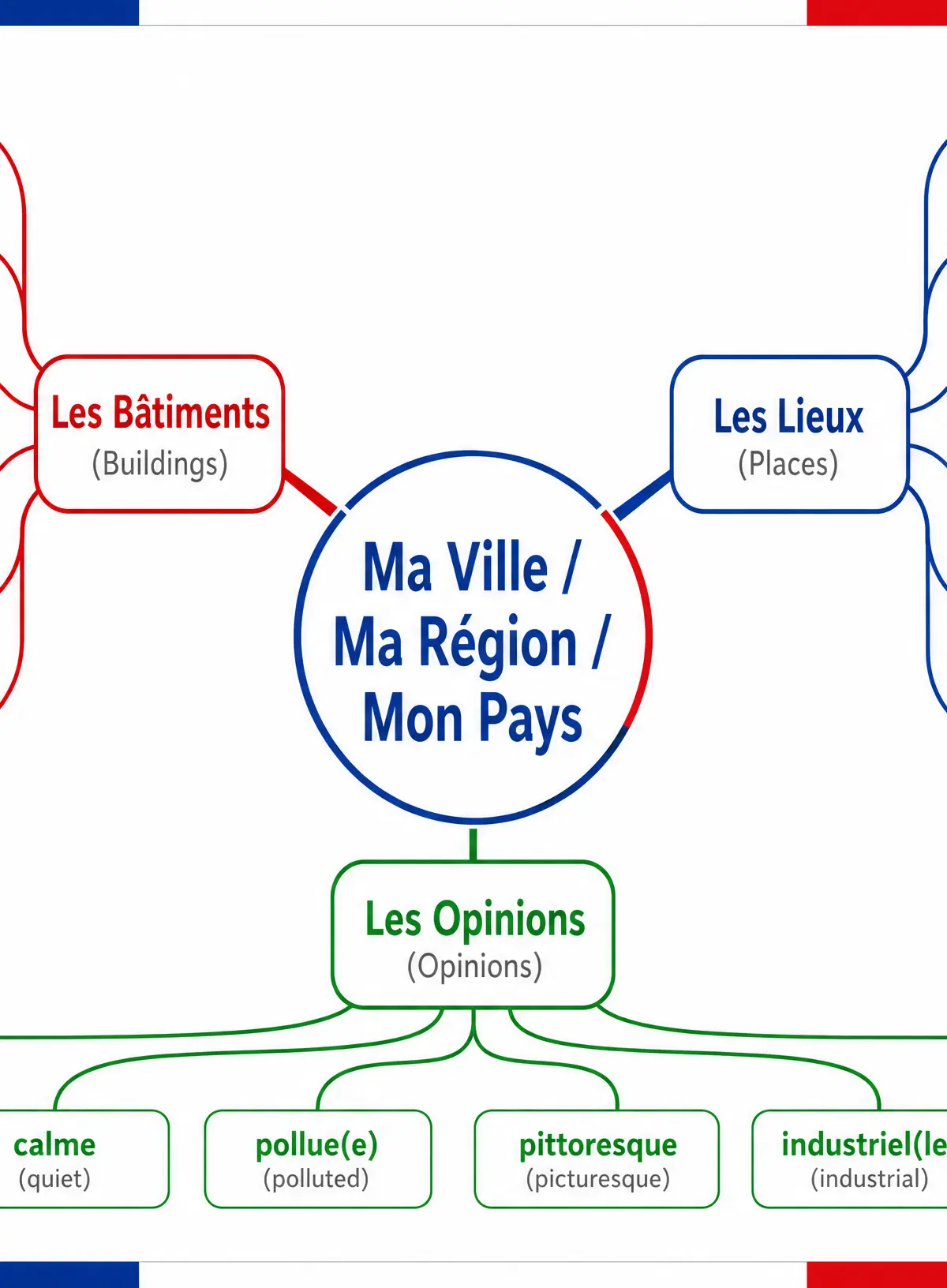
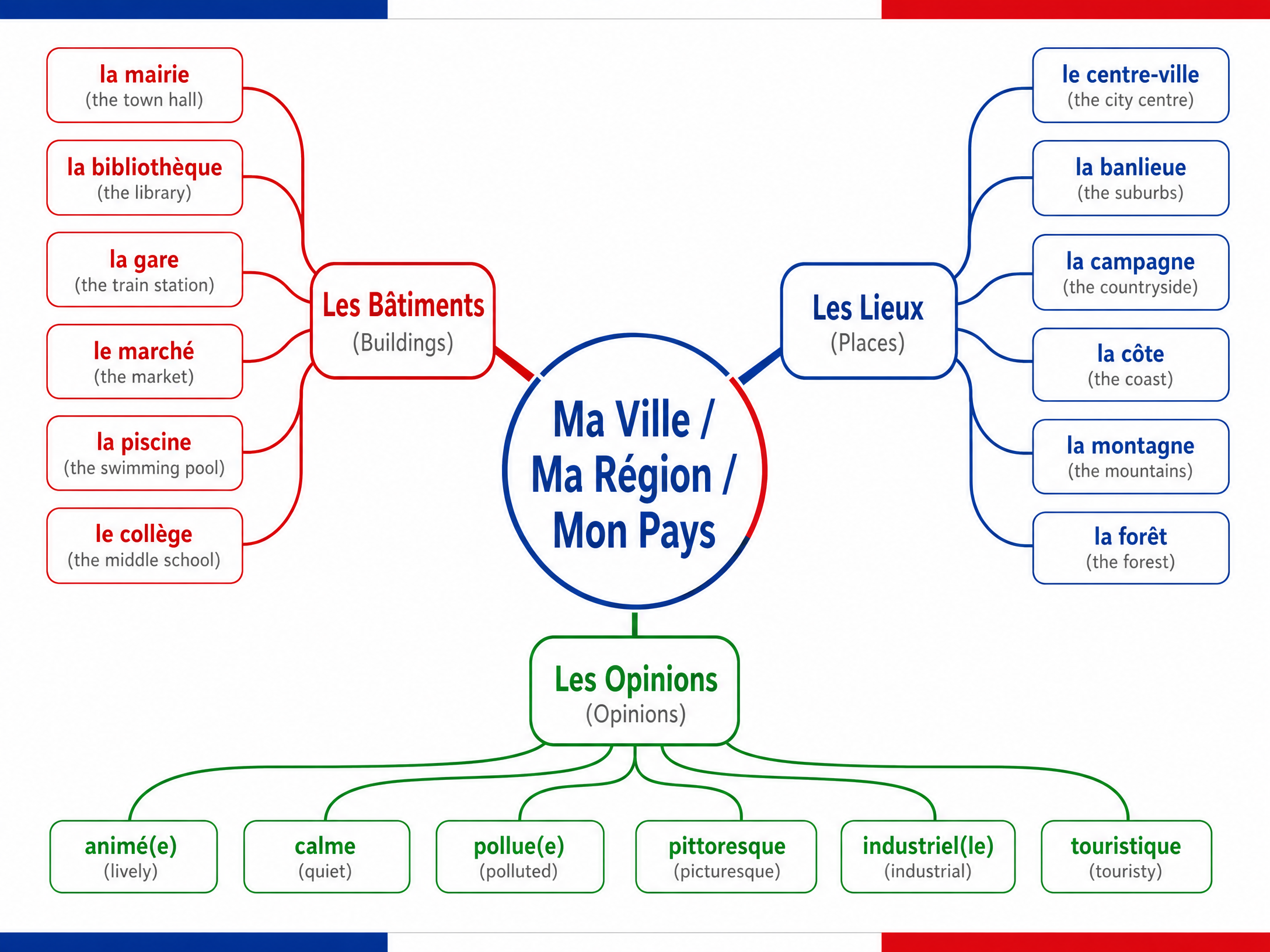
Key Buildings: la mairie (town hall), la bibliothèque (library), la gare (train station), le marché (market), la piscine (swimming pool), le centre commercial (shopping centre).
Specific Knowledge: Examiners reward the accurate use of gendered nouns. Ensure you learn whether a place is masculine (le/un) or feminine (la/une).
Types of Areas
Locations: le centre-ville (town centre), la banlieue (suburbs), la campagne (countryside), la côte (coast), la montagne (mountains), la forêt (forest).
Core Grammatical Structures
Using 'Il y a' (There is/are)
This is the most critical structure for this topic.
- Present:
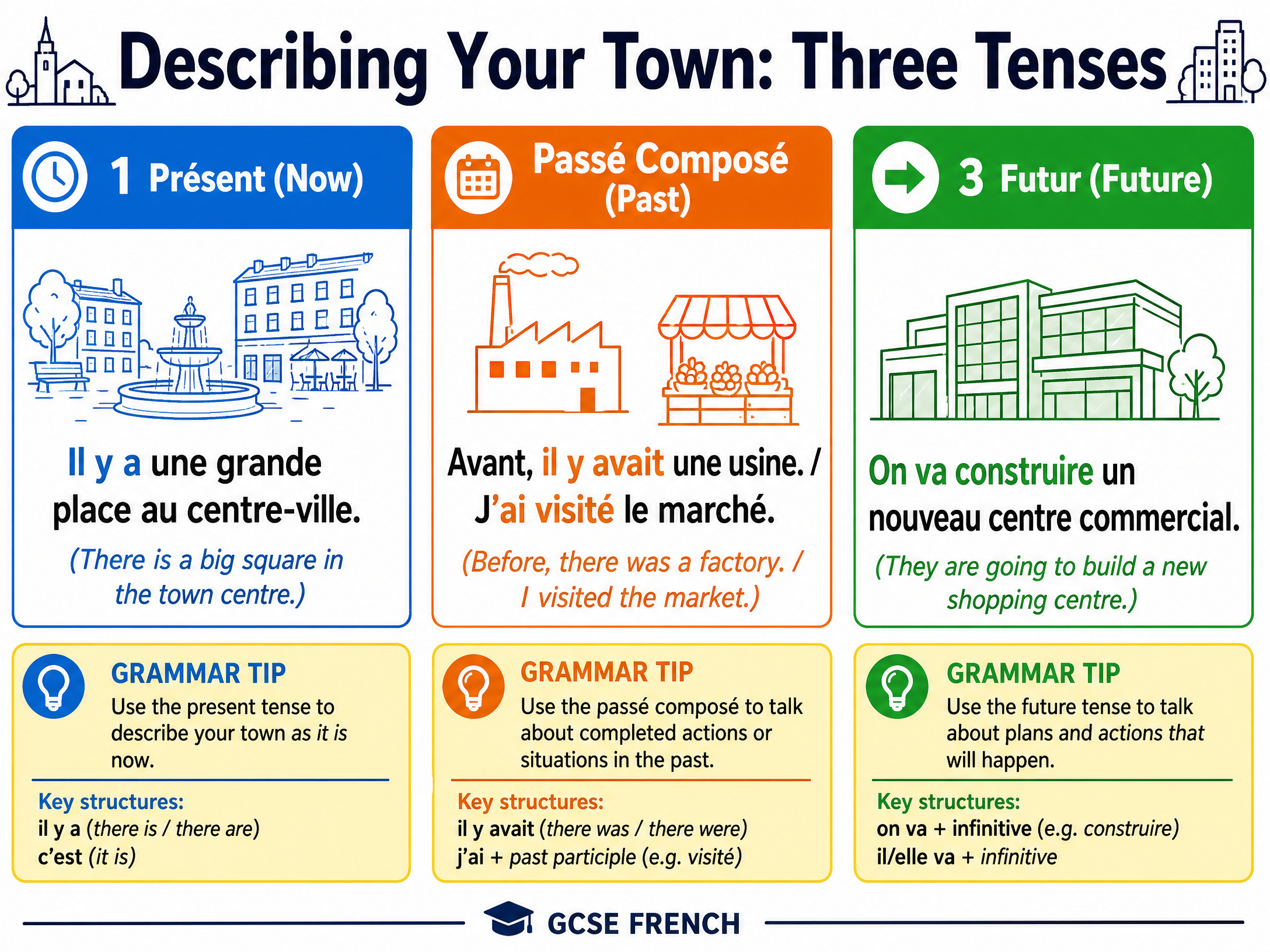
Il y a(There is / There are) e.g., Il y a un grand parc. (There is a big park.) - Negative:
Il n'y a pas de(There isn't / aren't any) e.g., Il n'y a pas de cinéma. (There isn't a cinema.)
The Three Time Frames (PPF)
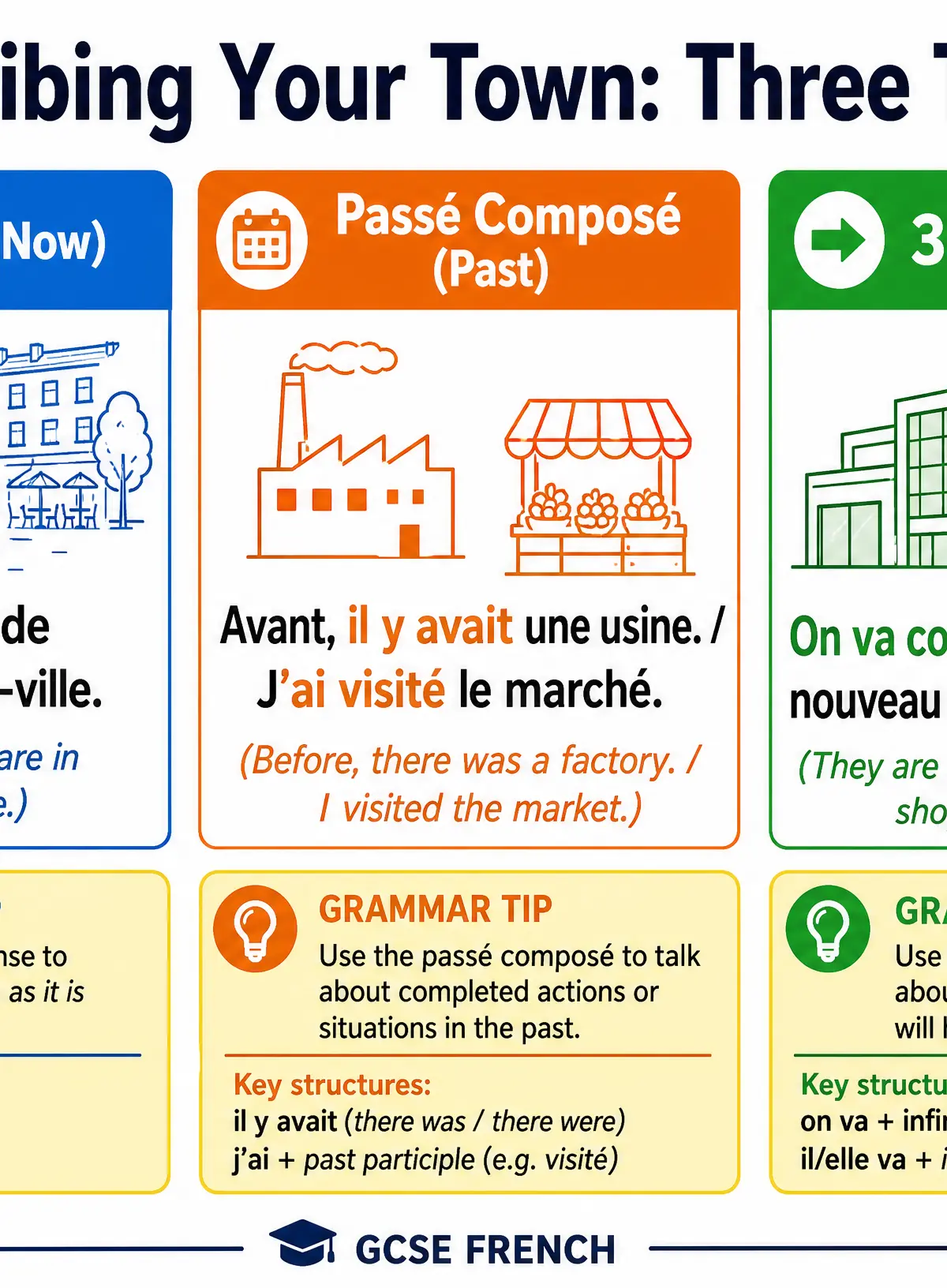
Examiners explicitly look for references to the past, present, and future. Candidates who only use the present tense will be capped at lower mark bands.
Expressing and Justifying Opinions
Opinion Adjectives
To secure higher marks, candidates must use a variety of adjectives to describe their town, ensuring they agree with the noun (e.g., adding an 'e' for feminine nouns).
- Positive: animé(e) [lively], pittoresque [picturesque], propre [clean], historique [historic].
- Negative: bruyant(e) [noisy], pollué(e) [polluted], sale [dirty], ennuyeux/ennuyeuse [boring].
Justification
Always follow an opinion with a reason using connectives: parce que (because), car (because), cependant (however).
Audio Revision
Listen to our comprehensive podcast covering all key aspects of this topic, including pronunciation practice and examiner tips.
Interactive Diagrams
1 interactive diagram to visualise key concepts
Conceptual Flow Outline
Mind map of essential town vocabulary
Worked Examples
3 worked examples — open one to explore the question and available guidance.
Practice Questions
Test your understanding — click to reveal model answers
Write about your town/region. You must include: what there is in your town, what you think of it, what it was like in the past, and what you will do there next weekend. (90 words)
Hint: Ensure you cover all 4 bullet points clearly. Use PPF (Present, Past, Future) and justify your opinions.
Translate into French: 1. In my town there is a big park. 2. I like the countryside because it is quiet. 3. Next year, they are going to build a new swimming pool.
Hint: Watch out for adjective agreements (big park) and the correct future tense structure (aller + infinitive).
Speaking Role-play: Your French exchange partner asks you what the disadvantages of your town are. How do you respond?
Hint: Use negative structures and negative adjectives.
Reading Comprehension Extract: 'J'adore ma région car le paysage est magnifique. L'hiver dernier, il y avait beaucoup de neige, donc j'ai fait du ski. Bientôt, la nouvelle gare sera ouverte.' Question: What did the writer do last winter?
Hint: Look for the past tense verb associated with 'l'hiver dernier'.
Write a 150-word essay on the topic: 'La vie en ville est meilleure que la vie à la campagne.' (City life is better than country life). Discuss advantages and disadvantages.
Hint: This requires a balanced argument, comparative language, and high-level vocabulary.
Test your understanding of Town, region and country
Active recall beats re-reading. Take an instant quiz now to test what you’ve learned and lock it into long-term memory.
7 days Premium · Then free forever · No card, no charge