Pearson Edexcel · GCSE · French
Travel and tourist transactions
Master the essentials of Travel and Tourist Transactions for GCSE French. This guide covers vital vocabulary, key grammar structures like the three time frames, and transactional role-plays to ensure you secure top marks across all four skills.
- 4 min read
- 3 worked examples
- 5 practice questions
- 6 key terms
Study Notes

Overview
The 'Travel and Tourist Transactions' topic is a cornerstone of the GCSE French specification, falling under the broader theme of holidays and travel. It is highly practical and frequently assessed across all four exam papers: Listening, Reading, Speaking, and Writing. Examiners expect candidates to demonstrate the ability to navigate real-life transactional scenarios—such as booking accommodation, purchasing transport tickets, and requesting information at a tourist office.
To achieve the highest grades, candidates must move beyond simple vocabulary recall. Success requires the accurate application of key grammar structures, particularly the use of three distinct time frames (past, present, and future), correct gender agreements, and the ability to give and justify opinions using extended sentences. This guide provides the essential vocabulary, grammatical frameworks, and exam techniques needed to excel in this topic.
Key Vocabulary & Transactions
1. Transport (Les Transports)
Accurate vocabulary and preposition use are vital when discussing transport.
Key Vocabulary:
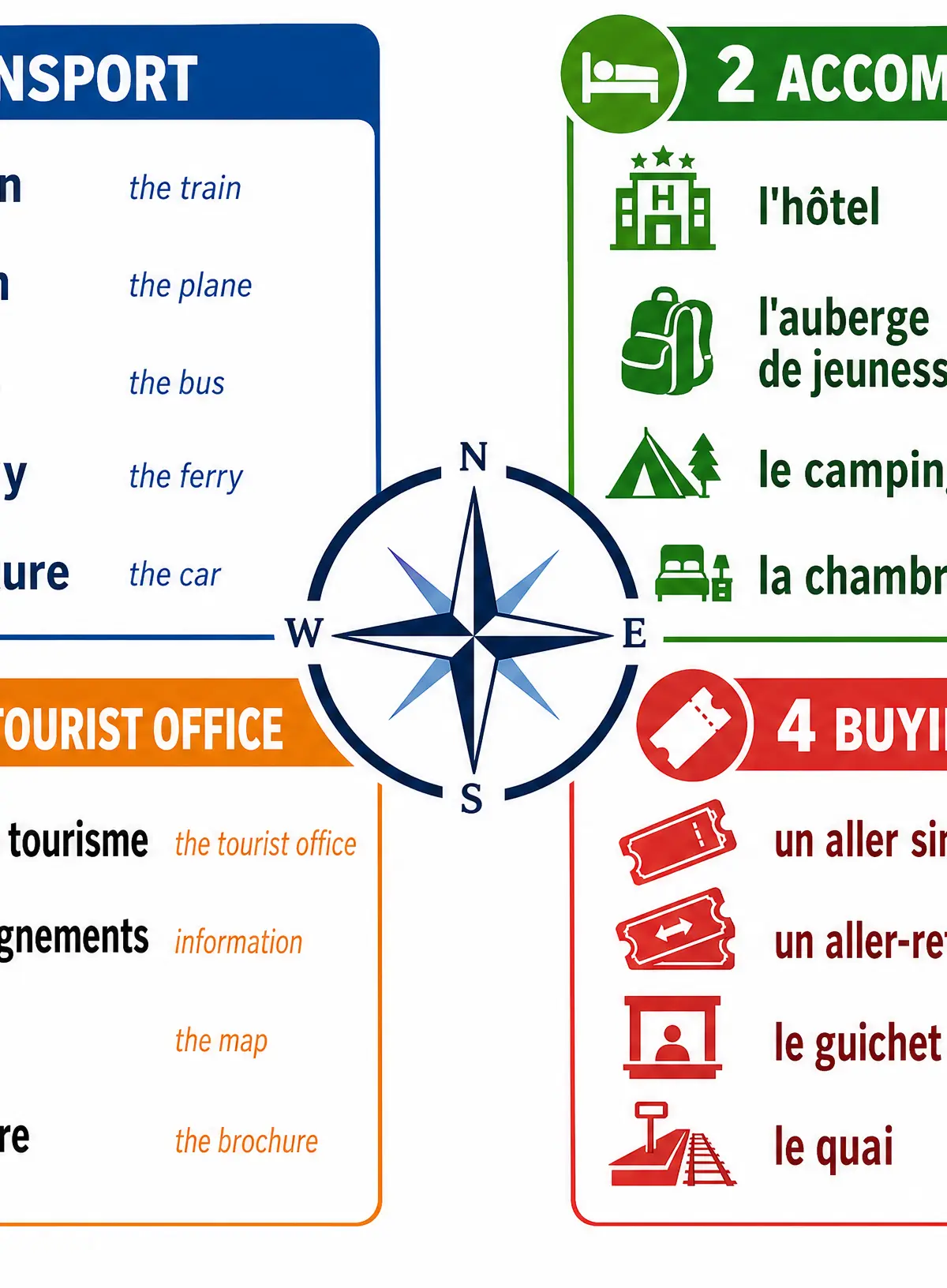
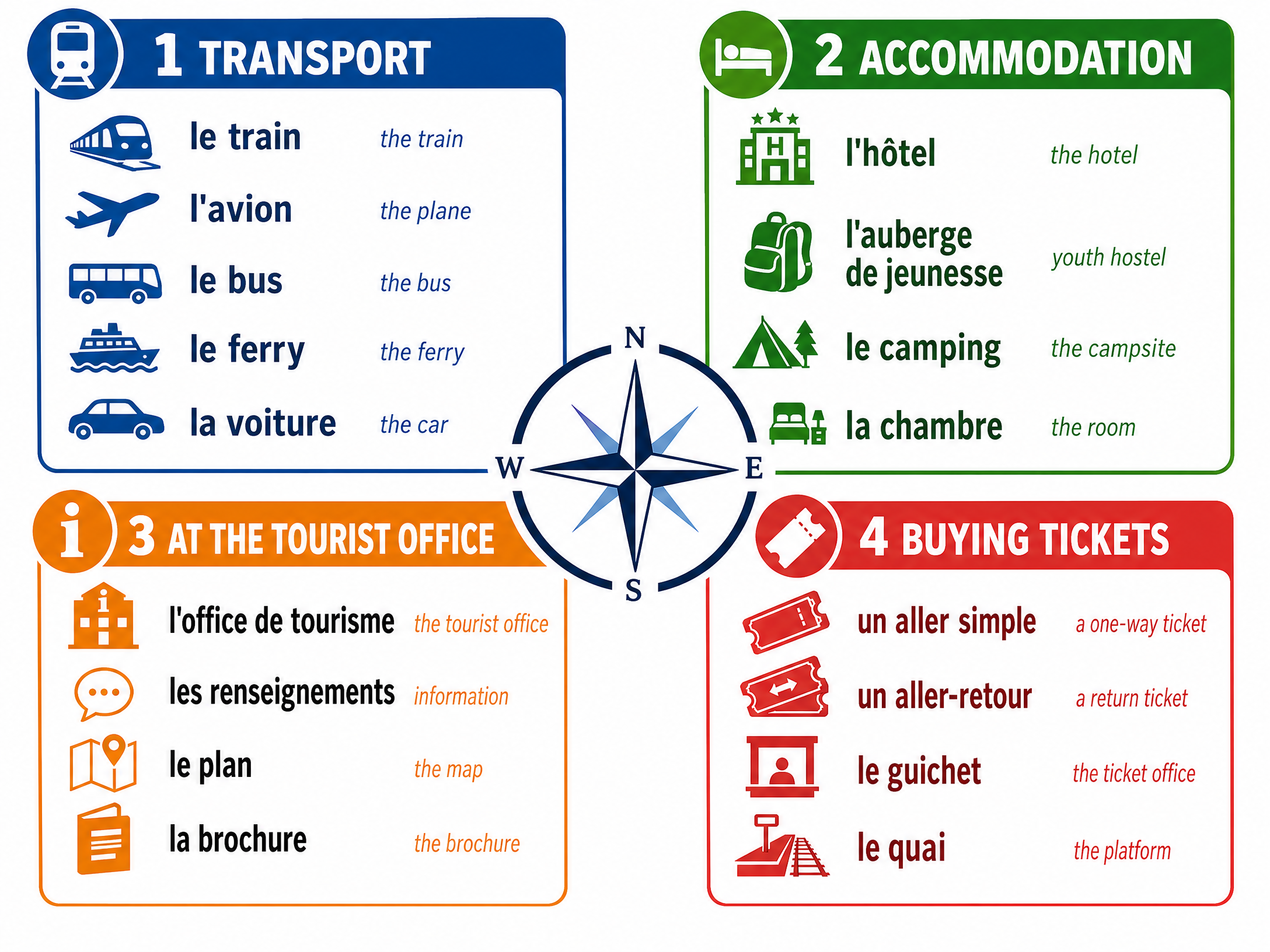
- le train (train)
- l'avion (plane)
- le bus / le car (bus / coach)
- la voiture (car)
- le ferry (ferry)
- à pied (on foot)
- à vélo (by bike)
Examiner Focus: Candidates are frequently tested on the correct preposition. Use en for enclosed transport (en train, en voiture) and à for open transport or walking (à pied, à vélo).
2. Buying Tickets (À la Gare / À l'Aéroport)
Transactional role-plays often feature ticket purchases.
Key Phrases:
- Je voudrais un billet pour Paris, s'il vous plaît. (I would like a ticket to Paris, please.)
- Un aller simple (A single/one-way ticket)
- Un aller-retour (A return ticket)
- Le prochain train part à quelle heure ? (What time does the next train leave?)
- Le train a du retard. (The train is delayed.)
3. Accommodation (L'Hébergement)
Booking and describing accommodation is a common writing and speaking task.
Key Vocabulary:
- l'hôtel (hotel)
- l'auberge de jeunesse (youth hostel)
- le camping (campsite)
- la chambre d'hôtes (B&B)
Key Phrases:
- Je voudrais réserver une chambre pour deux nuits. (I would like to book a room for two nights.)
- Avec salle de bains. (With a bathroom.)
- Le petit-déjeuner est-il inclus ? (Is breakfast included?)
4. The Tourist Office (À l'Office de Tourisme)
Candidates must be able to ask for information and understand replies.
Key Phrases:
- Avez-vous un plan de la ville ? (Do you have a map of the town?)
- Quelles sont les heures d'ouverture ? (What are the opening hours?)
- Combien coûte l'entrée ? (How much is the entry?)
Core Grammar: The Three Time Frames
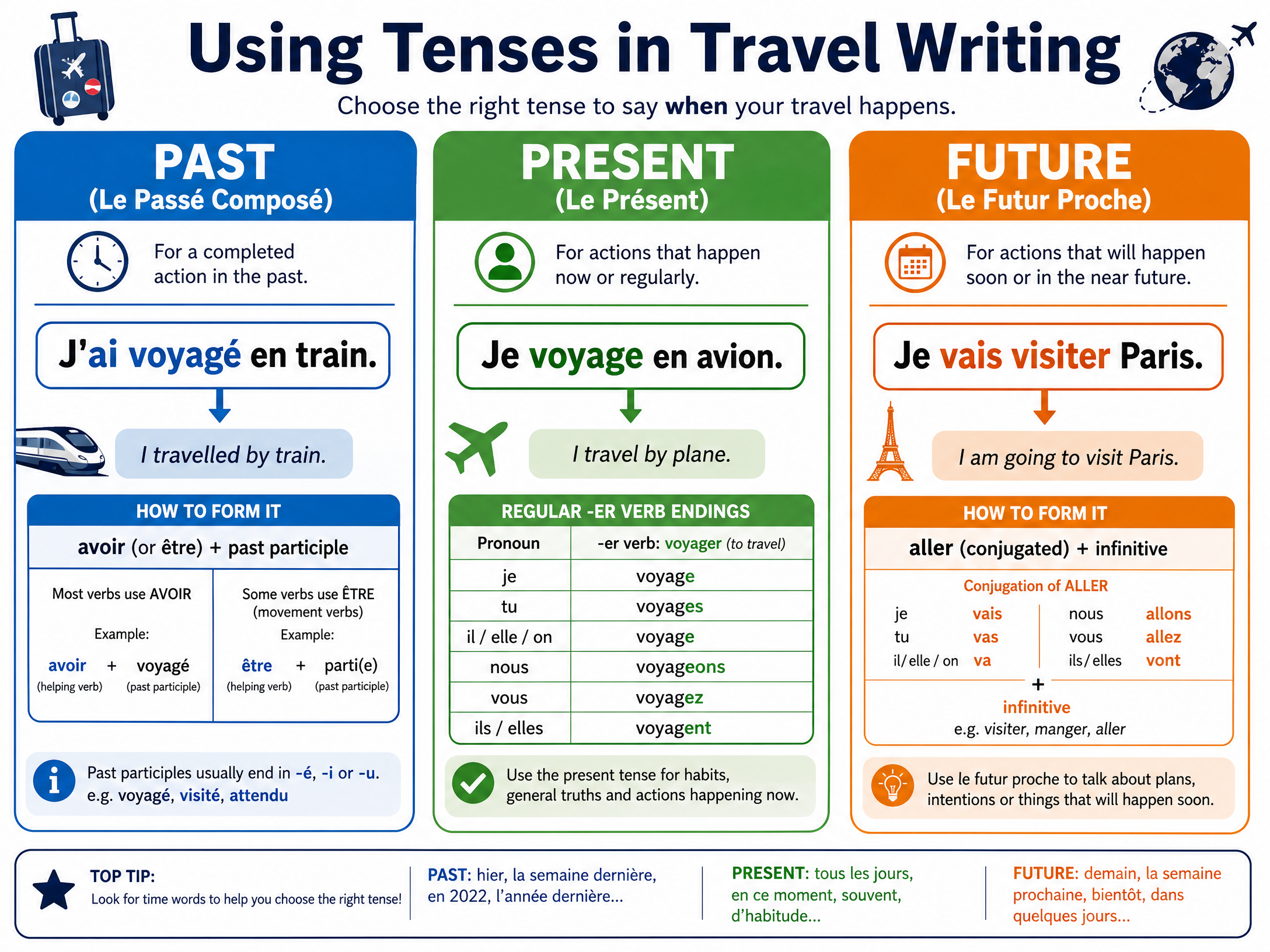
Examiners consistently reward candidates who can confidently use the past, present, and future tenses in a single response.
The Past (Le Passé Composé)
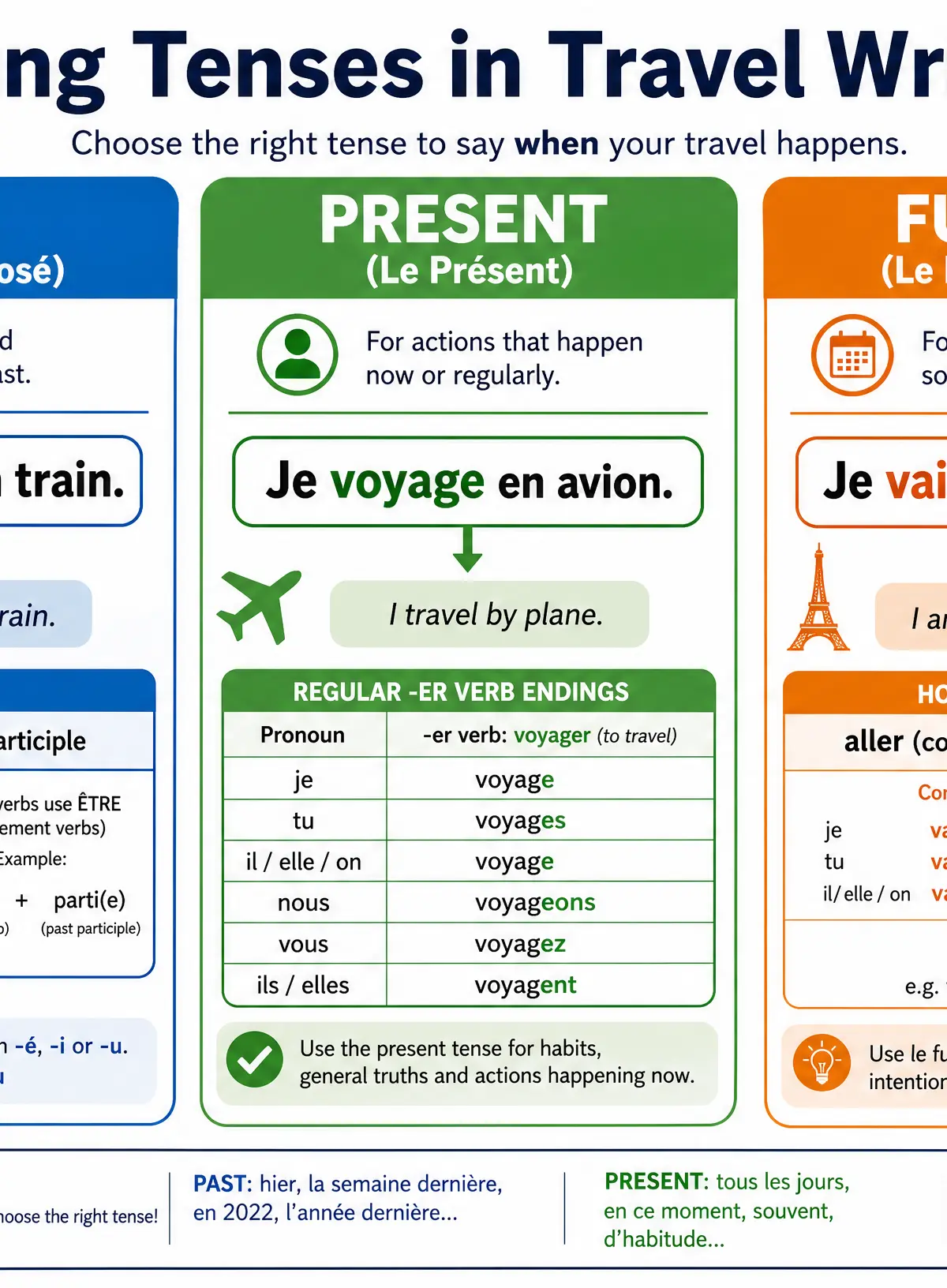
Used for completed actions. Formed with avoir or être + past participle.
- J'ai voyagé en train. (I travelled by train.)
- Je suis allé(e) en France. (I went to France.)
The Present (Le Présent)
Used for current actions or general truths.
- Je voyage souvent en avion. (I often travel by plane.)
- Il fait beau. (The weather is nice.)
The Future (Le Futur Proche)
Used for plans and intentions. Formed with aller (conjugated) + infinitive.
- Je vais visiter les monuments. (I am going to visit the monuments.)
- Nous allons rester dans un hôtel. (We are going to stay in a hotel.)
Giving and Justifying Opinions
To access higher mark bands, candidates must provide opinions and justify them using complex sentences.
Opinion Starters:
- À mon avis (In my opinion)
- Je pense que (I think that)
- Je trouve que (I find that)
Justifications:
- parce que / car (because)
- puisque (since)
- donc (therefore)
Example: Je préfère voyager en train parce que c'est plus rapide et plus confortable que la voiture. (I prefer travelling by train because it is faster and more comfortable than the car.)
Visual Resources
2 diagrams and illustrations
Interactive Diagrams
1 interactive diagram to visualise key concepts
Conceptual Flow Outline
Navigating Tourist Transactions
Worked Examples
3 worked examples — open one to explore the question and available guidance.
Practice Questions
Test your understanding — click to reveal model answers
Speaking Role-play: You are at the tourist office in Paris. Ask the assistant for a map of the city and ask what time the museums open. (10 marks)
Hint: Remember to use polite forms ('Je voudrais' or 'Avez-vous') and the correct vocabulary for map and opening times.
Writing (90 words): Write a blog post about your recent stay at a French campsite. Include: where it was, what the facilities were like, what you did there, and if you would recommend it. (16 marks)
Hint: Ensure you use the past tense for what you did, the imperfect for describing the facilities, and give a justified opinion.
Reading Comprehension: Read the text and answer in English. 'L'année dernière, nous avons logé dans une auberge de jeunesse. C'était bon marché mais très bruyant.' What type of accommodation did they stay in, and what were the two opinions given? (3 marks)
Hint: Look for the translation of 'auberge de jeunesse', 'bon marché', and 'bruyant'.
Translation into French: We are going to travel by train because it is fast. (3 marks)
Hint: Use the futur proche for 'we are going to travel'.
Speaking Picture Task: Describe a photo showing people waiting at a train station. Mention who is in the photo, where they are, and what they are doing. (15 marks)
Hint: Use phrases like 'Sur la photo il y a...', 'Ils sont...', and the present tense for actions.
Test your understanding of Travel and tourist transactions
Active recall beats re-reading. Take an instant quiz now to test what you’ve learned and lock it into long-term memory.
7 days Premium · Then free forever · No card, no charge