Pearson Edexcel · GCSE · French
What school is like
Mastering the 'La Vie Scolaire' topic is essential for success in GCSE French, as it frequently appears across all four exam papers. This comprehensive guide covers crucial vocabulary, tenses, and opinion phrases needed to access the highest mark bands.
- 4 min read
- 3 worked examples
- 5 practice questions
- 6 key terms
Study Notes

Overview
The topic of 'What school is like' (La Vie Scolaire) falls under the broader thematic context of 'My personal world'. It is a cornerstone of the GCSE French specification and is highly likely to feature in your speaking, writing, reading, and listening assessments. Examiners expect candidates to communicate confidently about their school environment, daily routines, subjects, and teachers. Crucially, to access the highest mark bands, you must be able to express and justify opinions, refer to past, present, and future school events, and use accurate, varied vocabulary. This guide will walk you through everything you need to secure top marks.
Essential Vocabulary
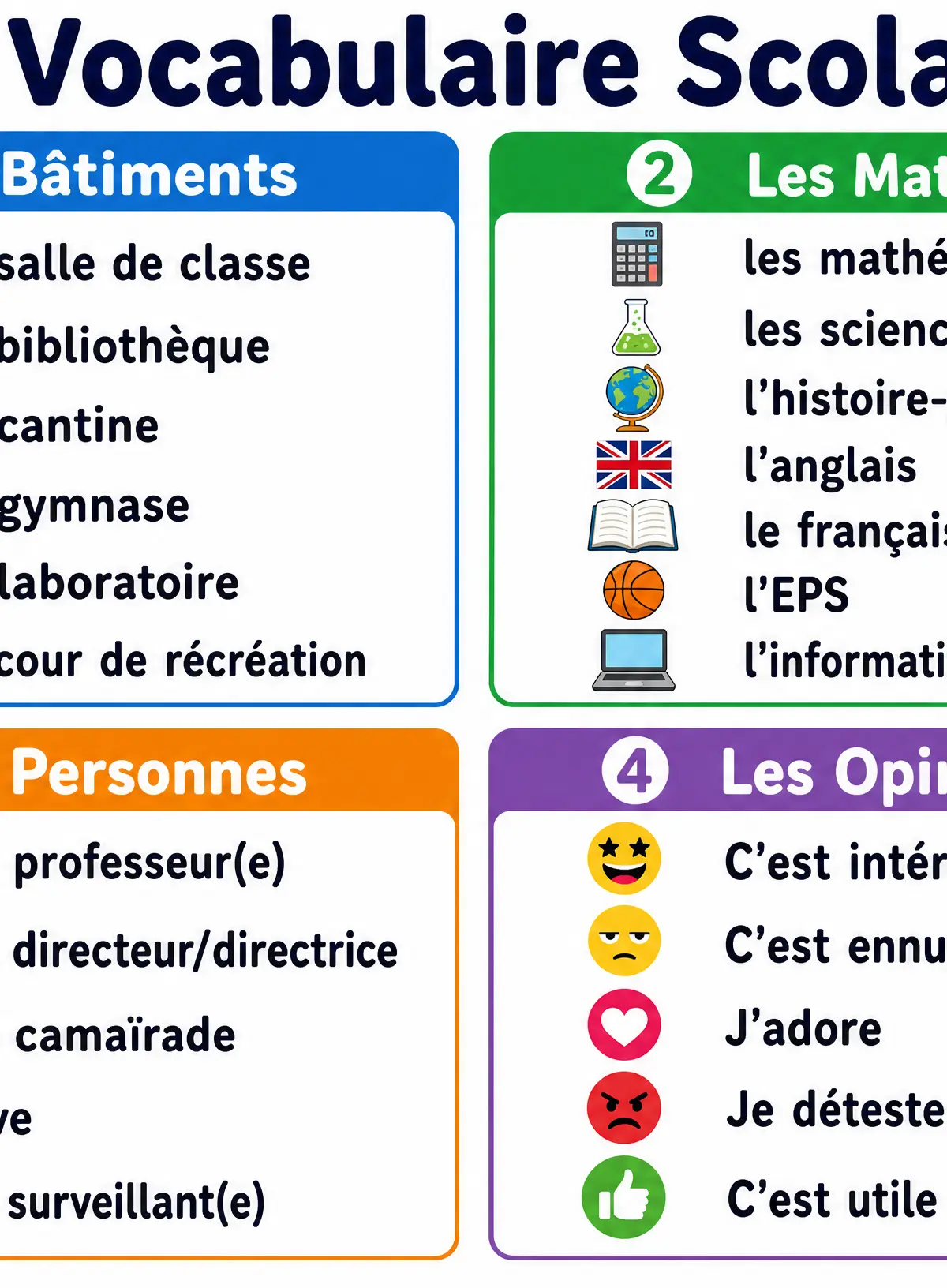
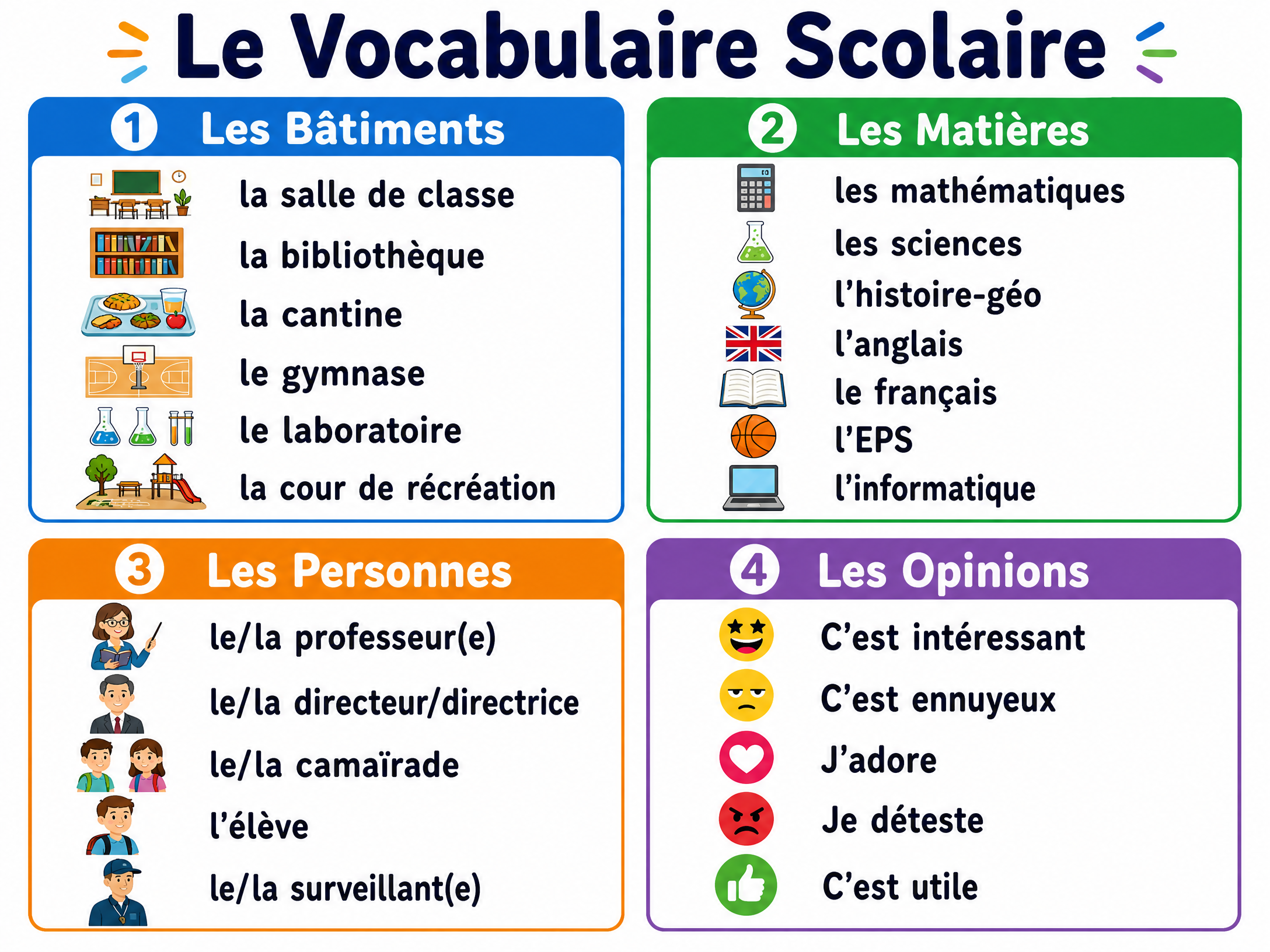
Les Matières (School Subjects)
To score well, ensure you use the correct definite article (le, la, l', les) with each subject.
- les mathématiques (les maths): maths
- les sciences: science
- l'histoire-géographie (l'histoire-géo): history and geography
- l'anglais: English
- le français: French
- l'EPS (l'éducation physique et sportive): PE
- l'informatique: computing/IT
- la musique: music
- les arts plastiques: art
Les Bâtiments (School Buildings)
- la salle de classe: classroom
- la bibliothèque: library
- la cantine: canteen
- le gymnase: gym
- le laboratoire: science lab
- la cour de récréation: playground
- la permanence: supervised study room
Les Personnes (People at School)
- le professeur / la professeure: teacher
- le directeur / la directrice: headteacher
- le/la camarade de classe: classmate
- l'élève: pupil
- le surveillant / la surveillante: supervisor
Mastering the Tenses
Examiners explicitly look for the ability to refer to past, present, and future events. This is non-negotiable for higher grades.
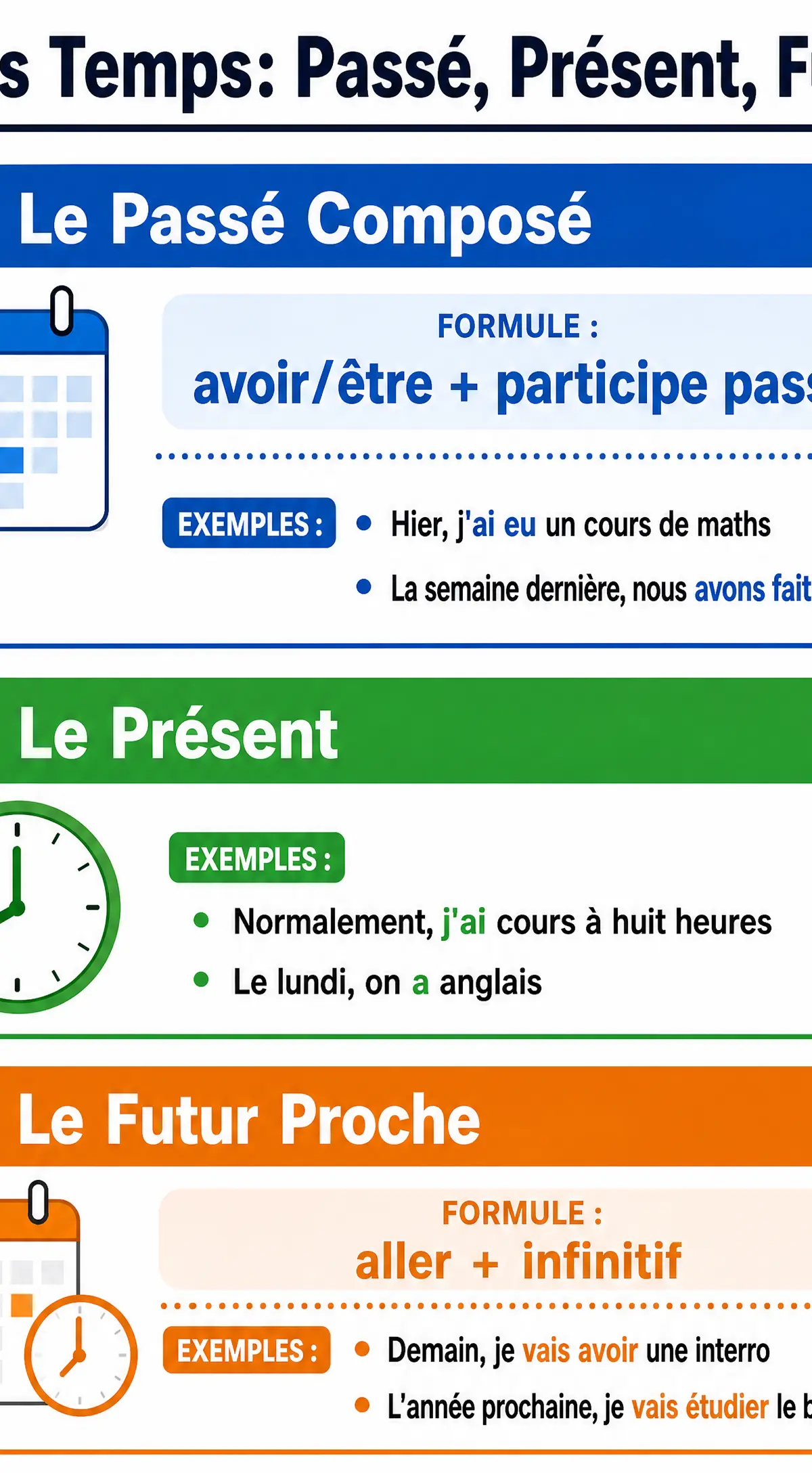
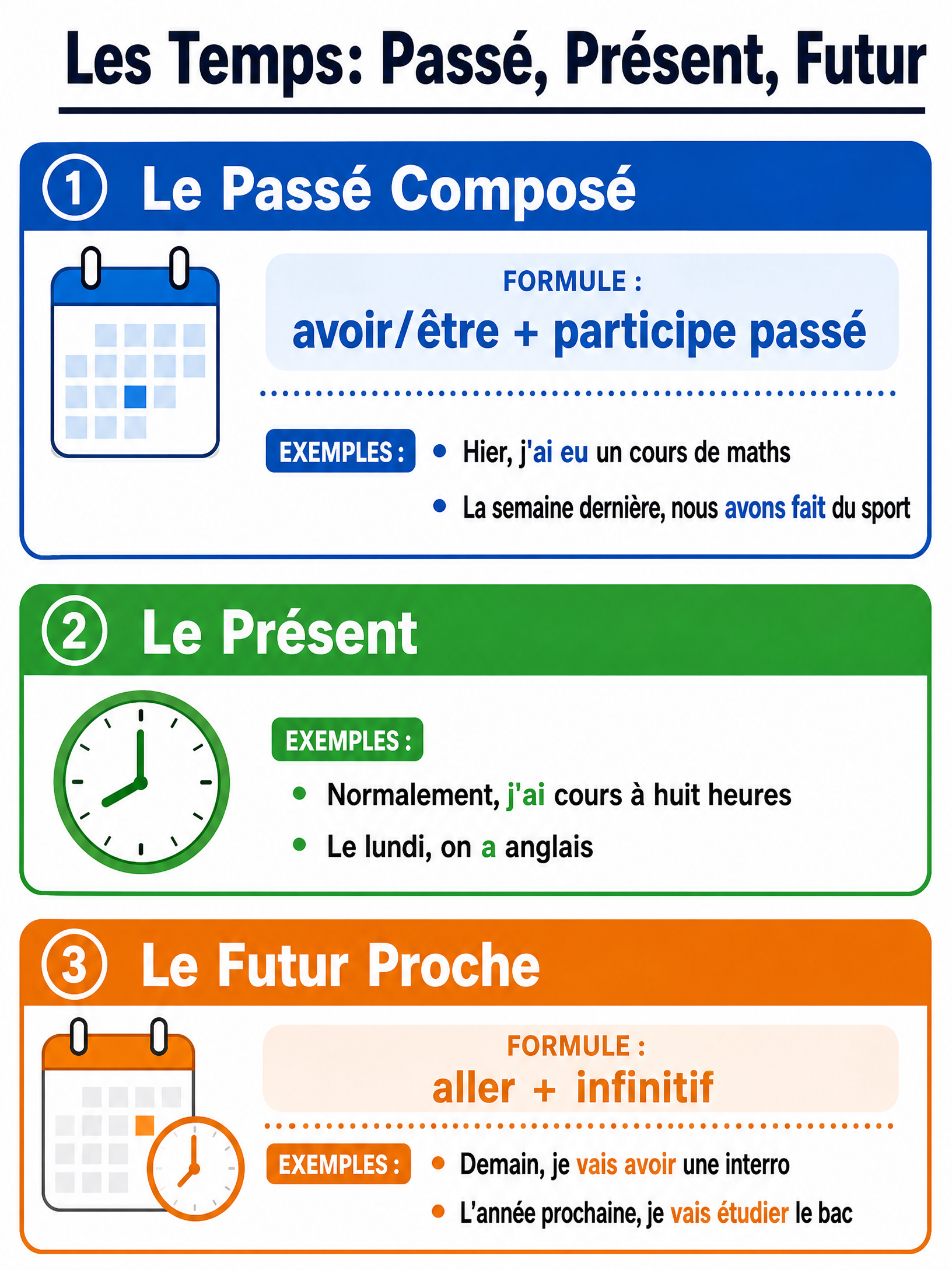
Le Présent (The Present Tense)
Use this for routines and general opinions.
- Normalement, j'ai cours à huit heures. (Normally, I have lessons at eight o'clock.)
- Le lundi, on a anglais. (On Mondays, we have English.)
Le Passé Composé (The Past Tense)
Use this for specific events that happened in the past (e.g., yesterday, last week).
- Formula: avoir/être + participe passé
- Hier, j'ai eu un cours de maths. (Yesterday, I had a maths lesson.)
- La semaine dernière, nous avons fait du sport. (Last week, we did sport.)
Le Futur Proche (The Near Future Tense)
Use this for plans and upcoming events.
- Formula: aller (conjugated) + infinitif
- Demain, je vais avoir une interro. (Tomorrow, I am going to have a test.)
- L'année prochaine, je vais étudier le bac. (Next year, I am going to study for the baccalauréat.)
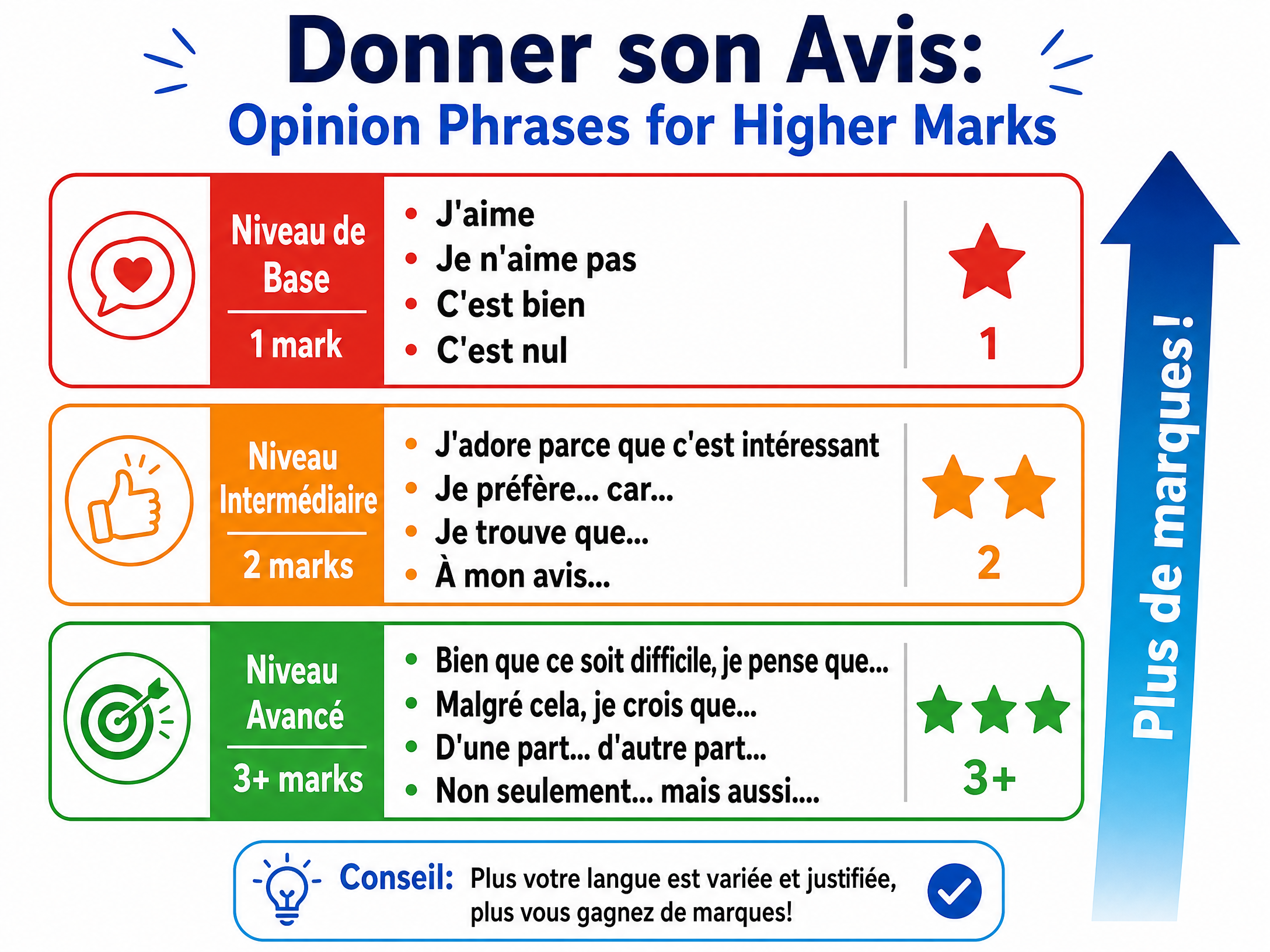
Giving and Justifying Opinions
Stating a fact is not enough. You must express an opinion and justify it with a reason.
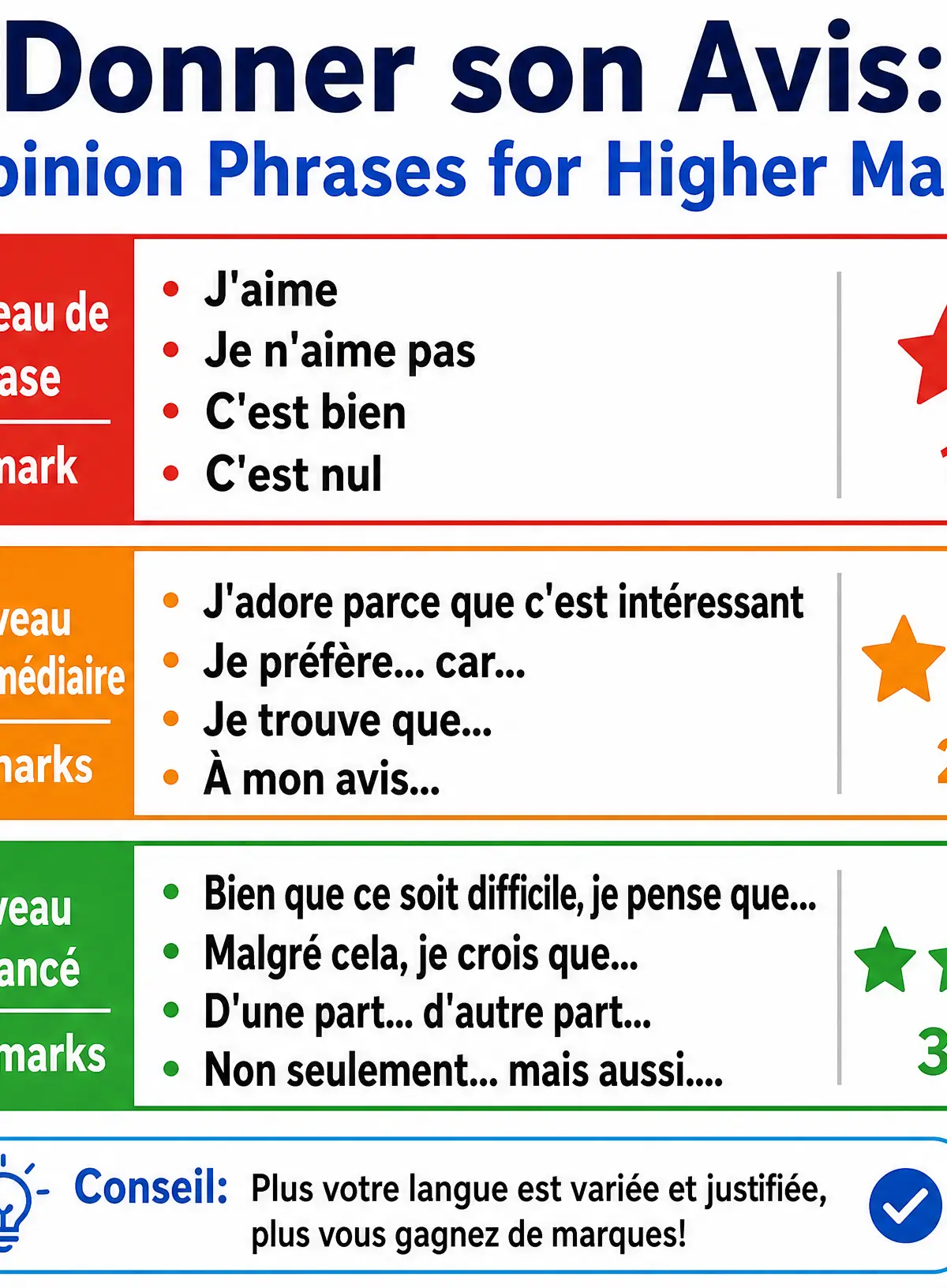
Basic (Niveau de Base)
- J'aime les maths. (I like maths.)
- Je n'aime pas le sport. (I don't like sport.)
Intermediate (Niveau Intermédiaire)
- J'adore les sciences parce que c'est très intéressant. (I love science because it's very interesting.)
- Je trouve que les professeurs sont stricts mais justes. (I find that the teachers are strict but fair.)
Advanced (Niveau Avancé)
- Bien que ce soit difficile, je pense que les maths sont utiles. (Although it's difficult, I think maths is useful.)
- Non seulement j'aime le sport, mais aussi j'adore la compétition. (Not only do I like sport, but I also love competition.)
Audio Revision: Podcast Episode
Listen to this comprehensive 10-minute podcast episode covering pronunciation, grammar tips, and a quick-fire recall quiz.
Visual Resources
3 diagrams and illustrations
Interactive Diagrams
1 interactive diagram to visualise key concepts
Conceptual Flow Outline
The French School System Structure
Worked Examples
3 worked examples — open one to explore the question and available guidance.
Practice Questions
Test your understanding — click to reveal model answers
Writing Task: Write a blog post about your school routine. Mention: your favourite day of the week and why, what you eat at the canteen, a recent school trip, and your plans for next year. (16 marks)
Hint: Ensure you cover all four bullet points and use three different tenses (present, past, future).
Speaking Task (General Conversation): Que penses-tu de ton collège? (What do you think of your school?)
Hint: Use the ORCA structure (Opinion, Reason, Contrast, Aspiration).
Reading Task: Read the text and answer the question in English. 'Je n'aime pas du tout la cantine. Le repas coûte cher et ce n'est jamais chaud.' Why does the student dislike the canteen? Give two reasons. (2 marks)
Hint: Look for the negative structures.
Translation (French to English): Translate: 'Bien que ce soit difficile, j'adore les mathématiques.' (2 marks)
Hint: Recognize the subjunctive phrase 'bien que ce soit'.
Writing Task: Translate into French: 'My teachers are strict.' (2 marks)
Hint: Remember plural agreements for nouns and adjectives.
Test your understanding of What school is like
Active recall beats re-reading. Take an instant quiz now to test what you’ve learned and lock it into long-term memory.
7 days Premium · Then free forever · No card, no charge