Pearson Edexcel · GCSE · French
Who am I?
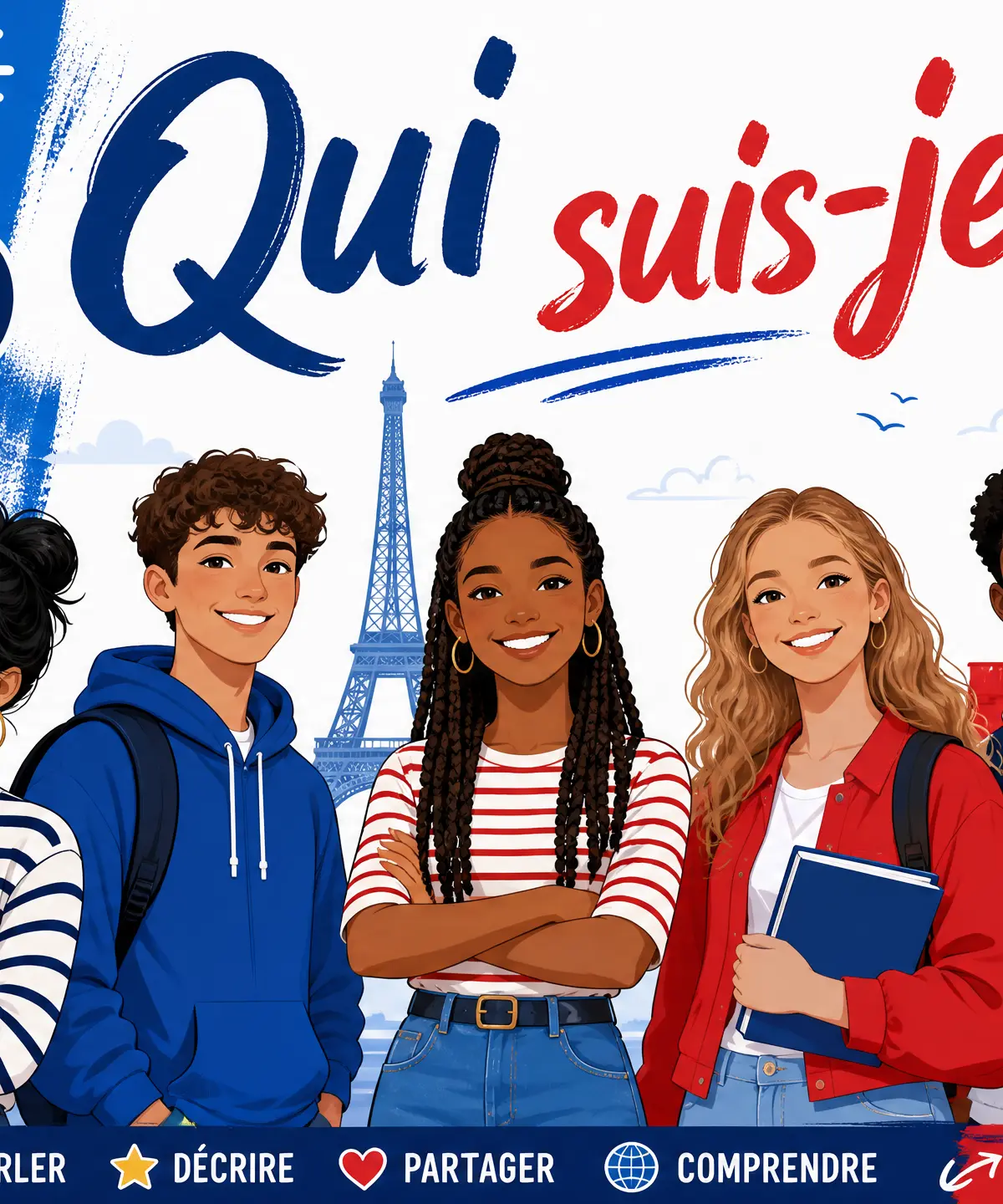
Master the essential GCSE French topic 'Qui suis-je?' (Who am I?). This comprehensive guide covers identity, family, physical descriptions, and opinions, providing you with the exact vocabulary and grammatical structures examiners look for to award top marks.
- 4 min read
- 3 worked examples
- 5 practice questions
- 6 key terms
Study Notes
Overview
The 'Who am I?' (Qui suis-je?) topic forms the foundation of the 'My personal world' thematic context in your GCSE French specification. This topic is critical because it equips you with the vocabulary and structures to communicate about yourself, your family, friends, and relationships. It's often the first topic assessed in speaking exams because it draws on personal experience. Examiners are looking for your ability to express identity, likes, dislikes, and opinions accurately. To achieve top marks, candidates must demonstrate clear pronunciation, accurate application of grammatical structures (especially adjective agreement), and the ability to refer to past, present, and future events when discussing personal relationships and activities.
Listen to the Podcast
Key Vocabulary Areas
1. Personal Identity (L'identité personnelle)
Key Phrases:
- Je m'appelle... (I am called...)
- J'ai seize ans. (I am 16 years old.)
- Je suis anglais/anglaise. (I am English.)
- J'habite à... (I live in...)
- Je suis né(e) le... (I was born on...)
Examiner Tip: Remember that nationality adjectives do not take a capital letter in French unless they are used as a noun (e.g., Je suis anglais vs Les Anglais aiment le thé).
2. Family and Relationships (La famille et les rapports)
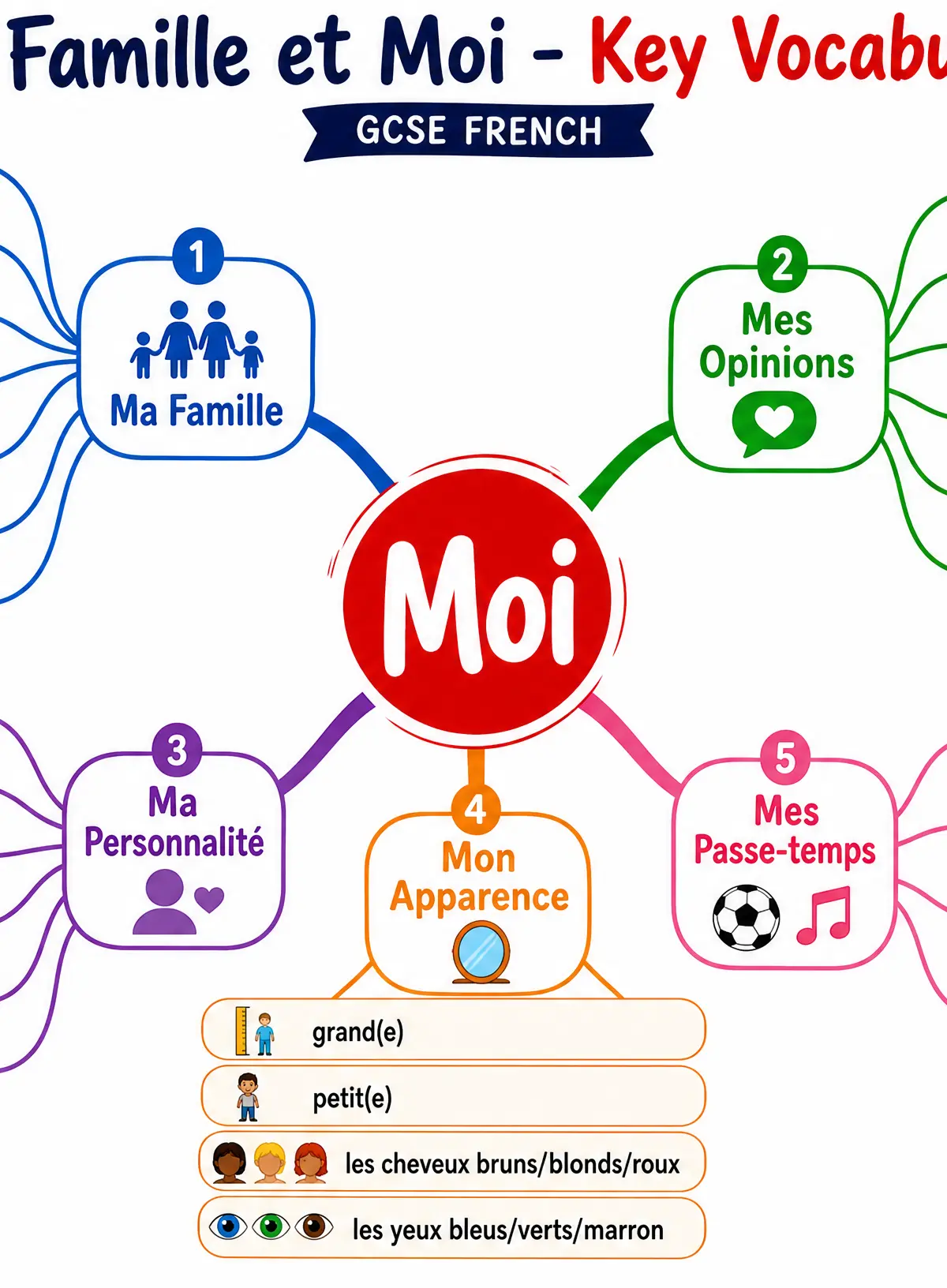
Immediate Family:
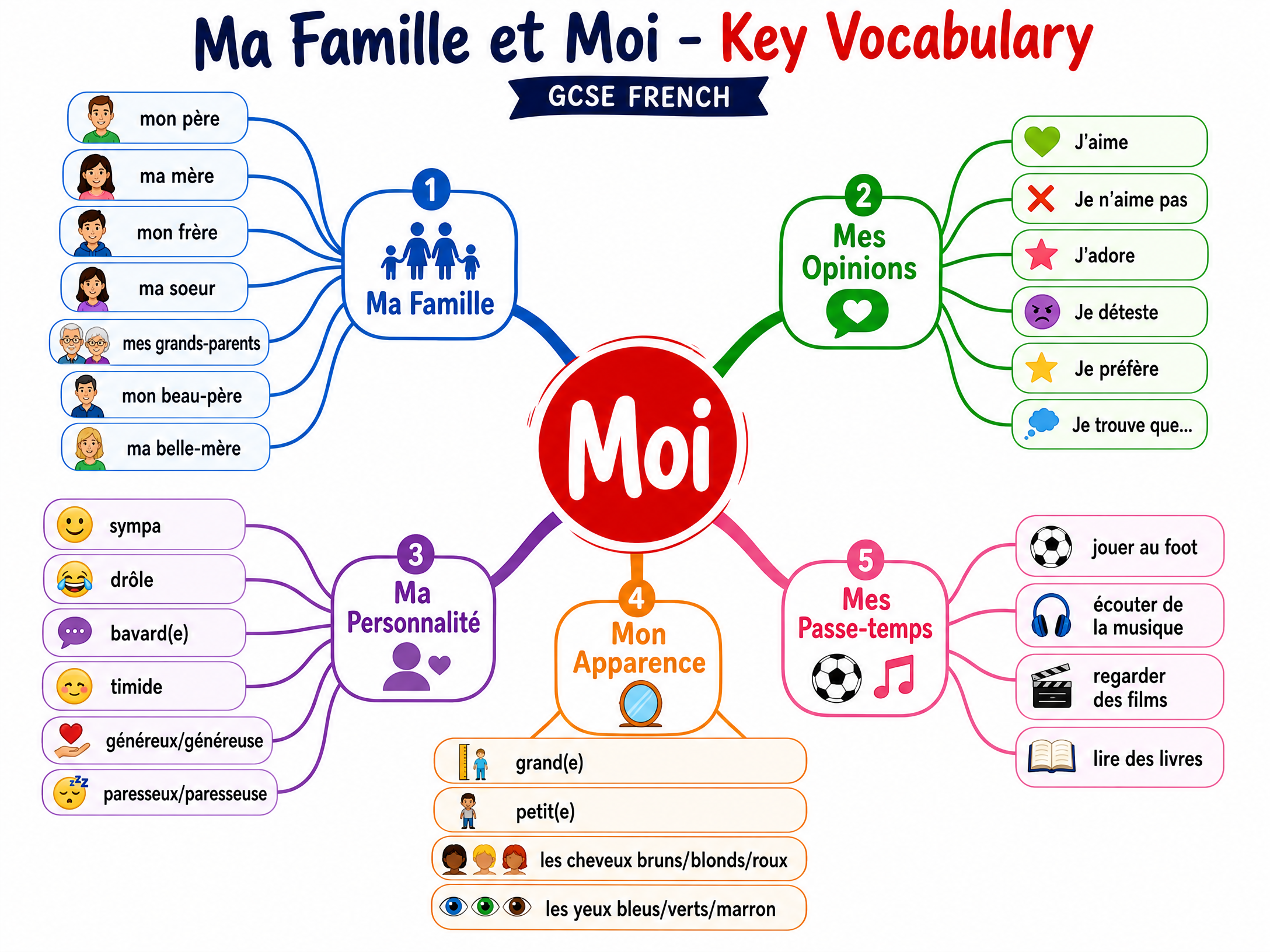
- mon père (my father)
- ma mère (my mother)
- mon frère (my brother)
- ma sœur (my sister)
Extended & Modern Family:
- mes grands-parents (my grandparents)
- mon beau-père (my stepfather / father-in-law)
- ma belle-mère (my stepmother / mother-in-law)
- mon demi-frère (my half-brother)
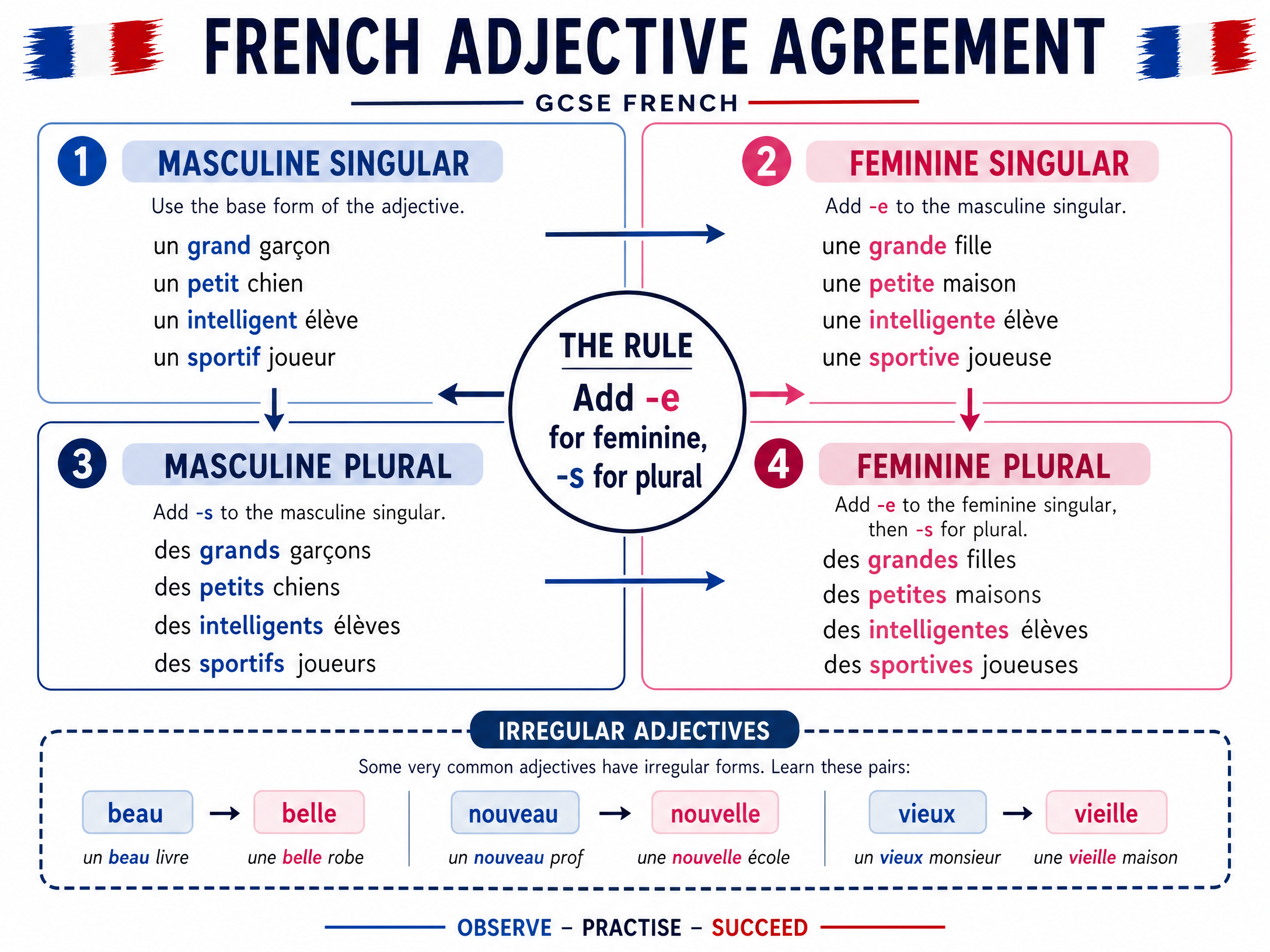
Examiner Tip: Possessive adjectives (mon, ma, mes) must agree with the noun they possess, not the person speaking. Even if you are a girl, you must say mon père because père is masculine.
3. Physical Appearance (L'apparence physique)
Key Phrases:
- Je suis grand(e) / petit(e) / de taille moyenne. (I am tall / short / of medium height.)
- J'ai les cheveux bruns / blonds / roux / noirs. (I have brown / blonde / red / black hair.)
- J'ai les yeux bleus / verts / marron. (I have blue / green / brown eyes.)
Examiner Tip: Marron is invariable. It never takes an 's' in the plural: les yeux marron.
4. Personality (Le caractère)
Key Adjectives:
- sympa (nice)
- drôle (funny)
- bavard(e) (talkative)
- timide (shy)
- généreux/généreuse (generous)
- paresseux/paresseuse (lazy)
- travailleur/travailleuse (hardworking)
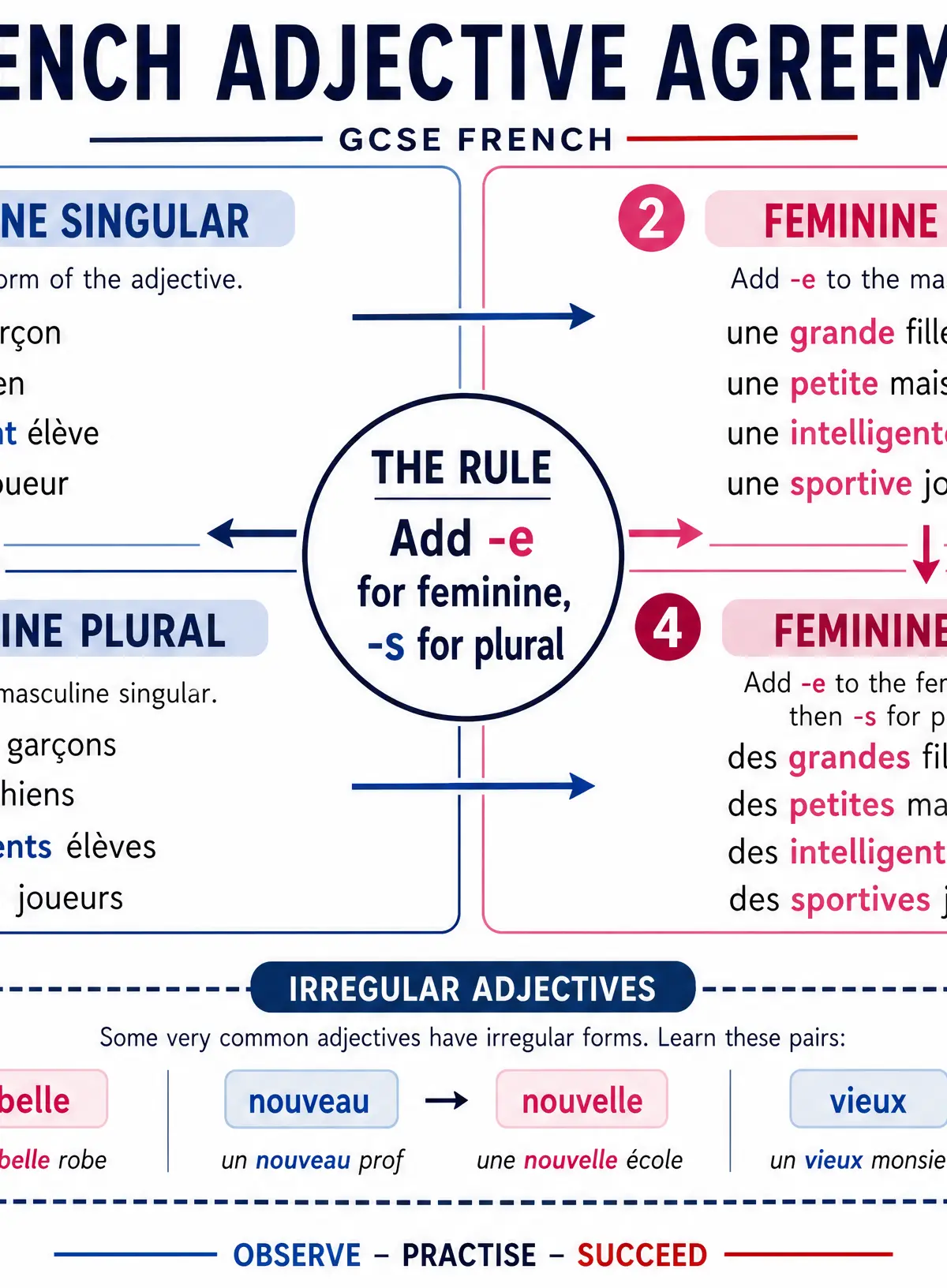
Examiner Tip: Adjective agreement is heavily penalized if incorrect. Always check if the person you are describing is masculine or feminine, singular or plural.
5. Tenses (Les temps)
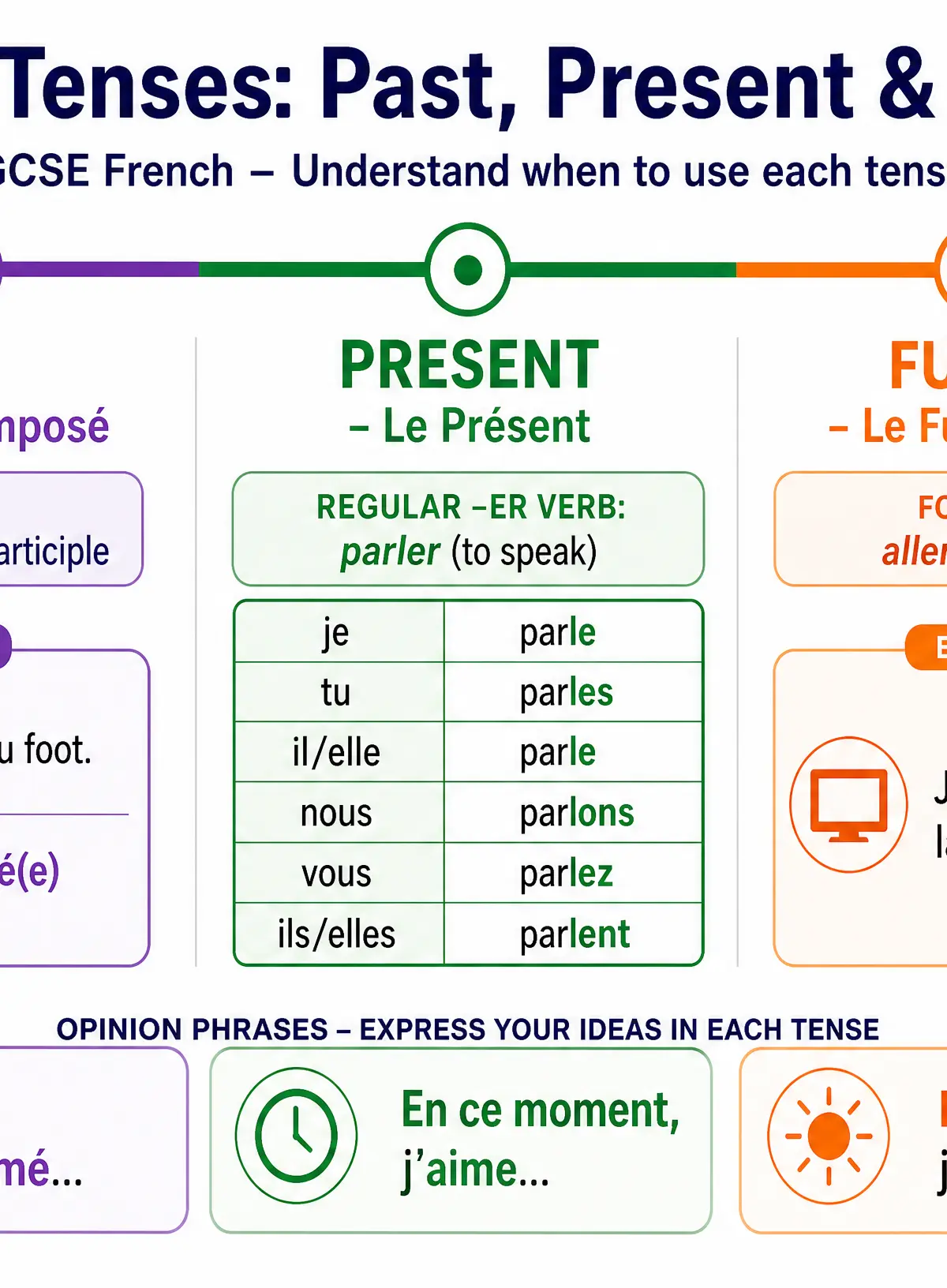
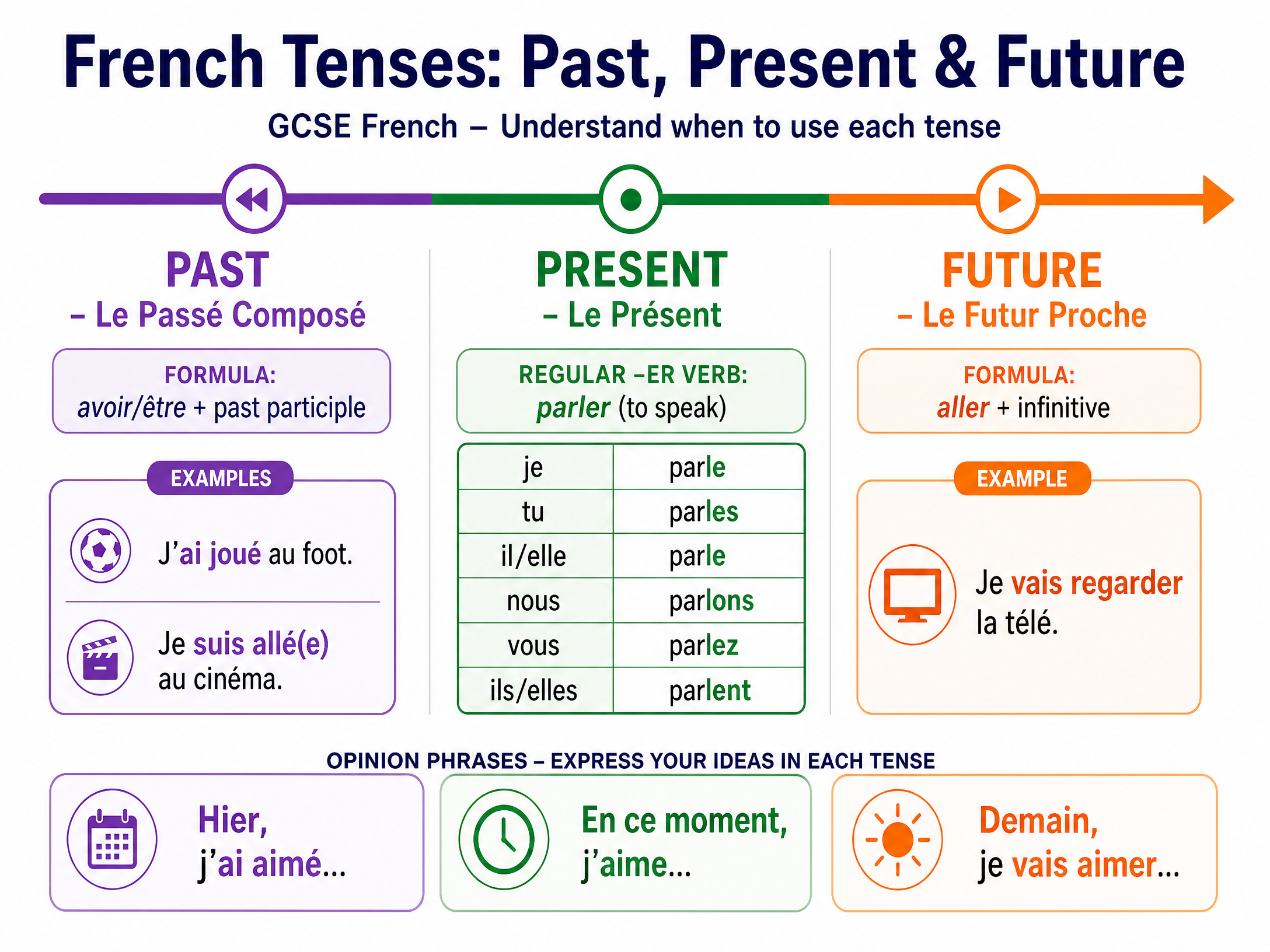
To access the highest mark bands, you must use three time frames.
- Le Présent: Je joue au foot. (I play football.)
- Le Passé Composé: J'ai joué au foot hier. (I played football yesterday.)
- Le Futur Proche: Je vais jouer au foot demain. (I am going to play football tomorrow.)
Worked Examples
3 worked examples — open one to explore the question and available guidance.
Practice Questions
Test your understanding — click to reveal model answers
Translate into French: My step-brother is very talkative and quite lazy.
Hint: Check the gender of step-brother to choose the correct possessive adjective and adjective endings.
Writing: Write a short paragraph (approx. 40 words) describing your best friend's physical appearance and personality.
Hint: Include height, hair, eyes, and at least two personality traits with a justification.
Reading Comprehension: Lisez le texte. (Read the text). 'Je m'appelle Amélie. J'ai les cheveux longs et bruns. Je suis fille unique, donc je n'ai pas de frères ou de sœurs. Je m'entends très bien avec ma mère car elle est généreuse, mais mon père est trop strict.'
Question: Why does Amélie get on well with her mother?
Hint: Look for the connective 'car' (because) in the text.
Speaking (Photo Card): Look at a photo of a family having dinner. Answer the question: Que font les personnes sur la photo ? (What are the people in the photo doing?)
Hint: Use the present tense to describe what is happening right now.
Writing (Higher Tier): Write about your relationships with your family and friends. Include: who you get on best with and why, what you did with your friends recently, and your plans for next weekend. (90 words)
Hint: Ensure you use the present, passé composé, and futur proche tenses clearly.
Test your understanding of Who am I?
Active recall beats re-reading. Take an instant quiz now to test what you’ve learned and lock it into long-term memory.
7 days Premium · Then free forever · No card, no charge