Constructions — OCR GCSE Study Guide
Exam Board: OCR | Level: GCSE
Constructions and Loci is one of the most mark-rich precision topics in OCR Further Mathematics, demanding not just accurate drawing but a clear demonstration of method through visible construction arcs. Candidates who master the four fundamental loci and learn to combine them algebraically — interpreting strict versus inclusive inequalities — will find this topic a reliable source of full marks. The examiner rewards method as much as accuracy, making it a topic where disciplined technique pays dividends.
## Overview
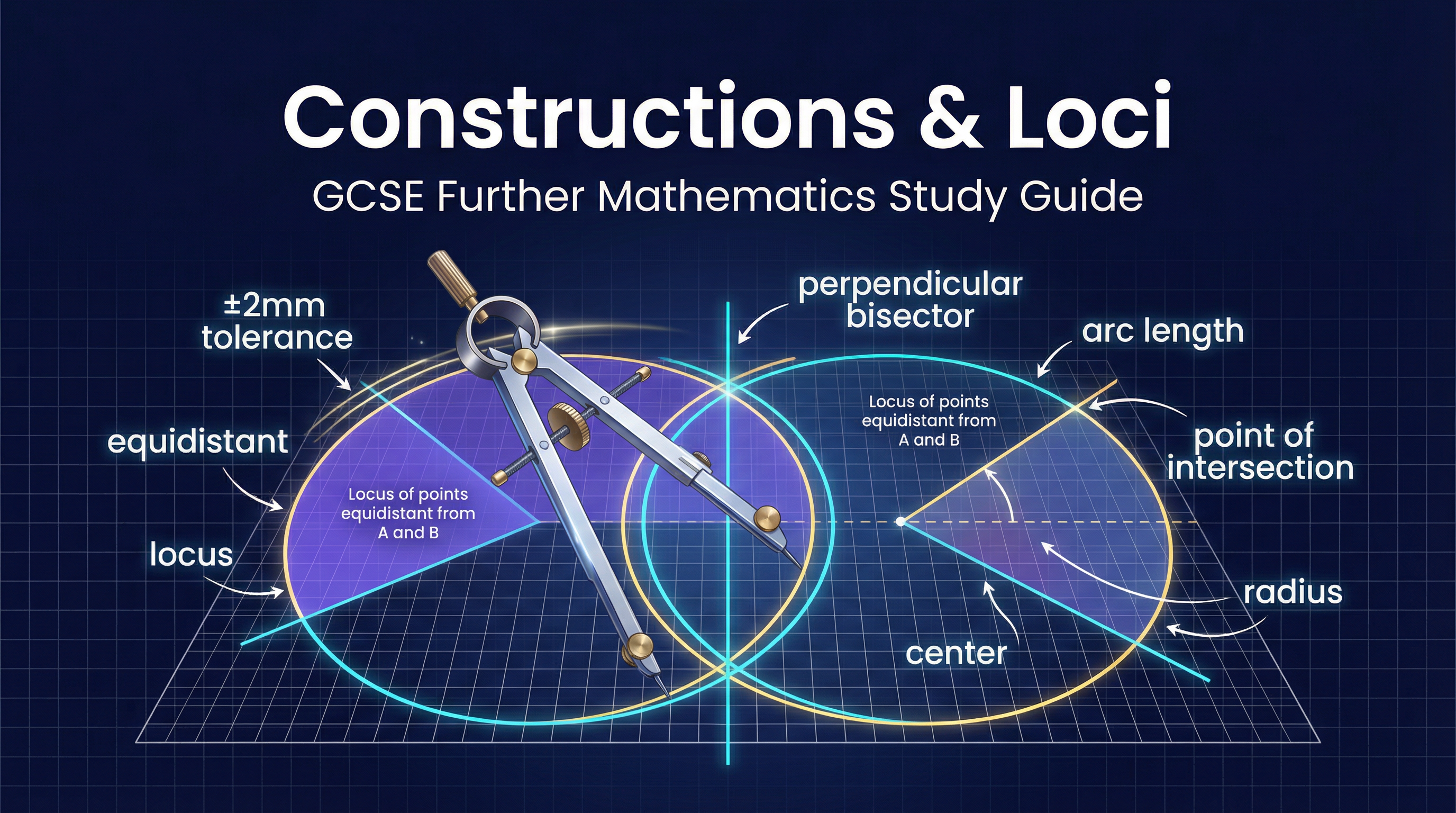
Constructions and Loci sits at the intersection of geometry and algebra in the OCR Level 2 Further Mathematics specification (Section 4.6). Unlike standard GCSE, this course demands a higher level of rigour: candidates must not only produce accurate geometric constructions but must also interpret and combine multiple locus conditions — often expressed as algebraic inequalities — to define precise regions on a diagram. The topic draws on compass-and-ruler techniques that date back to Euclid, yet the OCR Further Mathematics examination applies them in sophisticated, multi-step contexts that reward careful reading and methodical working.
In the exam, questions on this topic are typically worth between 3 and 6 marks and will almost always carry the command word **'Construct'** or **'Show the region'**. These command words carry specific expectations: 'Construct' requires visible construction arcs, and 'Show the region' requires correct shading with attention to whether boundary lines are solid or dashed. Understanding these expectations is the difference between full marks and a frustrating loss of method marks.
This topic connects directly to coordinate geometry (the equations of loci can be derived algebraically), to inequalities (the shading of regions mirrors linear programming), and to circle theorems (the perpendicular bisector of a chord passes through the centre). Mastering constructions therefore strengthens your performance across the entire specification.
---
## Key Concepts
### Concept 1: What is a Locus?
A **locus** (plural: *loci*) is the complete set of all points that satisfy a given geometric condition. Think of it as the 'path' or 'region' traced out by a point that moves according to a rule. The word comes from the Latin for 'place', and that is exactly what it describes: every place a point can be, given a constraint.
For example, if you are told that a point P is always exactly 3 cm from a fixed point O, then P can be anywhere on a circle of radius 3 cm centred on O. That circle *is* the locus. The power of loci is that a single geometric rule generates an entire shape.
**Why does this work?** Because every point on a circle is, by definition, equidistant from the centre. The locus rule and the geometric shape are two descriptions of the same mathematical truth.
---
### Concept 2: The Four Fundamental Loci
Candidates must be fluent in constructing all four of the following:
| Locus Rule | Resulting Shape | Construction Method |
|---|---|---|
| Fixed distance from a **point** | Circle | Set compass to radius; draw full circle |
| Equidistant from two **points** | Perpendicular bisector | Intersecting arcs from each point |
| Equidistant from two **lines** | Angle bisector | Arcs from vertex, then arcs from intersections |
| Fixed distance from a **line** | Running track (stadium) shape | Parallel lines + semicircular ends |
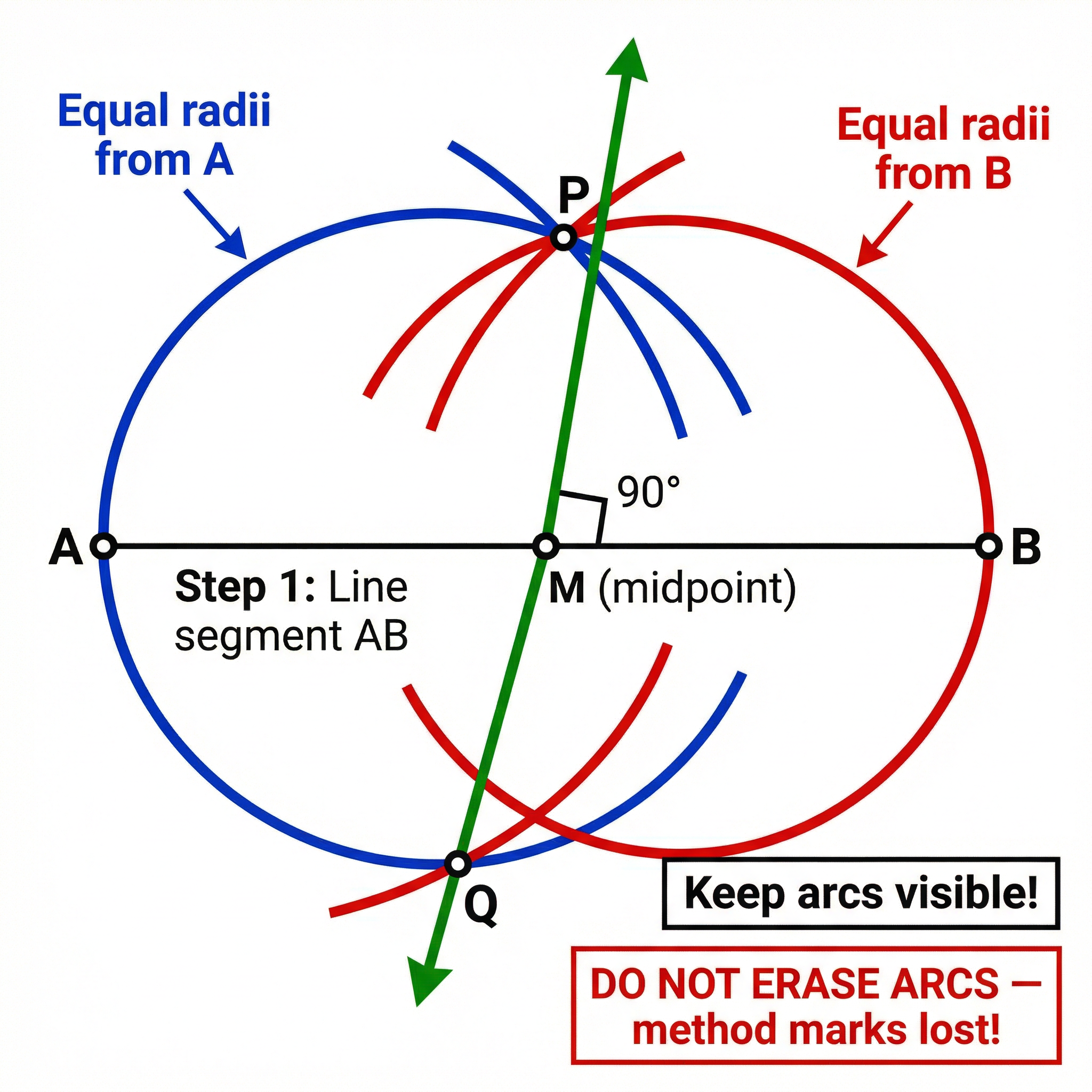
**The Perpendicular Bisector in Detail:** This is the most frequently examined construction. Given two points A and B, the perpendicular bisector is the unique line where every point is exactly the same distance from A as it is from B. The construction requires opening the compass to a radius *greater than half* of AB, drawing arcs from A and B that intersect above and below the line, and connecting those intersection points. The resulting line is perpendicular to AB and passes through its midpoint.
**The Angle Bisector in Detail:** Given two intersecting lines meeting at a vertex V, the angle bisector is the ray from V that cuts the angle exactly in half. Place the compass on V and draw an arc crossing both lines. From each crossing point, draw equal arcs into the interior of the angle. Connect V to where these arcs meet.
---
### Concept 3: Combining Loci to Define Regions
This is where OCR Further Mathematics raises the difficulty above standard GCSE. A question will present **multiple locus conditions simultaneously**, and candidates must identify the region that satisfies all of them at once.
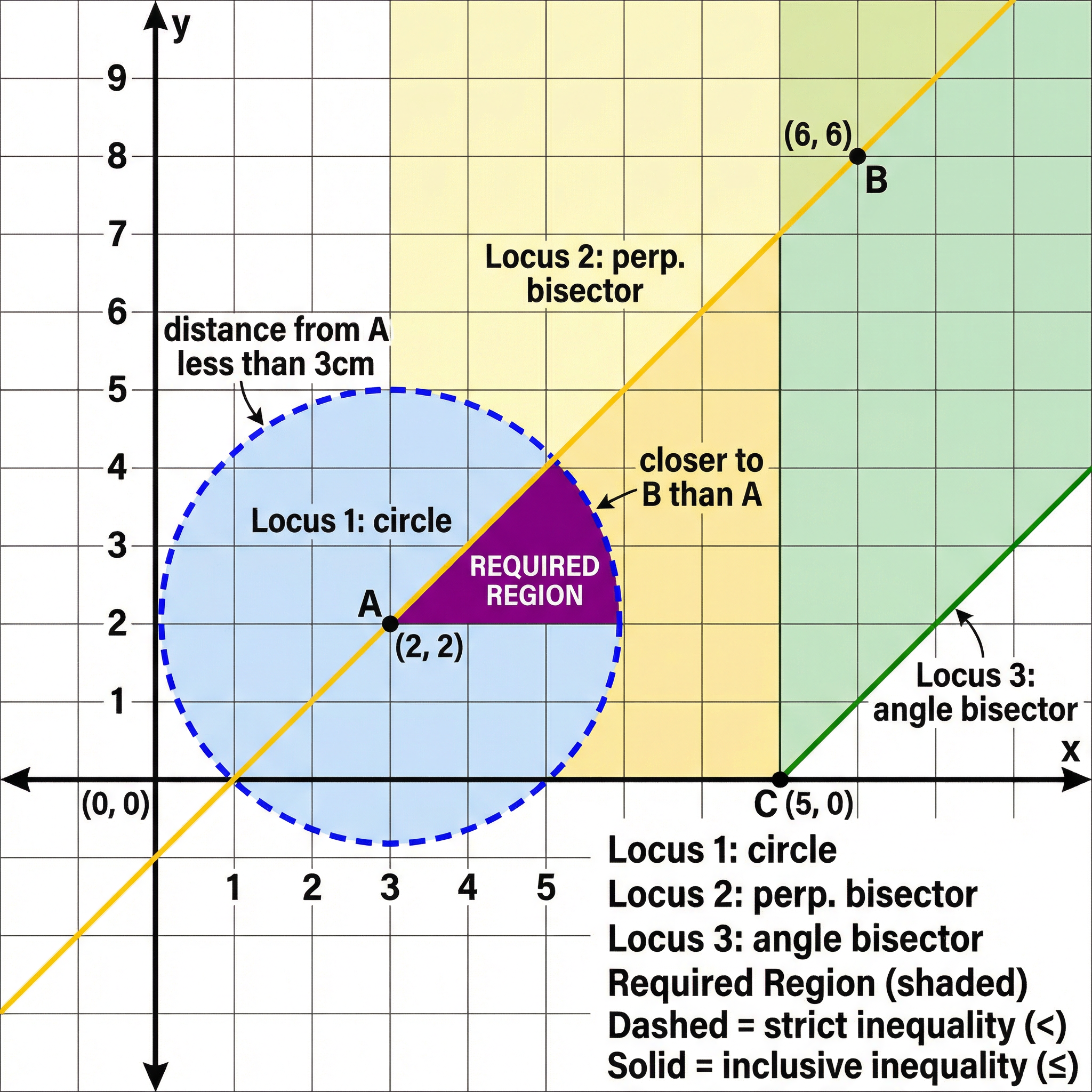
The process is always the same:
1. Construct each locus boundary separately.
2. Identify which side of each boundary satisfies the given condition.
3. Shade the intersection — the area that satisfies *all* conditions simultaneously.
**Worked Strategy:** Suppose the conditions are: (i) distance from point A is less than 4 cm, and (ii) closer to B than to C. Construct the circle of radius 4 cm centred on A (condition i) and the perpendicular bisector of BC (condition ii). The required region is inside the circle AND on the B-side of the perpendicular bisector. Shade where these two regions overlap.
---
### Concept 4: Strict vs Inclusive Inequalities — Dashed vs Solid Lines
This is a mark-scoring detail that many candidates overlook. The type of boundary line signals whether the boundary itself is included in the region:
| Inequality Symbol | Meaning | Boundary Line Style |
|---|---|---|
| < or > (strict) | Boundary NOT included | **Dashed line** |
| ≤ or ≥ (inclusive) | Boundary IS included | **Solid line** |
This mirrors exactly the convention used in graphical linear inequalities. An examiner's mark scheme will explicitly credit candidates who correctly distinguish between dashed and solid boundaries. Drawing a solid line where a dashed one is required will cost a mark.
**Analogy:** Think of a nightclub with a height restriction. 'Taller than 1.8 m' (strict, >) means someone who is *exactly* 1.8 m cannot enter — dashed boundary. 'At least 1.8 m' (inclusive, ≥) means exactly 1.8 m is fine — solid boundary.
---
### Concept 5: Accuracy and the ±2mm Tolerance
The OCR mark scheme awards accuracy marks only when constructions fall within **±2 mm** of the correct position. This means:
- Your compass pencil must be sharp. A thick pencil line can be 1–2 mm wide on its own, consuming your entire tolerance allowance.
- The metal compass point must be placed precisely on the given point, not approximately.
- For circles, check the radius carefully against the scale of the diagram before drawing.
A common trap is a diagram drawn to a scale (e.g., 1 cm represents 2 m). If you are asked to construct a circle representing a distance of 6 m, you must draw a circle of radius 3 cm on the diagram. Failing to apply the scale results in a circle of the wrong size — and no accuracy mark.
---
## Mathematical Relationships
The loci studied here have precise algebraic equivalents, which can be tested in the Further Mathematics context:
- **Circle** (locus equidistant from point (a, b) at distance r): $(x - a)^2 + (y - b)^2 = r^2$ — **Must memorise**
- **Perpendicular bisector** of two points $(x_1, y_1)$ and $(x_2, y_2)$: found by setting distances equal and simplifying — derived from the distance formula — **Must memorise method**
- **Distance formula** (used to verify locus conditions algebraically): $d = \sqrt{(x_2 - x_1)^2 + (y_2 - y_1)^2}$ — **Must memorise**
Note: The circle equation is given on the OCR formula sheet in some forms, but candidates should be comfortable deriving and applying it independently.
---
## Practical Applications
Constructions and loci appear in real-world planning and design contexts that examiners sometimes use as question settings:
- **Mobile phone mast coverage**: The area within signal range of a mast is a circle (locus equidistant from a point). Overlapping coverage areas model the intersection of loci.
- **Equidistant boundaries**: Property boundaries, electoral ward boundaries, and Voronoi diagrams in geography all use perpendicular bisectors to define regions equidistant from two locations.
- **Safety exclusion zones**: A fixed distance from a hazardous line (e.g., a railway) produces the 'running track' locus shape.
- **Navigation**: A ship maintaining a fixed distance from a coastline traces a locus parallel to that coast.