OCR · GCSE · Further Mathematics
Functions (notation and composition)
Master OCR GCSE Further Maths Functions (2.5) with this guide, covering notation, composition, and inverses. We focus on exam technique, showing you how to secure every mark by understanding how functions are combined and reversed, a key skill for higher-level maths.
- 5 min read
- 3 worked examples
- 5 practice questions
- 6 key terms
Study Notes

Overview
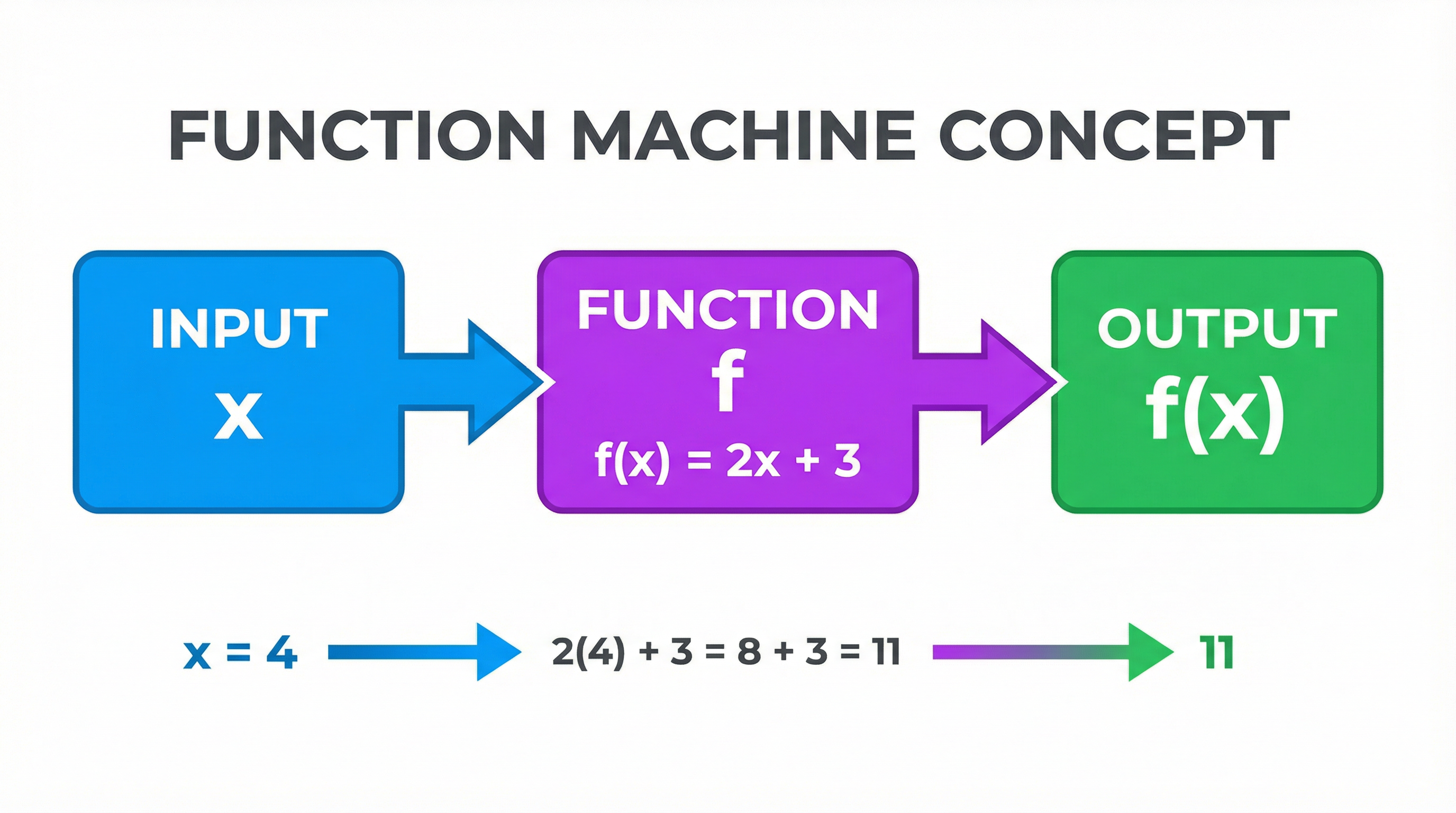
Welcome to the study of Functions, a cornerstone of advanced mathematics. In OCR GCSE Further Mathematics, this topic (specification reference 2.5) moves beyond simple substitution and into the powerful concepts of composite and inverse functions. Think of a function as a precise recipe: it takes an ingredient (an input, x), follows a set of instructions, and produces a result (an output, f(x)). This guide will show you how to combine these recipes (composite functions) and how to work backwards from the result to the original ingredient (inverse functions). Mastery of this topic is not just about algebraic skill; it is about logical problem-solving. Examiners frequently use function questions to test a candidate's ability to handle abstract concepts and apply multi-step processes. Expect to see questions asking you to find fg(x), solve equations like gf(x) = 12, or determine the inverse function f⁻¹(x). This topic has strong synoptic links to solving equations, algebraic manipulation, and graph transformations.
Key Concepts
Concept 1: Function Notation
Function notation is the language we use to describe these mathematical machines. When you see f(x) = 2x + 5, it means the function f takes an input x, multiplies it by 2, and then adds 5. The letter f is just a name; you could have g(x), h(t), or any other letter. The variable in the bracket is the input.
Example: If f(x) = x² - 4, to find f(3), we substitute 3 for every x in the expression. So, f(3) = (3)² - 4 = 9 - 4 = 5. Credit is given for the correct substitution and evaluation.

Concept 2: Composite Functions
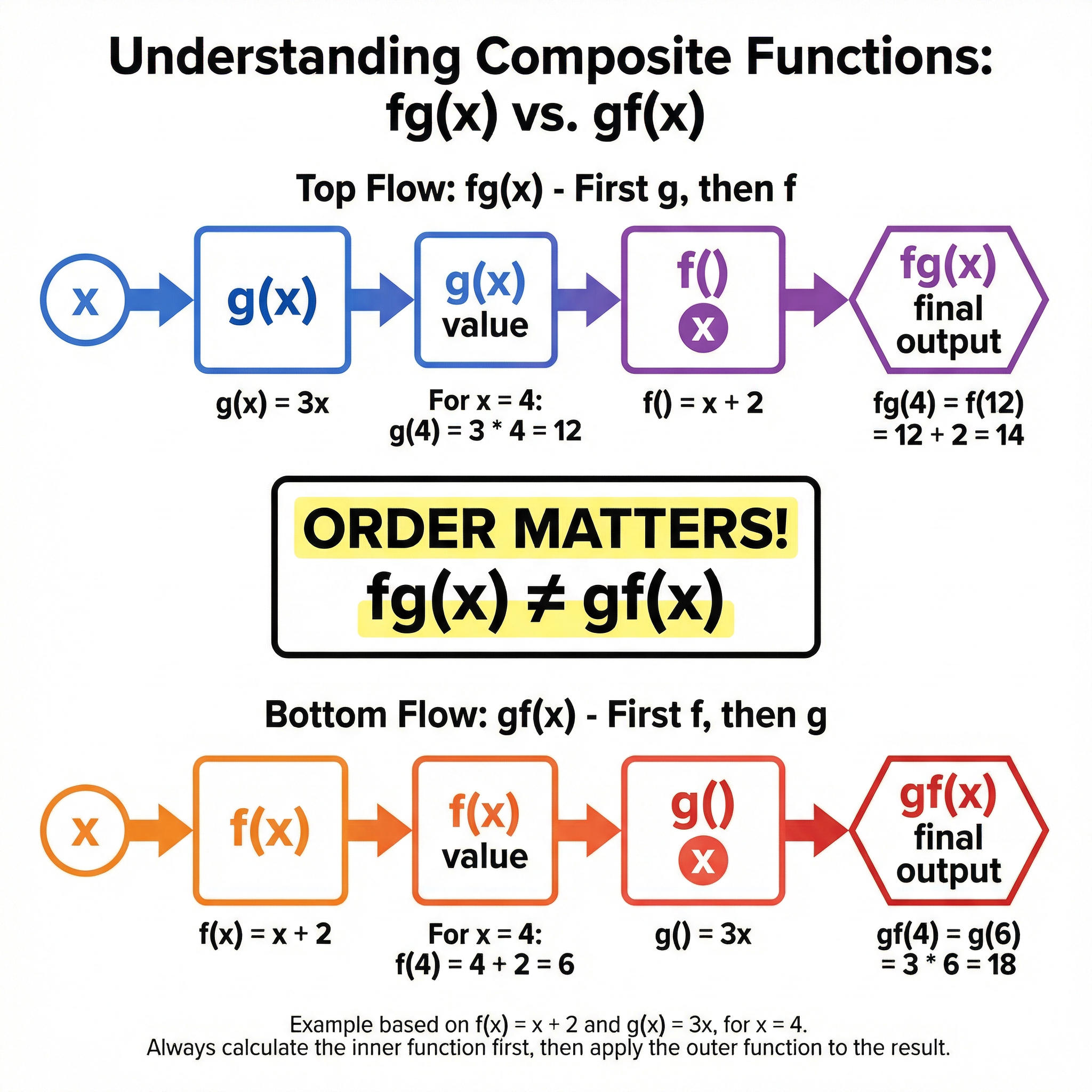
A composite function is a 'function of a function'. It involves applying one function to the output of another. The notation fg(x) means you apply the function g first, and then apply the function f to the result of g(x). A common mistake is to multiply f(x) by g(x), which is incorrect and will score no marks.
Example: Let f(x) = 2x and g(x) = x + 3. To find fg(x), we substitute the entire expression for g(x) into f(x).
fg(x) = f(g(x)) = f(x + 3) = 2(x + 3) = 2x + 6.
To find gf(x), we do the reverse, substituting f(x) into g(x):
gf(x) = g(f(x)) = g(2x) = 2x + 3.
Notice that fg(x) is not the same as gf(x). The order is critical.

Concept 3: Inverse Functions
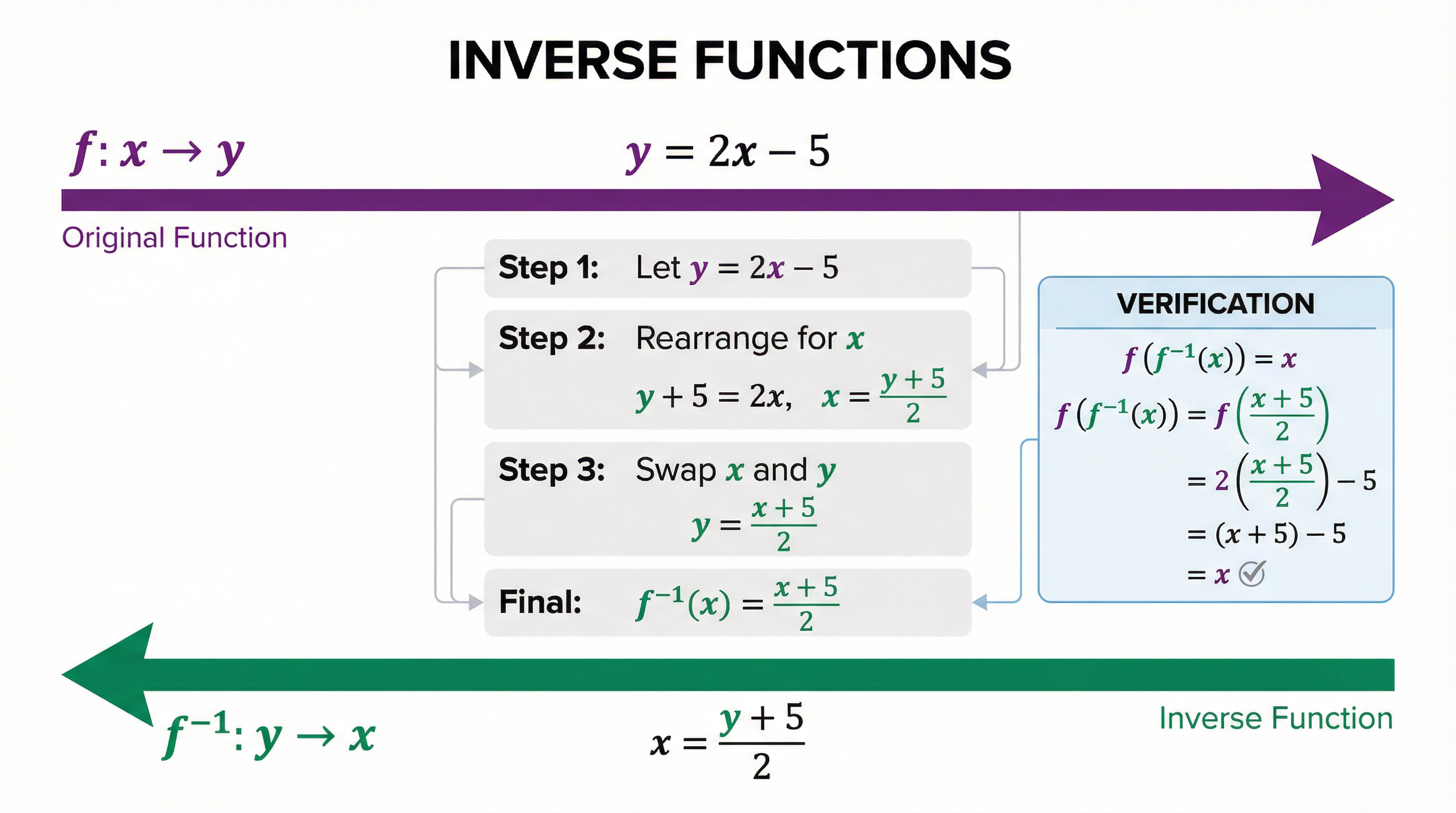
An inverse function, denoted f⁻¹(x), reverses the action of the original function. If f turns a into b, then f⁻¹ will turn b back into a. A crucial point is that f⁻¹(x) is not the same as 1/f(x) (the reciprocal). This is a common misconception that examiners see frequently.
To find the inverse of a function, we use a reliable three-step method:
- Let y = f(x): Rewrite the function with
yas the subject. - Rearrange for x: Make
xthe subject of the new equation. - Swap x and y: Replace every
ywith anxand thexwithf⁻¹(x)to state the final inverse function.
Example: Find the inverse of f(x) = 3x - 2.
Step 1: Let y = 3x - 2.
Step 2: Rearrange for x. y + 2 = 3x, so x = (y + 2) / 3.
Step 3: Swap x and y. y = (x + 2) / 3. So, f⁻¹(x) = (x + 2) / 3.

Mathematical/Scientific Relationships
- Function Definition: A rule that assigns to each input exactly one output.
y = f(x) - Composite Function:
fg(x) = f(g(x))(Apply g, then f). Must memorise. - Inverse Function:
f⁻¹(f(x)) = xandf(f⁻¹(x)) = x. The inverse function undoes the original function. Must memorise. - Finding an Inverse: The three-step process (Let y = ..., Rearrange for x, Swap x and y). This is a method, not a formula, and must be memorised.
Practical Applications
While functions in GCSE Further Maths are largely abstract and algebraic, the underlying concepts are fundamental to many real-world systems. For example, in computer programming, functions are blocks of code that take an input and return an output, and chaining them together is a form of composition. In economics, functions can model cost, revenue, and profit based on production levels. In physics, equations of motion are functions of time. Understanding how to manipulate and combine these functions is a foundational skill for STEM fields.
Visual Resources
3 diagrams and illustrations
Interactive Diagrams
2 interactive diagrams to visualise key concepts
Conceptual Flow Outline
Flowchart showing the order of operations for the composite function `fg(x)`.
Conceptual Flow Outline
Sequence diagram illustrating how a function `f` maps an input `x` to an output `y`, and how the inverse function `f⁻¹` maps `y` back to `x`.
Worked Examples
3 worked examples — open one to explore the question and available guidance.
Practice Questions
Test your understanding — click to reveal model answers
Given f(x) = 5x - 3, find the value of f(4).
Hint: Substitute the input value for `x` in the expression.
Let f(x) = x² and g(x) = x - 10. Solve the equation fg(x) = 144.
Hint: First find the expression for the composite function `fg(x)`, then set it equal to 144 and solve.
Find the inverse of the function g(x) = (2x - 1) / 5.
Hint: Use the three-step method: Let y = ..., rearrange for x, then swap x and y.
Given f(x) = 2/x and g(x) = 3x - 1. Find gf(x) and state its domain.
Hint: Substitute `f(x)` into `g(x)`. The domain of the composite function is restricted by the domain of the inner function `f(x)`.
The function h(x) = 4 - x is defined for all real values of x. Show that h(x) is a self-inverse function.
Hint: Find the inverse function `h⁻¹(x)`. If `h⁻¹(x)` is identical to `h(x)`, then the function is self-inverse.
Test your understanding of Functions (notation and composition)
Active recall beats re-reading. Take an instant quiz now to test what you’ve learned and lock it into long-term memory.
7 days Premium · Then free forever · No card, no charge