OCR · GCSE · Further Mathematics
Indices (integer and fractional)
Master the power of indices for your OCR GCSE Further Maths exam. This guide breaks down integer and fractional indices, showing you how to manipulate complex expressions and solve exponential equations to secure top marks.
- 4 min read
- 3 worked examples
- 5 practice questions
- 6 key terms
Study Notes

Overview
Indices, or powers, are a fundamental concept in mathematics, providing a concise way to represent repeated multiplication. In OCR Level 2 Further Mathematics, your understanding of indices is pushed beyond basic rules to include fluent manipulation of negative and fractional powers, often embedded within complex algebraic expressions. Mastery of this topic is crucial not only for standalone questions but also for its application in algebra, equation solving, and understanding exponential growth. Examiners will test your ability to apply the index laws with precision, convert between radical (root) and index forms, and solve equations by equating bases—a key skill before you learn about logarithms. Expect to see questions that demand careful, step-by-step simplification and a deep understanding of how powers and roots interact.
Key Concepts
Concept 1: The Five Index Laws
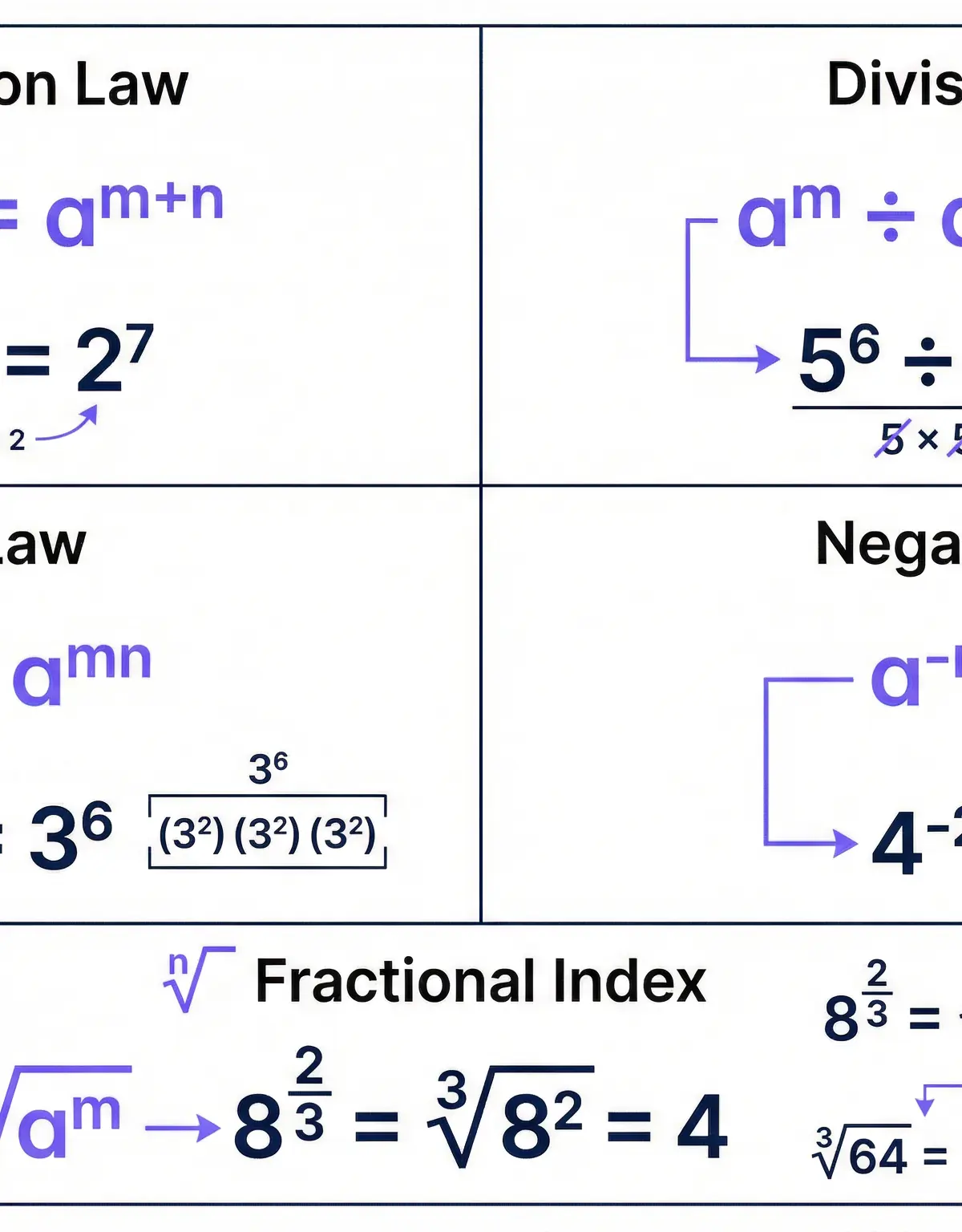
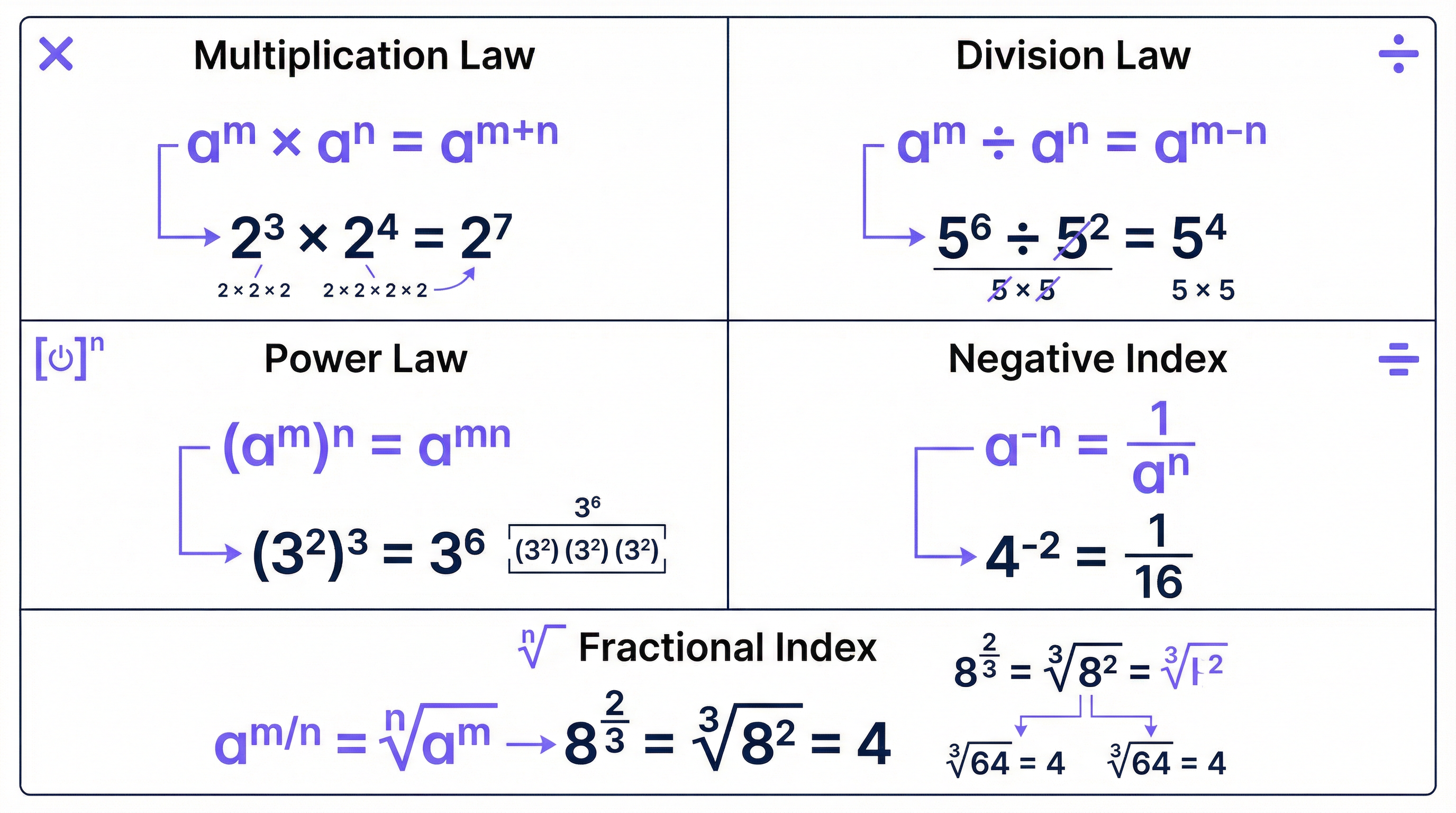
The foundation of this topic rests on five key laws that you must know instantly. These rules govern how we combine and simplify expressions involving indices.
Example: A typical exam question might ask you to simplify (3x^2y)^3 * 2x^(-1)y^4. Applying the laws systematically is the only way to guarantee the marks.
Concept 2: Negative Indices
A negative index signifies a reciprocal. It does not make the number negative. This is a frequent source of confusion for candidates.
The rule is:
a^(-n) = 1/a^n
Example: 4x^(-2) means 4 * (1/x^2), which simplifies to 4/x^2. Notice the 4 is unaffected as the power is only attached to the x. Credit is often given for correctly interpreting the negative power as a reciprocal.
Concept 3: Fractional Indices
Fractional indices combine powers and roots. The denominator of the fraction represents the root, and the numerator represents the power.
The rule is:
a^(m/n) = (n√a)^m = n√(a^m)
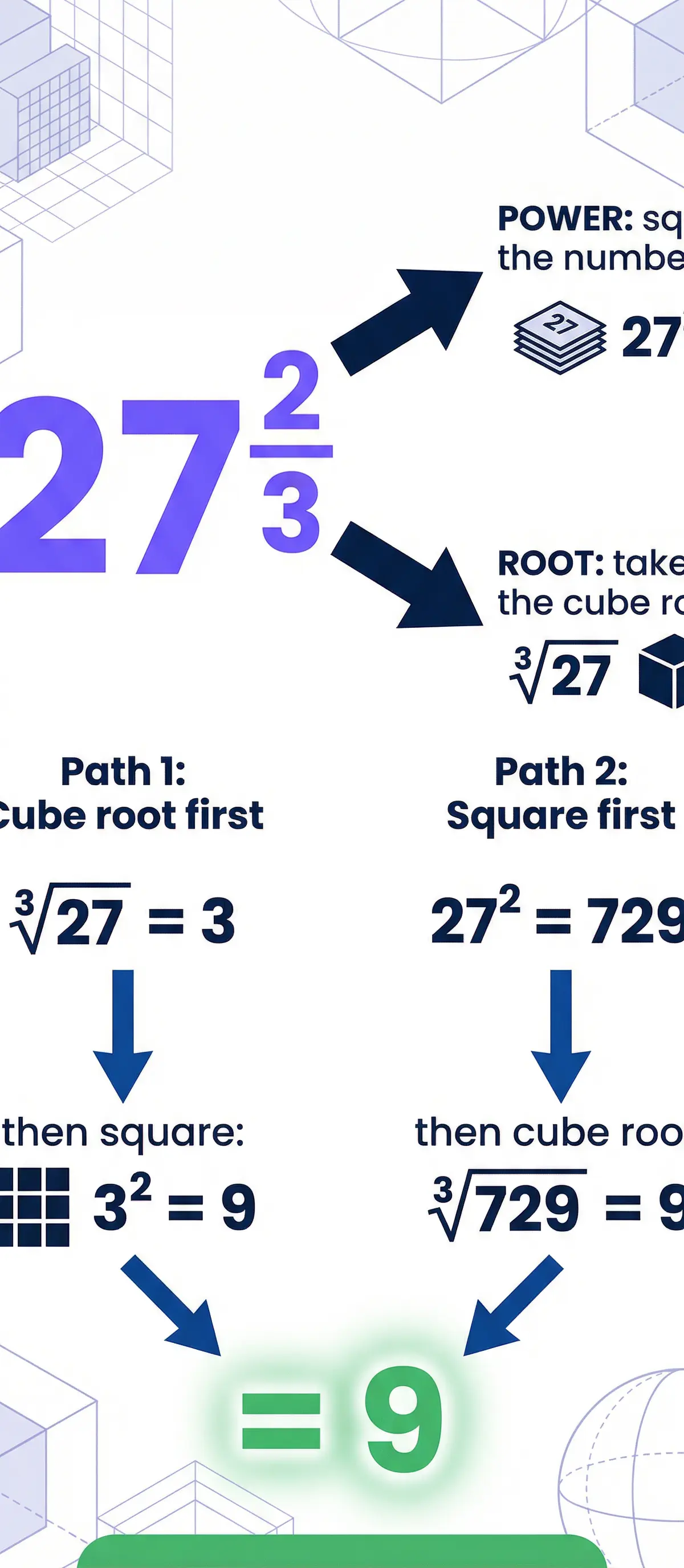
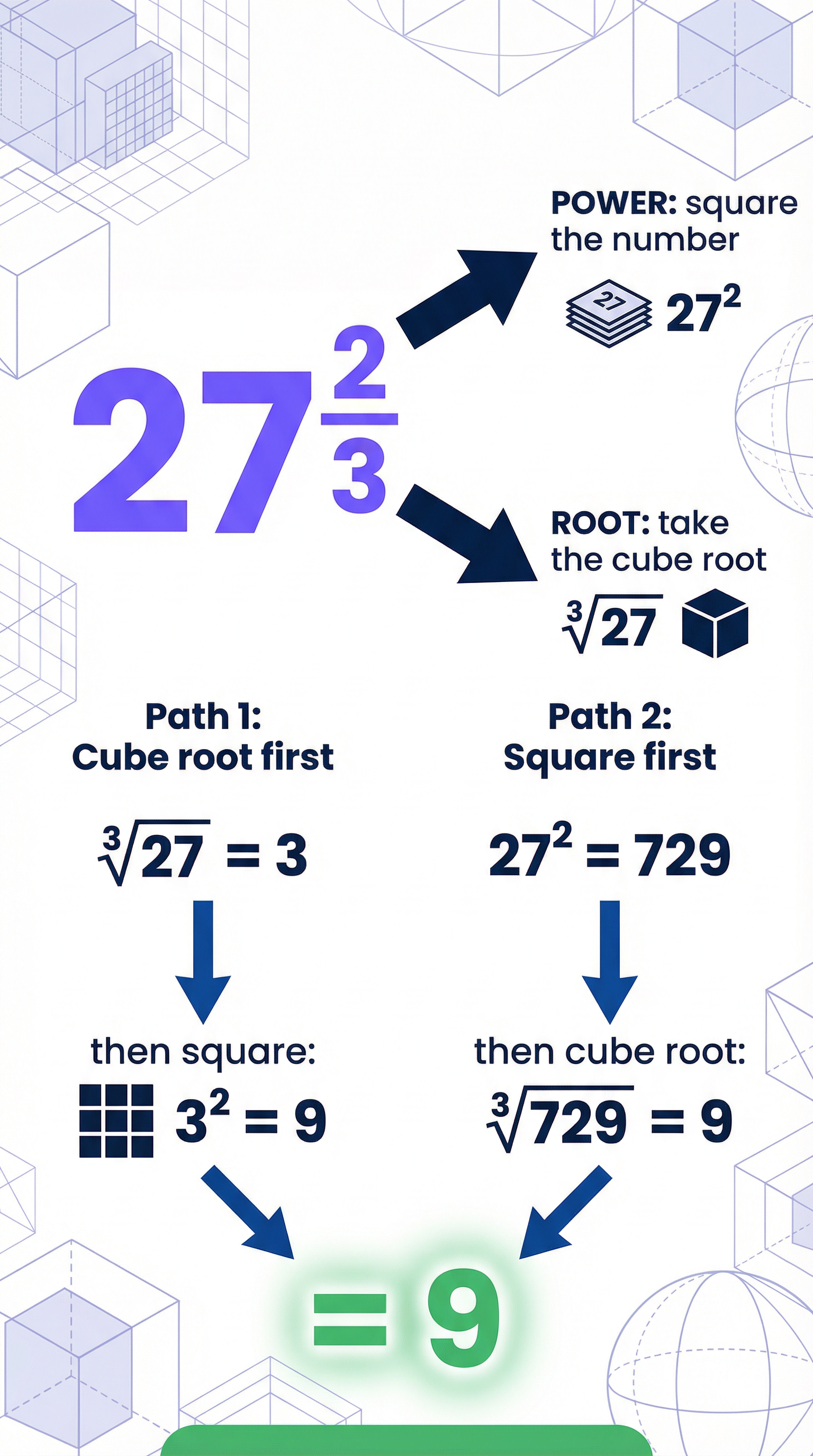
Example: To evaluate 27^(2/3), you can either cube root 27 first (to get 3) and then square it (to get 9), or square 27 first (729) and then cube root it (9). Taking the root first is almost always easier. Marks are awarded for showing this two-step process.
Mathematical/Scientific Relationships
- The Zeroth Power: Any non-zero number raised to the power of zero is 1 (e.g.,
x^0 = 1). This can be derived from the division law:a^n / a^n = a^(n-n) = a^0, and we also know that any number divided by itself is 1. - Solving Exponential Equations: If
a^x = a^y, thenx = y. This is the principle used to solve equations where you can make the bases the same. For example, to solve4^x = 8, you rewrite both sides with base 2:(2^2)^x = 2^3, which gives2^(2x) = 2^3, so2x = 3andx = 1.5.
Practical Applications
While Further Maths is often abstract, indices have wide-ranging applications in science and finance. They are the language of exponential growth and decay, used to model everything from population growth and radioactive decay to compound interest calculations. Understanding how a small change in an index can lead to a massive change in the result is a key insight that links to real-world phenomena.
Visual Resources
2 diagrams and illustrations
Interactive Diagrams
2 interactive diagrams to visualise key concepts
Conceptual Flow Outline
A flowchart showing the methodical steps to simplify a complex expression with a fractional index, separating the coefficient and variable to reduce errors.
Conceptual Flow Outline
A process diagram illustrating the key stages of solving an exponential equation by finding a common base, applying the power law, and equating the indices.
Worked Examples
3 worked examples — open one to explore the question and available guidance.
Practice Questions
Test your understanding — click to reveal model answers
Write (5x^3y^(-1/2))^2 in a form without brackets or negative indices.
Hint: Remember the 'party in a bracket' rule. The power outside applies to every single term inside.
Evaluate (125/8)^( -4/3 ).
Hint: Use the 'Power, Root, Flip!' mnemonic. Deal with the negative sign first by flipping the fraction.
Given that y = 2^x, express (2^(2x) - 1) / (2^x + 1) in terms of y and simplify your answer.
Hint: Recognise that `2^(2x)` can be written as `(2^x)^2`. This turns the expression into a familiar algebraic structure.
Solve √2 * 2^x = 1/8.
Hint: Start by converting every term into the same base. The common base here is 2.
Express (4x^2 - 1) / (2x^(1/2) + x^(-1/2)) in the form ax^(b) - cx^(d).
Hint: This looks intimidating. Try to simplify the denominator first by factoring out a common term, perhaps `x^(-1/2)`.
Test your understanding of Indices (integer and fractional)
Active recall beats re-reading. Take an instant quiz now to test what you’ve learned and lock it into long-term memory.
7 days Premium · Then free forever · No card, no charge